A Cat’s Cradle, by Carly Rheilan: A Review

A Cat’s Cradle is not a book for everyone. It is certainly not a book for those who rush to judgement, either of the author or her characters, nor is it a book for those who see the world in black and white, or who turn away from the realities of sexual abuse. (And yet, those things are exactly what the book is about.) It must have been a difficult book to write; it is a difficult book to read.
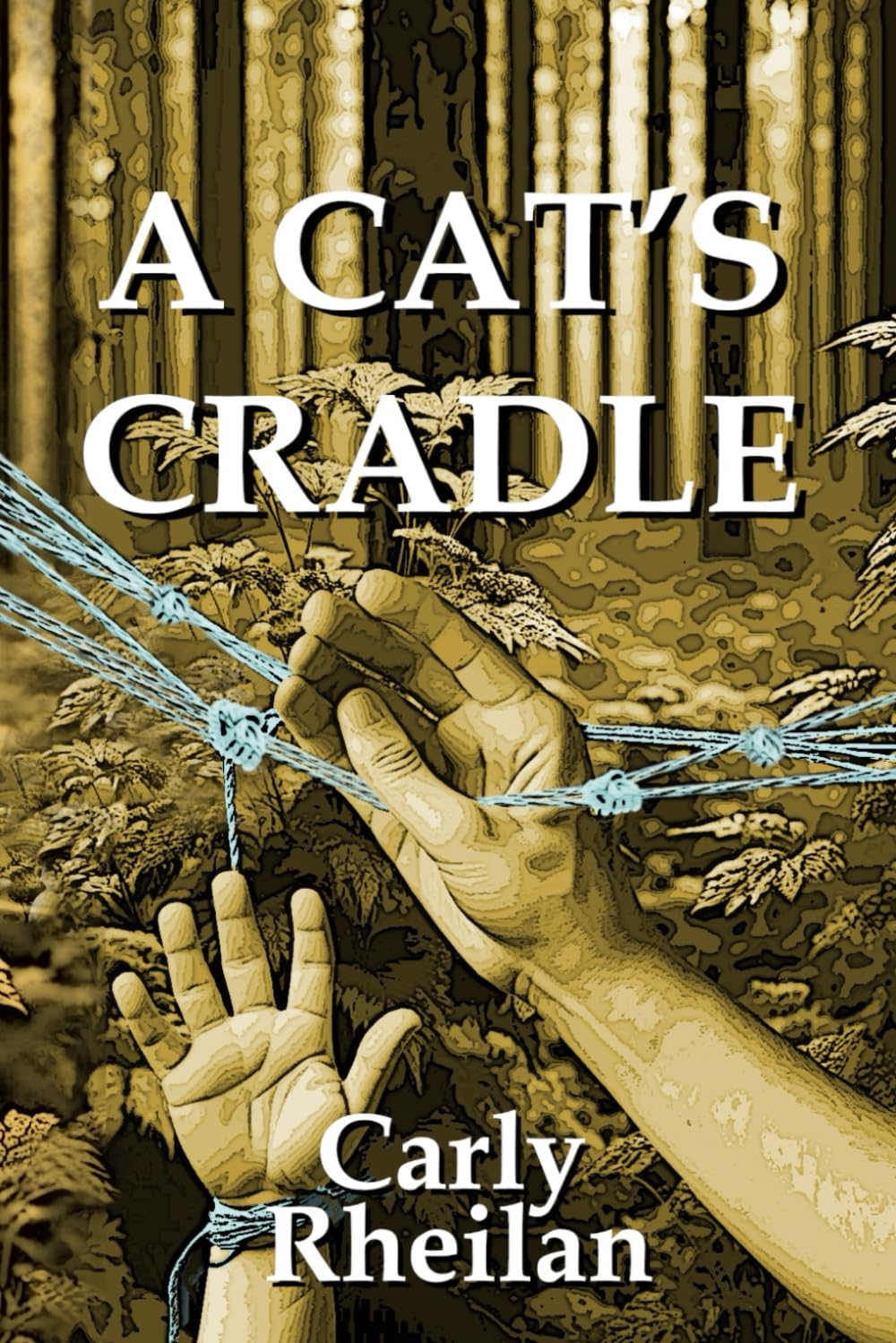
Mary, seven, lives in a small village where she is viewed suspiciously as an incomer, warned against being  ‘forward’ by her new teacher, and discouraged from making friends by her mother, who considers herself superior to the local people. Mary has no one to play with but her older brothers, who, in the way of older brothers, both torment and ignore her, using any excuse to leave her on her own. Her father has left the family, something her mother is trying to hide while also desperately attempting to keep up appearances.

Fourteen years earlier, Ralph Snedden abused and murdered a girl he was babysitting. He has served his time and been released. On a rare visit to his ailing mother, he encounters Mary. They are drawn to each other: Mary thinks she has found a special, secret playmate; Ralph convinces himself he can control his urges and be the friend Mary craves.

All villages have their secrets, their dark sides which are never spoken of, whether they are rural villages or urban ones. This one is no different. Families have them too, and when everyone is related to almost everyone else, much that is known is never spoken of, never explained. What happened fourteen years earlier is never discussed, but Ralph’s mother is a pariah, abandoned in her failing health by all but the district nurse and an exploitative carer. So many silences, so much shunning, so many layers of judgement and pride – and pain hidden under those layers. Would anything have changed, if honesty and openness had prevailed?

Author Carly Rheilan allows the characters’ words and thoughts and action to tell the story without judgement. Both Mary and Ralph’s decisions and motives are dispassionately shown in the context of their troubled lives, the elements that draw the two together. We are observers of Mary’s loneliness, of the inklings of danger she suppresses in the name of good behavior and politeness, but also of Ralph’s rationalization and self-deception, and his ultimate and inevitable lack of self-control.

Even after the climax of the novel – an ending I won’t spoil – secrets and self-deception remain, and it is up to the reader to interpret  the actions of characters, their compulsion to hurt and exploit or ignore the pain of others, the loss of many sorts of innocence, the desire to not admit to wrongs done or wrongs imposed; the desire not to see. A powerful, searing book for a mature, thoughtful reader.

Purchase link: https://mybook.to/CatsCradle

About the Author

Carly Rheilan was born in Malta and lives in the UK. She was educated in Oxford University (which she hated and left) and then at Brunel (a small-town technological university where she stayed for a PhD). As an academic and a psychiatric nurse she has done research into criminal justice, taught in universities and worked for many years in the NHS. She has children of her own and has also fostered two children with mental health problems.

Her novels address issues at the edges of psychiatry, crime and personal trauma.
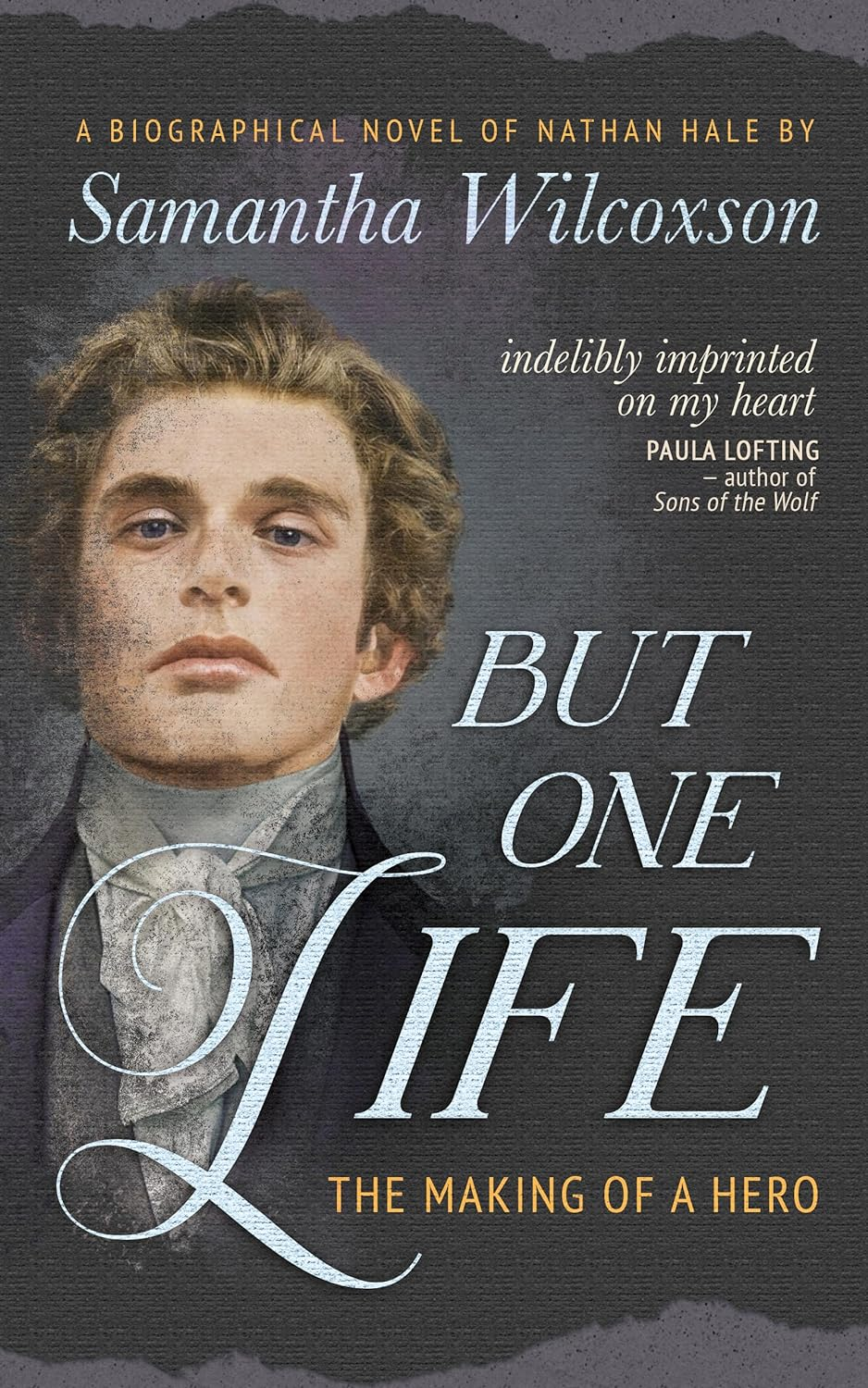
But One Life, by Samantha Wilcoxson

“If I had ten thousand lives, I would lay them all down.”

In the early 1770’s, Nathan Hale is a young philosophy student at Yale. There, he, his brother, and their friend, Ben Tallmadge, are busying themselves with intellectual debate and occasional mischief.

Only too soon, their patriotic ideals of revolution and liberty would be put to the test. Forced to choose between love and duty, young Nathan has to face the harsh personal cost of deeply held beliefs as he leaves to become Washington’s spy.

In this powerful novel of friendship and sacrifice, Samantha Wilcoxson paints a vivid portrait of a young man’s principled passion and dedication to his ideals, turning the legend into flesh and blood.

This is the touching and thought-provoking story of how an ordinary boy grew into an extraordinary man – an American hero.

My Review

Samantha Wilcoxson’s But One Life, a biographical novel of Nathan Hale, is thoroughly and deeply researched, immersing the reader in a convincing, detailed recreation of late 18th century colonial life in the United States. The influences on Hale’s life are clearly delineated: faith, bolstered by his brother Enoch’s even deeper religious conviction; classical thought (translated through a popular play of the time, Joseph Addison’s Cato), and the beliefs fostered and developed through debate and discussion during his years at Yale, especially in the Linonian Society.

Hale is a hero to many citizens of the United States, for his actions and his attributed last words: I only regret that I have but one life to give to my country – but he is also a tragic figure, a young man who allowed his impatient desire to contribute to the colonists’ War of Independence against Great Britain to be his downfall.  Unsuited for the role he takes on, untrained and working against his friends’ advice, his bold gesture of patriotism results in his death by hanging. Wilcoxson does not shy away from this interpretation, showing Hale’s actions in his last days as they were: naïve and bound to fail.

Wilcoxson’s novel fleshes out Hale’s life with a writer’s imagination, although only a failed romance strays far from the established facts. Hale’s life may have been one lived in a limited geography, but the ideas of thinkers and statesmen travelled to his world, as did news of the clashes between colonists and British troops even as early as his years at Yale. Here lies my only quibble with But One Life: other than reports of two uprisings involving violence, very little background into the causes of the growing frustration of the colonists with Britain is given: the Stamp and Townsend acts, resulting in taxation without representation; the Port Act, and the insistence by the British parliament that they had political control of the colonies. The discussions at Yale, especially in the Linonian Society, could have provided an ideal vehicle for background, which, while it may be familiar to readers educated in schools in the United States, may not be to readers from other countries.

Nonetheless, But One Life is a solid, well written biographical novel of a man seen by many as an American hero. Recommended.

ABOUT THE AUTHOR

Samantha Wilcoxson is an author of emotive biographical fiction and strives to help readers connect with history’s unsung heroes. She also writes nonfiction for Pen & Sword History. Samantha loves sharing trips to historic places with her family and spending time by the lake with a glass of wine. Her most recent work is Women of the American Revolution, which explores the lives of 18th century women, and she is currently working on a biography of James Alexander Hamilton.