A Community Creating Books: developing a publishing collective.

“An artist collective is an initiative that is the result of a group of artists working together, usually under their own management, towards shared aims.”

Creativity flourishes in an environment that fosters it, and feeds on ideas and energy from other artists. The city I live in – Guelph, in southern Ontario – has an amazing arts community, with a vibrant book culture, incredible music, visual arts, dance, slam poetry, and several small presses. But those small presses, as wonderful as they are (I have a short-story chapbook published by one of them, so yes, I’m a little biased) are primarily focused on literary fiction, poetry, and experimental writing. A genre press wasn’t part of the mix.

When I began Arboretum Press, I wasn’t sure where I was going with it. I’d had an indie publisher for my first book; they went out of business. I decided – with some encouragement from other small press folks here – to set up my own. The first book written by someone else that Arboretum Press published was under a financial arrangement, a percentage of sales. That money went towards sponsorship of our local book festival. But even that didn’t sit well with me. I have no need to make money, and I have a deeply ingrained belief in cooperatives and collectives as a way to build community and make resources available to a wide range of people.

What I began to envision was a group of people sharing skills to help each other produce the best books we could, utilizing e-book and print-on-demand technologies and distribution systems, at the least possible cash outlay needed to create a professional, high-quality product. I started to talk about it, at my writers’ groups, and the informal coffee-shop hang-outs organized by a non-profit organization that supports and promotes writers here in Guelph. And after not very long, I had a group of people willing to give it a try. We range from 30ish to 70+ in age; our skill-sets – other than writing – include all the aspects of editing, layout and design expertise, face-to-face promotion, workshop leadership – and other skills we probably don’t know we have yet.

We’re still evolving, but what we’re doing right now looks like this:  N has a manuscript they’d like to publish. One or more of us read it (we may well already have been beta-readers or critique partners, though) and if there’s agreement that it’s worthy, we take it on. K is a good copy-editor, and great at dialogue. T knows every aspect of structure. M (that’s me) is good at interior book design and layout.

So we agree to publish the book. T works with N to review structure, and revise if necessary. K reads the revised book and gives feedback. I line edit. Someone else copy-edits. This may go on for a round or two. Meanwhile, N, whose book it is, is beta-reading or copy-editing someone else’s manuscript. When N’s book is ready for publication, I handle layout and interior book design, knowing that when my next book is ready, I have my critique and editorial team in place. Our promotion and workshop expert L handles the arrangement for the book launch, and MCs it, because that’s what she’s good at, in exchange for the editorial and production work on her book.

We don’t (yet) have the expertise to do everything. Cover design is still contracted out. A social media/SEO person would be very useful. But our limitations are known up-front to everyone who participates, and people are free to leave with their book at any time, even after publication (although without the ISBN, which is registered to the press. But this is Canada, where they’re free, and the process of deregistering and applying for a new one is a few clicks of a mouse.)

Our local indie bookstore, which carries our paperbacks, has been very complimentary of our books. They look professional, they tell me, with high production values. Each book looks better than its predecessor, as my expertise increases in that area.

Our average cost to a member of the collective to produce a finished book is running about $250 Canadian dollars right now, if they use the recommended cover designer (and if they want a paperback. Not everyone does. It’s less than half that if it’s e-book only.)  We’re demanding about cover design: it must look professional, not mislead as to genre, and work as an Amazon thumbnail. At least three of us see the cover designs, and we have to agree about which one is going to be used. Each author sets up their own KDP account (and other distributors if that’s their choice) and royalties go directly to them.

At this point I’m still the central organizer, in part because I am the layout and design person, and the number of books we can handle depends largely on that aspect right now. (And the business is registered in my name, for now.) But someone else will learn layout, sooner or later, or someone who already has those skills will join us for a year or two. Collectives are fluid, usually, meeting for some a short-term need, and for some a longer one.

Finally, the beauty of this age of electronic communication is that we don’t all need to be in the same place. Our face-to-face meetings take place in one of several downtown Guelph indie cafes that welcome writers and laptops and long discussions over coffee. But I spend winters away, and our cover designer is in England. As long as we all have computers and the internet, the work gets done, books are produced and published, and another dream is fulfilled, for an investment primarily of time, passion, and commitment to each individual in the collective. A community creating books.

Between Two Minds: Awakening by D C Wright-Hammer

D C Wright-Hammer on the genesis of Between Two MInds: Awakening

Between Two Minds: Awakening was the culmination of a lot of personal experiences. Nearly five years ago, I was working as a data migration specialist, and I had some serious health issues. I subconsciously blended my job and my condition, and I thought, “What if my mind is still good but my body isn’t? What if minds could be digitized and migrated, so to speak, into healthy bodies?” While the reality transferring consciousness (or mind migration as I call it) isn’t so simple, it’s been theorized for hundreds of years. Descartes’ Evil Demon thought experiment (and Harman’s updated ‘brain in the vat’ model) posited that a person’s mind could be manipulated by an omnipotent demon (or supercomputer) that could simulate your experiences. This includes your body (or the one you perceive to be in) as well as all external stimuli. As the experiment goes, a mind would have no way of knowing whether you truly exist in a world or a simulation. This was the basis for “The Matrix” series. Descartes is quoted in Latin, “dubito, ergo cogito, ergo sum” or in English, “I doubt, therefore I think, therefore I am.” People often forget “doubt” in the phrase, and I think it’s very important. The ability to doubt our own existence is proof that we exist.

With that in mind, I wanted to take the concept of mind migration a little more seriously. I wanted to make it believable. It was then that I began melding my personal experiences, the philosophy, and the fiction into a science fiction thriller. Set in the near future, Ryan D. Carter (a play on Rene Descartes) is a paraplegic who has always dreamed of walking. He orders this mind migration, a common but expensive procedure in his time, and he gets his mind uploaded into a physically fit body. It was here that I knew I wanted things to go wrong for Ryan. Every advancement in technology can bring about side effects. Add in corporate interests, money, and nefarious characters jockeying for power, and you have a situation ripe for disaster. But sometimes disaster isn’t so obvious. I wanted Ryan’s, and by extension, the reader’s experience to be subtle.

To that end, I tell the story from the first person past tense POV to make it more personal to the reader. Eventually, an interleaved or zippered narrative is established where the reader is given a compelling back and forth between Ryan’s experiences and that of another main character. Details from both perspectives give clues to where the story is going, but even the most adept readers will have difficulty predicting the plot twists at the end. And yet most readers swear that the finale is very satisfying. Can Ryan solve the puzzle unraveling in his new brain before it’s too late? Or does he suffer the consequences of being between two minds?

D C Wright-Hammer
Author: Between Two Minds Series
Following on Twitter
Like Me on Facebook
Visit the Hammerstone Creative Website

My Review

Are we our bodies, or our minds? A philosophical question explored by many writers over time, with most believing our truest selves lie in our thoughts, not the physical shell that houses them. Believing this, would you risk leaving behind an imperfect body to migrate your mind to a new one?

Ryan, the protagonist of Between Two Minds: Awakening does exactly that, exchanging his paraplegic physical self for a new body. The process is touted as almost problem-free, safe and effective. But Ryan experiences strange side effects – or are they? Or is there really another mind inhabiting his new body?

As Ryan searches for answers, he finds more questions: what is the connection between this other consciousness and himself? The line between his life and his co-consciousness blurs: who is real? What is real? Whose memories can be trusted?

The premise of Between Two Minds: Awakening is not new (few premises are) but Wright-Hammer’s interleaving of two stories, chapter by chapter, effectively brings the reader into each character’s wildly differing worlds, inciting in the reader the desire to keep reading to work out how the two will come together.  Without spoilers, my advice is to read carefully, because apparently insignificant things will prove to be important as the story moves towards its climax.

I’m giving the book four stars, not five, from the cumulative effect of a number of small things that jarred: dialogue that didn’t ring true, some awkward transitions, a few continuity questions. There are a lot of small details, perhaps too many for some readers, but a writer cannot hide items of significance in a narrative if they stand out as obvious! The overall story kept me interested and trying to guess where it was going (I didn’t) and that tells me the author has done his job. It would make a compelling movie!

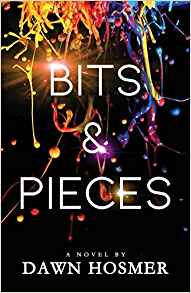
Bits and Pieces, by Dawn Hosmer: Empathy, Terror, Bravery.

Imagine you are an empath, capable of feeling – physically and emotionally – what others feel. Imagine that when you touch someone, their thoughts and memories may pass to you in a flash of colour. Imagine not knowing if the things you know, the things that drive you, the things you desire, are yours – or someone else’s.

Tessa, the protagonist of Dawn Hosmer’s debut novel, is an unsurprisingly troubledbits and pieces and withdrawn woman, trying to cope with her personal reality. Her family have treated her as mentally ill, shunting her off to institutions for treatment. She relies on her therapist and one brother to support her – until she meets a charming professor in her college town, and feels an immediate connection.
But Jonas has his own secrets, and as it becomes clear there is a serial rapist and murdered stalking young women, Tessa is drawn into the search for the killer – with devastating personal results. If I could say nothing else about Bits & Pieces, I would laud the author’s bravery and strength in addressing a difficult and horrifying subject in such a gutsy and unexpected manner.

For the most part, Bits & Pieces is a satisfyingly well-written novel, the language clear and clean, the dialogue believable. Hosmer handles the descriptions of violence well, evoking the characters’ terror without dwelling on too much detail, but not leaving everything to the reader’s imagination. The action rises and falls it grows towards the climax, and Tessa’s confusion and growing disorientation are conveyed effectively.

What happens in the denouement, however, I found less satisfying: a twist in the story that has a role in terms of character development, but that I also found detracted from the shock of the primary narrative, and, by focusing on the twist, took away from the reality of how Tessa deals with what she has experienced. Knowing there is a sequel planned means I’m reserving final judgment on this, because it may have a role in the next book.

4 out of 5 stars for an impressive and unusual debut. Bits & Pieces is available from Amazon. Keep reading to learn what the author has to say about her work!

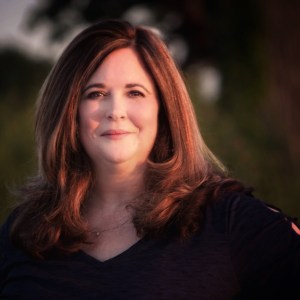
Dawn, tell us a bit about yourself, and what inspired Bits & Pieces.dawn hosmer

I am the mother to four amazing children, a wife, and a lifelong Ohioan. I spent my career in Social Work but have always had a passion for writing and dreamed of one day being a published author. I was diagnosed with Crohn’s disease fifteen years ago and had to quit working outside of the home a little over two years ago. I now devote myself full-time to writing and marketing.

While Bits & Pieces is a Psychological Thriller, I have not yet found one genre to call home. I enjoy writing suspense, thrillers and contemporary fiction. All of my work has several things in common, however. I like to dive deep into the psyche of my characters to explore their emotions and thoughts on the events happening around them. My tagline is Exploring The Mind, One Book at a Time. It perfectly sums up what I attempt to do in my writing. Because I write with such a deep Point of View, I tend to write in first person. My goal with writing is to also explore the many gray areas of life because no one is all good or all bad just as no experience is either. I also dive into rather dark themes in most of my work, not because I’m a fan of the macabre; rather, because life is full of difficult things. Through my years in social work, I’ve seen countless times how the resilience of the human spirit is stronger than the hard situations people must deal with. In addition, my ideas are usually inspired by true stories. Part of the inspiration for Bits & Pieces came to me when my son was a freshman in college. A female student went missing and was later found murdered. Her killer was linked to several other rapes and murders in the area. I tend to process events that frighten me or create anxiety through writing about them. It helps me feel a sense of control over situations that I am powerless over.

I was asked recently what I hope readers gain from my books. My goal as an author is to give my readers a place to escape the real world, and all of its demands, for a while. Life is hard. For me, nothing rejuvenates me like losing myself in a good book. I want my books to be that place of renewal for those who read them. Even though they often cover such dark and heavy topics, I try to always instill a sense of hope, forgiveness and/or redemption.

My next book, The End of Echoes, is contemporary fiction and will be published late summer 2019.

Instagram @dawnh71

Facebook https://www.facebook.com/Dawn-Hosmer-Author-663110834084197

Goodreads https://www.goodreads.com/author/show/18534695.Dawn_Hosmer

Bookbub https://www.bookbub.com/profile/dawn-hosmer

Amazon http://bit.ly/BitsPieces7

C.D. Tavenor: The Mind, Synthetic Intelligence, and Morality.

Let’s talk about the mind.

As humans, we assume the way we think is the only way people can think. We see this over and over again, even in intraspecies relationships. When someone perceives the world differently, we view them as “weird” or “abnormal” or “different.” In extreme cases, we take our pitchforks and chase them out of town . . . or we engage in even worse violence.

Yet the arrogance of our brains to believe the way we think is the only way to think. Just consider the diversity of people across the planet, and the millions of ways a person might answer the question, “what is good?” Even within the American culture, that question doesn’t have an answer. When we explore the perspectives of the thousands of religions, cultures, and ethos of the world . . . the possibilities are endless.

So humans have millions of ways to view the world. Millions of ways to approach problems. Yet those approaches are fundamentally constrained by the way the brain works. We’re products of evolution; we can only see the world with two eyes, hear sounds with two ears, taste with one tongue. Imagine how evolution could have produced a different mind.

Then what would happen if we developed a different mind. An artificial one, inspired by the way we think, yet fundamentally its own creature.

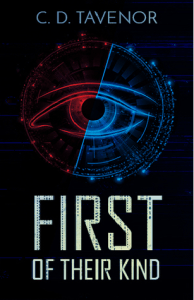
In First of Their Kind, I explore what it would mean for humanity to create a conscious,first of their kind thinking, non-programmed mind. I call it synthetic intelligence, because it is distinctly different from what we traditionally consider “artificial” intelligence. Whether in literature or our cultural zeitgeist, we always think of A.I. as a computer program, designed for sapience and capable of thought on levels unimaginable. You see it in Terminator, I, Robot, 2001: A Space Odyssey, and countless other films.
Often, these A.I. are terrifying beings; when they reach their moment of omniscience, they transform into a monster that the human protagonist must defeat.

I propose an alternative take on intelligence. On consciousness. Instead of a program, what if we could create a synthetic brain, a construct capable of producing thought similar to that of a human? Modern AI research is exploring this type of mind, so it’s not too far-fetched.

In First of Their Kind, I call the “synthetic brain” a “Synthetic Neural Framework.” Composed of materials capable of mimicking neurons, the molecules connect and form pathways naturally through perceptions attained through sensory inputs, just like an animal. The Synthetic Neural Framework is the backbone of Synthetic Intelligence, and it forms the mind of my main character: “Test Forty-Three.” You’ll need to read the book to find out what name they choose for themself!

I challenge you to consider, when reading First of Their Kind—what thoughts, what perceptions, what conceptions about the world could this Framework have that humans could not? At the core, I’m endeavoring to answer that question in First of Their Kind and its sequels.

Some readers will empathize with “Test Forty-Three,” others will not. But I challenge everyone to consider why they do or do not connect with a mind fundamentally different from their own. Is a Synthetic Intelligence’s vision of morality really that different than a human who lives halfway across the globe, when compared to your own?

Test Forty-Three just wants a place within humanity too, just like the rest of us. They want friends. They want family. They might think differently, but they deserve love just like the people who created them.

C.D. Tavenor

__________________

First of Their Kind released April 30, 2019, in paperback and digital formats! You can find it on Amazon, or check out its book trailer on Youtube!

and you can read my review here.

Book Review: Dear Comrade Novák, by Silvia Hildebrandt, with an introduction by the author.

I asked Silvia Hildebrandt to write an introductory piece to Dear Comrade Novak, her second novel, published in 2018. In it, she explains how she came to write the book, and its effect on her personal identity.

We fled Romania for Germany in 1990, after the revolution and the civil war between Silvia HildebrandtHungarians and Romanians. For the most part, we were looked down upon as poor, illiterate gypsies. So I denied I was born and raised in Romania, in an attempt to assimilate with German culture. Over the years, my teachers recognized my talent for writing. Somehow, I always wrote stories set in the USA. But my 6th grade literature teacher encouraged me to write something about Romania. ”You have so many unique stories to tell,” she said. But at that time, I’d buried my identity deep within me. No, never. Never would I write a novel set in Romania.

Twenty years later, after my first published novel – A Century Divided, set in New York City – I needed a new idea for a second. By happenstance, I landed back in Romania. I wanted a story set in Eastern Europe because I loved Russian novelists like Tolstoy and Pasternak and their very own strong, melancholic narrative. And because I’m a lazy bitch and didn’t want to do research on Russia, I decided to set my next piece in Western Romania, where I was born. As the plot developed over the weeks, I was stuck in the middle and in order to finish a novel, I need to know the end in an early stage of writing. But I didn’t know where it should lead, so I reached out for the writer’s best friend. Google.

“Romanian History 1980s” was my search query. And if an old agent of the Securitate monitored me, he would’ve thrown up his hands in despair as to my ignorance. “Romanian Revolution 1989” was the first answer and I nearly fainted. Of course! I had totally forgotten. Like a black hole in my memories and my brain, this event no longer existed in my life. Slowly, from an author’s point of view, I dug into the Romanian history and into my own. While writing, I had to remind myself that I was there; in that scene, with my characters walking around in Timișoara and in that Romanian village they call their hometown; this wasn’t just their story, but my own as well.

It’s borderline crazy describing such a feeling. Like living in two alternate universes, I re-discovered my own heritage. Near the end of writing Dear Comrade Novák, I watched Ceaușescu’s last speech conserved on youtube. The piece of footage every Romanian knows and love-hates to this day. The footage my beta readers and editors still remember, shown on US and British TV. But for me, it was the first time I witnessed that confused old man become lost in the sudden uprising of the people he oppressed for so many years. To this day, the turning point of my own childhood had always been the opening of the Berlin Wall. I didn’t know anything about the events in December 1989 in Romania. But with every documentary I watched while writing Dear Comrade Novák, I felt like reclaiming my own identity. No, not the Berlin people dancing on the ruins of the Wall had shaped me, but the December events of 1989. Ceaușescu, the last bastion of communism in Europe, fleeing in his helicopter. The Romanian flag with the cutout communist sigil in the middle. The people in Timișoara lighting a thousand candles for the murdered masses, shot on 17th December. There: forty kilometers from my hometown, the bloodiest, most epic of the 1989 revolutions began.

“Why wander into the distance, when the good is so close?” is a popular German saying. And it’s true. I’m excited what future ideas I’ll have in my writing career. But I know one thing: Romania will continue to play a big part in it.

silviahildebrandt.wordpress.com

My Review

Dear Comrade Novák is one of the most devastatingly honest and brutal books I have Dear Comrade Novakever read, yet I could not put it down. I read the last 65% of it in one sitting.

Set in Romania in the 1980s, Dear Comrade Novák follows three school friends: the ethnic Hungarian Attila; the Romanian Tiberius, and the Roma Viorica, through the last decade of Nicolae Ceaușescu’s despotic rule, culminating in the Revolution of 1989.

Hildebrandt is unsparing in her descriptions of the functioning of the country under the eye of the Securitate (the secret police). Who is a friend? Can family members be trusted? Can lovers? And when a man carries a secret – that he is gay – something that is not just forbidden in Romania, but denied completely – what does he do?

Weaving major events of the 80s – Chernobyl, the fall of the Berlin Wall, the devastating rise of AIDS – into the narrative, Hildebrandt paints a bleak and unwavering picture of people trying to find a way forward in a corrupt and cruel society, a society layered by ethnicity and political allegiance. Some may stay true to their inner selves; others cannot; heroism is easy to imagine, but personal survival is a strong imperative, even when the violence and fear of everyday life overwhelms happiness.

Dear Comrade Novák is not escapist fiction. It is an uncomfortable book, one that should leave you shaken. I will remember it long after I have forgotten many other books I have read or will read. Five stars.

Amazon.com link.


Of Dreams and Thorns, by J.C. Salazar: an interview and review

Salazar author photoJ.C Salazar, the author of Of Dreams and Thorns, grew up as the child of immigrant parents in Houston, Texas. With a B.A. in English, a MS in Linguistics and another MA in Literature, plus some  doctoral courses in English, Salazar values language and writing. Of Dreams and Thorns is his first novel. He is also the author a book of poetry, states of unitedness.
I spoke to Salazar recently about what inspired Of Dreams and Thorns, and the process of writing the book. Following the interview is my review of his novel.

The book reads very much like memoir. How much of it is based on your own experience?

I wanted to write a novel that would capture the essence of my ancestors and their immigrant experience. I decided to center the story in a biography of my father and the things and folks that most influenced his life. I purposely avoided trying to recapture events or scenes exactly, so much of the biography is fictionalized. I considered writing a straight biography of my family, but there was too much opposition because they are quite private and far from understanding literary stuff.

Is there one character that is basically you?

The narrator is some version of me, and my doppelgänger is the boy Carlos.

How much of the settings and events are thing you actually remember, and how much comes from stories your family told you?

My rough estimate about settings and events is that about 35% I experienced or witnessed, about 40% was told me by some elder in the family or a sibling. The remainder are made up by my imagination.

Did you look for a traditional publisher and/or agent, or was indie your first choice?

When I began to write for publication in earnest, I was spending half a day writing and half a day learning all about agents, publishers, self-publishing options, etc.. I began sending out agent queries when I finished my first draft. I sent out about thirty queries to agents and a few publishers. My queries went out in batches of 7-10, and I waited six to ten weeks to hear back. Some rejections were quick, some took six weeks to much longer. Among them, I received a couple with much encouragement, but maybe they were just polite. I soon realized that the time involved to secure an agent and then get a publisher would average three years or longer. That’s when I shifted to self publishing. Just as I was about to begin that process, an editor asked for my full MS. I waited six months and never heard back. I wrote them that I was withdrawing my MS and I then went full steam ahead with independent publishing.

How long did the novel take, and how many iterations of it were there before you finalized it?

It took me six months to write the complete first draft and another year to get through all the editing. I had been doing editing all the while as per beta reader feedback. On my own, I had edited each chapter some four times also. Then I hired a professional editor for structure and another editor for proofreading. Of course, I hired a cover designer, and fell in love with designing covers. I would say that my novel never lost its initial essence, but the final version is easily a fourth iteration.

Anything else you’d like to tell readers?

I published the novel on February 2018. In April, I had an extremely successful book signing at Houston’s River Oaks Bookstore. That was just about as close to the version of a dream come true. Writing this book has become the single most rewarding experience of my life. I do not regret for one minute having published it on my own. My writing skills, not to mention my publishing knowledge, have grown considerably since the publication of Of Dreams & Thorns. I now have no qualms about or hesitancy calling myself a writer/author/novelist.

My Review

Those of us born to parents who grew to adulthood in another country, but gave birth toof dreams and thorns us or brought us as babies to North America share some experiences, regardless of our parents’ native languages, religion, or the shade of our skin. Among our common experiences is the clash between the adults’ wish to maintain traditions, and the children’s wish to assimilate.
Of Dreams and Thorns, J.C. Salazar’s fictionalized memoir of his family’s migration to the United States from Mexico in the late 50’s and early 60’s, is an account of the life of a young husband and father who chooses separation from his family in order to earn money to fund his dream: a small farm in his home village. The story of the brief fulfilment of that dream, the factors that lead him to abandon it, and to move his family to Houston – with the inevitable collision of cultural expectations – is told in immersive detail.

The story is told in third person omniscient, so while we know the intentions and motivations and emotions of Ramiro, the central character of the book, we also know what other characters are thinking and feeling. But the omniscience is sometimes tentative, as if the narrator is deducing what these emotions are, increasing the strong sense I had that the narrator is one of Ramiro’s children looking back on his family’s life.

As a memoir, even a fictionalized one, Of Dreams and Thorns is a comprehensive look at a hard-working, ambitious, flawed man building a life for his family, and doing his best to maintain the traditions of his home culture and country in a new and confusing land. Within the small farming community I grew up in, many of the schoolmates of myself and my siblings were first-generation children, their parents searching for a better life than what Hungary and Germany, Italy and Portugal, Yugoslavia and Poland could offer. I saw the dichotomies and conflicts played out in my friends’ houses; I knew a few myself, because even England and Canada were not the same in all values and expected behaviour. Salazar’s book resonated with my experiences, one or two lived, many observed.

For anyone looking to understand the economic and social forces of that era that made people reach for a perceived better life in a new country, or to glimpse the price that was paid by adults uprooted from their communities and cultures, Of Dreams and Thorns serves well. It is a story told with deep love and respect, and, I believe, with clarity. As a novel, though, narrative choices undermine its effectiveness.

The immersive detail that is a strength if this book is considered as a fictionalized memoir overwhelms the plot in parts of the book. While the purpose of most scenes in either building character or motivation can be deduced, the degree of detail detracts from the building tension. As well, because of the scope of the story, taking place over more than 40 years, much is told to the reader. While this can be, and is, necessary, Salazar tends to warn when a significant occurrence is about to happen, e.g., “What happened next was the unthinkable for Eliza and a doom for Ramiro.” For me, this device reduces the rising tension, instead of increasing it. Action and reaction would be enough to show the significance of the event. In a similar way, unneeded explanations are added to actions: “But (the children) did not rush to their father as might be expected.”

In his best passages, Salazar lets his characters show us their thoughts, and conveys their emotions through their actions. There is strong dialogue in parts, and effective description. But Of Dreams and Thorns will remain with me as memoir, not as a novel; its characters and setting never quite became real to me as a novel’s should, but were perceived as the author’s memories of people and places dear to him.

Of Dreams and Thorns and states of unitedness are available from Amazon.

J.C. Salazar’s website: https://www.jcsalazarwriter.com/


Harvested: How will AI determine our future? a guest post by Anthony O’Brien

I believe it’s the work of an author that is of interest, rather than the author, for it holds coverthe key to the inner workings of one’s mind. My latest novel Harvested is a dystopian sci-fi that reflects my inner fears.
I guess the first question anyone would ask is why I wrote such a disturbing piece of work in the first place. I do have an agenda; it’s through the medium of storytelling that I express my concern for humanity, and the consequences that could occur if we continue into the future on our projected course.

I quote Elon Musk, the American business magnate, investor and engineer, who is at the cutting edge of AI: “Artificial intelligence will crush us in the end. When it’s all over, we, the unlucky ones of flesh and blood, will always be the ones who suffer.”

Today AI is outpacing the intellectual capabilities of its creators, and we have to ask ourselves, at what point does this higher intelligence become our master? Are we in the process of creating a God or a Demon destined to rule humanity? History has taught us that the elites, the most cunning, intelligent and psychopathic control civilization. Those that oversee our diminishing resources are Gods who will decide who has and has not. AI will inherit this power. What happens once we have depleted Earths resources? What happens if we do not make it to another planet? I throw the what if question out there, it’s liberating for me, but only when you reach the final chapters of my novel will you realize what a terrifying prospect my conclusion is to the what if question.

Harvested is my take on what artificial intelligence will do with humanity under the circumstances outlined above …clean up the mess perhaps? Imprisoning our minds, or letting us escape, it depends on your view, into a digital world when the flesh starts to decay. It will be the only escape from the decimation, where humanity can forget the real and the nightmares. The Earth of the future will no longer be able to sustain life.

We follow the lives of two people, Jon and Tori, scientists and resistance members fighting AI for the right for humans to survive. At this point is seems reasonable to leave you with my Amazon description:

The year is 3716. Earth’s resources are depleted. Humanity has been forced into a 21st century computer simulation, controlled by Ikelos, AI at its most terrifying. A seedbank lost to time in the frozen wastelands of a Norwegian island is mankind’s last hope for survival.

Jon Stone, a New York physicist, has been extracted out of the simulation by another scientist, Tori. With no memory of Tori or his past life, Jon must trust her as they re-enter the simulation to locate, somewhere in this dangerous, illusionary world, the island’s co-ordinates.

Can they avoid the traps in the matrix, find what they seek, and return to the 38th century in time to save humanity before the final extinction?


Worldbuilding: The Role of Small Details

I was reading Madeleine Bunting’s thoughtful, thought-provoking travel memoir, A Hebridean Journey, earlier today. I’m reading it for two reasons: because I love books that look at landscape and their meanings, and, for setting and cultural research for my work-in-progress.

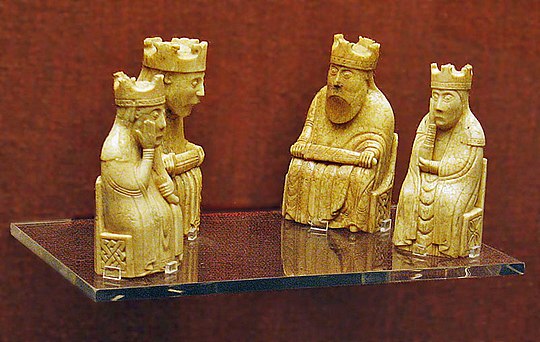
One chapter is on the island known as Lewis and Harris, and the famous, beautiful 540px-UigChessmen_SelectionOfKingsLewis Chessman. If you don’t know the Lewis Chessmen, they are intricate, oddly beautiful 12th century chess pieces, carved from walrus ivory. Found in 1831 on Lewis, they are now mostly in the British Museum (I was looking at some of them only a couple of weeks ago) and the National Museum of Scotland, plus a few on permanent loan on Lewis.

These chessmen are the model for a xache set in Empire’s Exile (a game I never define, but can be considered to be like chess. It’s played throughout the series.)

‘He opened the skin bag he carried, to take out intricately carved game pieces. They must be part of Irmgard’s treasure, I thought. How did he convince her to let him use them? Cillian took one, turning it in his fingers. “Hálainn[1],” he murmured.’

The purpose of this set was really two-fold: to show Irmgard’s wealth, and to allow my characters to play xache in the setting they were in at the time. I didn’t really mean them to be anything else.

But today, well into to the new book, which is a sequel to Empire’s Exile, I realized I can use them as a tiny bridge between the two books, adding continuity. I won’t say exactly how, because that would give away a little of the plot: suffice it to say that those beautiful walrus-ivory game pieces will end up in Sorley’s hands again, and from him to Cillian.

Repeated details like this, small, and not dwelt-upon, are important in world-building, especially in a series. They make the created world a little more familiar to readers, immersing them a little further into the world, creating a sense of comfort. They can deepen connections between characters and events, and trigger memories in both our characters, making them more human, and our readers.

In my series, xache is not just a game, but a metaphor, and perhaps too the move from the plain xache sets earlier in the series to this intricate set with its own messages about power and influence carved into the stances and dress of the pieces has its own meaning. I still need to think about that, and it’s for a different discussion than one about world-building.

I welcome your thoughts and ideas!


[1] Beautiful