A Cat’s Cradle, by Carly Rheilan: A Review

A Cat’s Cradle is not a book for everyone. It is certainly not a book for those who rush to judgement, either of the author or her characters, nor is it a book for those who see the world in black and white, or who turn away from the realities of sexual abuse. (And yet, those things are exactly what the book is about.) It must have been a difficult book to write; it is a difficult book to read.
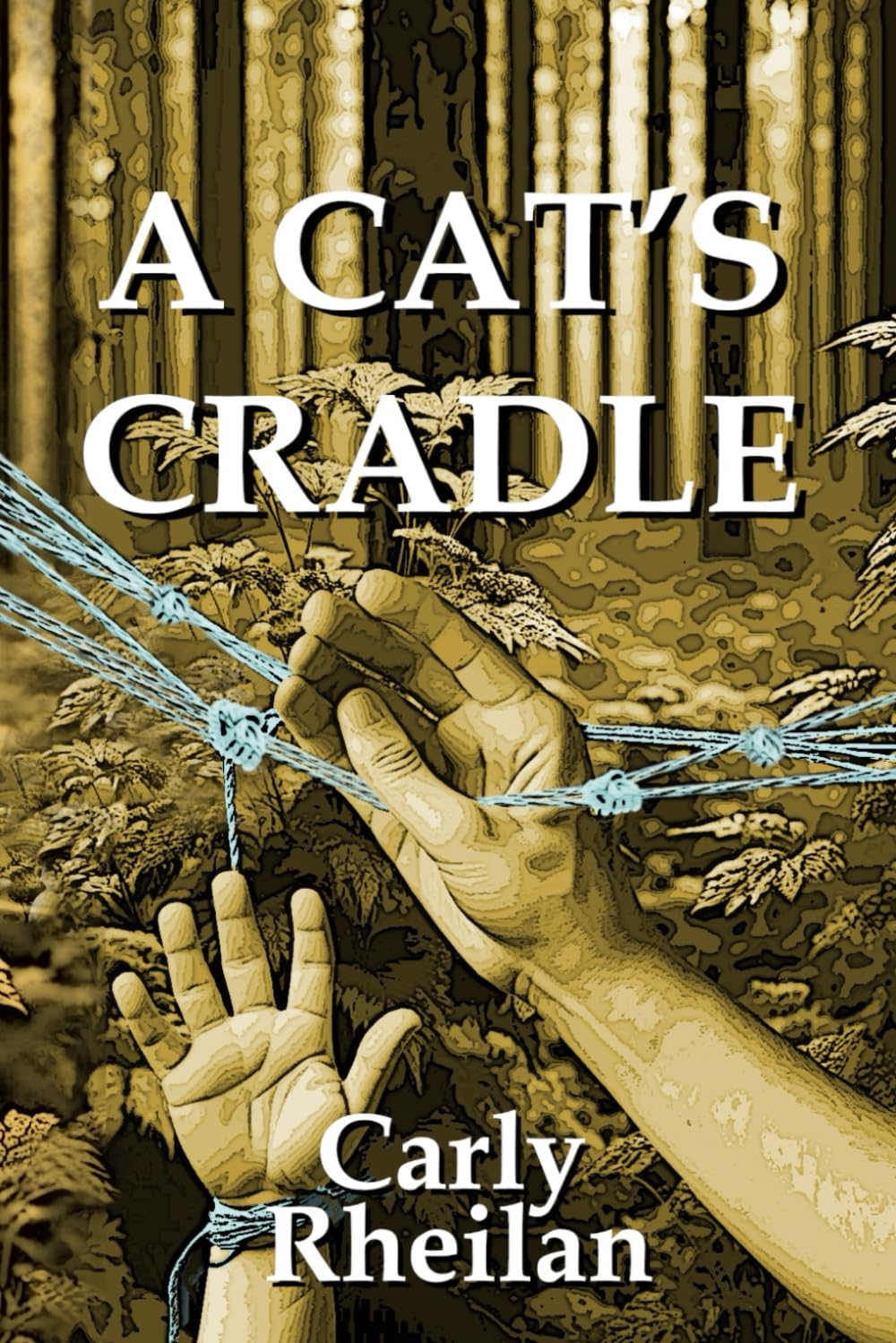
Mary, seven, lives in a small village where she is viewed suspiciously as an incomer, warned against being  ‘forward’ by her new teacher, and discouraged from making friends by her mother, who considers herself superior to the local people. Mary has no one to play with but her older brothers, who, in the way of older brothers, both torment and ignore her, using any excuse to leave her on her own. Her father has left the family, something her mother is trying to hide while also desperately attempting to keep up appearances.

Fourteen years earlier, Ralph Snedden abused and murdered a girl he was babysitting. He has served his time and been released. On a rare visit to his ailing mother, he encounters Mary. They are drawn to each other: Mary thinks she has found a special, secret playmate; Ralph convinces himself he can control his urges and be the friend Mary craves.

All villages have their secrets, their dark sides which are never spoken of, whether they are rural villages or urban ones. This one is no different. Families have them too, and when everyone is related to almost everyone else, much that is known is never spoken of, never explained. What happened fourteen years earlier is never discussed, but Ralph’s mother is a pariah, abandoned in her failing health by all but the district nurse and an exploitative carer. So many silences, so much shunning, so many layers of judgement and pride – and pain hidden under those layers. Would anything have changed, if honesty and openness had prevailed?

Author Carly Rheilan allows the characters’ words and thoughts and action to tell the story without judgement. Both Mary and Ralph’s decisions and motives are dispassionately shown in the context of their troubled lives, the elements that draw the two together. We are observers of Mary’s loneliness, of the inklings of danger she suppresses in the name of good behavior and politeness, but also of Ralph’s rationalization and self-deception, and his ultimate and inevitable lack of self-control.

Even after the climax of the novel – an ending I won’t spoil – secrets and self-deception remain, and it is up to the reader to interpret  the actions of characters, their compulsion to hurt and exploit or ignore the pain of others, the loss of many sorts of innocence, the desire to not admit to wrongs done or wrongs imposed; the desire not to see. A powerful, searing book for a mature, thoughtful reader.

Purchase link: https://mybook.to/CatsCradle

About the Author

Carly Rheilan was born in Malta and lives in the UK. She was educated in Oxford University (which she hated and left) and then at Brunel (a small-town technological university where she stayed for a PhD). As an academic and a psychiatric nurse she has done research into criminal justice, taught in universities and worked for many years in the NHS. She has children of her own and has also fostered two children with mental health problems.

Her novels address issues at the edges of psychiatry, crime and personal trauma.
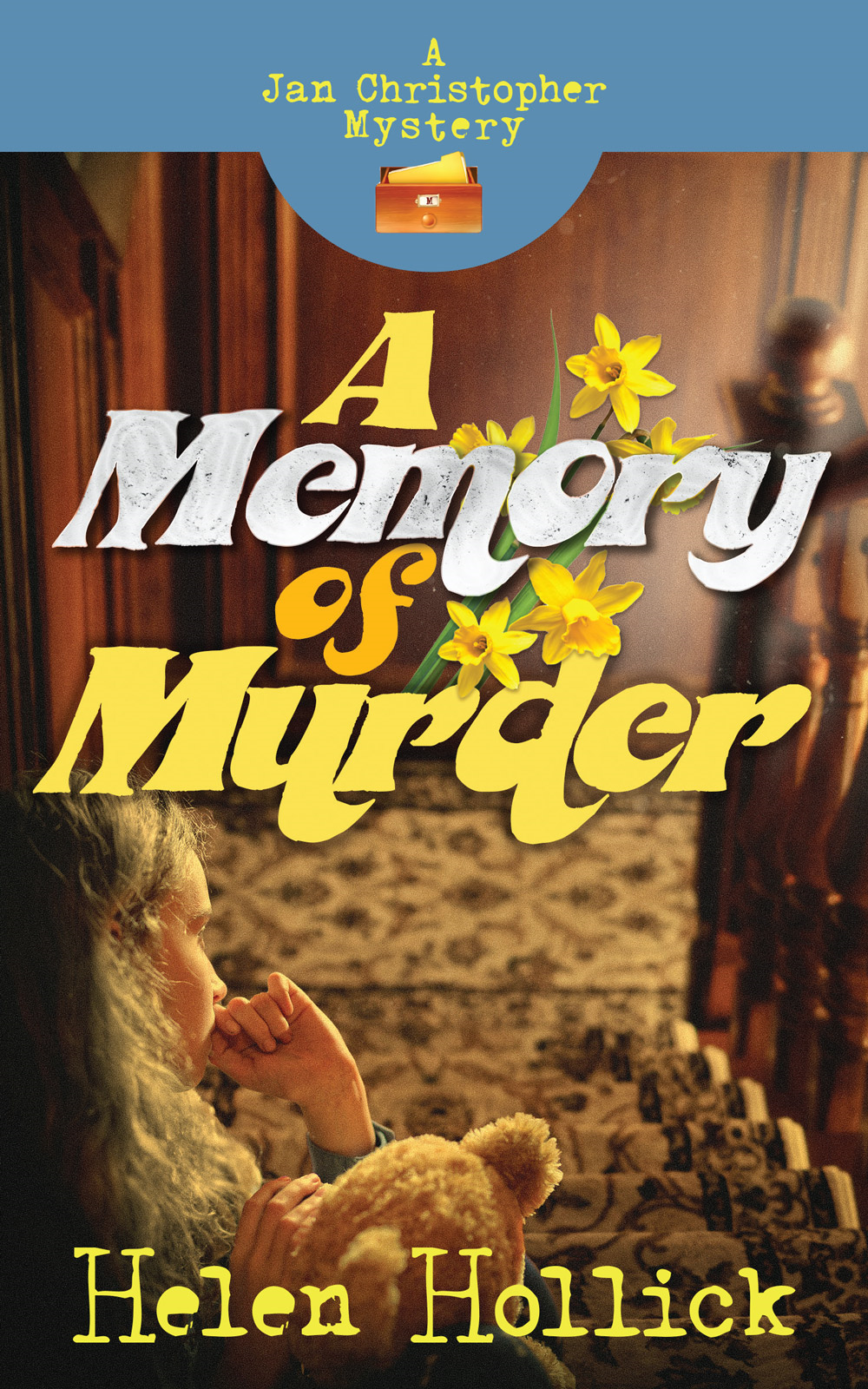
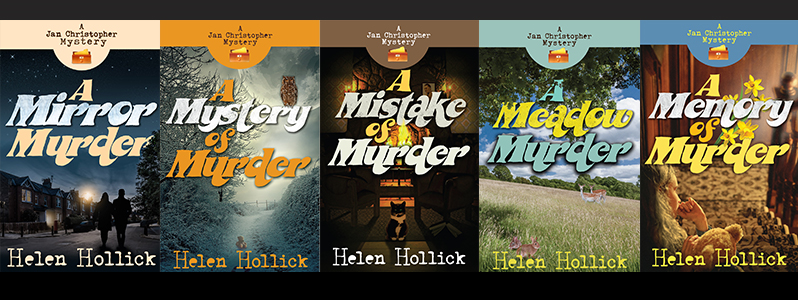
A Memory of Murder

Book 5 in the Jan Christopher Series by Helen Hollick

A Memory of Murder is the fifth in Helen Hollick’s Jan Christopher series, set in a less complicated time (at least as far as electronic communication is concerned!). It’s 1973, and Jan (January) Christopher’s work as a library assistant is disrupted by the decorating of the library, and by one particularly annoying workman who won’t take Jan’s engaged status as a deterrent to his attentions. Her Easter holiday plans with her fiancé, DS Laurie Walker, are disrupted too: a young girl has gone missing, and odd-but-significant objects are appearing at Jan’s family home. At least the circus arrives on its annual circuit to provide some distraction!

The details of life in a London suburb in the 1970s (Hollick draws on aspects of her own life in recreating this world) bring a comfortable sense of nostalgia to A Memory of Murder. The pace is in keeping with the time and place, and while the book fits into the ‘cosy’ subgenre, with a limited number of suspects, an amateur sleuth, and minimal on-page violence, the story does have a darker edge. Hollick writes with both humour and a keen sense of human nature; she is a talented writer whose books in any genre don’t disappoint. I look forward to what comes next!

THE JAN CHRISTOPHER MYSTERIES by Helen Hollick

A Memory of Murder – a new  cosy murder mystery to solve –  along with library assistant Jan Christopher, her fiancé, Detective Sergeant Laurie Walker and her uncle, Detective Chief Inspector Toby Christopher.

Set in the 1970s this easy-read cosy mystery series is based around the years when Helen was a north-east London library assistant, using many of her remembered anecdotes, some hilarious – like the boy who wanted a book on Copper Knickers. (You’ll have to read the first book, A Mirror Murder to find our more!)

The mysteries alternate between Jan’s home town, and where Laurie’s parents live – North Devon, (where Helen now lives.)

In this fifth episode, there’s a missing girl, annoying decorators, circus performers, and a wanna-be rock star to deal with. But who remembers the brutal, cold case murder of a policeman?

Buy Link:

Amazon universal: https://mybook.to/AMemoryOfMurder

(e-book available for pre-order: published on 18th May –  paperback release to follow)

Or order from any bookstore(cheaper on Amazon)

Reader’s comments:

“Can I say this is the best one (of the series) yet? YES! For the depth of the writing, the maturity of the main character, and the complexity of the premise. It’s cosy…with a few chills for good measure!” Elizabeth St John, author

“I sank into this gentle cosy mystery story with the same enthusiasm and relish as I approach a hot bubble bath, (in fact this would be a great book to relax in the bath with!), and really enjoyed getting to know the central character…” Debbie Young bestselling cosy mystery author

“Jan is a charming heroine. You feel you get to know her and her love of books and her interest in the people in the library where she works. She’s also funny, and her Aunt Madge bursts with character – the sort of aunt I would love to have had. I remember the 70s very well and Ms Hollick certainly gives a good flavour of the period.” Denise Barnes (bestselling romance author Molly Green)

“A delightful read about an unexpected murder in North East London. Told from the viewpoint of a young library assistant, the author draws on her own experience to weave an intriguing tale” Richard Ashen (South Chingford Community Library)

“Every sentence pulls you back into the early 1970s… The Darling Buds of May, but Devon not Kent. The countryside itself is a character and Hollick imbues it with plenty of emotion” Alison Morton, author

“An enjoyable novella with a twist in who done it. I spent the entire read trying to decide what was a clue and what wasn’t … Kept me thinking the entire time. I call that a success.” Reader’s Review

ABOUT HELEN

First accepted for traditional publication in 1993, Helen became a USA Today Bestseller with her historical novel, The Forever Queen (titled A Hollow Crown in the UK) with the sequel, Harold the King (US: I Am The Chosen King) being novels that explore the events that led to the Battle of Hastings in 1066. Her Pendragon’s Banner Trilogy is a fifth-century version of the Arthurian legend, and she writes a nautical adventure/supernatural series, The Sea Witch Voyages. She has also branched out into the quick read novella, ‘Cosy Mystery’ genre with her Jan Christopher Mysteries, set in the 1970s.

Her non-fiction books are Pirates: Truth and Tales and Life of A Smuggler. She is currently writing about the ghosts of North Devon for Amberley Press, and another, Jamaica Gold for her Sea Witch Voyages.

She lives with her family in an eighteenth-century farmhouse in North Devon with their dogs and cats, while on the farm there are showjumper horses, fat Exmoor ponies, an elderly Welsh pony, geese, ducks and  hens. And several resident ghosts.

Website: https://helenhollick.net/

Facebook: https://www.facebook.com/helen.hollick

Blog: promoting good authors & good reads: https://ofhistoryandkings.blogspot.com/

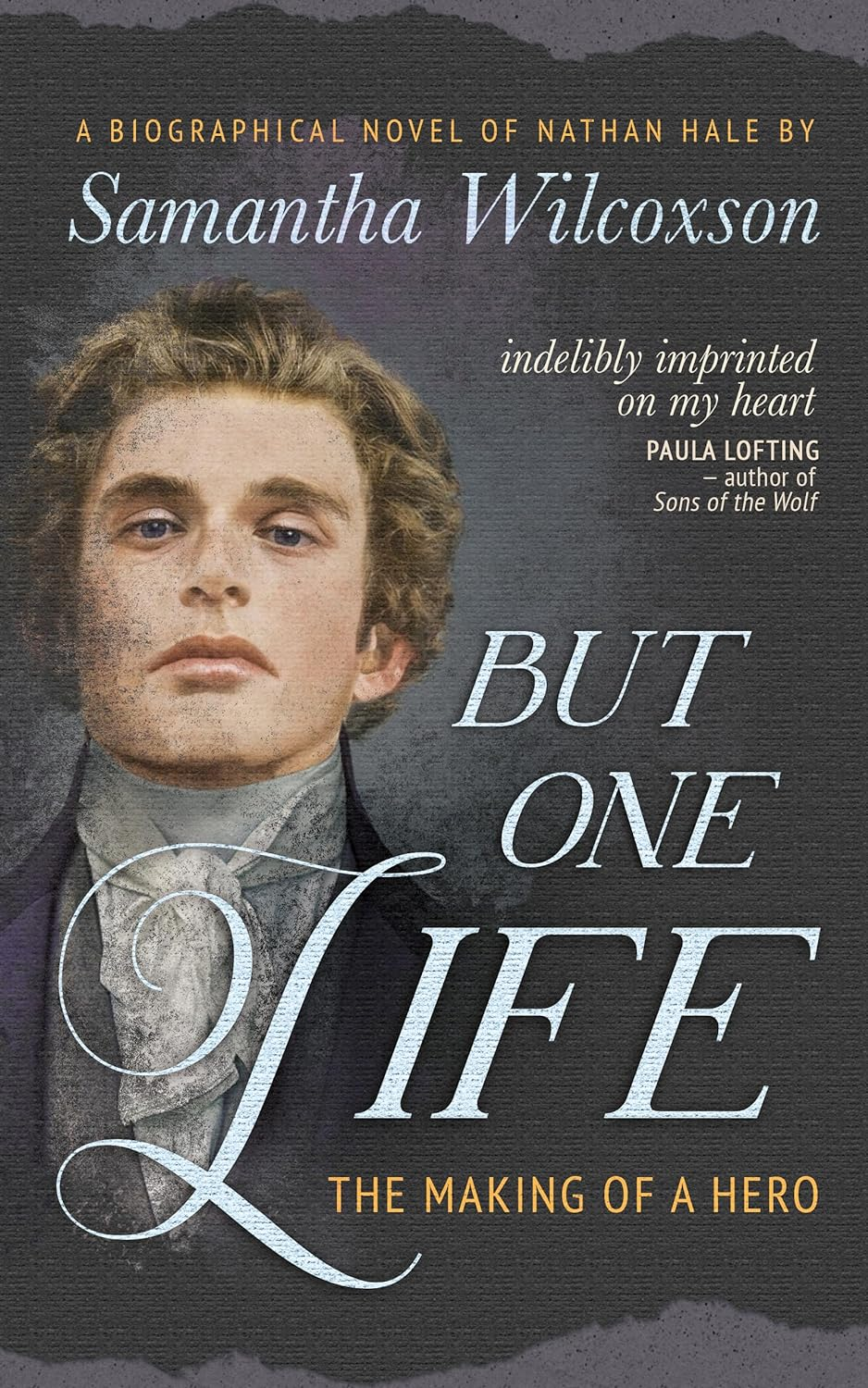
But One Life, by Samantha Wilcoxson

“If I had ten thousand lives, I would lay them all down.”

In the early 1770’s, Nathan Hale is a young philosophy student at Yale. There, he, his brother, and their friend, Ben Tallmadge, are busying themselves with intellectual debate and occasional mischief.

Only too soon, their patriotic ideals of revolution and liberty would be put to the test. Forced to choose between love and duty, young Nathan has to face the harsh personal cost of deeply held beliefs as he leaves to become Washington’s spy.

In this powerful novel of friendship and sacrifice, Samantha Wilcoxson paints a vivid portrait of a young man’s principled passion and dedication to his ideals, turning the legend into flesh and blood.

This is the touching and thought-provoking story of how an ordinary boy grew into an extraordinary man – an American hero.

My Review

Samantha Wilcoxson’s But One Life, a biographical novel of Nathan Hale, is thoroughly and deeply researched, immersing the reader in a convincing, detailed recreation of late 18th century colonial life in the United States. The influences on Hale’s life are clearly delineated: faith, bolstered by his brother Enoch’s even deeper religious conviction; classical thought (translated through a popular play of the time, Joseph Addison’s Cato), and the beliefs fostered and developed through debate and discussion during his years at Yale, especially in the Linonian Society.

Hale is a hero to many citizens of the United States, for his actions and his attributed last words: I only regret that I have but one life to give to my country – but he is also a tragic figure, a young man who allowed his impatient desire to contribute to the colonists’ War of Independence against Great Britain to be his downfall.  Unsuited for the role he takes on, untrained and working against his friends’ advice, his bold gesture of patriotism results in his death by hanging. Wilcoxson does not shy away from this interpretation, showing Hale’s actions in his last days as they were: naïve and bound to fail.

Wilcoxson’s novel fleshes out Hale’s life with a writer’s imagination, although only a failed romance strays far from the established facts. Hale’s life may have been one lived in a limited geography, but the ideas of thinkers and statesmen travelled to his world, as did news of the clashes between colonists and British troops even as early as his years at Yale. Here lies my only quibble with But One Life: other than reports of two uprisings involving violence, very little background into the causes of the growing frustration of the colonists with Britain is given: the Stamp and Townsend acts, resulting in taxation without representation; the Port Act, and the insistence by the British parliament that they had political control of the colonies. The discussions at Yale, especially in the Linonian Society, could have provided an ideal vehicle for background, which, while it may be familiar to readers educated in schools in the United States, may not be to readers from other countries.

Nonetheless, But One Life is a solid, well written biographical novel of a man seen by many as an American hero. Recommended.

ABOUT THE AUTHOR

Samantha Wilcoxson is an author of emotive biographical fiction and strives to help readers connect with history’s unsung heroes. She also writes nonfiction for Pen & Sword History. Samantha loves sharing trips to historic places with her family and spending time by the lake with a glass of wine. Her most recent work is Women of the American Revolution, which explores the lives of 18th century women, and she is currently working on a biography of James Alexander Hamilton.

Try the Leopard’s Mouth, by Charles Moberly: A Review

Try the Leopard’s Mouth is the story of a man with two dangerous obsessions: one with a country, and one with a woman. Tom Etheridge is a young man who takes a job in Rhodesia towards the end of Ian Smith’s government, at first working as a salaried farm manager but quickly wanting to become his own man and farm his own land. He lacks the capital to do so, but through the intervention of a friend is introduced to the daughter of the owner of the local hotel, the informal club of the white population of the area. Rapidly becoming obsessed with Briony, he trusts her when she tells him she can, through family connections, arrange financing for his farm.

While Tom falls in love with both the land and the woman, both are becoming increasingly dangerous. Briony has her secrets, and between his obsession with her and his desire to farm, he ignores the inconsistencies and nagging doubts, and becomes the owner—perhaps—of Chingwele.

Among the more typical crops of a Rhodesian farm, Tom and Briony are also growing tancava, a (fictional) local plant known as goat’s ear which, when ingested, allows people to function without food or drink for many days. Locally used during illnesses to mitigate dehydration, its use by military or para-military organizations means a potentially large market, one Briony appears eager to pursue.

As the battle for what will become Zimbabwe heightens, Tom is caught in the middle. Slowly he realizes Briony is not who she seems to be, nor is his friend Jamie, not entirely. But just who, exactly, are they?

Moberly neatly parallels Tom’s two obsessions. The white population of Ian Smith’s Rhodesia were said to be ‘more English than the English”, clinging to ideas and behaviours already disappearing in the ‘mother country’. Briony is fixated on her dead mother, wanting to emulate her and her relationship with Briony’s godfather, a man slowly revealed to be both controlling and corrupt. Like the beautifully described Zimbabwean landscape, Tom can wish to be fully a part of her life, but neither she nor the land can truly belong to him.

Sympathetic to the injustices of colonialism but acknowledging the problems and divisions of establishing self-government, Charles Moberly creates a fairly balanced view of a country in a time of reluctant and sometimes violent transition. Tom is both a perpetrator and a victim, a man caught in events and in relationships more complex than he can navigate. Fans of Wilbur Smith are likely to enjoy Try the Leopard’s Mouth.

About the author

Charles Moberly’s novels are different from one another in style and genre. He likes to push boundaries, and to address subjects rarely covered by other writers. If there is a common theme, it is tension arising from misunderstandings.

His blog is https://charlesmoberlyauthor.blogspot.com.

Moberly has written three novels to date: The Scrotum Toad, a satirical comedy (Winner of A Chill with a Book Reader Award); The Corncrake, a historical novel set in 1909-10 and 1914-15, (Winner of a Chill with a Book Premier Award); and Try the Leopard’s Mouth, a romantic thriller with a firm historical base (Winner of a Highly Recommended Award by The Historical Fiction Company).

Exiles, by Miles Watson: A Review

One man: an unwanted, abused orphan who found an escape in books, and in a moment of danger decides to model himself on a fictional character.

One woman: sold to a whorehouse as a child who has found her escape in the discipline and ruthlessness needed to become a captain of a smuggling ship.

A second man: convinced of his superiority, admitting no morality or laws but his own, who has sworn to destroy the despotic government known as The Order.

Eniton Champoleon, Marguerite Bain, Magnus.

Marguerite Bain, Captain of the Sea Dragon, is hired by The Order to take food and water to a tiny island on which a man is exiled. She is to make no contact with them. But Marguerite is not of a mind to do as she is told, and she leaves writing materials in one shipment. The story she is given in return tells of the unwanted orphan who becomes a wanderer and a conman, a tramp – until the day he accepts a free meal in exchange for listening to a political speaker. Caught up in the movement against The Order, he invents a history for himself and a future for the revolutionaries: one that has no basis in reality. But his lies will have a price, when a rising revolutionary called Magnus reveals his hand.

Marguerite, her own past too painful to dwell on, finds herself questioning her own choices as she reads Champoleon’s autobiography. Drawn to him, her interest in his story becomes compulsive, and dangerous.

Written in the style of a political thriller, set in an alternative future Europe, Exiles is also a psychological study of exile both voluntary and involuntary. Champoleon and Marguerite are both set apart from others by the circumstances of their childhoods and the paths taken as adults, whether by choice or by fate. Neither have anyone to trust, or love. Magnus, who believes himself an Übermensch, to use Nietzsche’s term, has no use for humanity except as tools for his vow to overturn The Order. All three have fictionalized their own lives, shaping them into an image individual to each character, but separate, alone, untouchable.

Dante in Exile by Domenico Petarlini
Public domain, via Wikimedia Commons

The novella, while capable of being read as a standalone, is also backstory for Watson’s earlier book Deus Ex. Much of it is told in great detail through Champoleon’s biographical writing – a technique I found palled after a while. But it does have the effect of distancing the reader from Champoleon, leading to the question of whether or not any of what he writes is true, or simply another story.  

Exiles has many twists and reversals, in good thriller style, and the tension and action builds throughout. Character voices are distinct. Watson is a writer of talent and imagination, with deeper themes beyond the surface stories of his books.

Miles Watson holds undergraduate degrees in Criminal Justice and History and a Masters of Fine Arts in Writing Popular Fiction, and served in law enforcement for nearly ten years before moving to Los Angeles, where he has worked on over 200 episodes of television and half a dozen feature films. But his first and last passion is writing.

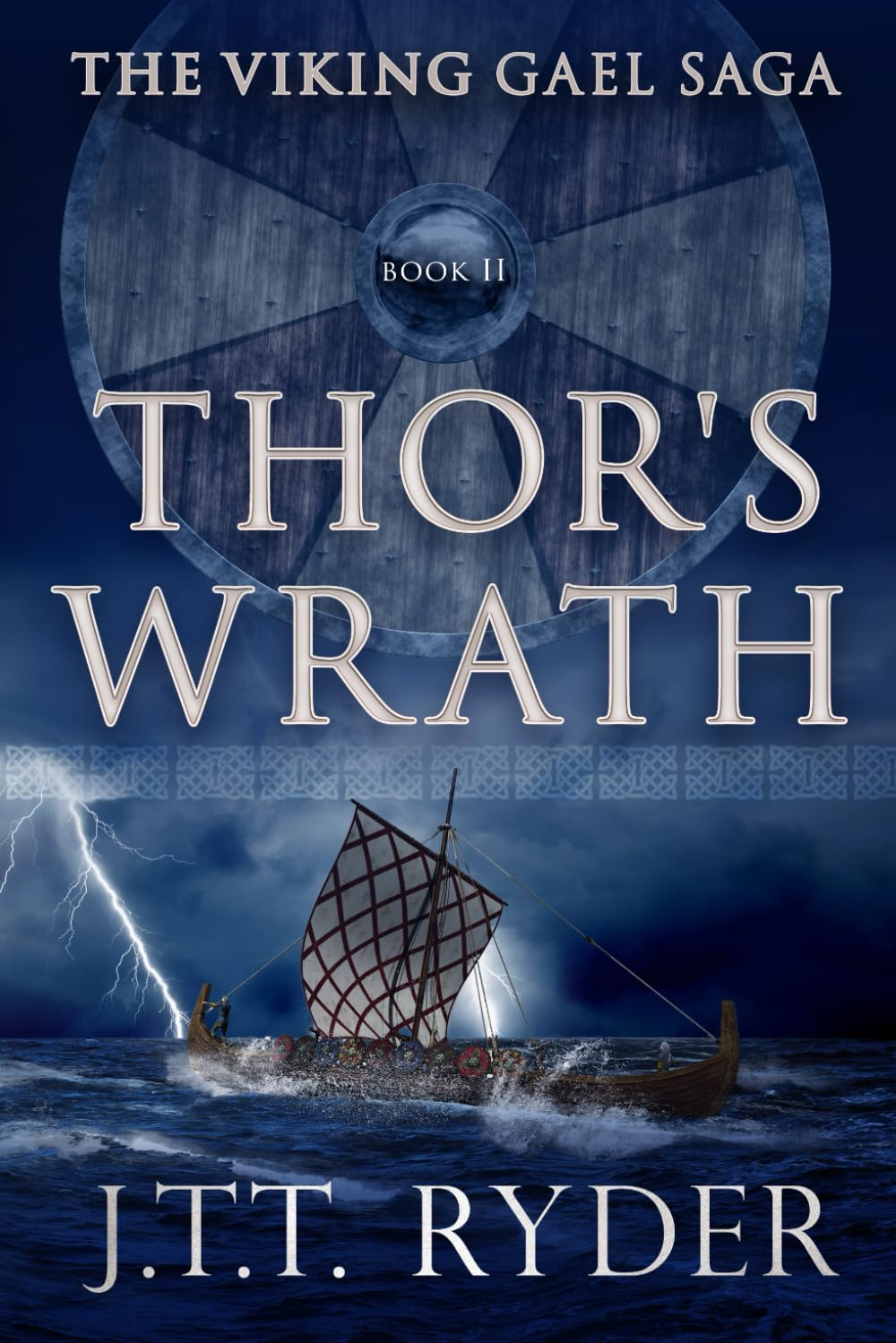
Thor’s Wrath: Book II of the Viking Gael Saga, by J. T. T. Ryder: A Review

When we left Asgeir in book 1, he had saved his life (and his cat) but lost his honour. Now, as Harold Finehair works to unite Norway, Asgeir lands in the Orkneys, into conflict and battle: a chance for Asgeir to overcome his shame and redeem himself in his eyes and his gods.

J.T.T. Ryder continues to draw on his extensive knowledge of the history and archaeology of the setting – both time and place – in recreating a 9th century north-western European world. While Asgeir (and his compatriots) worldview is not ours, it is convincing: enmity and friendship flipping back and forth; the importance of personal honour; the role of single combat over warfare. This is a world of foresight, of visits from gods, of visions and portents–all are real, all are to be taken seriously.

The story moves quickly; the reader and Asgeir together are given little respite as threats are overcome, peace is agreed, only for another threat or a betrayal to begin the action again. Ryder’s writing is sometimes lyrical, especially in his place-based descriptions: ‘A whirlwind of puffins blackened the sky over the rocky, chilly islet… Mist shrouded the horizon like unspun wool, and the wind bit as remorseless as a fox…” In other places it echoes the alliteration of the sagas: ‘shocked him with sleet sideways.’ Even the occasional unusual word choice adds to the story, creating a sense of a world different from ours, refracted through time and distance.

The story is perhaps Ryder’s best, the complexity of Asgeir’s choices and of his thinking deepening as the youth matures into manhood. The telling is excellent. The editing, I am sorry to say, is less so.

(I dislike on-screen reading, so whenever possible I buy the paperback, so these comments pertain to the first paperback edition published in 2023.) I am tolerant of a certain number of typographical errors: they appear in even the best edited books, traditionally published or independent. But repeated sentences, repeated scenes, should not. Nor should a leg of lamb in one paragraph become a leg of pork in another. These errors spoke of a rushed production, an incomplete editing process, and one, inevitably, that jolts the reader out of the story. A second, corrected edition* is strongly suggested.

But! Thor’s Wrath is still well worth reading, and I look forward to the next book in Asgeir’s saga. (And yes, the cat is still Asgeir’s companion at the end of this installment.)

*Update: correspondence with the author assures me these errors have been or are in the process of being corrected.

Dying for Work

Luminous: The Story of a Radium Girl, by Samantha Wilcoxson.

Imagine you are a young working-class woman in 1920s USA. Imagine you have elderly relatives to help support, and are offered a well-paying job in your home town. You would, of course, take it.

Imagine that job will kill you. Not just you, but many of your friends. And the company will deny the dangers, smear your name, conduct false medical tests, and conceal others, while all the time ensuring that their lab personnel have all the protected equipment available at the time.

You and your friends were disposable.

This piece of history, played out in Illinois and New Jersey, is the focus of Samantha Wilcoxson’s Luminous: The Story of a Radium Girl: a fictionalized biography of Catherine Wolfe Donohue, a worker at the Ottawa, Illinois Radium Dial factory. Catherine and her coworkers, all young women, were hired to paint watch dials with radium paint, so that the numbers would glow in the dark. To create the fine point needed on the brush for the exacting, precise work, they were told to run the brush point, loaded with paint, between their lips. One by one, they began to sicken and die.

Wilcoxson begins Catherine’s story in the late summer of 1921, when she is nineteen. Fall is in the air, garden produce is being harvested, and the slow rhythms of small town life are evoked in a few brief, effective paragraphs. An advertisement for girls to work at Radium Dial is advertised in the local paper; Catherine applies and is hired.

For a while, the job seems wonderful. The pay is good and the camaraderie with other girls creates close friendships. But then the illnesses start, and the deaths: horrible deaths, in many cases.

Catherine is not one to rock the boat, but she begins to ask questions. The management of Radium Dial deny any relationship with the paint; a fact claimed in Ross Mulner’s book Deadly Glow but not mentioned in Wilcoxson’s is that in some cases the women’s symptoms were blamed on syphilis, effectively destroying both their credibility and their reputations.

When her friends continue to sicken and die, painfully and gruesomely, Catherine—now married—has also fallen ill. Wilcoxson does not shy away from the details of the illnesses, primarily bone cancers, that these women contracted. With the support of her husband, eventually she and others sue the company, a nearly hopeless cause.

The devastation that radium poisoning caused to women and their families is clearly told, and the ground-breaking fight for compensation that Donohue helped win with her deathbed testimony is an important part of the history of workers’ rights. But perhaps because the dialogue often didn’t quite ring true to me, or perhaps because the story is told over twenty years, and is therefore necessarily episodic, while I felt for the destruction of lives and the injustice of their treatment intellectually, I never quite connected emotionally with the character: I was observing Catherine’s life, not immersed in it.

Luminous: The Story of a Radium Girl is a solid work, historically accurate and a window into a terrible exploitation of workers in the name of profits and a fight for workers’ rights—rights which are under siege in many places today as profit, not people, remains the focus of too many companies. Could this happen again? Under a slightly different guise, I am afraid so.

Samantha Wilcoxson

At the End of All Things

Wolf Weather, by Miles Watson: A Review

Imagine if you had lived a life of cruel discipline from the time you were a child, and were constantly called upon to do battle for an emperor you had never seen. Now imagine that emperor orders you far off the map, into a frozen land where the sun never shines and the only light comes from the grinning moon. Imagine that once there, hundreds of miles from the warmth of civilization and the sun, you encounter supernatural beasts somewhere between wolf and man; cunning creatures who slaughter your comrades and lay siege to the fort you have built with your own hands. Imagine that one by one, your fellow legionnaires are torn to bits and consumed, or worse yet, turned into beasts themselves…until at last, only you remain. The sole survivor and inhabitant of Fort Luna. Now imagine that’s where the story begins.

I read most of Wolf Weather with a smile of appreciation on my face, and that is rare. Author Miles Watson’s ability to create a setting and a structured world in the first few pages of a very short novella was the start of that appreciation; he takes the familiar and modifies it just a bit, enough for you to know this is a fantasy world, but not so much you need pages of exposition or explanation to understand it. The character of Crowning, the narrator, is equally well-drawn: again, he is both familiar and unique.

But beyond my admiration for Watson’s deft, spare creation of another world was also respect for his ability to ask hard questions about what a man at the edge of existence might do, facing something unimaginable that his mind cannot fully realize. Crowning is a man defined by discipline; the tenets of the military to which he belongs are literally written on his skin: by discipline we live, by discipline we die. Even when he is the only soldier left alive, in a fortress under perpetual night at the arctic edge of the world, he maintains the discipline by which he lives. Even though a horror lives in the darkness, a horror that has taken all his companions. Some are dead. Some are not, but neither are they living men any longer.

But Crowning is only human, and when in exhaustion he forgets part of his routine in his endless battle against that horror,  that breach of discipline has consequences—and the central question of the novella is made clear: when we let go of the expectations of civilization, of the disciplines required by communal life, by society; when we embrace ‘at the end of all things’ the darkness and the desires that run in the tracings of our blood—what might happen? Unbridled passion can destroy, but it can also engender.

Deceptively simple, Wolf Weather is a story I won’t soon forget.

Miles Watson

An Imagined History

The Scots of Dalriada: Fergus Mór by Rowena Kinread

Feargus Mòr Mac Earca may have been a 5th century ruler of Dál Riata, the Gaelic kingdom that encompassed parts of modern-day Scotland and Ireland. While there are doubts about his historical authenticity – think of him as somewhat more historical than Arthur and at about the same level as Ragnar Lodbrok—the kings of Scotland from Kenneth MacAlpin onward claim descent. With few contemporary records to go by—most of what is written about Fergus Mòr is from many generations later—author Rowena Kinread is free to imagine and enlarge his story.

The jealousies and conflicts among the rulers and potential heirs to various 5th century kingdoms are believable, a portrait of the complex and shifting loyalties among the boys of one family, when any one of them could be determined to inherit the kingdom: it went to the most worthy, not the oldest, by the decision of a council. Brother could turn against brother—or stand by his side in support. Nor does Kinread shy away from the violence and brutality of the time, whether in war or in casual violence against both men and women—and from both men and women.

The book’s style is unusual, passages of present-tense, omniscient narration interspersed with scenes that are largely dialogue. (I did wonder if Kinread was attempting to echo the way some English translations of the Ulster cycle are presented, the way Dorothy Dunnett echoed first the sagas and then ecclesiastic writings in King Hereafter, her imagined history of Thorfinn, Earl of Orkney.) Within the narration are some lovely descriptions: ‘the leather bridles…polished until they shine like dogs’ noses.’ While most of the book’s action unfolds in a linear timeline, the first eight chapters do not follow this pattern—pay attention to the chapter headings! 

The Scots of Dalriada: Fergus Mór is published by Vanguard Press, one of the imprints of Pegasus, a hybrid publisher in the UK. Their editorial team has done the author no favours. Typographical errors are too frequent – I counted six within seventeen pages. The use of modern or otherwise anachronistic terms—a pregnant character refers to ‘the first trimester’—jolted me out of the story many times, as did inaccuracies in the setting: ‘vultures circling’. (Ravens, yes. Vultures in the northern UK, no.)  

Kinread’s imagined history of Fergus Mòr’s rise to power and the eventual kingship of Dalriada has a good story at its heart, in places effectively told. A better editor could have made it shine.

The Abdication, by Justin Newland: A Review

Justin Newland’s The Abdication is a complex, layered, philosophical novel. Like Philip Pullman’s His Dark Materials, it explores the concept of free will against obedience to an authoritarian higher power: the protagonist, Tula, is seeking the guidance of the angels of the town of Unity in her quest for a spiritual life. To reach Unity, across the forbidden Via Angelica bridge, she must first pass through the human town of Topeth, ruled by avarice and corrupt religious leaders.

The Abdication is deceptively simple, seen through the eyes of a young woman on a journey to understand the visions she has and the voices she hears. The town – Topeth – she believes a haven is instead a place of terror and corruption, turned away from its founder’s vision of a community where human free will can be allowed to grow and develop. The proper expression of free will, she learns, is hard; it is easier to obey a set of rules, even when they are the rules of a vindictive, false religion in league with a destructive, profit-driven elite.

Newland has created a world that feels both familiar and strange. Tula inhabits a world that seems to be ours: there are references to ancient Earth cultures; the flora and fauna are real. The mythology of Unity and Topeth is based, in my limited recognition and understanding, on Abrahamic teachings – pre-Christian interpretations of both gods and angels and the powers of both.

Aspects of The Abdication reminded me of two books from my childhood: a youth’s version of The Pilgrim’s Progress, and Charles Kingsley’s The Water Babies: the former for the allegorical obstacles the protagonist must overcome on the journey to the city of their desire and enlightenment; the latter for the motif of the shedding of skins on the way to becoming the purest self.  Throughout the book, the image of winged beings, both helpful and threatening, repeats, reinforcing and reflecting the idea of angels as many people imagine them, and perhaps also suggesting the revelations of the ending.

If I have one niggle with The Abdication, it is the almost non-stop action of the last chapters. For a book asking hard questions about the balance – in a world where gods and angels are real and powerful – between blind obedience and the exercise of free will, there was little time for the reader to contemplate what Tula has learned and the choices she makes. It felt a little like the last chapters of a thriller, where, as the protagonists reach the climax of the plot, rapid reversals leave the reader barely able to draw breath.

Overall, The Abdication is an intriguing book, leaving me with the feeling that if my understanding of the religious underpinnings of its world-and-mythology building was better, I would have found it even more captivating. Even without that, its questions about what free will means and the choices made in its pursuit made it both challenging and compelling.

Justin Newland was born in Essex, England, three days before the end of 1953. He lives with his partner in plain sight of the Mendip Hills in Somerset, England.
Justin gives author talks in libraries and does books signings in Waterstones, WH Smiths and indie bookshops. He has appeared at literary festivals and regularly gives media interviews.
He writes secret histories in which real events and historical personages are guided and motivated by numinous and supernatural forces – that’s history with a supernatural twist.

https://www.justinnewland.com/