$0.99 E-Book Weekend!

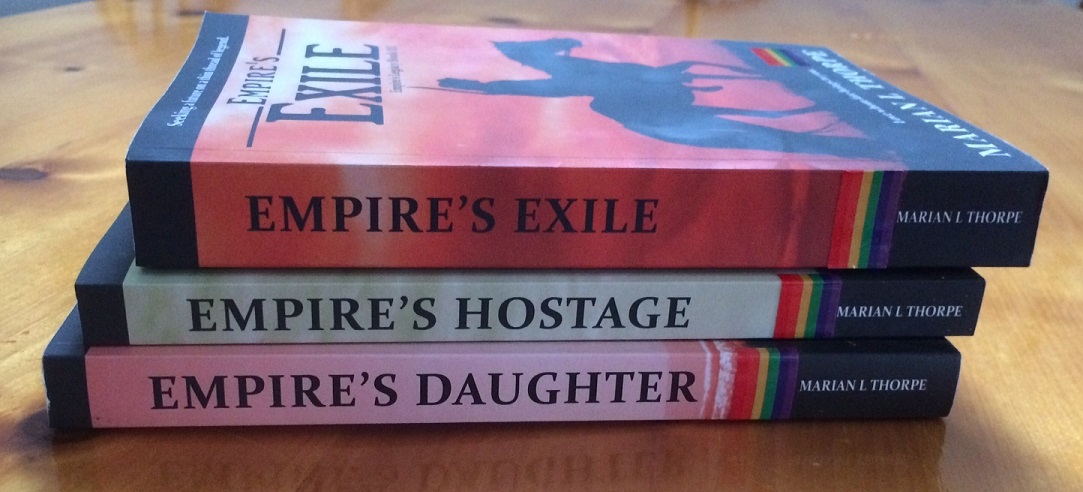
cover trio

Available Nov 29 – Dec 4 for 0.99 cents each on Amazon


In a world reminiscent of northern Europe after the fall of the Roman Empire, this historical fantasy series explores the meaning of loyalty and love in a rapidly changing society. Following the protagonist, Lena, over a period of four years, from the day a soldier rides into her small village with an audacious request – that women learn to fight – to a last, desperate battle to save her land – Empire’s Legacy considers the impact of war and violence on men and women, and the price we pay for freedom.


“Involving, evocative, intelligent – an outstanding historical fantasy.” Maria Luisa Lang

“The consistency of the ever-evolving plotlines and character development has been nothing short of brilliance…” Cover to Cover

Still Breaking the Heart

three spines rainbow flag wpSince I wrote my last blog post on the quotes that kept me focused while writing Empire’s Exile, I’ve been noticing what else I use to keep to my themes and moods. Unsurprisingly, and especially for the work-in-progress, music is a large influence.

In Exile, the ear-worm that both plagued and focused me throughout was REM’s Losing my Religion. (Those of you who’ve read the book may see the connection.) But in Empire’s Reckoning, the chief narrator, the lord Sorley, is a musician, and so music is very important.

Given that my imagined country of Linrathe and its administered land Sorham are analogues of Scotland, Gaelic or Gaelic-influenced songs make up the largest part of the tracks I’m playing over and over again. The band Runrig is almost always on my i-pod, and most especially their song The Beautiful Pain. The lines:

All that’s constant and wise

I still see in your eyes

And it was always that way from the start

Right here where I stand

On the last of the land

But you’re still breaking the heart.

so perfectly captures my narrator Sorley’s angst that I’m hard-pressed to find a better way of expressing it.

But then there’s Stan Rogers’ beautiful song Turnaround, and its lines:

Now it’s not like you made out

To hang around

Although you know I made some sounds

To show that I cared

And when it looked like you heard the call

I didn’t say a lot,

Although I could have said much more

Had I dared

But yours was the open road

The bitter song, the heavy load

That I couldn’t share

Though the offer was there

Every time you turned around.

which again is a flawless summation of Sorley’s regret.

Whenever the story appears to be becoming too easy on my protagonists, I play these again. Sure, I’d like them to ‘live happily ever after’…but that is neither a good story nor realistic. We cannot shape the circumstances to fit our lives, only our lives to fit the circumstances. What defines us, as men and women, is how we respond to those circumstances, my character Casyn said in the first book of the trilogy, Empire’s Daughter. It’s still the overriding theme.

No Unwounded Soldiers

In war there are no unwounded soldiers.

This quote from José Narosky is written in large letters on the whiteboard in my study. Its purpose is to focus me on the main theme of my work-in-progress.

three spinesIn all the books in the Empire’s Legacy series, the titles reflect the main themes of the book. In Empire’s Daughter, the theme  was duty, and how that is perceived by a daughter of a mother, a village, a country. My mother served in the British Army in WWII, as a teletype operator, both in London and in France. After the war, and after emigration to Canada, she was a member of an organization called the Imperial Order of the Daughters of the Empire (IODE).  I don’t remember what that group actually did, but from its name, and my mother’s own attitudes towards volunteering to serve, came the title of my first book.

Empire’s Hostage looks at the concept of being held hostage, both physically and intellectually; hostage to ideas and concepts, reflecting the growth we all make in determining what aspects of our upbringing we accept, and which we reject. I’m just old enough remember the end of the Viet Nam war, the protests and anger, but I am also very aware of the damage done to veterans who had served, in patriotism or in conscription, who returned to be repudiated and vilified for what they had done, sending them into a form of exile in their own country. From that came the title and theme of the third book, Empire’s Exile. Its title refers to exile in its many forms: physical, emotional; exile by choice or by decree, by forgetfulness, by history…and whether redemption from any of these is possible.

Exile is a longer book, divided into four sections. Each section  has a quote heading it, defining the sub-theme of that part. The final section, which deals with battle and sacrifice, was the easiest to find a quote for. Fittingly for a historical fantasy series set in an analogue of Europe in the days after the decline of the Roman Empire, it is from MacCauley’s Lays of Ancient Rome: And how can man die better than facing fearful odds, for the ashes of his father and the temples of his gods?  The quote also brings the series full circle, to the themes of the first book: what is duty, in the face of war?

The work-in-progress, tentatively entitled Empire’s Reckoning, examines the price paid – by soldiers and civilians and nations – for war. It’s not proving to be an easy book to write, but that’s all right. It serves to remind me, on this Remembrance Day weekend and every day, of the truth in Naroksy’s words: In war there are no unwounded soldiers.