The Travelling Writer

When both writing and travel are important, how do you balance the two?  I’m on the road far too often to not write while travelling, or I’d never get my books finished. Over the years they’ve been written at picnic tables in campsites and parks all over North America; in cafes across the world; in planes and trains and ships; and in tents in Mongolia and cottages in England.

There are three major considerations to writing while travelling: teaching yourself to write anywhere; keeping your work safe, and managing the technology. I didn’t used to be able to write unless I had complete privacy. Some of that was the beginner writer’s desire for secrecy, the reluctance to reveal to the world what I was doing. As I became more confident, and as I had deadlines to meet, that reluctance dissolved. The deeper I am into a story, the easier it is for me to write absolutely anywhere.

If noise distracts you, consider earplugs or listening to music. Or start with planning, writing character sketches, descriptions: background information you’ll need, if you can’t get into your story in a public place. I do better with dialogue; often I’ll fill in the description and actions afterwards, but I can almost always ‘hear’ the discussion between my characters, wherever I am.

Several years ago, just before a 9-week, 4-country, 27-flights trip, I bought a tiny laptop: not a netbook, because I am almost always places without internet. It fits neatly into my backpack, cost me $300 Canadian, and it has SD-card storage, as well as USB. Several points here: if I lose the laptop, or it’s stolen, or broken, it was cheap. Secondly, the removable storage was important. My work is not on the hard drive. It’s saved to the SD card, and to a flash drive, and those two things are kept (separately) on my body with my passport and wallet. Plus, I back up to cloud storage whenever and wherever possible, so my work is as secure as I can make it. It’s easy to get sloppy about doing this, but so far I’ve maintained the discipline…and when my laptop stopped working in Fiji (it didn’t like the 100% humidity) I could relax, knowing I wasn’t losing work. (It began working again back in drier, air-conditioned Canada, and has kept on working ever since.)

Managing the technology is again mostly a matter of discipline. Charge the laptop whenever you can: this means ensuring you have adaptor plugs. Carry a spare charge cord – unlike iPhone charge cords, which I’ve been able to buy everywhere in the world except Antarctica, it’s not easy to get a replacement laptop cord. Because my husband and I have identical laptops, we always have two charging cords. If access to electricity is rare, run your laptop on airplane mode, with the Wifi search off too – it will save power. Dim your screen. Turn it OFF, not to sleep. And of course, carry notebooks and pens or pencils. Writing doesn’t require a laptop – I just prefer it.

Finally, don’t leave your laptop at security after it’s been x-rayed. That may sound self-evident – but for all my experience, I’ve done it twice, in busy airports where security was busy and crowded. Luckily both times we were called back! 

What are your tips for writing when traveling? Please share!

72 and Counting

by Nikki Everts

A few random thoughts about how I came to be publishing my first novel at age 72.

I have always written – mostly for myself in journals where I bemoan my fate, rant against those closest to me and try to sort out the confusion of my life. These journals are confined to a dusty box and while I dread the thought of my children reading them when I’m dead, I cannot yet bring myself to throw them away. They are embarrassingly dull and depict a person going round and round the same mulberry bush of problems year after year. However, writing down my thoughts and feelings when I knew no one would be watching gave me a fluidity and freedom in writing that has been very helpful. So when the real authors advise us newbies to just keep writing, they are on to something.

I’d still be writing only for myself if it weren’t for writers’ groups, gatherings and workshops. The first one I dared to participate in was led by an off the wall, erudite bibliophile named Gord Jones who made me believe that my writing was worthy of being read by others. That gift of confidence gave me the impetus to actually write one of the two stories I’d been playing around with. A novel writing course offered at a local college was my next step. The teacher insisted at our first meeting that we break into groups based on genre. Naturally, I panicked – I had to choose between my two darlings: mystery or sci-fi? I simply could not decide. Then a woman burst into the classroom late. I immediately liked her and she sat down beside me. She had no qualms about choosing a genre – mystery it was. And there you are; my decision was made. There were three mystery writers and we persisted meeting together long after the course was over. Those monthly meetings motivated me to keep writing chapter after chapter, if only to have something to read to the group. Although I enjoy the process of writing I am not disciplined and need extrinsic motivation. So, know yourself and put in place whatever you need to keep walking, running, crawling or limping towards your writing goal.

I’d imagined the life of a writer in an ivory tower sort of way. Perhaps this works for some, but the encouragement, feedback and contributions of others have made my writing much better than it ever could’ve been had I gone it alone. The novel I just published with Arboretum Press, Evidence of Uncertain Origin, began thirty years ago when, for reasons I do not remember, I daydreamed a vivid scene that became the climax of the story. I spent a very long time figuring out who the people were in the scene and how they got there and what happened to them afterwards. The story shifted and morphed as I shared it with others and became a better story than the one I started with. I know it is terrifying to share your writing with others – it is a tender shoot of your very own tender soul – but taking the risk really is worth it.

Stay true to your story. Don’t take short cuts or try to be clever. Don’t fall in love with your own words. Integrity makes or breaks a story. If a sub plot or character or those well-crafted words do not harmonize with the whole, be ruthless and kill them off. You know the ones I mean.

I’m not sure I could’ve completed a novel any earlier in my life than I have now. I truly do believe that it is never too late to find out what you love to do and do it. So go for it!

Graduating in in 1969 from the University of California, Berkeley, Nikki travelled for several months, arriving in Montréal in April, 1970 where she lived until 1992. Nikki came of age in California during the sixties and held a sympathetic view of the Front de libération du Québec until the October Crisis. The events leading up to the FLQ’s kidnapping and murder of Pierre Laporte, the beauty of Montréal and the complexity of Québec politics inspired the setting and backdrop of Evidence of Uncertain Origin, Nikki’s first mystery novel.

Nikki lives and writes in Guelph, Ontario. She has self-published a book of poetry, connect dis connect with the help of Vocamus Press and developed writing workshops under the auspices of her small business, Scripted Images. She is working on a second mystery novel.

Purchase links for Amazon, Barnes and Noble, and other sources here.

Of Bere and Beer

I demand historical accuracy of my alternate-Europe: its geography, social constructs, and history may differ somewhat from the real world, but the background is as correct as my research allows. (And my interpretation of that research, of course.) But this conversation between two characters in my fifth book, Empire’s Reckoning, led me down a research path I hadn’t expected.

 “Should I put the meadows along the water to the plough, if I can find seed? They’ve been grazed, but we’ll not have sheep in numbers for a few years yet.”

“If those meadows are like the Ti’ach’s, they’re wet,” I said. “Better leave them to the sheep, and plough better drained land, if you can.”  He’d be late getting the barley in…

And then I stopped. This scene is taking place in early May, in a land that is an analogue of lowland Scotland, in more-or-less the 7th century.  Was this TOO late to plant barley?  Would it mature before winter came? (I have a graduate degree in crop science, and so I think about these sorts of things.)

I googled  ‘medieval Scotland planting date barley’…and discovered something I didn’t know. (Not terribly surprising, that, except that due to the aforementioned graduate degree in crop science, I actually do know a fair bit about the origins of cereal grains. And the professor who taught that bit was not only a Scot, but a whisky aficionado…which will become relevant.)

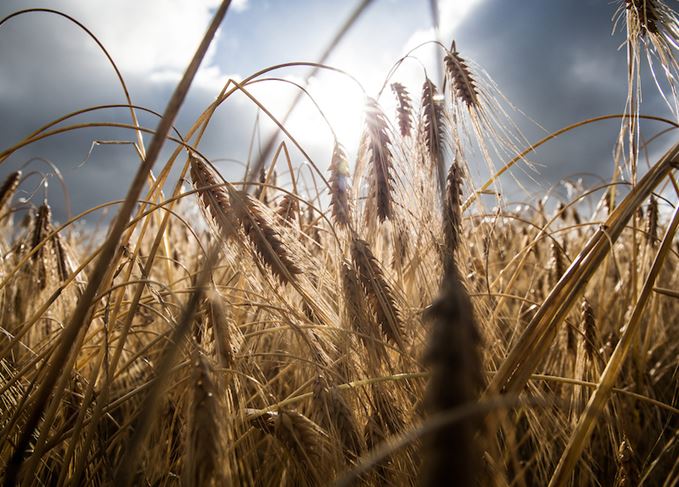
What I discovered was ‘bere’ (pronounced bear): a barley race introduced to northern Scotland by the Vikings in the 8th century or earlier (earlier was good). Peter Martin, director of the Agronomy Institute at Orkney College, part of the University of the Highlands and Islands (UHI), says, ‘Bere is probably the oldest cultivated barley, definitely in Britain and probably one of the oldest still in cultivation in Europe.’ Adapted to the climate and soils of the far north, it matures in 90 days. Plenty of time for my character to plant it in lowland Scotland in mid-May (or even June by the time he gets those fields under plough) and harvest it in late summer.

It’s also taller than modern varieties, which means it has an unfortunate tendency to lodge, or fall flat on the ground near to harvest in heavy rain or wind. I knew this about older barley varieties, so I’d already written this later scene, a different landholder and a different year than the earlier one.

In the long summer twilight, the clouds and rain now blown eastward, we walked up to the barley fields. Much of the grain lay flat. Roghan clicked his tongue. “Harder work for the men,” he said. At the greener field, he shook his head. “It will mould before it ripens. We’ll try to rake it, but likely I’ll turn the cattle out on it in the end.”

At the start of this century, there may have been less than 10 hectares of bere left in Scotland, grown only in small fields in the far northern and western islands. What has saved it is its unique flavour when used to brew beer or whisky. Small breweries and small distilleries produce short-run, expensive beverages with it, aimed at the increasing market for local-provenance food and drink. Barony Mill, a watermill on Orkney, produces flour (beremeal) from it as well. It’s a tough grain, difficult for modern machinery to handle — and would likely have ground down the teeth of people who ate it regularly (that and the flakes of stone from the grinding).

I’m visiting Orkney  in April, too early to see bere growing. I’ll look for the whisky, if it doesn’t break the bank. Well, maybe one glass, somewhere on that northern island, in honour of my constructed world and the real one it’s based on.

(Well, that visit didn’t happen, because COVID did. Still hoping to get there someday!)