Every so often, usually on Twitter, someone asks the question, “As an author, what do you consider success?” The answers range from thousands of sales to those who just want to sell a book to someone who isn’t family or a friend.
Pondering the question as I was walking this morning, I realized what success is for me: I no longer feel like a fraud. Writing is my third career. I spent a decade in research; for a short while I was doing cutting-edge research into plant enzymes. I was good at it. I felt like a fraud.
Then I moved to education, and into special education specifically, and for almost twenty-five years that’s what I did. I liked teaching, and I liked (most) of what I did as a special education consultant. I was good at it. I felt like a fraud.
Looking back, I know why. My heart was never in any of it, not truly. I wanted to write. I always wanted to write. I did write, but fear of failure and fear of what – condescension? pity? – kept me from submitting anything. Until somewhere in my late 30’s, when I was mature enough to say, ‘I’m doing this.’
My first small successes came as a poet, with acceptances to little journals. Then the first novel, accepted by a small publisher. My fifth title comes out at the end of May. The books have a niche audience and moderate sales. That doesn’t matter: that’s not how I measure success. Failure was ignoring what my heart told me I should be doing.
And I haven’t felt like a fraud since Empire’s Daughter went out to the world in 2015.
…And the wind lifting the song, and interrupting it, Tossing it up under the clouds.
And all this comes to an end, And is not again to be met with…
Exile’s Letter, by Li Po ( c.760 AD), translation by Ezra Pound
I’ve been thinking, perhaps not surprisingly in a life where we are all estranged from normalcy just now, about the concept of exile. It is the dominant theme in my series Empire’s Legacy, although it is explored most strongly in Empire’s Exile and the upcoming Empire’s Passing. I read a number of poems and stories about exile while I was writing Empire’s Exile; about physical banishment, but also about spiritual and psychological exile, because the book isn’t just about being physically outcast. Some of those expressions of exile stayed with me more than others, no more so than a small excerpt from the Chinese poet Li Po’s greatest poem: the idea of a random wind, a random act, (a random virus?) interrupting an idea or a life, ending joy. Very close to the end of my book, I echoed his thoughts in these lines:
A gust of wind rattled the grasses. If he replied, I did not hear the words. I raised my head for one last, long kiss, and then he stood, holding out his hand.
“Time does not stop,” he said, “for all we wish it might.”
Homage to a great poet, but also a purposeful echo. Not one I expect one reader in a thousand to hear, but that’s all right. Sometimes the influences are more obvious; sometimes they’re subtle.
In my 2020 release, Empire’s Reckoning, there is a stronger echo of a classic tale of exile, purposely done. I was acknowledging the importance of a certain – what? – story, mythology, archetype? – in my soul, when I chose to do this. In this case – and I’m not going to tell you what it is – it influenced both how the plot develops and a specific setting in the story. Some readers will see it. Some with recognize a familiarity but won’t quite identify its source. Some may do neither. All of this is, again, all right. Books speak to us on different levels, and writers write on different levels, too, and sometimes we don’t fully know what those are. But it too is about exile.
Edward Said, in Reflections on Exile and Other Essays, wrote
“exile is…the unhealable rift forced between a human being and a native place, between the self and its true home: its essential sadness can never be surmounted. And while it is true that literature and history contain heroic, romantic, glorious, even triumphant episodes in an exile’s life, these are no more than efforts meant to overcome the crippling sorrow of estrangement.”
“Homesickness swept through me, a wave of longing: cianalas, in my tongue,” my narrator Sorley tells us in Empire’s Reckoning. The crippling sorrow of estrangement; the unhealable rift that only compromise and perhaps a reluctant acceptance can even begin to bridge.
I didn’t know I’d release this book into a world forced into involuntary separation and distance, ravaged by political differences, challenged by climate change. We all became homesick now, longing for the world we had. In Li Po’s translated words, again:
If you ask how I regret that parting?
It is like the flowers falling at spring’s end,
Confused, whirled in a tangle.
What is the use of talking? And there is no end of talking—
I used to work in a job so multi-faceted and complex that when I left, I was replaced by two people. I had dozens of projects on the go, several teams of people to oversee, and a huge budget to manage. There is no doubt I worked too hard and too long, and I left burnt out, but I also learned some very valuable lessons in managing time and projects that I still use today in my third career as a writer, editor and the coordinator of a small indie collective press.
I’ll throw in my usual caveats here: I’m in my 60s; no children, and this is what I do full time. I’m not balancing another job, children, elderly parents, house renovations, commuting…life. (I did, though, minus the children, and that’s why my first book took 12 years to write.)
I recognized my lack of organizational skills somewhere in grad school. I have ADHD, which has both its own challenges and its own rewards, the ability to hyperfocus for long periods of time on certain things being the most obvious positive feature (for me). But I needed processes to replace my poor executive function, because without them, it was and is all too easy to be overwhelmed with the amount of work in front of me. And if I get overwhelmed, I simply do nothing.
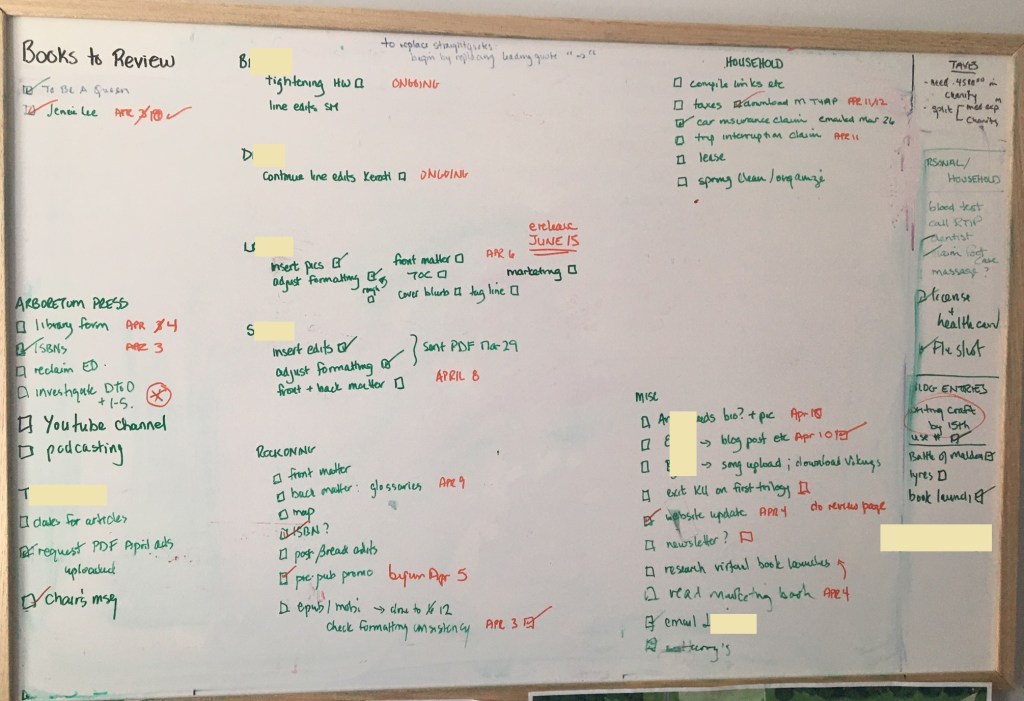
I won’t bore you with a list of the books I read and the methods I tried. Most didn’t work; they required too much time and focus. But I took bits from most of them, and now I have a system that works fairly well. It’s quick and it’s visual, both requirements for me.
As you can see, I use a series of checklists, and a forward-projection of the dates on which each project needs to be completed. This allows me to then subdivide the project into chunks, and schedule those, as well, working backwards from the completion date.
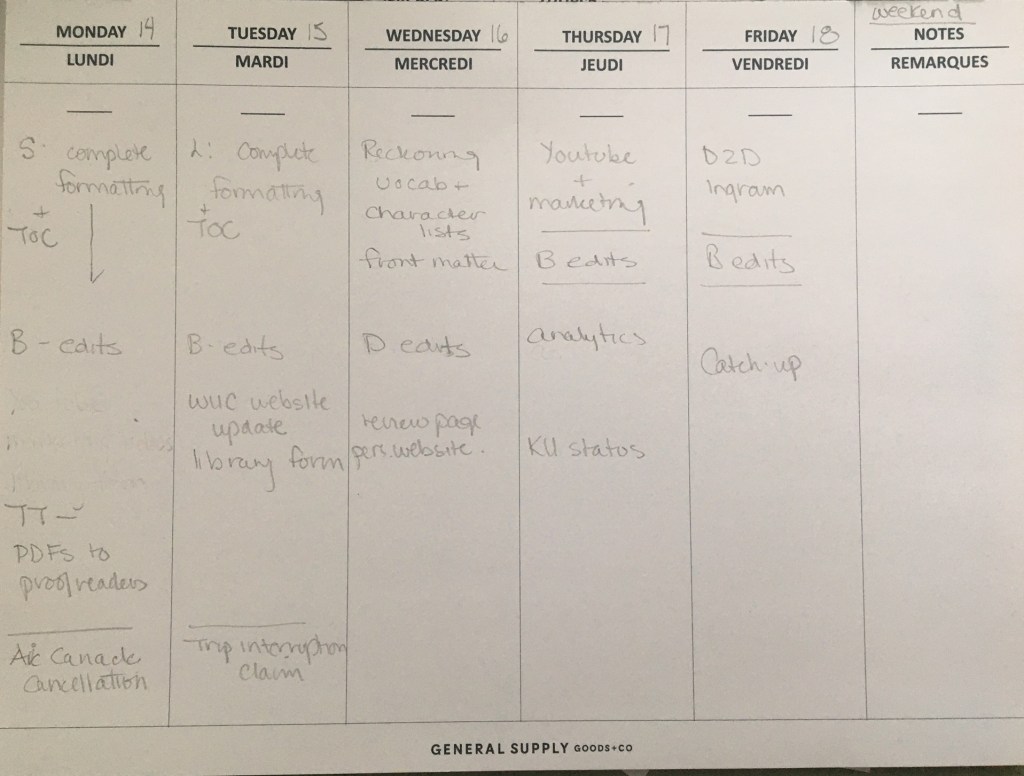
Then I use a daily planner. I know I’m most productive in the mornings, so between 8:30 and 11:30 is my intensive work time. That’s my time to work on my own book, when I have one in progress – and when I am actively writing, it’s nearly every day. I don’t wait for creativity to strike: most of the time, once I start, the words will flow. Perhaps not as well as I’d like, but as the saying goes, you can’t edit a blank page.
When I’m not actively writing, this is the time I use to learn something new or do in-depth research: whatever the big tasks are that the board shows me I need to complete. I take a couple of breaks, for movement and coffee, usually sneaking in a load of laundry or some other household chore.
After lunch I’ll generally check emails & social media, deal with anything important (or amusing) and then work on non-writing projects (that includes editing other people’s work or doing video meetings with other writers) for an hour or two. Exercise next, a walk or cycling for at least an hour and then another hour or so on ‘little’ things, tasks that don’t take a lot of creativity, such as updating websites, checking analytics, filling out forms, sending information out. But even most of those – barring an urgent response – have been scheduled, again to prevent me from feeling overwhelmed by the sheer number of them. Then I settle down with a cup of tea and read – books for review and/or pleasure – for 15 minutes to half an hour.
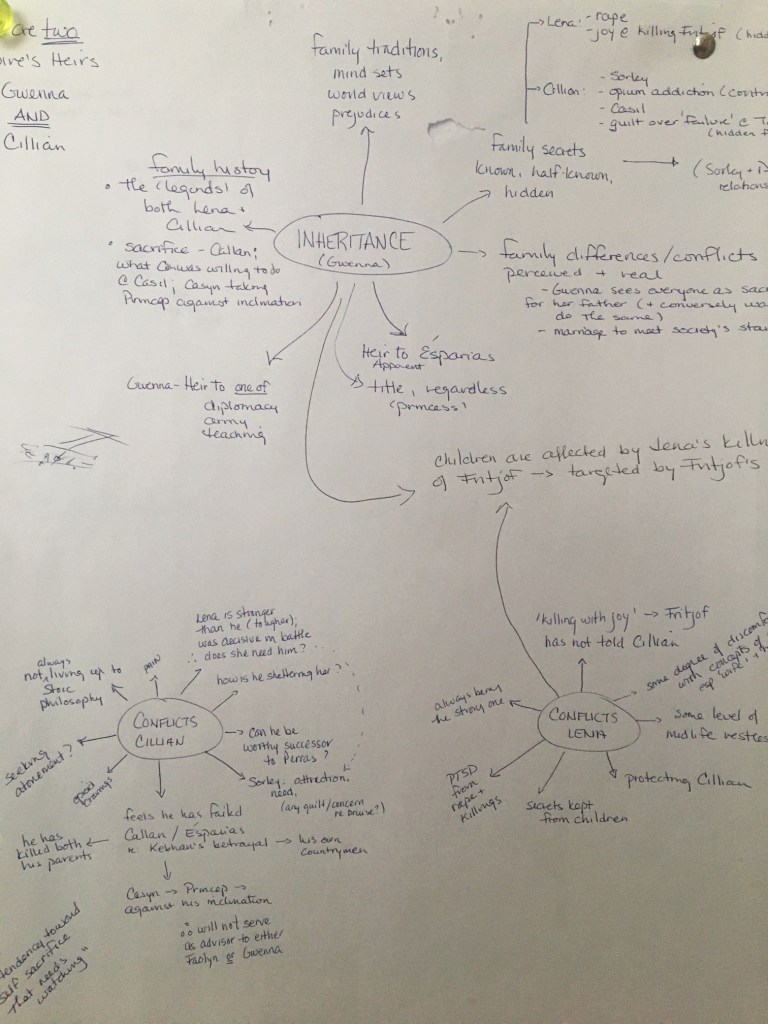
A few nights a week I work between about 10 and midnight: that’s a different sort of creative time for me, the time I write scenes that never make it into the book, but teach me about my characters and their responses; the time I do mindmaps of the major themes and conflicts of the story, the free-flowing ‘right brain’ associations and lateral thinking taking over. I’m about half-way between the poles of pantser and plotter, and this time is completely necessary to my writing process, and very different from the task-oriented approach I use the rest of the time. I’ll likely have music on, songs that relate to my work-in-progress in some manner. I might read poetry, looking for epigraphs or just for the expression of emotion I too am looking to convey.
Of course, life gets in the way of any schedule. One of the best pieces of advice I ever read was to not overschedule your day, so that there is room for the interruptions and minor ‘emergencies’. Friday afternoons are unscheduled, for catch-up, and my weekends look different from Monday to Friday: I may work for myself, but I still get weekends! Groceries and cleaning and movie matinees and dinners with friends (well, not the two last ones just now, in the middle of COVID-19 social distancing) are all part of the week too.
Does it work perfectly? Of course not. I have days when I’m just too scattered, and that’s likely a day I choose to do something that I know I will hyperfocus on – designing ads, doing layout, or very detailed editing on my own work – and sometimes I just need to walk away from everything. But when I come back, the structure is there to guide me as to priorities: I don’t have to reinvent them. It keeps my mind calmer, and when my mind is calm, I’m productive.
Oh, and I have one other necessary ingredient in all this: coffee!
Twenty years ago, I wrote the following words: “I was seventeen, the year Casyn came home.” I had an image in my mind – a geography: it is always place, landscape, that I begin with – and a concept of a lone fishing village, and a young woman. Fifteen years later, two major rewrites and a failed publisher, Empire’s Daughter went out to meet the world. A standalone young-adult novel, I thought.
Then I learned two things, from the early reviews, from comments made to me by readers: my audience wasn’t young adult, and they wanted more of Lena’s story. Today, on my 62nd birthday, Empire’s Reckoning, the fourth full book (plus one novella) set in Lena’s world became available for Kindle pre-order. It’ll be published at the end of May.
The first trilogy takes place over about four years. The new book is a two-time line story, bringing the narrative forward fifteen years from the last chapter of Empire’s Exile, to the next generation of characters. The planned next two books will jump forward another four years for Empire’s Heir, and then yet another ten or so for Empire’s End.
My major characters from the first trilogy: Lena, the narrator; Cillian, Sorley, Druisius: all these figure into the next two books, watching their dreams and goals pass to the next generation; counselling, guiding, worrying, but also living their own complex and meaningful lives. Lena will have gone from a young woman of almost eighteen to a grandmother in her fifties; Druisius and Sorley a few years older, and Cillian will be…well, just a little older than I am now.
The plots of the next two books are outlined. But what will be the greater challenge, I think, is reflecting the changes life brings, the regrets and compromises, the wisdom and judgment, as I jump characters forward several years at a time. It took me a long time to truly find Sorley’s voice (he’s the narrator of Empire’s Reckoning) at 39: I had to work out a lot of backstory to understand who he is, this middle-aged musician, and how he got there from the trusting, naïve 24 year old in Empire’s Exile. The others, too – who were they, fifteen years later?
Gwenna, the main character and narrator of the planned next book, is fourteen in Empire’s Reckoning; she’ll be eighteen (fully adult, in my fictional world) and facing a very difficult choice in Empire’s Heir. I’ll spend time this summer learning who she is – and because of the way my mind works, that means writing a lot that will never make it into the book – before I truly begin the first draft. (My goal is to begin the book in September: years in academia programmed me to think this is when new work really starts, and that’s been true for the previous books.)
And sometimes I wonder what would have happened if the demands of life had been fewer, and I’d finished Empire’s Daughter while I was still in my 40s, and it had been published then. Would I have found the same audience? Would the stories have been the same? How many of my own life lessons, how much of my own personal growth, is reflected in my characters’ journeys, things that, knowing how my mind works, I couldn’t have articulated without writing them into fiction? Heraclitus wrote “No man ever steps in the same river twice, for it’s not the same river and he’s not the same man.” Nor can we step into the same flow of creativity at different times in our lives. I am curious to see who my characters are when they’re four years older, and to see, too, what that tells me about myself.
 marianlthorpe.com
You must be logged in to post a comment.