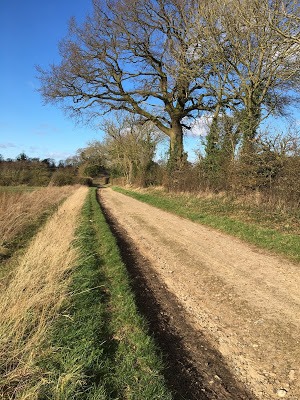
I walk steadily up the slight incline, my boots thumping rhythmically on the hard soil. Nearly two millennia past, Roman troops were doing the same: the track follows the line of a Roman road. It’s likely older than that; bronze age barrows lie to either side, on the high ground above the river valley below, and it ends very close to the place the wooden circle of uprights known as Seahenge was uncovered.
Within a few miles of my temporary, inherited house are three ringed enclosures (hillforts, as they’re generally known, whether or not they’re on a hill) that date to Iceni times. One corresponds with Tacitus’s description of the Iceni defensive structures during Boudicca’s rebellion. The line of another Roman road which approaches that hillfort lies to its south, perhaps a response to the Iceni uprising, perhaps part of the Saxon Shore defenses.
The Romans stayed another four hundred years, before Rome’s wars and finances made them withdraw. More invaders – or migrants – arrived from the continent, the people we call Saxon and Angles. They built in wood, not stone, except for the round towers of a few churches, leaving their mark in place names, a few roads, and moot hills. The Vikings arrived in the 800s and were ousted – at least in rule – in the 900s. The settlers stayed, though, and both archaeological finds and place names attest to this. And then it’s 1066 and William of Normandy winning at Hastings, and the rulers – not just the king, but the landholders and princes of the church – change again.
After that, sheep bring wool-wealth to Norfolk, huge churches in every village, and a Hanseatic port at King’s Lynn. The plague arrives, some medieval villages disappear, and the population plummets. In the 17th century agricultural improvement – fen drainage and sea-wall construction, then the work of ‘Turnip’ Townsend and Coke of Norfolk in crop rotation and soil improvement – slowly move Norfolk from grazing to crop production. The Enclosure Act changes who has access to land, and where. Hedges are planted. More medieval villages disappear, because major landowners move them off their deer parks. New roads are built, others disappear, to become bridleways and footpaths.
Because of all this, and my family’s long connection (on one side) with west Norfolk, I love this place. I could claim it’s in my DNA, which reflects the series of migration – violent and peaceful – that I’ve encapsulated here, but the scientist I once was raises an eyebrow at that statement. It is, I think, more about stories: my grandmother’s, my father’s, the cousin who made me her executor and beneficiary. Environment, too: I was brought up in a house where history mattered.
I’ve been here eight weeks; I’ll be here just about another two. It’s not the first long stay – we wintered here after retirement until the pandemic, January to March of every year, trading Ontario’s snow and ice and cold for the relative warmth and good walking of west Norfolk. But it’s the first time I’ve been here alone, my husband staying, for good reasons, in Canada.
I find myself like my character Sorley, torn between who he loves and where he loves. Because part of me wants to stay. This land and its long history is the wellspring of my creativity, the source of my invented lands and their histories and the details of worldbuilding readers love. I lay my fiction lightly on this place, seeing it reflected all around me.
But in Canada are the people I love: my husband, my extended family, my friends. And, a city I love in a different way, for its cafes and bookshop and trails for bike and foot; for its university and the two rivers and the farmers’ market, and for the writing community I’m part of. So in 12 days, I will go home, both gladly and sadly.
The question of what and where home is echoes through my books, one of the themes of the series. In the work-finally-in-progress, Empire’s Passing, it will be a key question for my MC Lena. “I had always turned for home. But where is home for the tamed falcon, when there is no falconer to hold out his arm?” Some of the intricacies of that question – and its answer – will be shaped by my own divided heart.

 marianlthorpe.com
You must be logged in to post a comment.