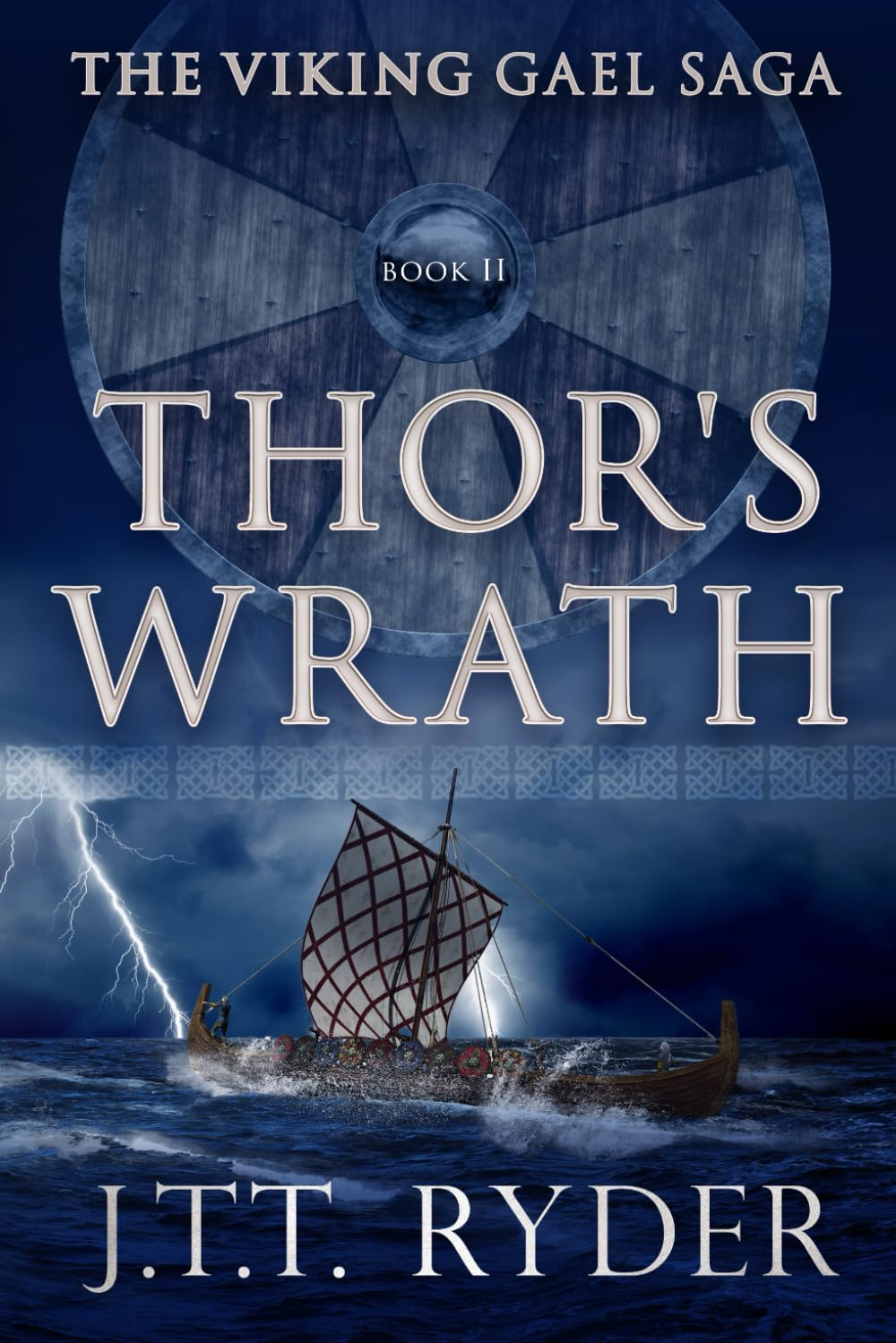
When we left Asgeir in book 1, he had saved his life (and his cat) but lost his honour. Now, as Harold Finehair works to unite Norway, Asgeir lands in the Orkneys, into conflict and battle: a chance for Asgeir to overcome his shame and redeem himself in his eyes and his gods.
J.T.T. Ryder continues to draw on his extensive knowledge of the history and archaeology of the setting – both time and place – in recreating a 9th century north-western European world. While Asgeir (and his compatriots) worldview is not ours, it is convincing: enmity and friendship flipping back and forth; the importance of personal honour; the role of single combat over warfare. This is a world of foresight, of visits from gods, of visions and portents–all are real, all are to be taken seriously.
The story moves quickly; the reader and Asgeir together are given little respite as threats are overcome, peace is agreed, only for another threat or a betrayal to begin the action again. Ryder’s writing is sometimes lyrical, especially in his place-based descriptions: ‘A whirlwind of puffins blackened the sky over the rocky, chilly islet… Mist shrouded the horizon like unspun wool, and the wind bit as remorseless as a fox…” In other places it echoes the alliteration of the sagas: ‘shocked him with sleet sideways.’ Even the occasional unusual word choice adds to the story, creating a sense of a world different from ours, refracted through time and distance.
The story is perhaps Ryder’s best, the complexity of Asgeir’s choices and of his thinking deepening as the youth matures into manhood. The telling is excellent. The editing, I am sorry to say, is less so.
(I dislike on-screen reading, so whenever possible I buy the paperback, so these comments pertain to the first paperback edition published in 2023.) I am tolerant of a certain number of typographical errors: they appear in even the best edited books, traditionally published or independent. But repeated sentences, repeated scenes, should not. Nor should a leg of lamb in one paragraph become a leg of pork in another. These errors spoke of a rushed production, an incomplete editing process, and one, inevitably, that jolts the reader out of the story. A second, corrected edition* is strongly suggested.
But! Thor’s Wrath is still well worth reading, and I look forward to the next book in Asgeir’s saga. (And yes, the cat is still Asgeir’s companion at the end of this installment.)
*Update: correspondence with the author assures me these errors have been or are in the process of being corrected.
 marianlthorpe.com