Writing in a Time of Uncertainty

Like many of us (all if us?) I’m having trouble concentrating right now. There’s nothing surprising in this: our world has been turned upside down; many of the things we took for granted are on hiatus; some of us are losing jobs; some of us are losing family or friends. We’re frightened and confused.

What I’m going to talk about in this blog post is what worked for me in a similar situation before. It won’t work for everyone, so let me say that right at the beginning. I have no experience in dealing with the added stresses of having kids at home, or not being able to pay the bills. I’m not pretending these ideas will work for everyone – I’m not even sure they’ll work for me this time. But for what it’s worth, these were (and are) my coping mechanisms.

Six years ago I was diagnosed with a stage 3, high grade cancer. A terrifying diagnosis, and a shattered world. I had a 50% chance of survival. But: in the first year of treatment  – major surgery, chemo, and radiation – I retrieved my first book from its bankrupt publishers, got it out to the world, began the second book.  How?

  1. Accept that your mind is not working at its full capacity. Don’t expect it to,  but help it out. In my case, and to this day, this means starting each day with a set of goals. Not just for writing, I will add, but with all the things I both want to do, and need to do. (In that first year of anxiety and chemo brain, it included things like ‘shower’ and ‘get dressed’.)
  2. Be gentle with your writing goals. Don’t overschedule. Give yourself time to relax, too, however you can: watch half an hour of tv; play a video game; read, draw, bake, play music – and schedule that in as often as you need it. Schedule exercise too; outdoors if you can, indoors if you can’t. Even if you only write for half-an-hour a day, you’re still writing.
  3. Accept that things will take longer, and you will find yourself scattered and losing your train of thought. This is normal. Don’t beat yourself up over it.
  4. Accept you may not produce your best work. (Or maybe you will, through channeling your emotions into your writing.)
  5. Consider exploring other forms of writing: poetry, creative non-fiction, short stories: the challenge distracts the mind. I wrote a creative non-fiction blog for about two years, which was really about finding gratitude in little things, like baking bread. I may go back to it. It helped ground me, and everything we write hones our craft.
  6. Share. That was partly what my creative non-fiction blog was about, too. Talk about your writing to someone who cares, if you can; it solidifies it as important, and helps you with perspective.

I lived with uncertainty for the five years for ‘official’ survival, and I continue to live with uncertainty, because cancer could well still be lurking somewhere in my cells, waiting. I am at a higher risk with COVID-19 because of my medical history and my age. But as my character Casyn tells the young Lena in the first book of my series: “We cannot shape the circumstances to fit our lives, only our lives to fit the circumstances. What defines us, as men and women, is how we respond to those circumstances.” There’s no one right response, but for me, it is taking control of those factors in my life I can, but being gentle with my expectations of myself, both as a writer and a human being. We’re all in this together. Hang in there.

Empire’s Exile by Marian L Thorpe – Lena’s story of a long and challenging journey

When your book and its reader are meant for each other.

joulesbarham's avatarNorthern Reader

A tremendous final book in a stunning trilogy, this is a gripping and sometimes moving book in which a young woman has to find a new way of surviving. Following on from “Empire’s Daughter” and “Empire’s Hostage” this book goes seriously beyond an Empire with a strong resemblance to the Roman Empire into vastly new territory. These books present an alternative history which is nevertheless impeccable in its research and holds together brilliantly; it is a consistent tale in both its setting and characters. Lena has changed much over the preceding two books, from an older girl who loved and lost her partner Maya over the need to defend their women’s village from a seaboard attack. Not only did she learn to become an effective warrior in defence of her home village over a period of some days, but also she began to learn and appreciate the problems and possibilities…

View original post 450 more words

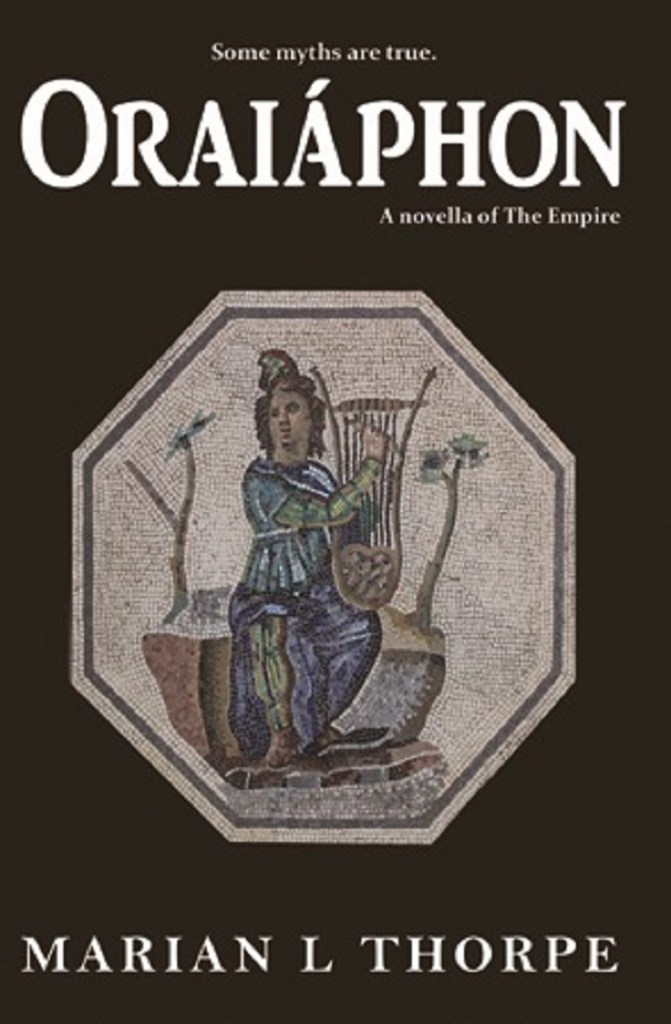
Oraiáphon: A Novella of The Empire by Marian L. Thorpe

A lovely review of Oraiáphon from Liis Scanlon’s blog. Thanks so much, Liis!

Liis's avatarCover to Cover

SourceFormatPagesPublisherGenrePublication Date
Authorebook165Arboretum PressHistorical FantasyFebruary 29th, 2020

You may have noticed I failed to include the blurb for the novella – that was on purpose due to potential spoilers as this novella follows what is one of my favorite trilogies out there: Empire’s Legacy!

Now, there is a small chance that you have missed out on reading my reviews for the trilogy. Fear not, and you are forgiven, here are the links again for your comfort 😉

Empire’s Daughter * Empire’s Hostage * Empire’s Exile

As a brief, this trilogy starts off with some serious girl power vibes, moves into the very intriguing political atmosphere and has complicated web of personal relationships throughout with some of the most epic and sweat inducing love stories (inc same sex love stories) I have ever come across. The most important vibe…

View original post 396 more words

Critique Partner, Life Partner: A Risky Proposition? #AuthorToolBoxBlogHop

When I tell other writers that my critique partner is also my life partner, reactions tend to fall into two categories: ‘how wonderful’, or, ‘OMG, that would split us up!’. It works well for us, but why?

Just so we’re all on the same page, here’s the definition of a critique partner that I’m using here: A critique partner is a fellow writer with whom you exchange critiques of your manuscripts.[1] In the marvellous article by K.M. Weiland that I borrowed this definition from, she goes on to list and discuss the qualities a writer should look for in choosing a critique partner. I’m not going to reiterate them – you can read the article! Instead, I’m going to look at what matters in the relationship between critique partners, and how we’ve developed these.

  1. Respect

Brian and I are both writers, in different stages of our profession. But our respect for each other’s abilities goes way beyond writing. We’ve been together for 42 years; we met in university. We both did advanced degrees in related subjects, and worked together on research, even co-authoring research articles. My expertise there was more technical; his was more theoretical. We complemented each other. Our next careers, both in education, were again different but complementary. Finally, we share a major hobby: birding. Again, we know our skills support each other. Seeing a bird in flight, I can identify bird families easily; given that, he can narrow down species faster than I can, usually.

Important in this was watching each other (and helping each other) learn, as scientists and teachers and birders. We have confidence in each other’s ability to grow in a field, to take theoretical knowledge and translate it to action. So as we learn and develop as writers, together and separately, we strengthen each other’s writing. For example, he’s a much better plotter than I am, and quick to point out where my plot is weak or inconsistent. I’m a better stylist, hearing the cadence and flow of words better than he can.

Respect for differing skills is an advantage I’ve heard from other writers, too. At Maple Mystery Games, co-creators Jan and her husband John work together. John is best at plot twists, while she is the detail person. “I tend to brainstorm ideas with hubby at the start of writing a murder mystery game and also when I first work on creating characters. His brain works in a different way to mine,” Jan said.

  • Trust

We’re not competing. I write adult alternate-world historical fiction, character-driven books focused on personal choices in difficult times. He writes plot-driven young adult fantasy. But we are both committed to helping each other write the best books we can, and we know how to separate the building blocks of craft from the emotional attachment to the stories we are writing.

An advantage of your life partner as your critique partner is that in the middle of brushing your teeth you can say to them, ‘Do you think Character A would react in this way?’ (While our books aren’t the only subject of conversation between us, it does sometimes sound that way.) We know each other’s world and characters very, very well, but without the same degree of emotional attachment. So when Brian told me a while back that in my latest book (where the previous MC is now a supporting character) that he didn’t like how I was portraying her, I knew he had a valid point. When I told him I thought a supporting character in his series needed a larger role (and why) he agreed, after consideration.

This advantage can also be a disadvantage. Sometimes we’ve had enough of each other’s world and characters, especially if we’re working on a tough plot point, or an external worry or commitment has to take priority – or we just want to shut up and watch television. Trust here means knowing the other one will get back to that question, just not right now.

  • Communication

This is not always easy!  I am the world’s worst verbal communicator, especially off-the-cuff, and on top of that, much of what I know about writing – especially style – is instinctive. Often, I don’t know how to explain my suggestions. Add to that my tendency to pick up terms and jargon quickly, and my explanations to Brian are often sources of frustration. He is much more precise. We can both be very blunt.

But we listen to each other, even when the instinctive reaction is ‘no’. Sometimes the first reaction is right, but most of the time the other person’s opinion needs serious consideration. Mostly we discuss the differing viewpoints, searching out the reasons behind the suggestions and critiques.

Is there a down side? Only, I think, that by the time the work-in-progress reaches the end of the first draft, we each know plot twists and reveals so well it’s hard to read with fresh eyes. But even then, Brian’s read-through of the latest version of Empire’s Reckoning, my WIP, resulted in thoughtful, appropriate and necessary criticisms, which I am in the process of addressing. Then it’ll be on to the beta-readers.

Oh, and yes, Brian critiqued this blog post, too.


[1] https://www.helpingwritersbecomeauthors.com/how-to-find-the-right-critique-partner/

Oraiáphon

Some myths are true

Orpheus with his lute made trees,

and the mountain tops that freeze,

bow themselves when he did sing:

To his music plants and flowers

ever sprung; as sun and showers t

here had made a lasting spring.

Every thing that heard him play,

even the billows of the sea,

hung their heads, and then lay by.

Shakespeare; Henry VIII

Without readers, where would writers be? We are storytellers, and while I like telling my characters’ stories to myself, I prefer telling them to other people. But some of those readers become highly invested in the characters, and want to know more.

The last book of the Empire’s Legacy trilogy ended on an ambiguous note, with an epilogue that makes things clearer (for most readers. Some truly didn’t get it, even then.) But between the end of the last chapter and the brief epilogue is a three-year gap, and some important things happened in that time. I might have just left them to the reader’s imagination, except three things happened.

One was that in beginning the next, related trilogy, I realized there were a couple of major backstory pieces that had to be explained, and two, quite a few of my readers begged to know what happened in those missing years. The third consideration was that I was switching narrators (I write in 1st person), and while readers knew my new MC as a supporting character from the first trilogy, I thought they needed an opportunity to get to know him a bit better.

So I wrote those loyal readers a story that I hope meets their wishes, explains the backstory, and moves the character Sorley from supporting actor to a leading role. It launches February 29th in all markets. Here are the links:

Amazon US

Amazon Canada

Amazon UK

Amazon AU

World-building through Historical Characters: Gnaius and Galen

“Exactly so,” Gnaius agreed. “May I say more? I have lived in many of Casil’s provinces over the years. A physician travels with the army, if he wishes to become a skilled surgeon.”

– from Oraiáphon: A Novella of the Empire, 2020.

In my Empire’s Legacy series and its sequels (both completed and planned), the supporting character Gnaius plays, and will play, an important role. Gnaius is a physician, erudite and highly skilled, who has held many positions with both the army and to the Empress of Casil. He is a product of my imagination, of course, but he is based on the historical physician Claudius Galenus, best known to the modern West as Galen.

Galen (public domain)

I want to talk about Galen not so much in terms of the historical person, but as an example of how, in my alternate-world historical fiction, I use history to inform my world without being bound by it. The city in my world, Casil, is physically based on 4th century Rome, but politically it’s a blend of Rome and Byzantium. However, many of the conflicts that occur are from later in Europe’s history, between about 600 and 1000.

Galen lived in the 2nd century of the common era, at the same time as the emperor Marcus Aurelius, who appears as a figure from the past in my series (under a different name, of course). But this doesn’t matter: I’m not writing history. What matters is that Galen did almost everything I wanted Gnaius to have done: travelled extensively, learned about surgery and wound treatment in the field, practiced medicine in the capital city and became the personal physician to Emperors. So I have, effectively, lifted Galen out of the 2nd century and inserted him into my world at a later date.

There are both pros and cons to doing this. Readers will fall roughly into three categories: those who know nothing about early-medieval medicine, and will assume I’ve made Gnaius up entirely; those who have some knowledge of Galen, may well recognize consciously or unconsciously that Gnaius seems familiar, or right for the times; and those who know a fair bit about the subject, and may object to him being dragged forward several centuries.

My goal throughout the series has been to create a world that feels familiar to a reader brought up on the history of Britain and northern Europe, but has enough dissonance to make readers think about the questions raised by the conflicts with which the characters must deal, both personal and political. The real-life Galen fits neatly into the world, he’s just in the wrong century. (Certain readers may throw the book across the room in disgust at recognizing Gnaius as more-or-less Galen, although if they are that wedded to historical accuracy, they’ve probably given up on the series long before Gnaius makes his appearance 2/3 of the way through the third book.)

By some combination of serendipity and synchronicity, I learned in my research trip to Rome last week that Galen had lectured extensively at The Temple of Peace in the Forum, and indeed had stored his writings there for safekeeping. This plays right into the plot outline for the book (#5) I was there to research…and then I learned a fire at the Temple destroyed a fair number of those works. I’d already considered a fire in that general location as a plot device; now I have a historical occurrence to build around. The fire is not just plausible, it happened, and the destruction of some of Galen/Gnaius’s writings may well feed part of the plot of book #6, which is now little more than a concept.

The Temple of Peace in 1749 (public domain)

Gnaius is a minor character, although an important one. But by using Galen’s life as the basis for his, the verisimilitude of setting, character and plot is strengthened. Reviewers frequently comment on the depth and quality of world-building in my books: this is one way I do it. What are your methods for creating believable worlds?

The Travelling Writer Part 2: The Research Trip #AuthorToolboxBlogHop

In the summer of 2019, with my work-in-progress, Empire’s Reckoning, well on its way to completion, and the outline of the book after that, Empire’s Heir, forming in my mind, I realized a trip to Rome would be useful.  I write alternate-world historical fiction, the world in question an analogue of Europe after the (apparent) fall of Rome, but with real differences in culture, geography and history. The capital city of the Eastern Empire in my series, Casil, is a cross between Rome and Byzantium:  Rome in geography, but politically a blend.

In a previous book in the series, I’d used the marvelous Rome Reborn videos to structure my city, so it is, effectively, 4th C Rome. But only about a quarter of Empire’s Exile takes place in Casil; probably 2/3 of Empire’s Heir will. And the buildings and public areas will play an important role. I wanted to go there, to look at the ruins, understand their relationship to each other better, imagine myself there.

We divide our time between Canada and England, spending our winters in the UK county of Norfolk. A quick trip to Rome is easy: Norwich Airport is 45 minutes away: hop to Amsterdam on KLM and then on to Rome. So I booked a trip, and a guide, and now I’m sitting in the airport waiting for my flight to be called and thinking – and blogging – about how to prepare for a research trip. Especially since life and other work got in the way, the WIP isn’t done, and the book I’m preparing for hasn’t had the thought and outlining I’d hoped it would at this point. It would be very easy to be overwhelmed by what there is to see in Rome.

This isn’t my first research trip – I dragged my long-suffering husband to Hadrian’s Wall in March a few years ago, and we’re headed to northern Scotland in April – but it’s definitely the most intense. Here’s my experiential advice for using your time well.

  • Develop a plot.  This sounds obvious, I know. Just a vague idea isn’t going to work in this case. Without spoilers, I know that my MC will be moving between a palace and a forum, down a certain set of stairs, and that the temples that were extant in the forum in the 4th C will be important. I know that the view from the palace matters, as do sightlines and distances…the actual, physical realities of moving around the city. Travel will matter quite a bit. Knowing all this means I can focus on those particular factors – and, to be practical – buy the right tickets to the right sites.  
  • Do preparatory research.  The Forum, for example, is a big area. Not all the buildings were there in the 4th C. What was? What was the building’s role then – if it was built in the 1st C as a temple, was it still used that way?  What stood where the 7th C building is now?  What do we know about what a building – exterior and interior – looked like in the 4th C?  What role did buildings and public areas play in the 4th C city?
  • Know what questions to ask. This is an extension of #2, but also, if you’re using a guide – either private or group – ask whatever comes into your mind. They may well know, or know where to send you to find out.
  • Take photos, if you need to.  I probably won’t take many. I have a very visual memory – but certain details, and certain views, will need recording. Write notes as you go. Use voice recording on your phone, if that works for you. Don’t trust your memory, especially on an intense, busy trip.
  • Be open to new ideas, new locations – if something really catches your eye, maybe you want to include it. The one-time farmhouse that houses the Vindolanda museum just south of Hadrian’s Wall became the model for a school in my books, although I hadn’t intended that at all when I visited.
  • Know how to follow up. After this trip, I’ll be going back to the Rome Reborn videos, and to a FutureLearn course I signed up for, which also focuses on virtual reconstruction of Rome.
  • Pace yourself, both mentally and physically. I’m nearly 62. I don’t have the energy I did at 25, or 40. But not only am I planning half-day tours for my physical stamina, but also for my mental focus. I need time not only to absorb what I’ve seen, but to write my impressions and my thoughts, and notes about what I need to do further research on, and what I’ve seen that might change my plot. Otherwise, it will all become a blur of sights and sounds and sore feet.

(And anyhow, there should be time to just sit at a sidewalk café, and watch the world go by, shouldn’t there?)

What are your tips for a successful research trip?

Five Years an Author

Five years ago this month, Empire’s Daughter was published, the first book of my Empire’s Legacy trilogy. (Not that I knew, at that point, it was the first of a trilogy. I’d written it as a stand-alone.) I was 56.

I’d wanted to be a writer all my life, and I’d written all my life. And, to be fair, I was a writer, just not of fiction. In my first career, I wrote scientific papers for peer-reviewed journals, and procedural manuals, and monographs and chapters in highly technical books. Then I moved away from research and into education, and I wrote curriculum for the entire province, and a textbook, and many presentations and more technical manuals. Oh, and grant applications, in both careers: I was very good at grant applications.

All the writing I did in my previous two careers was very structured; there were protocols to follow. In scientific writing, precision of language was required: the exact scientific or technical term had to be used and the explanations needed to be accurate, unembellished, and follow a logical, clear, order. In writing grant applications, all those restrictions still applied, but I also needed to know what the ‘buzz’ words were, the terms that met the priorities of the granting agencies. Those terms had to be included in a natural way, not forced into the wording of the application.

In my career in education, I had to write for different audiences. A middle grade textbook uses different language than a guide to assistive technology for parents. A curriculum written for high school teachers, following the template provided by the province, is different again. I learned to match my word choice and sentence structure and the layout of the project to the audience.

Very importantly, none of this was done alone. I might be – and often was – responsible for the actual writing, but the final product had always gone through peer review, editing, rewriting, more review….and from that I learned the value of other eyes and minds, and how to take feedback (leave your ego at the door) and how to throw out something I loved.

So by the time I’d written Empire’s Daughter, and decided it was worth sending out to the world, I’d already learned a lot of the lessons a writer of fiction needs. (I’d written two previous novels during this time, too. They’ll never be published: they were practice in the craft.) I’d learned about structure and tailoring language to an audience. I’d learned ways to describe concisely and accurately. I’d learned about embedding concepts seamlessly into narrative. And most importantly, I’d learned about listening to those within my field charged with improving the work, and how even a competent and confident writer needs an editor.

The editors I worked with at the small, now-defunct press that first accepted Empire’s Daughter for publication taught me more about writing fiction, but much of what I learned was an extension of what I already knew about writing. I have four books behind me now, and I continue to learn: I hope I always will. But I don’t regret the years I spent in my other careers, the years spent absorbing and practicing how to use words to convey a message precisely, concisely, and with impact. They helped make me the writer I am now. Something else did, too, but I’ll leave that for another day.

The Travelling Writer

When both writing and travel are important, how do you balance the two?  I’m on the road far too often to not write while travelling, or I’d never get my books finished. Over the years they’ve been written at picnic tables in campsites and parks all over North America; in cafes across the world; in planes and trains and ships; and in tents in Mongolia and cottages in England.

There are three major considerations to writing while travelling: teaching yourself to write anywhere; keeping your work safe, and managing the technology. I didn’t used to be able to write unless I had complete privacy. Some of that was the beginner writer’s desire for secrecy, the reluctance to reveal to the world what I was doing. As I became more confident, and as I had deadlines to meet, that reluctance dissolved. The deeper I am into a story, the easier it is for me to write absolutely anywhere.

If noise distracts you, consider earplugs or listening to music. Or start with planning, writing character sketches, descriptions: background information you’ll need, if you can’t get into your story in a public place. I do better with dialogue; often I’ll fill in the description and actions afterwards, but I can almost always ‘hear’ the discussion between my characters, wherever I am.

Several years ago, just before a 9-week, 4-country, 27-flights trip, I bought a tiny laptop: not a netbook, because I am almost always places without internet. It fits neatly into my backpack, cost me $300 Canadian, and it has SD-card storage, as well as USB. Several points here: if I lose the laptop, or it’s stolen, or broken, it was cheap. Secondly, the removable storage was important. My work is not on the hard drive. It’s saved to the SD card, and to a flash drive, and those two things are kept (separately) on my body with my passport and wallet. Plus, I back up to cloud storage whenever and wherever possible, so my work is as secure as I can make it. It’s easy to get sloppy about doing this, but so far I’ve maintained the discipline…and when my laptop stopped working in Fiji (it didn’t like the 100% humidity) I could relax, knowing I wasn’t losing work. (It began working again back in drier, air-conditioned Canada, and has kept on working ever since.)

Managing the technology is again mostly a matter of discipline. Charge the laptop whenever you can: this means ensuring you have adaptor plugs. Carry a spare charge cord – unlike iPhone charge cords, which I’ve been able to buy everywhere in the world except Antarctica, it’s not easy to get a replacement laptop cord. Because my husband and I have identical laptops, we always have two charging cords. If access to electricity is rare, run your laptop on airplane mode, with the Wifi search off too – it will save power. Dim your screen. Turn it OFF, not to sleep. And of course, carry notebooks and pens or pencils. Writing doesn’t require a laptop – I just prefer it.

Finally, don’t leave your laptop at security after it’s been x-rayed. That may sound self-evident – but for all my experience, I’ve done it twice, in busy airports where security was busy and crowded. Luckily both times we were called back! 

What are your tips for writing when traveling? Please share!

72 and Counting

by Nikki Everts

A few random thoughts about how I came to be publishing my first novel at age 72.

I have always written – mostly for myself in journals where I bemoan my fate, rant against those closest to me and try to sort out the confusion of my life. These journals are confined to a dusty box and while I dread the thought of my children reading them when I’m dead, I cannot yet bring myself to throw them away. They are embarrassingly dull and depict a person going round and round the same mulberry bush of problems year after year. However, writing down my thoughts and feelings when I knew no one would be watching gave me a fluidity and freedom in writing that has been very helpful. So when the real authors advise us newbies to just keep writing, they are on to something.

I’d still be writing only for myself if it weren’t for writers’ groups, gatherings and workshops. The first one I dared to participate in was led by an off the wall, erudite bibliophile named Gord Jones who made me believe that my writing was worthy of being read by others. That gift of confidence gave me the impetus to actually write one of the two stories I’d been playing around with. A novel writing course offered at a local college was my next step. The teacher insisted at our first meeting that we break into groups based on genre. Naturally, I panicked – I had to choose between my two darlings: mystery or sci-fi? I simply could not decide. Then a woman burst into the classroom late. I immediately liked her and she sat down beside me. She had no qualms about choosing a genre – mystery it was. And there you are; my decision was made. There were three mystery writers and we persisted meeting together long after the course was over. Those monthly meetings motivated me to keep writing chapter after chapter, if only to have something to read to the group. Although I enjoy the process of writing I am not disciplined and need extrinsic motivation. So, know yourself and put in place whatever you need to keep walking, running, crawling or limping towards your writing goal.

I’d imagined the life of a writer in an ivory tower sort of way. Perhaps this works for some, but the encouragement, feedback and contributions of others have made my writing much better than it ever could’ve been had I gone it alone. The novel I just published with Arboretum Press, Evidence of Uncertain Origin, began thirty years ago when, for reasons I do not remember, I daydreamed a vivid scene that became the climax of the story. I spent a very long time figuring out who the people were in the scene and how they got there and what happened to them afterwards. The story shifted and morphed as I shared it with others and became a better story than the one I started with. I know it is terrifying to share your writing with others – it is a tender shoot of your very own tender soul – but taking the risk really is worth it.

Stay true to your story. Don’t take short cuts or try to be clever. Don’t fall in love with your own words. Integrity makes or breaks a story. If a sub plot or character or those well-crafted words do not harmonize with the whole, be ruthless and kill them off. You know the ones I mean.

I’m not sure I could’ve completed a novel any earlier in my life than I have now. I truly do believe that it is never too late to find out what you love to do and do it. So go for it!

Graduating in in 1969 from the University of California, Berkeley, Nikki travelled for several months, arriving in Montréal in April, 1970 where she lived until 1992. Nikki came of age in California during the sixties and held a sympathetic view of the Front de libération du Québec until the October Crisis. The events leading up to the FLQ’s kidnapping and murder of Pierre Laporte, the beauty of Montréal and the complexity of Québec politics inspired the setting and backdrop of Evidence of Uncertain Origin, Nikki’s first mystery novel.

Nikki lives and writes in Guelph, Ontario. She has self-published a book of poetry, connect dis connect with the help of Vocamus Press and developed writing workshops under the auspices of her small business, Scripted Images. She is working on a second mystery novel.

Purchase links for Amazon, Barnes and Noble, and other sources here.