Of Bere and Beer

I demand historical accuracy of my alternate-Europe: its geography, social constructs, and history may differ somewhat from the real world, but the background is as correct as my research allows. (And my interpretation of that research, of course.) But this conversation between two characters in my fifth book, Empire’s Reckoning, led me down a research path I hadn’t expected.

 “Should I put the meadows along the water to the plough, if I can find seed? They’ve been grazed, but we’ll not have sheep in numbers for a few years yet.”

“If those meadows are like the Ti’ach’s, they’re wet,” I said. “Better leave them to the sheep, and plough better drained land, if you can.”  He’d be late getting the barley in…

And then I stopped. This scene is taking place in early May, in a land that is an analogue of lowland Scotland, in more-or-less the 7th century.  Was this TOO late to plant barley?  Would it mature before winter came? (I have a graduate degree in crop science, and so I think about these sorts of things.)

I googled  ‘medieval Scotland planting date barley’…and discovered something I didn’t know. (Not terribly surprising, that, except that due to the aforementioned graduate degree in crop science, I actually do know a fair bit about the origins of cereal grains. And the professor who taught that bit was not only a Scot, but a whisky aficionado…which will become relevant.)

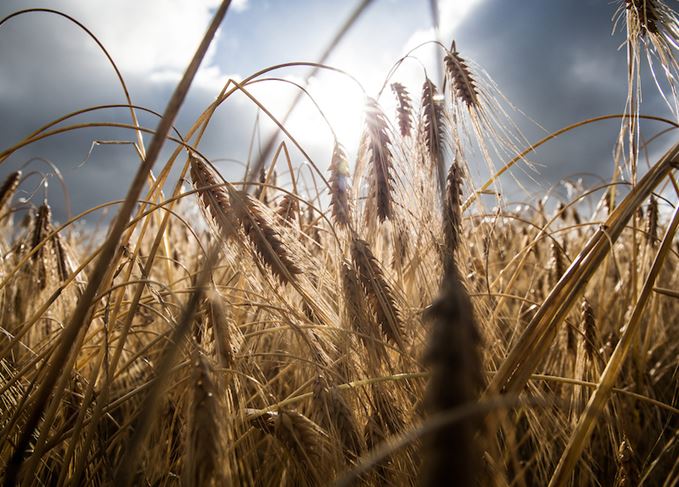
What I discovered was ‘bere’ (pronounced bear): a barley race introduced to northern Scotland by the Vikings in the 8th century or earlier (earlier was good). Peter Martin, director of the Agronomy Institute at Orkney College, part of the University of the Highlands and Islands (UHI), says, ‘Bere is probably the oldest cultivated barley, definitely in Britain and probably one of the oldest still in cultivation in Europe.’ Adapted to the climate and soils of the far north, it matures in 90 days. Plenty of time for my character to plant it in lowland Scotland in mid-May (or even June by the time he gets those fields under plough) and harvest it in late summer.

It’s also taller than modern varieties, which means it has an unfortunate tendency to lodge, or fall flat on the ground near to harvest in heavy rain or wind. I knew this about older barley varieties, so I’d already written this later scene, a different landholder and a different year than the earlier one.

In the long summer twilight, the clouds and rain now blown eastward, we walked up to the barley fields. Much of the grain lay flat. Roghan clicked his tongue. “Harder work for the men,” he said. At the greener field, he shook his head. “It will mould before it ripens. We’ll try to rake it, but likely I’ll turn the cattle out on it in the end.”

At the start of this century, there may have been less than 10 hectares of bere left in Scotland, grown only in small fields in the far northern and western islands. What has saved it is its unique flavour when used to brew beer or whisky. Small breweries and small distilleries produce short-run, expensive beverages with it, aimed at the increasing market for local-provenance food and drink. Barony Mill, a watermill on Orkney, produces flour (beremeal) from it as well. It’s a tough grain, difficult for modern machinery to handle — and would likely have ground down the teeth of people who ate it regularly (that and the flakes of stone from the grinding).

I’m visiting Orkney  in April, too early to see bere growing. I’ll look for the whisky, if it doesn’t break the bank. Well, maybe one glass, somewhere on that northern island, in honour of my constructed world and the real one it’s based on.

(Well, that visit didn’t happen, because COVID did. Still hoping to get there someday!)

Two Men and Two Bears: by BD Rennie

BD Rennie is my husband, and he is currently in the last stages of writing a YA trilogy. Both his books and mine have an incident involving a bear, and our protagonists’ different ways of dealing with the bear have been the subject of a great deal of loving teasing over the last couple of years.

Today, he presented me with this story.

Two Men and Two Bears

The large, brown she-bear moved slowly through the bushy scrub, stopping to wait for its half-grown cub. The cub sniffed every leaf, fascinated with its new world. Birds sang overhead and squirrels chattered as they ran along branches.

From opposite sides of a slight rise, two men watched the bears, each unaware of the other. Kahj, an old Wooden Man from Klend, feared the animals might attack the two children he had committed himself to protect for the past thirteen years. Cillian, a diplomat from Linrathe, worried the bears might attack a woman from one of the fishing villages, a woman he secretly loved.

The two children and the woman stood on the same riverbank, hidden from each other by the bend in the river and the dense bushes. None were aware of the bears approaching them as they enjoyed the sunshine and the splashing water. The two men knew that the roar of the fast-moving river would mean any calls of warning would go unheard.

The men each set about preparing, in case the bears should attack. Kahj checked the fletching on his arrows, with their dull, wooden tips. As a Wooden Man he could not use iron. Cillian, facing no such limitations, sharpened the edge of his arrows’ iron tips. Both strung their bows, ensuring the sinew was flexible and subtle.

 Noises from the undergrowth told the men the bears were on the move towards the river. As the animals were between them and their loved ones, neither man felt they could run through the bushes to warn the woman or children. That action might just drive the bears closer to the river. Taking their bows in hand, they each notched an arrow and moved towards the bears.

Cillian of Linrathe thought about the books he had read dealing with hunting. He had never killed before, but he knew the theory of a kill shot. Kahj of Klend, an experienced hunter and great warrior, knew the key was to stay downwind so that the bears would have no idea someone stalked them.The bushes started shaking violently and both men realized that the bears were charging their loved ones. Kahj raced out into the open in time to see one bear run at the children. His first arrow hit the bear in the cheek, irritating it, but doing no real harm. The bear looked from the man to the children, unsure which to attack. Kahj’s second arrow hit the animal in the flank, and it abandoned the children. The man ran to the tree he had selected, quickly climbing out of reach. The bear snarled at Kahj and clawed at the tree, then moved away, frustrated.

Cillian saw the second bear break free from the bushes and run towards the river. Although it was moving away from the woman, he felt compelled to act. He had read that men did such things. As soon as the bear came into range, he released his arrow, taking the animal in the shoulder. The steel tip cut deep into its flesh. Confused and bleeding, the bear looked around in wide-eyed terror. Cillian, now confident he could make the kill, approached the wounded animal and sent his second arrow deep into its chest from only a few paces away. The bear collapsed with a cry. Cillian had protected his woman: he felt proud.

The she-bear, hearing the dying cry of her cub, ran at Cillian, taking him unawares from behind. Kahj heard the screams of the man as the bear mauled him, but he chose to ignore it. He likely deserved it, he thought. Walking their separate ways from the river, the children and the woman wondered who the idiot was who had managed to get himself eaten by a bear on such a beautiful day.

And now my rebuttal story:

Lena heard the deep scream from Cillian, but she kept walking, her heart pounding. She had to trust he had listened to her, although her instinct was to run to help. But they were not alone along this river, and the old man had moved like a hunter.

He had his belt knife, and one of her seccas, and he was agile and fast. And that scream had sounded like a threat, not a cry of pain. She circled around the hill, senses on alert. Everything she had learned when she had trained as an assassin was coming back. She dropped to her belly, crawling through the rough grass.

Another sound from below: definitely one of pain, but animal, not human, or so she hoped. She kept crawling forward. At the top of the rise, she lifted her head. Below her was the old man and the two children she had seen earlier. They had not reacted to Cillian’s scream, and there could be only one reason for that: the old man wanted him dead. Did he know she was with Cillian? Was she hunted, as well as a hunter?

She had one secca. Studying the group, she decided the boy and girl were perhaps thirteen: two of her assassin cohort had been no older, but they’d been trained. The man was old, his muscles ropy. A vēsturni, perhaps? The boy could be his apprentice, but who was the girl?

The trio were eating now, a cold meal. Lena lay still, watching. Behind her, she heard ragged breathing. With all the discipline she had learned as a guard on the Wall, she didn’t look around.

The hand that touched hers was bloody. “I hope that’s bear’s blood,” she whispered.

“Mostly,” Cillian murmured. “It raked my shoulder before I could kill it. A knife—mine, not yours—in its throat. What’s happening?”

“Nothing much. I would think they were just travelers, but from where? To where? And the old man didn’t try to help you, which makes me think he knew we were here, and wanted us—or you, at least—dead.”

Cillian gazed down on the small party. With his eyes on them, Lena turned to look at his back. His tunic was ripped, and the gashes beneath it oozed dark blood. “Gods, Cillian,” she said, “That must hurt.”

“Pain is to be ignored,” he murmured. His beloved philosopher, Lena thought in resignation. Why had she fallen in love with this annoying man? Maybe she’d fall out again, and then she’d be glad she had never told him.

“I’ll clean it up later,” she said, her mind wandering appreciatively to the feel of his muscles under her hands…She wrenched her attention back to the three people they were watching.

“We have two choices,” Cillian said. “We approach them, or we let them leave.”

Or we kill them, Lena thought, but she wasn’t going to voice that. Bears were one thing, but in the Empire, she was sure Cillian would have suffered the same fate as his uncle: castration, for not being able to kill. And that would be a pity, she mused. He’s far too good in bed.

“Perhaps,” Cillian said, “the old man is deaf. Perhaps he didn’t hear me scream at the bear. Watch the three of them. The children always face him when they speak, and they stay close.”

Lena watched. “You may be right,” she said. “And they just can’t be that important, can they? Just travelers, going from one village to another. Let’s leave them alone.”

“Stories that have barely crossed,” Cillian said. Oh, gods, Lena thought, don’t get started on philosophy again.

“Come,” she said. “Back to the river. Let’s get those wounds washed, and I’ll make some anash tea against any infection.”

Sitry looked up from where she sat, eating the last of the midday meal. “How strange,” she murmured.

“What, my child?” Kahj asked. “A vision?”

“No, not quite. An odd feeling….as if I had woken inside one of our lore books. A story come alive. But not one I remember – are there huge cities in any of these lands?”

“Not that I ever heard of,” he told her. “Just your imagination. Come, children. It’s time to move.”

Songbird: A Novel of the Tudor Court

A review with a guest blog from the author, Karen Heenan.

I absorbed my father’s love for Tudor history almost by osmosis, and it’s never left me, although the better-known aspects of Henry VIII’s six wives and his rift with the Roman Catholic Church were never the parts that interested me the most. Social history and the lives of people who were not courtiers or nobles, but still affected by the massive changes that Henry brought to England during his reign, are my area.

Karen Heenan’s Songbird caught my attention as soon as I heard about it, pre-publication. I knew about Henry’s love for music: he was reputed to be a skilled musician himself. I knew, vaguely, that he had court singers and minstrels, and with a little thought I would have related the name William Cornysh with Henry’s court, and I might have even known he had something to do with music.

This tale of Bess, a young girl sold to the King for her pure, lovely voice, and of her training to be part of the troupe of singers who entertained Henry and his court plunges the reader into the lives of a group of young men and women of the back corridors and rooms of the palaces. Like all royal servants, they had little control over their lives; they were subject to royal demands and whimsies: sing now; travel now; perform now, as they moved in and out of favour.

It would be easy to see them as pawns, unimportant, but Heenan crafts a rich and satisfying story around three lives, the girl Bess, the boy Tom, and the outsider Robin. The names expected in a Tudor court story are there, of course: Henry himself, Queen Katherine, Anne Boleyn, Cardinal Wolsey. But they are the minor characters.  Through Bess’s eyes, we see events unfolding that are familiar to any student of Tudor history, but we also see the intimate details of her own.

Heenan writes with confidence and style, vividly drawing the reader into the Tudor court. Each character in her story is fully real, even the enigmatic Robin, and as they mature over the course of the book, their personalities develop. They become much more complex, but in ways that seem fully consistent with the children the reader first meets.

Court intrigues and politics; the fear of almost-random death from disease or accident; the divisions of class and the restrictions of religion: all these form the background to a bittersweet love story that unfolds over the course of the story. Each colours Bess’s view of life. her expectations, and her determination to grasp as much control of her life as is possible for a young woman in her position.

I wanted to read this book in one long sitting, immersing myself in its beautifully drawn world both familiar and new. I didn’t: I rationed myself, to enjoy it longer. I await its planned sequel with impatience.

William Cornysh and the Alchemy of Fiction

by Karen Heenan

Songbird was inspired by a throwaway fact in a biography of Henry VIII: the music-obsessed King once purchased a child from his mother to sing in the chapel choir. That was all it took to send me down the rabbit hole of history.

Then, of course, it occurred to me that meant I would be writing a book about music. I knew next to nothing about Tudor-era music, its structure, or its instruments. Thankfully, my main character, Bess, was a singer, so I could start there and learn as I wrote.

I quickly encountered the King’s Music, the name used for the royal company of minstrels who entertained at court, both publicly and in private, and placed Bess among them.

On researching the Music, and the topic of Tudor music generally, it was impossible to miss William Cornysh, who, in addition to being a significant composer of music both religious and secular, was Master of the Children of the Chapel Royal, and also managed many of the musical and dramatic entertainments at court.

Those few facts were enough to start building the man, and then, with the strange alchemy that is fiction, when I learned more about him, those new facts fit the character I had created. Cornysh was talented, hard-working, and seemingly underappreciated, having only been rewarded with a grant of property shortly before his death in 1523. He was also a father figure to the choristers, many of whom were quite young. When the court was in London, the children often spent nights at Cornysh’s house with him and his wife, Jane, giving them a taste of normal life.

Much of my research for Songbird was done in the dark days of the pre-internet era, which on one hand meant I stumbled across interesting facts that I didn’t know I needed, but on the other meant I didn’t always find what I needed, except by the same happy accident.

As an example, the story had moved on from Bess’s early days with the Music, and Cornysh was mentioned only rarely. Then, while reading an online article totally unrelated to him, I saw a mention of his sudden death.

What to do? He wasn’t a major character at that point, and leaving him alive wouldn’t be egregious because history would not be changed in service to the story, but my sense of accuracy meant I could not suffer a man to live who had actually died.

Back I went to give him his end, and the story was actually stronger for his loss.

Songbird is available on Amazon

Steps to a Successful Book Launch

This past Sunday night, one of our indie press’s authors had her first book launch. This was only the second launch by the press, so we’re far from experts. But by almost all measures the launch was an overwhelming success.  I’m going to take a look at why.

What are our measures of success?

  • About 75 people attended.
  • We sold out all the paperbacks we’d ordered, and we sold another 17 in advance of the next shipment.
  • The other two authors who also read sold books too.
  • The musicians sold a bunch of CDs.
  • All the food was eaten and the bar did good business.
  • The buzz in the room told us people were having fun.

Book launches, unless you are a famous author, are primarily for the family and friends of the author to celebrate their success. It’s a little like a graduation. Judge the number of people who will come by that measure. Keeping that in mind, what can I share about a successful launch?

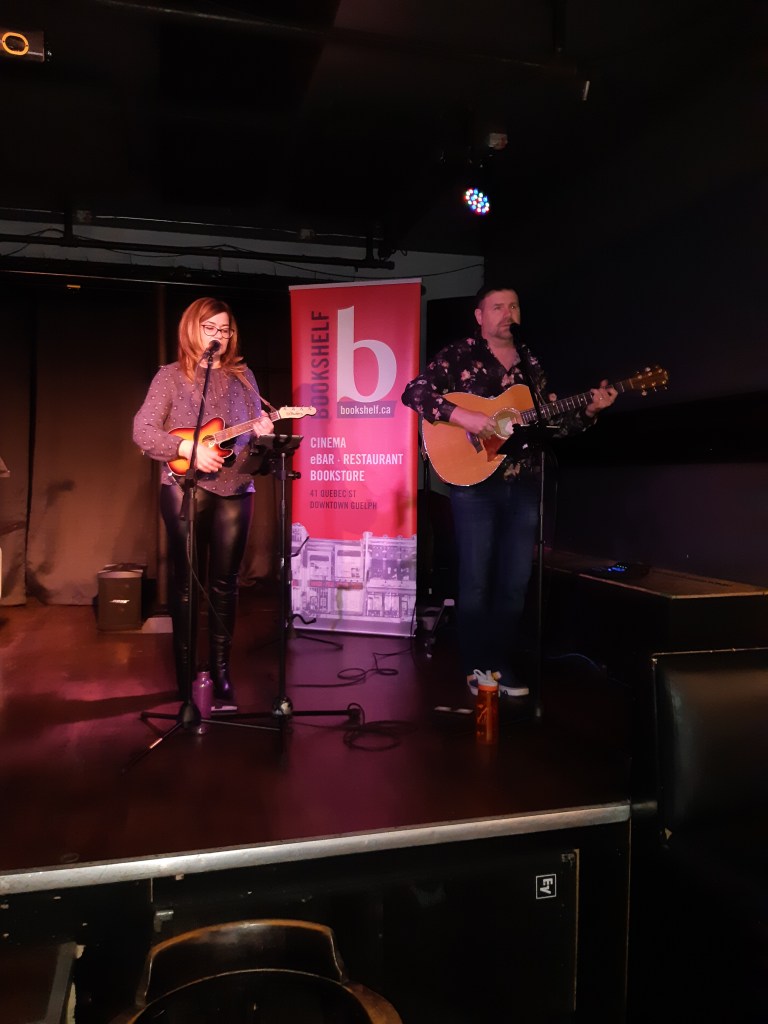
Location. We chose to go with the upstairs bar at our indie bookstore for several reasons. The space is frequently used for book launches: it has a stage, a sound system, and staff familiar with the entire process. By holding it there, it guaranteed free advertising on their website, and the book in their new releases section, and, the week of the launch, in their front window. There is a charge for the space, but for us the benefits were well-worth the cost.

Even though the space is downtown, on a Sunday night there is plenty of free parking, and it’s close to public transit, both serious considerations.

Day and Time: Because our author had friends and family coming from some distance, a weekend was ideal. Saturday night looks good at first glance, but there is competition for the space, for parking, for the musicians’ bookings. So we chose Sunday from seven to nine p.m: after dinner to not too late. Sunday afternoon worked well for another of our authors last winter, for most of the same reasons.

Format: The author’s book and her reading were the focus of the evening, but not the only entertainment. Two other authors with our press did very brief readings, and there were live musicians. Between the readings by the ‘warm-up act’ readers, and the author, the duo played two songs specific to the era and location in which her book is set, taking those of us old enough to remember (most of us) to Montreal in the late 60s.

Other readers help reduce the author’s anxiety, and it also encourages friends and family of those people to attend. Reading before the author means that any adjustments to the sound system or the lights that weren’t picked up in the sound check don’t fluster the author, and it settles the room.

We had an MC, a member of our press collective who is trained in drama and improv, but any outgoing person who can think on their feet can take this role. We also had a schedule, and she did a fine job of keeping us to it.

Book Sales: at the back of the room, with the author’s signing table well away from it to not block the flow of people. Once someone has the book in their hand, they’ll wait for the signing, whereas they may get impatient with waiting to both purchase and get the book signed. I suggest a tablecloth, stands to show off the books, clear pricing, plenty of small bills for change, a receipt book, bags for the few who want them, and, if possible, the ability to take credit and debit cards. We use the Square, and having it meant we sold a third more books than we would have otherwise. We’d also anticipated (too late) the possibility of selling out, so had created vouchers for people who wanted books but couldn’t get one.

Food and drink: We’d advertised hors d’oeuvres and a cash bar. The venue has a finger-food menu for these events, but it’s not necessary to feed people immediately after the dinner hour, if the budget doesn’t run to it.

What didn’t (on the surface) work?

We did a lot of (free) publicity for this event, through the events section of our local print and on-line papers, and through the indie bookstore that hosted the event in their upstairs bar. But nearly everyone who attended was a friend of the author, through work or community. On the surface, this looks like it wasn’t worth it. But looking at it more closely, that advertising means a lot of people in our town have seen an image of the book, and when they go into the bookstore and see it on the new-releases shelves, they’re a little more likely to pick it up. It’s familiar. (The bookstore has told me it’s selling.) So while this tactic didn’t bring in people on the night, it may have longer-term benefit.

A few other ideas: name tags for all the people helping out are useful. Make sure the MC points out washrooms, coat rooms, and any other ‘housekeeping’ type announcements. Tip the bar staff. Send thank you notes to everyone involved the next day.

And a ‘graduation’ present for the writer, especially if it’s a first book, is a nice touch. I suggest a bottle of Writer’s Tears Irish whiskey, personally.

And the book we were launching? Nikki Everts’ Evidence of Uncertain Origin, a mystery set in Montreal in the late 60’s, against the backdrop of FLQ violence. Published by Arboretum Press, it is most easily available in wide release from Amazon, in both paperback and ebook formats.

Trillium: an author interview with M.L. Holton

I recently reviewed M.L. Holton’s novel Trillium, a multi-generational saga set in Ontario’s fruit-growing Niagara Peninsula. I live less than an hour north of this area, and local history has always been an interest of mine. I thoroughly enjoyed the book (my full review is here), so I asked the author to talk a little bit more about the work.

Tell us about what inspired Trillium.

I had been thinking for awhile about how I wanted to focus on a rural environment rather than an urban one as per my last two novels, Economic Sex and The Gilded Beaver by Anonymous.

Small farming communities are tightly-bound social networks of multi-generational cross-breeding. They are, in the main, supportive and stable. In North America, they are rapidly becoming a thing of the past as the young move to the cities for better employment opportunities and generational farmers, with miniscule profit-margins, sell-out to larger agri-business concerns. The migration is undercutting the bedrock of our uniquely Canadian society.

I also wanted to explore and expand on the on-going controversy between ‘nature’ versus ‘nurture’. How do we become who we are?

Trillium spans a period of 250 years, from early settlement on the Niagara Peninsula to the early 2000. This timeframe gave me a much larger canvas to work.

❖ How has your life influenced your writing, specifically in this book?

There’s no question that I have pulled on my life experiences to craft this work.

I grew up on the fringe of a farming community in Halton County. We raised sheep and fowl on a small scale. As a child, I watched and learned from my enterprising father, (born and raised in the area), as he constantly interacted with the landscape and livestock on our property. Nature was omnipresent – dictating birth, life and death. Working outside with my brothers and my father was always fun and pleasurable. Wind in our hair, dirt up our fingernails. This quasi-bucolic country lifestyle was very far removed from the social lifestyle that my mother managed to create for our family. She was involved with various local charities, sport associations and social clubs ‘in the city’. That activity widened our community circle and life experiences. My father’s family business was involved with the early development of a yarn company in Hamilton during the 19th century. But, by the mid 1980s, this century-old family firm experienced an acute downturn as a result of cheaper South American and Asian imports. We all had to adjust.

As example, I was removed from a distanced private school of 600 students and started attending a nearby public high school of 3000 students. Rather than getting picked up by a bus, I walked to school. To a wide-eyed teen, the differences between the two learning institutions were acute. Coordinated school uniforms were replaced by the media-driven trends of ‘fashion’. Individual ‘popularity’ was valued more than team work or basic ‘competence’.

These kinds of juxtapositions caught my eye and ear and became a kind of foundation about my evolving observations about the ‘otherness’ of people. I seemed a perpetual ‘outsider’, and did not fully integrate into any group ‘clique’ after the transition.

I believe this ‘outsider’ status has served me well, long term.  It gives me not only an individualistic perception of ‘what’s going on’ but it provides a critical emotional distance to ‘assess’. I have always thought of myself as a ‘witness’ more than a participant. It is a good vantage point and strong starting point for any writer: distanced observation.

❖The cover is your own art work! Tell us about it.

I wanted a cover image that amplified the central idea of natural growth in the story. In this instance, the focus was on a regional grape vine. Initially, I started with a stark photo image but it was too hard. I then tried a stylized graphic but it was too ephemeral. I finally settled on a close-up detail from an oil painting I had done some years ago ~ of a man’s hand holding a grape cluster. To my mind, the image is perfect. It is a human hand connected to the growing land.

❖What do you hope readers will take from Trillium?

My intent was to write an entertaining as well as enlightening book about the evolving rural area around the southern end of Lake Ontario, in Canada.  

In order to do that, I crafted the bedlam and chaos of a ‘good story’, filled with emotional arcs and empathy etc,, but interwove the story around fascinating pieces of local history from the Greater Hamilton and Niagara area. The medley of colourful characters is also influenced by larger global events, like the rise of fascism in Europe during the 1930s and the two World Wars of the twentieth century. I wanted to make this fictional story ‘believable’ to the contemporary reader. As far as I know, no-one in the vicinity has attempted a similarly ambitious ‘grassroots’ construct.

I think my voice is rather unique in the telling. But, ultimately, readers must determine if that is true or not.

What is odd or quirky or engaging about your story or characters?


There’s plenty of quirk in this work, primarily because each character has an early failing or foible that manifests later. These insights drive the story forward so that there are ‘aha’ moments when a later incident clicks into place. It’s basic ‘cause & effect’ that amplifies the intimate causality of human interactions.

Character names were chosen to reflect the ethnic origins of their families and to help readers keep the large cast of characters clear in their minds. As example, Gregorio is clearly not part of the O’Sullivan clan …

One outstanding quirk was the development of the simpleton savant Anna. Illiterate and sheltered from the world by her protective Italian family, Anna, untethered from normal social conventions, has an uncanny knack with plants. She can grow anything. Her simplistic yet attuned capability irreversibly alters the course of her family’s evolution. To say more may ruin the story for some, so I’ll stop there except to say, readers do seem to resonate with her. She’s a peach, so to speak.

To whom would you recommend this book to? Are there any trigger warnings or age restrictions?

I would recommend this story to anyone who loves rambling family sagas, epic storytelling, and historical fiction that rides the vicissitudes of human logic and emotions. There’s a lot going on in this story: good, bad, ugly and even, at times, indifference as the narrative voice pulls back to ‘observe’.

As each generation matures into adulthood, Trillium could be seen as an adult ‘coming-of-age’ tale. As for warnings, there are three sex scenes that are rather graphic. Their violence is an integral part of the story, so that’s that.

Would Trillium translate well to the screen? If so, who should make it or star in it?

Ideally, I think this would make an engaging Canadian series ~ a timely cross between the British drama, ‘Peaky Blinders’ and the well-scripted American family drama, ‘Bloodline’, set in Florida.

Trillium would, of course, have to be 100% Canadian. Why? Because Canada is still very young on the world stage. We are in desperate need of these in-depth local stories to explain the unique evolution of our own particular civil society. Otherwise, we’ll continue to be swamped by better told English-speaking stories from elsewhere.

My dream team would be a co-production between Anglo-Canadian, Irish and Italian producers (to achieve maximum market share), with a well-rounded cast from each ethnic origin. The director, showrunners and crew would be Canadian. It could all be shot on location around the southern end of Lake Ontario – from hovels to mansions.

I have done a preliminary casting, just for fun. In the end though, that’s a pipedream for a writer. If the title was optioned by an established production company, all those casting and location decisions would be their responsibility. Yes, I am the originator of this story, but a team of seasoned scriptwriters would have to flush it out to make it truly noteworthy as well as globally marketable. The story is all there, for the right team.

What genre is Trillium? Is this your preferred genre to write in? What do you read?


I call this a hybrid historical fiction. As I explained above, I wrote a ‘good story’ around many current and timely issues.

In the past, I have written poetry, social history, journalism, and two other long-form fictional works. I love the nuances of languages and the endless possibilities that they offer to an open imagination.

My reading, as a human on the planet, has always been ferocious.


Tell us about your writing process.

For this title, I followed a strict regimen. From February to October of 2018, I did nothing but write, edit, re-craft and finalize the work. Literally, 10am to 6pm, 5 days a week. I took weekends off to recharge and took hourly lunches during the writing week to refresh myself.

It may interest your readers to know that I wrote a detailed outline for Trillium almost a decade ago. That outline smouldered in my writing box until I found the key to access the story. The key was ‘technology’.

Technology has transformed our lives over a very short period of time. I wanted to ‘document’ that evolution and could do that quite clearly within a historical context.

I stopped this story before the internet became ubiquitous.

LINKS – CA Amazon – https://amzn.to/2q0iEeL

US Amazon – https://www.amazon.com/Trillium-Margaret-Lindsay-Holton/dp/0992127289

The Book Fair

Saturday was our city’s yearly book fair. I’ve participated every year for the last four (except last year, when I was away) but this was the first time I was there as a representative of our press collective, responsible not just for my own books, but two other authors’ promotion as well.

We did a lot of research and brainstorming about what we needed to have. Table space was limited, so we went with a stand-alone banner, ordered from an on-line print shot for a reasonable price. I’d put the logo together already, so we didn’t have to design it.

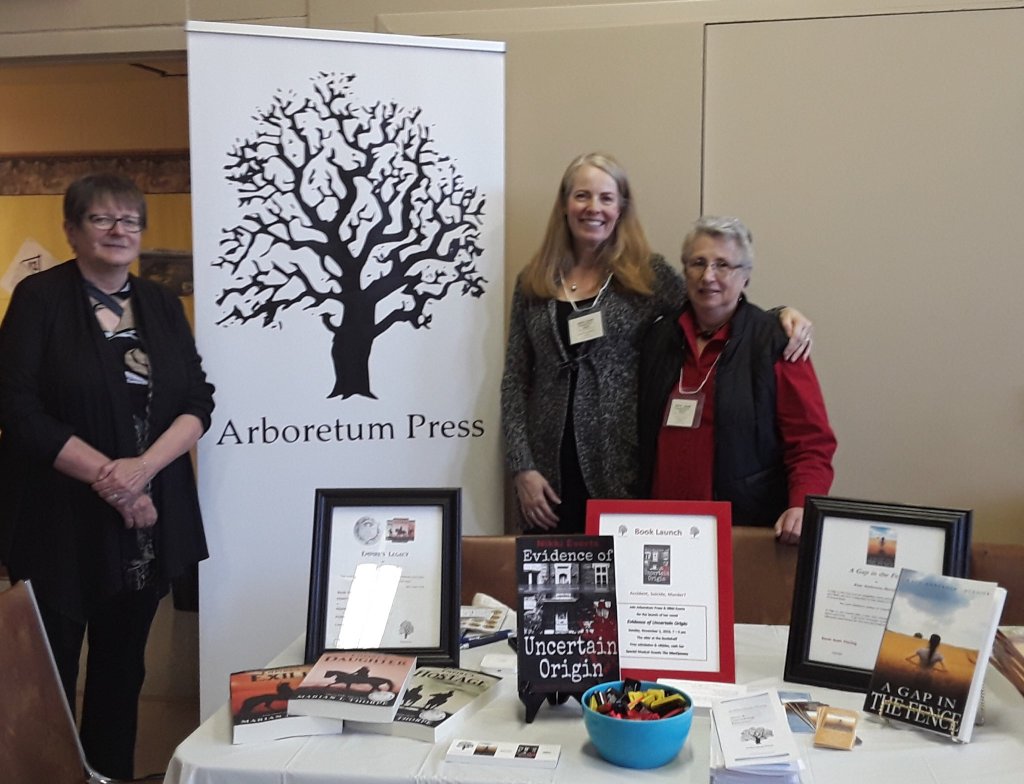
The banner, our table, and three authors.

Bookmarks with our current releases also seemed like a good idea – another online order – and brochures showing what’s available now and what’s available next year. So I made those, using MS Publisher, and printed them at our local print shop. Then we added a bowl of candies, posters advertising the launch of our newest release on November 3rd at our local indie bookstore and the prices of books – and hoped we’d got everything we needed.

As not everyone carries cash, we bought a Square reader, to take credit cards. Remarkably simple to use – and we needed it!  But also small bills – $5 and $10, to make change. A receipt book. Pens to sign books…..what are we forgetting?

OH!  Postcard-sized invitation cards for the book launch. Another MS Publisher production, printed at home.

A tablecloth! Arghhh…a last-minute dollar store purchase.

Books and the stand-up banner (in its case) go into a hockey bag, for easy movement. Everything else is in a tote box. I load up the car, and go to pick up one of the other authors. Her books should have been delivered for this fair, but print-on-demand turned out to be print-at-their-leisure, so we’ve been scrambling to promote the launch instead. She’ll bring a proof copy for people to look at, and vouchers for the book. The other author will meet us there.

Fast forward several hours. We’re tired, hoarse from talking, sore-footed from standing. But we’ve sold books in fair numbers, given out a lot of invitations to the book launch (we could have definitely sold several copies of this book, had they been there), and most of the bookmarks and brochures.

And, of course, several writers have wanted to know how our press collective works, and if they can join. So I explain they have to bring skills to the table, and it isn’t my decision alone. Some may pursue it; others won’t. Some just want advice and someone to talk to about their writing. I direct them to the man who runs the non-profit writers’ community in my town, and whose brainchild this book fair is. The support of Vocamus Writers’ Community has been instrumental in developing Arboretum Press, and supporting me and almost all the writers who are part of the collective.

And then I go home, unload the car, pour wine, and collapse onto the couch. To immediately begin thinking about next year. What could we have done better? Your thoughts, readers?  

Writing Battles

Author Tool Box Blog Hop

Battles do not occur frequently in my books, but when they do, they are pivotal scenes. I have no personal interest in warfare, in strategy and tactics or in battlefield recreations, or in the choreography of fighting. How then do I write the scenes?

I’ll use the final battle in Empire’s Exile, the third book of my Empire’s Legacy trilogy, as the focus of this discussion. Briefly, the battle is taking place between Viking-like invaders to a country with similarities with England. There is no magic, and both sides have relatively small numbers.

I begin as I do with all battle scenes: what needs to happen here?  Is there a particular topography or geographic feature I want to include? Is the weather important?  Is there a concept—betrayal, a specific act of heroism or selflessness, overwhelming odds—that must be included? Are particular weapons important?

Once I have those defined, Google and my long years of research into my particular time period become my friends. Quite simply, I go looking for a battle I can—not quite copy, but base mine upon.

What did I need for the battle in Exile?  Small numbers, as I’ve already said. Because I wanted to reference a battle described in Empire’s Hostage, Book II of the series, it needed to be on a river. A vague memory surfaced, something learned many long years earlier for the language it was written in, not the actual battle. A 10th Century poem…

I couldn’t remember more than that, but a quick search was all it took: The Battle of Maldon. I read the poem again, and as many interpretations of it I could find, both on-line and in my university library, but for ease of access, I’ll reference Wikipedia.  The italics indicate the parts I drew inspiration from.

The Vikings sailed up the Blackwater (then called the Panta), and Byrhtnoth called out his levy. The poem begins with him ordering his men to stand and to hold weapons. His troops, except for personal household guards, were local farmers and villagers of the Essex Fyrd militia. He ordered them to “send steed away and stride forwards”: they arrived on horses but fought on foot. The Vikings sailed up to a small island in the river. At low tide, the river leaves a land bridge from this island to the shore; the description seems to have matched the Northey Island causeway at that time. This would place the site of the battle about two miles southeast of Maldon. Olaf addressed the Saxons, promising to sail away if he was paid with gold and armour from the lord. Byrhtnoth replied, “We will pay you with spear tips and sword blades.”

With the ebb of the tide, Olaf’s forces began an assault across the small land bridge. Three Anglo-Saxon warriors… blocked the bridge, successfully engaging any Vikings who pressed forward. The Viking commander requested that Byrhtnoth allow his troops onto the shore for formal battle. Byrhtnoth let the enemy force cross to the mainland. Battle was joined, but an Englishman called Godrīc fled riding Byrhtnoth’s horse. Godrīc’s brothers Godwine and Godwīg followed him….Then many English fled, recognizing the horse and thinking that its rider was Byrhtnoth fleeing. The Vikings overcame the Saxons after losing many men, killing Byrhtnoth. After the battle Byrhtnoth’s body was found with its head missing, but his gold-hilted sword was still with his body.”

In Exile, the Emperor manipulates his enemy to fighting at a location based on the river and its islands and causeway, almost exactly as described in The Battle of Maldon. In a different source, I discovered that if the Viking ships had sailed into the mouth of the river at high tide, a sandbank at the mouth would prevent them from leaving until the next high tide, about 12 hours later. So I included that, too.

I put the confrontation between the two leaders into my battle, and Brythnoth’s words about ‘spear tips and sword blades’ are repeated by the Emperor. I used the blocking of the causeway. I used Godwin and the horse in a different way, a tactic by the enemy, but with similar results.  And at the end of the battle, the Emperor, like Brythnoth, is dead.

I wrote an outline of the scene, just the action. I drew pictures of what happened. Then I wrote the first version of it, through the eyes of my protagonist. I write in first-person, so the reader knows only what the protagonist knows, but also sees and hears and feels what she feels, including her interior thoughts. (Video comes in useful here, any good medieval battle scene, for the sounds and sights.) Smells need imagination —the metallic scent of blood; the pong of river mud, the stench of a disembowelled horse, the tang of sweat. Feelings—the horse underneath you, the sweat on your hands as grasp your weapon, wind in your face. Thoughts—fear, calculation, unnatural calmness, regret, anger, joy: however your protagonist would react.

Then I gave the scene to my critique partner, who does know a bit about battles and tactics, and he gave it back with a lot of suggestions, and after three rounds of that, I had my battle.  If you happen to be either a scholar of Old English poetry or 10th C English history, you might recognize its source. Its derivation adds verisimilitude to my fictional, analogue world, and it’s in keeping with how I do most of my world-building.

As for who wins…well, for that, you’ll have to read the book.

Follow the Author Tool Box Blog Hop for tips and thoughts on writing.

A Writer’s Life…or at least a morning.

Full-time? You’re a full-time writer?

Well, yes, I am – writer, editor, press coordinator –  but it’s not what you think. A thousand words per day, and time for leisurely lunches and long walks to get the creative juices flowing? Ha!

Most days I wake up at six, without an alarm or the cat encouraging me. I get up, yawn, wander into my study, wake up the computer, and sit down to do social media for an hour. The cat helps, or hinders; mostly she hinders, walking on the keyboard and blocking the external screen. I persuade her to settle on my left shoulder and type one-handed. I update and respond on Twitter and Facebook. I answer emails. I find news stories related to writing or to my historical period and add them to my feeds. I update Twitter again.

Then it’s coffee and breakfast. My husband and I may have exchanged a few words by now. Then I look at my very long to-do list, and my week’s priorities, and due dates and deadlines, and decide what I’m actually doing today. The collective press I coordinate has a book launch coming up in three weeks, and we’re attending a book fair in two. I’ve dealt with most of the immediate issues for both of those, and it’s too early to send out press releases about the book launch. Posters can wait until next week – more than two weeks’ notice, and they get lost in the huge number of events happening in our artsy town. But I still have to design those posters, so I can’t wait too long. I star that on my to-do list for Monday.

I have a semi-annual report to write for the community newsletter I chair, but that too can wait a few days. My priority today is to read the revised chapter one of our authors has sent me: we are meeting tomorrow to discuss her book. In our collective, she’s our face-to-face publicity person, our extrovert who MC’s book launches and fronts the table at book fairs. Her book is our first foray into non-fiction: it’s a look at using improv in the workplace to build teams. It needs a very different internal layout than a novel, and I’m doing a lot of research and consulting, both into appropriate layouts and programs with which to do this.

That will take a couple of hours. The cat will attempt to help. My ADHD mind will generate random thoughts and ideas and snippets of dialogue related to my own work-in-progress at any moment, so I have sticky notes to hand; they decorate the frame of my external screen like mustard fields in flower seen from a plane.

I try to get up every half-hour or so. Usually I stay in my pajamas till mid-morning, then shower and dress. I do laundry; I do bits of dinner prep, I water plants or pick tomatoes. Sitting for long periods is NOT good. The Pomodoro method more-or-less works for me, unless I’m so focused I just turn off or tune out the alarm.

Having written this blog entry, I’m off to start the focaccia I’m making for tonight’s dinner, and have my shower while the yeast is rising. Then I’ll jot down any thoughts that occurred while I was showering, put on some music, and make the bread. Then I’ll begin the chapter review.  Once I’ve analyzed the chapter, written notes and the agenda for tomorrow’s meeting, I’ll take a longer break, for coffee; maybe I’ll read an article in Medieval Warfare or another few pages in the research paper on land rights in early-medieval England I’m slowly getting through.

And then I get to work on my book for an hour!

Antonius, Son of Rome, by Brook Allen: A Review

Say ‘ancient Rome’ and you have my attention immediately. So I had to read Brook Allen’s debut novel, and I also invited her to contribute a guest post to this blog. So, here’s my review, and her piece, and some of her photos, too!

My Review

Marc Antony is a familiar historical figure. Whether it’s from Shakespeare, film, video games or history class, his basic story as Julius Caesar’s right-hand man, Cleopatra’s lover, and a key figure in the transformation of Rome from a republic to an imperial state is known to many. But how did he become this man? What drove him?

Brook Allen’s Antonius, Son of Rome, the first book in a planned trilogy about Marc Antony’s life. Beginning when Marcus is in early adolescence, the story intertwines known information with imaginative situations. Impeccably researched and richly described, Allen brings the beginning of the end of the Roman Republic to life. Her characterization of the young Antonius gives insight into and motivation for later actions.

Last year, in research for my own books, I took a course on the fall of the Roman republic. I rather wish I hadn’t bothered: reading Allen’s series will be a far more entertaining way of reminding myself of the history!  But even though the personalities and actions of this period are fresh in my mind, I wasn’t the least bit bored by Son of Rome. Creating suspense when the outcome is known is a difficult task, and one well-managed in this novel. When an author can vitalize known history and familiar characters as well as Allen has in this book, I know I’m onto a writer I’m going to want to follow.

Highly recommended for readers interested in the period, or who would like to know more about this tumultuous, influential time in the history of Rome and its empire. I am very much looking forward to the rest of the trilogy!

Antonius: Son of Rome is available from Amazon.

Just Like Us

I’ll never forget the first time I visited Pompeii.


I entered through the Marina Gate and as I walked slowly toward the Forum, it was as though I was going back into time with each and every step. And the place still possesses its very human story through its various buildings—some of which still stand complete—and it’s wall frescoes and plaster-cast molds of victims. The site is a world treasure. Though people and animals tragically died here, it’s a veritable time-capsule of information on just how ancient Romans lived and died. And perhaps the most surprising thing that a visitor takes with them upon leaving is the thought that, “They were just like us!”


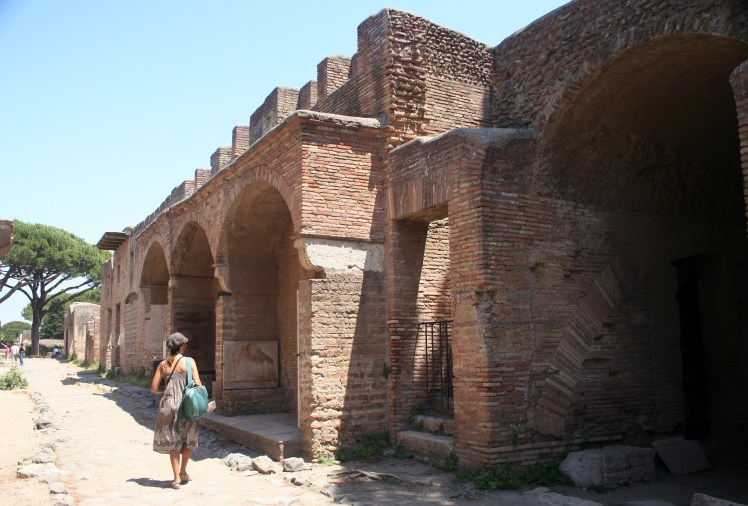
In Rome itself, apartment buildings called insulae (islands) were often up

Insulae at Ostia Antica: A typical insula (apartment building).

to seven or even eight stories high. Plutarch, an ancient biographer who liked to tell the stories of famous Greeks and Romans, told about Marcus Licinius Crassus, a contemporary of Julius Caesar. Crassus became rich through vast purchases of properties in Rome—specifically insulae. Since Rome had no fire brigade at the time, Crassus trained a band of his own slaves to be firemen. If there was a fire in an insula, which occurred regularly, due to people trying to cook in their apartments, Crassus would show up with his firemen. He’d offer to buy the insula for a ridiculously low price and the poor, panicked owner would either have to sell his enflamed property or watch it burn, as Crassus would only order his firemen into action if he sealed a deal.


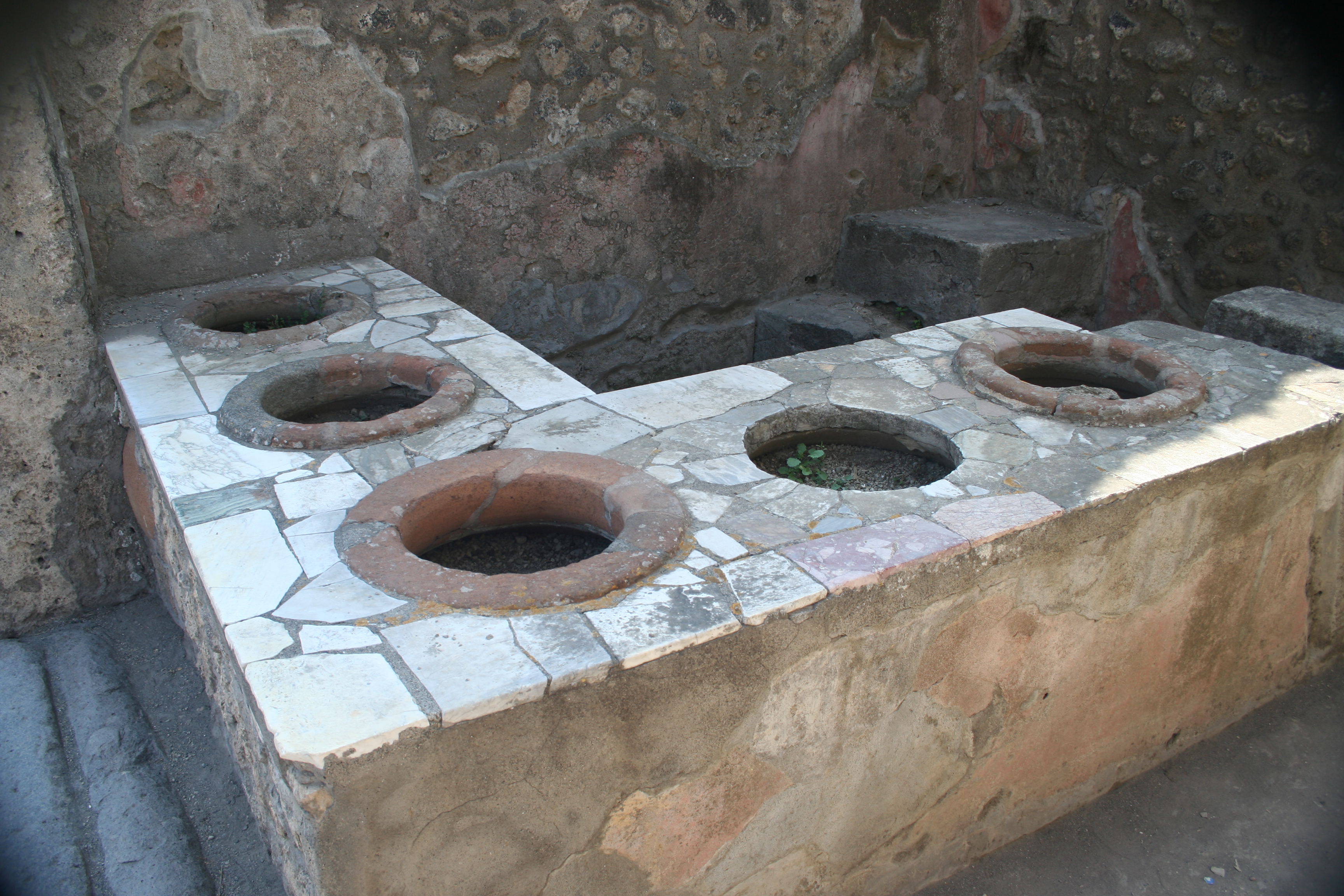
And—hey! McDonald’s anyone? Common plebians typically ate their meals at fast food stalls, located on the streets and sometimes even built into insulae. Americans might think they invented fast-food, but these tiny eateries would serve up steaming veggies and meats onto husks of bread for a filling meal two-thousand years ago. It was only the upper middle classes and families of noble descent who could really afford to recline in their painted triclinia, served by slaves.

Ancient fast food restaurant: 
This little taverna is in Pompeii. It’s very typical of the sorts of fast food establishments that existed in the ancient world.


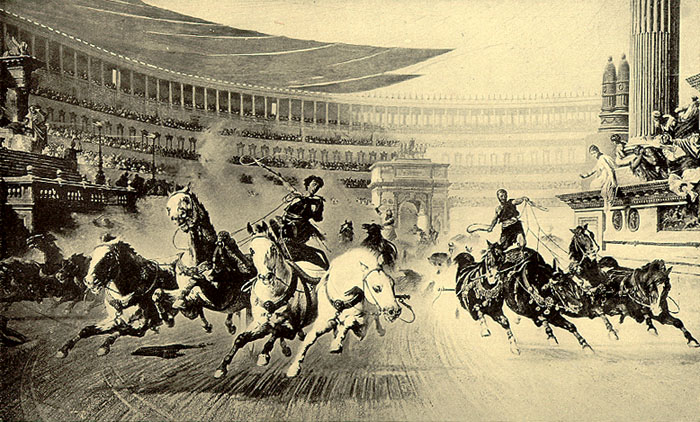
Lastly, I have to mention the Roman passion for games. Now their tastes were different than ours—bloody beast and gladiator shows were the norm. But this enormous public park easily lends to our imaginations what mighty structure once stood there. The Circus Maximus was the place to go for gladiator shows, public executions of criminals, and the favorite Roman pastime—chariot racing!

Circus Maximus Painting: As it may have been.


The Circus Maximus is HUGE and worth a visit. Visitors can still walk where the original track was laid out and see where the spina—the “spine” of the complex—once was. By Julius Caesar’s day, this enormous arena seated over one-hundred-fifty THOUSAND people! As the Republic morphed into Empire, several Emperors renovated and improved the mighty Circus Maximus, and other hippodromes similar to it were added in notable cities throughout the Roman Empire.


I am of the opinion that there’s NOTHING boring about history. People who poo-poo the study of other cultures from the past simply haven’t gotten INTO the spirits of the people who once lived so long ago. Tourists who visit Pompeii and experience the many similarities between ancient Roman culture and ours are right. In many regards, they were “just like us.”

Brook Allen (Click on Brook’s name to go to her blog, full of more information about Rome and its inhabitants.)