October Updates

This past month, when I wake in the night, there’s almost always a tawny owl calling outside – which is a hint that I’m not in Canada. Several things brought us to England in September, largely research for An Unwise Prince, my work-in-slow-progress: a chance to tour a medieval merchant’s house that’s only open a few times a year; the Silk Roads exhibition at the British Museum (and its medieval exhibits); Peterborough Cathedral, built as an abbey in the 13th C, which will become the physical model (more or less) for the school in the new book.

Peterborough Cathedral Precinct. My photo.

But also, of course, the birds, and the long walks, and in the four weeks we’ve been here we’ve had four days of serious rain. Most have been sunny. We caught the last of the summer birds, chiff-chaffs still singing, and the first of the winter migrants, pink-footed geese and redwings, as well as two birds new for the UK for us, yellow-browed warbler and cattle egret. The saltmarshes are washed pink with sea lavender, the hedges are bright with rose hips and hawthorn fruit and blackberries, and filled with red admiral and fritillary and cabbage white butterflies. Deer – roe and muntjac, fallow and Chinese water – browse field edges and park, and on the mud of the marshes probe godwit and golden plover, redshank and curlew.
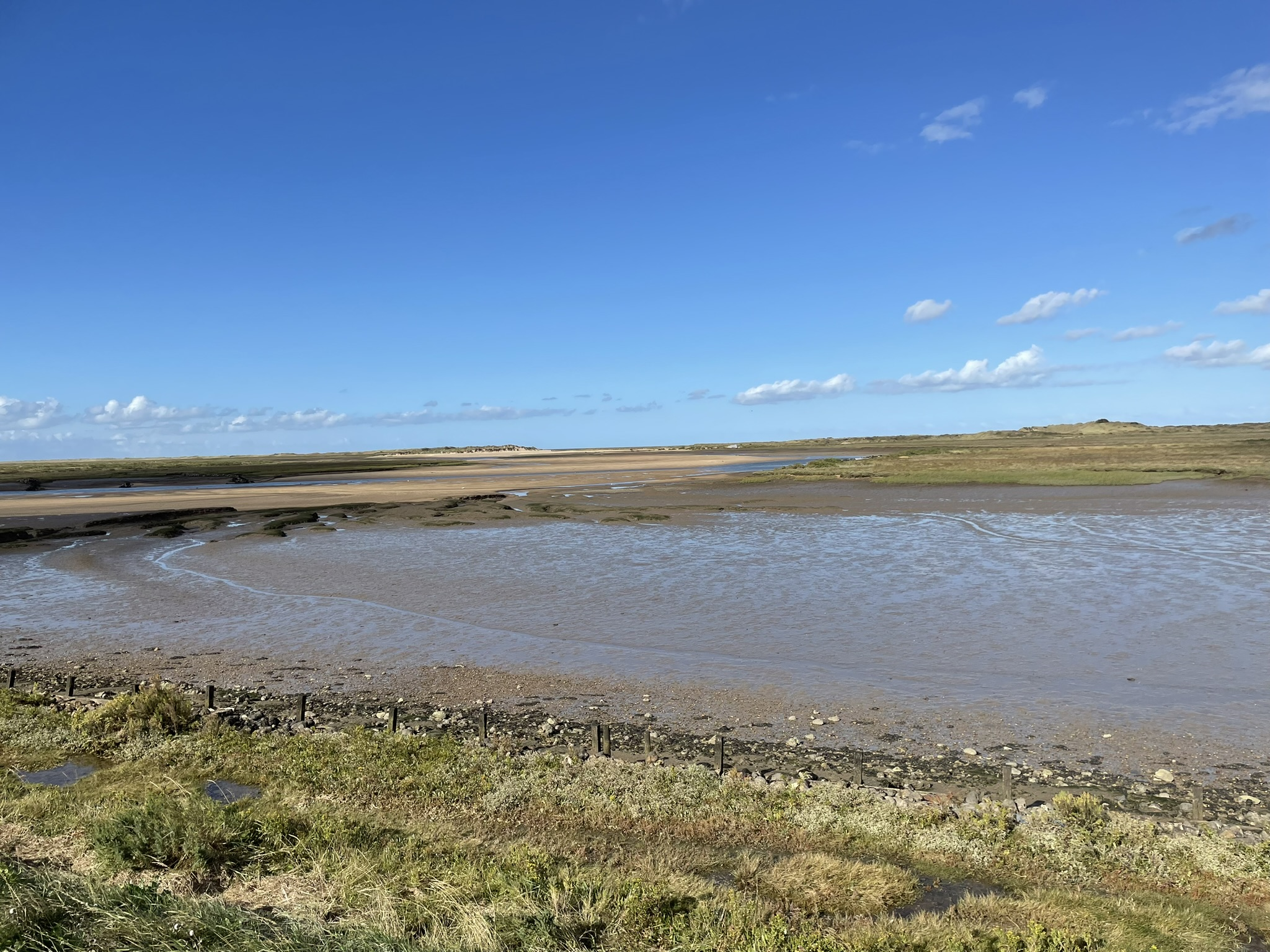
Burnham Overy Staithe harbour. My photo.

Yes, but how’s the book coming, you ask? I’m about 30,000 words into the first draft of what’s going to be the most complex book(s) I’ve ever tackled. It’s already clear it isn’t one book. I thought there were four point-of-view characters. Ha! I’ll be lucky to get through the story without adding at least another four. I’m borrowing from the Hanseatic League, medieval universities, Byzantium-North African-Arabic interaction, 12th C silk roads trade, intellectual exchange around the entire Mediterranean, the Mongol invasion of both the middle east and eastern Europe, Genoa’s near trade monopoly in the eastern Med, and the first crusade. All I can do is trust the process – do the research, let it marinate, and write down the words my characters dictate.

This are the tentative covers for the first two books. If it turns out to be more than a duology, the theme is easy to work with.

You may have noticed I’m not doing many updates here now. I will try to do monthly ones, but a much easier way to keep up with what I’m writing – short stories, poetry, non-fiction and a chance to read Empress & Soldier for free as a serialized novel – is to join me on Substack. My fiction site is History & Imagination; my non-fiction site is Landscapes of Memory.

Until November (I hope).

Marian

A Book Develops, Part VI

Pages from The Diwan of Al-Mutanabbi,
Khalili Collections / CC-BY-SA 3.0 IGO, CC BY-SA 3.0 IGO https://creativecommons.org/licenses/by-sa/3.0/igo/deed.en, via Wikimedia Commons

Inspiration and understanding can come from the most unexpected sources. In my other blog, which focuses mostly on writing – mine and others’ – about the natural world, I mentioned, a week or two ago, that I was reading a collection of essays about landscape and place called Going to Ground.  One of these essays is by Amina Khan, on the link between Islamic writing about nature and the Romantic movement in English poetry and prose.

My fictional world isn’t ours, but I can’t pretend it isn’t based on ours, and in the cultures I’m writing about, trade with my equivalent of North Africa and the Middle East is an important part of the story. In an earlier instalment of this series, I wrote about my youngest point-of-view character, Audun, and his love for the sea and sky and saltmarshes of Torrey, where he grew up. Audun is seventeen, academic, and of course he’s written some juvenile poetry.

Audun, being who he is, is expected to travel, to learn more of the world before he enters a life of teaching, his dream being to eventually be the head of my equivalent of a medieval university. His great-uncle, whom he hopes to emulate, spent a few years in his youth travelling east, gathering histories, settling down to a life of translation and comparison with the histories of the west. Luce, his aunt, is a doctor, much of her learning done in eastern lands as well.

But what Audun was going to learn in those travels (outside of life lessons, of course) I didn’t know. Until I was showering today (why do ideas so often arrive in the shower?) and my mind made the connection between Audun’s love for nature and the Islamic writing Amina Khan described in ‘A Wild Tree Toward the North’, her essay in Going to Ground.

Organized religions don’t exist in my books, replaced by philosophy and personal faiths in a wide range of deities.  But religious writing can also be read for its poetry, and that’s how I’ll approach this. The bonus here is I’ll read some poetry that I probably wouldn’t have otherwise, and my world, like Audun’s, will expand.

A Book Develops, Part V

Trade routes from central Africa to the Mediterranean, c 12-13th C. Illustration Cleveland Museum of Art. My photo.

Inspiration comes from many places, some random, serendipitous, some sought out. This week I drove the 1000+ km to and from Cleveland, to see an exhibition at the Cleveland Museum of Art called ‘Africa & Byzantium’, an exploration of mostly religious art produced in or resident in the lands of North and East Africa influenced by Byzantium.

But there’s no religion in your books, you might say. This is true – or rather, there are no large organized religions; personal faith is another matter – but it’s not religion per se that matters here. It was the communication, the translation of concepts and ideas I was interested in. The icon pictured below was possibly gifted to its Sinai monastery by Emperor Justinian himself, as he endowed the monastery in the mid-500s. It – and many other pieces of ancient art and writing – have been a part of the library of the Holy Monastery of St. Catherine since then.

In the new series set in my fictional world, the role of monasteries as repositories of knowledge and houses of learning is replaced by what the Ti’acha, the schools, of the Empire series have evolved into – the equivalent of the medieval universities not just of Europe but of the middle East and north Africa as well. So what writings – of philosophers from Casil and Heræcria and lands further east and south; of Heræcrian and Ikorani and Marai travellers, or even, at a more personal (for my new characters) level, of Cillian’s or Colm’s, Lena’s or Tarquin’s or Gnaius’s – might have found there way there, in original or copy, for Gerhart or Luce or Kirt to discover and learn from in their travels? Trade, medicine, history, mathematics, music, science: the knowledge held, exchanged, sometimes forgotten, the disciplines and interpretation of thought and ideas – all that still holds, even removing organized religion from the world.

I learned more practical, tangible things, too: the gifting of large brass trays, beautifully inscribed, as diplomatic gifts from the Mamluk sultanate; that a written language called Old Nubian existed; the trade routes from central Africa to the Mediterranean (invaluable); what block-printed linen of the period looked like; the three sources of treasured ivory. All useful things to be tucked away and possibly used, if and when they fit.

And, with pure serendipity, wandering the galleries before my entrance time to the exhibition, I walked into a room and saw – whatever the artist intended nearly 200 years ago – a portrait of my character Luce as a young student, studying medicine in an eastern school.

The Young Eastern Girl, Friedrich Amerling, 1838. Cleveland Museum of Art.
My photo.

Driving home along Interstate 90, I could feel this information slotting into the background of my world, hear the characters taking it in, shaping it to their experiences (and being shaped by it), becoming part of the world and character building. Both the book(s) and I are richer for it.