Perfect World, by Shari Sakurai: a Review

In twenty-second century London, Eric Rawlins has been genetically Perfect Worldengineered as a hero, a man with strength and speed and healing powers well beyond those of typical humans. Working for the London Security Agency (the LSA), Eric’s work is to keep London, and England, safe, isolated as it now is from Europe and the rest of the world by the aftermath of the Great Tsunamis of the twenty-first century and the political collapse and reorganization of the world’s powers.

The arch-enemy of the LSA is Adam Larimore, terrorist supreme and gorgeous bad boy. As Eric and Adam face off, Eric is drawn into Adam’s world, only to learn that perhaps Adam – and the LSA – are not all they seem. Is Adam telling Eric the truth, or is Eric developing Stockholm Syndrome?

I can’t fault Perfect World for being fast-paced or action-packed: it’s both, although there are times the plot machinations seem a bit engineered. The writing is adequate: there are a few awkward sentences and some minor usage errors (e.g., lie vs. lay), and, especially in the early chapters, the voice is too frequently passive. The reader is told, more than shown, what is happening. But where Perfect World fell apart for me was in the world-building. In what is essentially Fortress London, in a world where almost all resources appear to be directed to defense, a world devastated by climate change, people happily sit down to breakfast with coffee and orange juice.

But that wasn’t the biggest problem I had with Perfect World’s 22nd century London. By about three chapter in, I had a question: why was everyone, apparently, white? Why were their last names Matheson, Drake, Beasley, Rawlins, Larimore? Where were the Mbutus and the Patels, the Wus and the Chavezes and the Hussains and the Parks and the Walenskis, all of whom live in the 21st century London I know and love? For a city as multicultural as London to suddenly become purely Anglo-Saxon with no explanation was asking too much of my ability to suspend disbelief, which in turn affected my ability to believe in some of the twists and turns of the plot.

I rate Perfect World  as a bare 3/5, with low scores for world-building and plot contortions contributing to the overall score. As a young writer Shari Sakurai has promise, but needs to more fully realize and develop her world and its characters to reach her potential.

The author provided me with a copy of the book in exchange for an honest review.
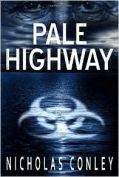
Pale Highway, by Nicholas Conley: A Review

Nicholas Conley’s debut novel, Pale Highway, has an unlikely setting: a pale highwaylong term care home. The protagonist is even more unlikely: a Nobel Prize-winning scientist losing his battle with Alzheimer’s. Once hailed as a saviour for developing a vaccine against AIDS, Gabriel Schist is slowly losing touch with everything he held dear, until it appears a new, deadly, virus has arisen, one that only Gabriel can understand and fight.
Conley has worked in care homes with Alzheimer’s patients, and this is clear not only from his descriptions of the environment, procedures, and organization of these homes, but from his accurate, compassionate depiction of the residents. Pale Highway is a science-fiction story, but it is also speculative fiction, speculative in terms of what reality is and might be in the mind of a man with Alzheimer’s.

The major characters in Pale Highway are complex and fully developed, and the prose lucid. The plot is suspenseful, and Conley finely balances the reader’s perceptions: is what is occurring in these pages real at all, or is everything happening within the disintegrating mind of Gabriel Schist? Like Life of Pi, the book questions what constitutes reality.

Gabriel’s struggle to maintain some control over his failing mind, not only to solve the medical crisis facing the world, but to hold on to his relationship with his daughter, is presented movingly and realistically. His current struggle reflects past struggles in his life. The novel jumps between past and present, showing us how Gabriel’s past issues have forged his character and determination.

My only niggle was that I found some aspects of Gabriel’s reality difficult to suspend belief enough to accept. Both how Gabriel is given help to do his work, and his ability to obtain the materials needed, led me to the conclusion that the actions must be taking place only in his mind. But that, I think, is a limitation of my imagination, not a limitation of the story; another reader may come to a different conclusion. Overall, 4 stars, for an impressive debut novel.

The author provided me with a copy of this book in exchange for an honest review.


Warrior Lore, by Ian Cumptsey: A Review

‘There shone out from the twelfth shield,

A raven, all in brown.

That carried Richard Ravengarth,

For rhymes and runes he’s known.’

When Ian Cumpstey offered me his book Warrior Lore, translations of Scandinavian folk ballads, for review, I was both intrigued and excited. Intrigued, because I know very little about Scandinavian ballads, and excited, because these exact ballads are important to the book I’m currently writing.Warrior Lore

Warrior Lore is a fine introduction to these ballads and to some of the heroic and historical figures of northern Europe. These are not dry academic translations, but rather lively, sometimes funny, sometimes sad verses which the reader can easily imagine set to music, being sung loudly and lustily in hall full of warriors, flickering firelight, and wide-eyed children. (To increase your appreciation of the verses, read them out loud!)

Cumpstey has organized the book well. Each ballad translation is preceded by a prose description and explanation of the history, characters and events of the verse. Having set the stage, the verse translation follows. While the rhymes sometimes seem imperfect, this is in keeping with the rhymes in the Swedish originals, and the rhyme schemes in the translations also mirror those of the originals. In the end-notes, the author explains that he has used multiple sources for most of his translations, as there are sometimes significant differences from one source to another.

The end result is a lovely introduction to Scandinavian folk ballads. I would recommend this book to anyone with an interest in the area, and to any writer (like myself) who needs source material that is accessible but academically sound. A solid 4 stars.

The author provided me with a copy of this book in exchange for an honest review.

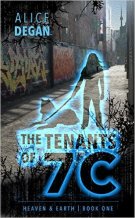
The Tenants of 7C, by Alice Degan: A Review

tenants 7cThere is something about urban fantasy that takes place in a city well-known to the reader that adds a level of charm and attraction. The Toronto setting of The Tenants of 7C was a bonus for me, but even without knowing the Kensington Market district, this is a delightful collection of connected short stories.
Above the Heaven & Earth Bakery, in an obscure back alley, the tenants of apartment 7C are an eclectic mixture of decidedly non-human characters: a young werewolf, a Japanese demon, and a very young satyr. They share the rooms of 7C: rooms that aren’t in the same dimension as the actual building, and frequently don’t stay in one place. The bakery itself isn’t really meant for humans either, its breads and cinnamon rolls providing sustenance to a wide range of supernatural creatures. How these three co-exist and survive in a their dual world, both with other “others” and with humans are the central conflict of each story.

While in some ways reminiscent of Charles deLint’s books, especially his early work set in Ottawa, The Tenants of 7C focuses on the lives of the ‘others’, not the lives of humans who interact with them. The characters of the werewolf Nick, Takehiko, the Japanese demon, and Yiannis, the satyr child, are not just stereotypes, but dimensioned individuals whose personalities develop over the collection. Nick, who is the protagonist, is especially well-realized, completely believable as a seventeen-year old who doesn’t fit in but is doing his best to manage his life, attending an alternative high-school, worried about his relationship with his parents, wishing his life were easier. It’s just that his problems, unlike most troubled adolescents, involve him turning into a wolf.

Degan’s writing is polished and competent and the tone and structure fits the action and mood of each story appropriately. She can switch the mood from light-hearted or contemplative to frightening in a few sentences, and uses enough manga, gaming and Doctor Who connections to make the stories attractive to a young adult/new adult audience (I verified this with a early-twenties friend), but the stories are also deeply rooted in, and consistent with, older traditions of fantasy. Degan blends these strands of different fantasy genres and traditions well, not an easy feat.

I had only a couple of niggles. Because the stories in The Tenants of 7C are not a linear narrative, but rather vignettes and episodes in a larger world-under-construction, there are some loose ends, sub-plots that arise but are not completed in this volume, and some inconsistencies. I wanted to know what happened in those subplots and to those characters that are introduced but disappear. I guess I’ll just have to wait for the next book!

Overall, 4 stars. If you’re a fan of urban fantasy, The Tenants of 7C is definitely worth your time.

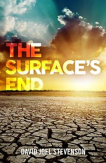
The Surface’s End, by David Joel Stevenson: A Review

The Surface's EndJonah, a young man in late adolescence, is responsible for providing his family with game, the major source of meat in their post-apocalyptic world. He’s found good hunting grounds at the edge of the dead zone, the desert known as the Deathlands, but even there the game is growing thin.
A wounded buck, fleeing the pain of Jonah’s arrow, leaves the shelter of the woods to run into the desert; Jonah, who cannot waste the kill, follows. Near where the buck finally falls, he finds a metal wheel…a wheel which is opens a door into another world – not a magical world: this is no rabbit-hole – but an underground city, peopled with the descendants of those who fled a ravaged Earth many generations earlier.

This is the premise of The Surface’s End, a young-adult dystopic science-fiction novel by David Joel Stevenson. I finished the book over two days: it’s short, at about 139 pages on my Kindle app, but it was also compulsively readable. Both the homesteading world of Jonah and his family and their fellow villagers, and the mole-rat like existence of the underground inhabitants were internally consistent and plausible, although both were slightly too one-dimensional, with no hint of strife or disagreement within the homesteaders and no positive aspects to the underground world.

SPOILERS AFTER THIS POINT!

Having the ‘wildlands’ adolescent discover the ‘city’, rather than the other way around, was a nice twist on the young-adult dystopic meme. The inevitable romance between Jonah and Talitha, the girl from underground, is handled sweetly, Jonah’s uncertainty and awkwardness particularly.

For the most part Stevenson’s writing flows smoothly (and occasionally brilliantly, as in the line, referring to the Deathlands: ‘He took his first step into the undiscovered lands.’, an echo of Hamlet describing death as ‘the undiscovered country.’). A minor niggle was that I found the tone and pacing of the narrative did not always reflect the tension and action of the story.

My only other niggle with the story was the scene in which Jonah and Talitha watch a digital feed of the deathbed confession of one of the original founders of the underground city. While it is important, a turning point in the story, the confession goes on too long, unbroken by the reactions and emotions of the two young people watching it.

All in all, though, I’m giving The Surface’s End four stars. It’s a worthy addition to the young adult dystopia genre (personally, I think it would make a good film), and it has enough originality to make it stand out from the crowd.

The author provided me with a copy of the book in exchange for an honest review. All opinions here are mine alone.

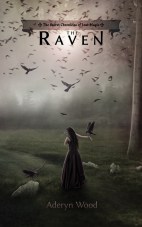
The Raven, by Aderyn Wood: A Release-Day Review

The-RavenIn a Bronze Age world, a child is born on the first night of Ilun, eight days of darkness. Orphaned, outcast, she is marked for sacrifice, but the shaman defies the tribe’s leaders to keep her alive. He has seen in her power beyond anything he has known, power the tribe may need some day. But will she be allowed to use it?

This is the premise of The Raven, by Aderyn Wood. I read an advance copy of The Raven over the course of three days. I would likely have read it in one in my younger days, when the luxury of reading all day was possible,which should tell you how much I liked it. Wood has crafted a believable, internally consistent fantasy world, with strong characters. The story is a classic conflict between choosing and using magical powers of good and evil, and as such has similarities with other stories in the fantasy genre, but it is neither excessively cliched nor stereotypical.

The tribal, semi-nomadic world that Iluna is born to bears some similarities to Jean Auel’s Earth’s Children series, and some to Guy Gavriel Kay’s Dalrei in The Fionavar Tapestry. But these are similarities only; this world stands on its own. Unusually, much time in the book is given to Iluna’s childhood (and therefore that of other key characters), a plot device which promotes both character development and world-building. In Wood’s competent hands the dramas and conflicts of childhood are woven into the larger challenges Iluna’s people face, and as the children mature, the complexity of those challenges increases, mirroring their understanding and role in them.

As Iluna grows to maturity, the scope of her world grows too, and she realizes that her gifts may be of interest and use to her whole network of tribes, and not just her own. Her choices and behaviour are those you might expect from a young girl on the edges of her society but aware of her unique powers, adding to the plausibility – and the tension – of the plot.

I had a few small niggles. There are a few wobbles in the consistency of voice, especially in dialogue, with modern sayings – “Stay safe” mixed in with archaic language – “…recent years have been ill-omened for us.” Wood uses ‘mountain lion’ in the first half of the book and ‘mountain cat’ in the second, apparently for the same species. And, perhaps most seriously, I found the description of the penultimate crisis, a battle scene, unconvincing, lacking in tension and broken by the statement “The fight wasn’t over yet.” Here, I felt, the author forgot the writer’s adage ‘Show, don’t tell.’

Overall, though, The Raven earns a very solid 4 stars. It was an enjoyable read, and one that I really didn’t want to put down. I don’t say that about many books. Available from Amazon.

The author provided me with a pre-publication copy of this book in exchange for an honest review. All opinions are mine alone.

Books of Influence: An Occasional Series

This is the first in an occasional series of posts about the books – mostly classic fantasy and science fiction – that have most greatly influenced my own writing and world-building.  First among these are The Chronicles of Tornor, by Elizabeth A. Lynn.

The Chronicles of Tornor, published in the late 1970’s and early 1980’s, consist of three books: Watchtower, The Dancers of Arun, and The Northern Girl. All take place in Arun, a land of city-states and northern keeps, grasslands and mountains, a land where certain psi powers, dance and warfare as two faces of one discipline, and a wider acceptance of differing forms of sexuality and love evolve over the several hundred years separating the three books. The first book in the series, Watchtower, won the World Fantasy Award in 1979.

Hailed at the time of publication as “an adventure story for humanists and feminists” (Joanna Russ) author Elizabeth A. Lynn’s spare, evocative prose and finely tuned characters made me long to be in Arun, but more importantly taught me how less is more in writing. The facets of sexuality revealed in her characters in this trilogy (and in two other of her books from the same general time, The Sardonyx Net and A Different Light), while common-place now, were still challenging readers at the time they were published. Important to her world (and ours), the sexuality of her characters is not an issue; it is an unremarkable part of the society and culture of Arun.

Each book can stand alone, but all are linked by the land in which they take place, the lineage of the characters, and a set of cards resembling Tarot cards. While there is physical action in all three books, it takes a back stage to the psychological and emotional change and growth that happens in the protagonists; it is these battles that are the focus of the stories, and hold the meaning. Lynn brings the story full-circle over the three books, beginning and ending at the northern keep of Tornor.

I first read this series in my early-to-mid twenties – now over thirty years ago- and of all the books I have read and will write about in this occasional series, The Chronicles of Tornor had the most direct influence on my own fictional land and some of the themes explored in the Empire’s Legacy series.  My paperbacks are tattered and torn, and one is a replacement, but they are books that will always have a place on my shelves.

Master, by Thomas M. Watt: A Review

What happens when dream and reality become one and the same, and you have no control over either?master

Ex-footballer Phil Gordon has chosen a life as husband, father, and pool cleaner over the possibility of NFL fame and fortune. He’s doing ok with the inevitable negative comments this decision engenders, but when a figure calling himself Master invades his dreams, making the same negative comments and threatening Phil’s wife, he begins to be frightened. In quickly escalating action, it becomes clear that Master has control of Phil and his family in his waking life as well as in his dreams, but is he real, or a construction of Phil’s subconscious, channelling repressed doubts and regrets about his life choices?

Master is a short book, 139 pages, with rapid, sometimes violent action, told from the first-person viewpoint of the protagonist. Its tone fits the confusion and fragmentation of Phil’s sudden immersion into a world gone mad, a writing style that is the equivalent of the hand-held camera effects of various recent films. In many ways, the book reminded me of a film script, strong on dialogue and descriptions of action, brief in descriptions of setting and characters, and bringing the action to a finale that completes the story but allows for a sequel.

Phil’s actions – and those of Master – unfortunately do not strain credibility in today’s world; the almost casual violence Master demands of Phil and practices himself exists in headlines weekly. Phil’s insistence that he is not a man of violence has little influence on his actions when his family is threatened; his motivation is clear. I had more difficulty fully understanding the motivation and behaviour of Ashley, an old girlfriend of Phil’s who is enmeshed in the unfolding events.

SPOILERS BEYOND THIS POINT!

My niggles? The technology that lies behind Master’s manipulation of Phil’s dreams is not really fully explained, and I felt was glossed over; a more detailed explanation of the technology and its effects could have added to the tension and drama of the narrative. The first half of the penultimate chapter reads more as an epilogue, tying up loose ends in brief explanatory paragraphs, before returning to the story. In addition, there were a few small production errors in the copy I was sent, but no more than are found in many books, both traditionally and electronically published.

Master will appeal to readers who like fast-paced thrillers with a strong psychological aspect. My rating is three stars. Master is available from Amazon.

The author provided me with a copy of the book in exchange for an honest review. The opinions expressed here are mine alone