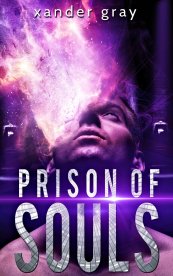
Prison of Souls, by Xander Gray: A Review

Prison of SoulsStephen Hawking, Ray Kurzweil, Randal Koene: all these scientists believe, to differing degrees, that it may (or will) be possible to upload the human mind to a computer. And what then?

One answer – one terrifying and convincing answer – to that question is the central premise of Xander Gray’s complex and intricate science-fiction novel Prison of Souls. Based on cutting-edge actual and theoretical research in quantum physics and mind uploading, Prison of Souls challenged me to believe the science and its implications, and yet at the same time proposed a logical and frightening outcome. This duality – fitting for a novel based on quantum research – kept me turning pages long after I should have put the book down and gone to sleep.

Prison of Souls received top rankings in all the categories I use to review books. Gray writes very well: his prose flows naturally, and his skill in describing everyday scenes, and contrasting them with the unreality of what is happening to the protagonist adds to the sense that what is real in this book is fractured and fluid, not conforming to commonly accepted versions of reality, like the particle/wave duality of light.

If I have one reservation about Prison of Souls, it is that the science is complex and difficult, but Gray uses dialogue to explain it in ways that make it reasonably comprehensible. The moral questions raised in Prison of Souls are real ones, and if Koene and Kurzweil are right in their belief that the uploading of human minds to computer networks will occur in the lifetimes of those who are now under fifty, then they are moral questions for which we currently have no answers, and have barely begun to consider.

I’m giving Prison of Souls five stars; it’s an outstanding debut novel. Available from Amazon.

The author provided me with a copy of this book in return for an honest review. The opinions stated here are mine alone.

A Sincere Thank You

Do what you love, and the work will come your way.

In the months that have passed since I officially retired from my salaried job (as opposed to the previous eight months, when I was off on medical leave), I’ve gone from a part-time writer, struggling to find the time to work with my editor and get Empire’s Daughter published, to a full-time writer, or, at least, someone involved in the indie writing world full-time.

I soon learned after retirement that I wasn’t cut out to do nothing but work on my own book. Perhaps because of years of having to juggle different projects, my ability to concentrate on one thing is limited to a couple of hours. After that, whatever I do probably isn’t worth the time it takes. So I gave it some thought: what aspects of my previous job(s) had I really enjoyed? What could I transfer to my new life?

The common themes going back through two different careers were these: writing, editing and reviewing. Over those careers, I’d written, reviewed, and critiqued everything from applications for hundreds of thousands of dollars worth of grants for scientific research, various master’s and doctoral theses (my husband’s M.Sc. thesis was classic, with the opening sentence going on for a page and half; luckily for our marriage, he’s a quick learner), and papers for submission to scientific journals. When I switched careers into education, I did the same for curriculum, writing prompts, policy and procedure documents, more grant applications, major reports to the government….But all this was non-fiction. Could it be transferred to fiction?

I’ve been reading since I was three, and have read (and continue to read) everything from classics to cyberpunk, from literary fiction to Lovecraft, and everything in-between. There is no better way to learn to write well – or recognize good writing – than to read and read and read. So, yes, I thought I could recognize good writing (and good storytelling, not always the same thing), and offer both fair and useful critiques.

So, as regular readers of this blog know, I started to write reviews. I offered editorial services, either beta-reads or full edits. Six weeks later, and my days (and both my review and editorial lists) are full. I spend my working hours in chunks of reading, reviewing, editing, and my own writing (plus a university course in a completely different area, to keep my scientific mind alive).

My own writing benefits greatly from this. Both in the reviewing and editing I am constantly reminded of what is good writing, what moves stories along, gives insight into characters, describes a situation or a location effectively. In looking at other writer’s work with a critical eye, I’ve become a better critic of my own work. In reading sentences or paragraphs or whole books that delight me, I learn more about what makes good writing – in my mind, that’s an apprenticeship without an end date.

So, to all of you who have offered me books to review, or trusted me with editorial services, thank you. I hope what I’m giving back is of value, but please know: you’re giving me work I love, and work I learn from. It’s very much appreciated.

Immaculate Conception by Guilherme Solari: A Review

Immaculate ConceptionImmaculate Conception (Cybersampa #1) is a cyberpunk novella by Brazilian journalist Guilherme Solari. The setting is the megalopolis of Megasampa, a couple of hundred years in the future, a sprawling, dystopic city that has swallowed Rio and Sao Paulo, ruled by corporations, dark and divided. A brutal murder introduces us to Cascavel, the protagonist, a man with a mysterious past, multiple synthetic parts, and a film-noir-detective attitude.

Immaculate Conception is in part an homage to the cyberpunk world of Philip K. Dick, and references to Do Androids Dream of Electric Sheep (the story on which the film Blade Runner is based) are embedded in the story, as are references to other dystopic classics. These references help ground the story in a classic cyberpunk world without detracting from the new creation of Megasampa.

The world-building is solid, pulling from established cyberpunk and other dystopic themes, but the South American setting gives it a different life. The characters are not quite three-dimensional, but are as developed as many characters in this genre. The plot is a mix of film noir, classic horror, and dystopian sci-fi, and for the most part maintains its momentum and tension well. Descriptions of the locations effectively evoke the desolation of Novo Bronx as well as the shiny artificiality of corporate headquarters.

English, I assume, is not Solari’s first language, and while most of the writing is competent, there are enough mistakes in spelling, grammar and voice to detract from the flow of the prose. These could be easily corrected in a second edition of the e-book. My other quibble is the description of the novella on Amazon as meant for the 12-18 age group; the subject of the book and its violent murders, as well as the reading level, suggest to me the lower age limit here is too low. This may be a difficulty with Amazon’s classifications and not the author’s intent, to be fair.

Overall, I am giving Immaculate Conception three stars; it would have been 3 1/2 except for the language errors. I should say cyberpunk is not a genre I have read widely, and most of what I have read is by either Dick or William Gibson, so I may be a bit out of date with the evolution of this type of writing. Immaculate Conception is the first in a planned series called Cybersampa, and I believe they will find a satisfied readership.

The author provided me with a copy of the book in exchange for an honest review. The opinions here are mine alone.

The Pharaoh’s Cat, by Maria Luisa Lang: A Review

Maria Luisa Lang definitely has a cat. Wrappa-Hamen, the feline narrator Pharaoh's catof The Pharaoh’s Cat, can only have been written by someone who lives with, or has lived with, at least one cat.

Through the fulfillment of a goddess’s decree from centuries before, Wrappa-Hamen gains the ability to talk, and to walk on his hind legs like a human. He becomes the companion of a lonely and sad young Pharaoh in ancient Egypt, accompanying him on his travels, sharing his meals, and sleeping on his bed. The evil Vizier, who has overseen the upbringing of the young Pharaoh, hates cats; the High Priest does not.

The Pharaoh’s Cat is a light-hearted adventure, set primarily in ancient Egypt, and an accurate if superficial portrayal of Egyptian mythology. Superficial is not a criticism here; any deeper discussion or description would have been inappropriate. Lang has a gift for writing amusing vignettes of life, and the first half of the book primarily consists of these vignettes, the plot moving along somewhat slowly. Suddenly the pace changes, and elements are introduced that are unexpected.

Lang’s writing is competent and flows well, keeping the same light tone throughout the book. Dialogue is realistic (assuming you can accept a talking cat, that is) but not complex, which is also true of the characters. They remain slightly two-dimensional, with Wrappa-Hamen showing the most development over the course of the story. The plot requires a fair bit of suspension of disbelief; it is a world where gods have real power and presence, and incantations, done properly, work, but this is not high fantasy that takes itself seriously. It’s fun.

Overall I am rating the book 3.5/5 (see how I review and rate books here) and would recommend it to any fantasy fan who enjoys a light-hearted, quick read. There’s a sequel coming out; I will be looking for it.

The author provided me with a copy of the book in exchange for an honest review.  The opinions expressed here are mine alone.


How I Review a Book

With twenty-five years in education behind me, it will come as no surprise to readers who are also teachers, or who know teachers, to read that my book reviews are based on something called a rubric.  A rubric has several meanings, but in education, it means:

a guide listing specific criteria for grading or scoring academic papers, projects, or tests

So what are my criteria?

I consider the following major categories in reviewing a book:

  • Writing style:  does it scan?  Is the mix of active and passive voice appropriate to the story? Is there too much description, or  too little? Does the tone fit the story? Is the pacing of the story balanced?
  • Dialogue:  is it realistic? Is it complex – are emotions, nuances, subtleties conveyed?  If meant to, does it convey regional accents or cadences?
  • Plot:  is it either original, or a new telling of a genre-standard story? Is it internally consistent?  Does it rely on coincidences or happenings that strain the reader’s belief?
  • Character Depth and Development:  are these real characters, or stereotypes? Do they have dimension?  Do they develop over the story?
  • World-building:  does the author make us believe in this world?  Is it fully explained over the course of the story, or are we left guessing? Does the author appear to understand her/his world thoroughly? Are phrases/terms used correct for the setting? (e.g., not using Australian terms when the book is set in Canada)
  • Spelling and grammar:  Are conventions followed?   Are spelling errors the result of spell-check limitations? (e.g., overseas/oversees).  If non-conventional use is purposeful, is it used consistently?  Do spelling/grammar errors detract from the story?

I also look at production issues (the way the book is formatted) and reading level if it’s not an adult book.

Each of the 6 main categories is rated out of 4, and then the overall rating made. (Educational rubrics, at least here in Ontario, are always out of 4…so that’s why I rate out of 4 –  habit.) I then mathematically convert that to a rating out of 5, to be consistent with Amazon and Goodreads. (Unlike those sites, though, I will report 2.5 or 3.5 or 4.5, but I will use the next full ‘star’ when posting the review on either of those sites.)

I read with a clipboard and the rubric beside me, and I take notes.  Using a rubric means I’ll be more consistent, and, it allows me to rate a book in a genre I don’t usually read.  But I’ll be honest – there’s a bit of gut reaction still in there.  I’ll give you an example from film.  Years and years ago my husband and I saw a film called Blood Simple.  It had internal plot inconsistencies.  It had production issues, especially with continuity.  It was clearly low budget – and both of us loved it.  It was the first Joel and Ethan Coen film to be released (I think) and it had all the hallmarks of their quirky, eccentric film-making, and those qualities over-rode the problems, in our opinion.

And the last thing to remember about any review?  The friends we were with hated Blood Simple.  In the end, it’s only my opinion.  I’ve been known to be wrong.


I AM SLEEPLESS: Sim 299, by Johan Twiss: A Review

i am sleeplessAidan is a prime. Primes have special powers, but each of those powers comes with a price, a defect that limits the prime in some significant way. Except for Aidan: his multiple prime gifts have not come with any defects, except that he doesn’t sleep.

Aidan, in his sleepless hours, meets secretly with General Estrago, who provides him with forbidden books for reflection and discussion, but additionally, Aidan spends his time working through the levels of the simulations designed to prepare each coterie of primes for battle against the Splicers, the creatures that sent this race from their home planet in search of safety. Aidan has reached Sim 299, the top level and a level higher than any other prime.

In attempting to conquer the challenges of Sim 299, Aidan must seek the assistance of both his friends and his enemies among the prime coteries, endangering them not only in the simulation but in real life. As the battles become all too real, Aidan uncovers a web of secrecy, betrayal and rebellion at the highest levels.

I AM SLEEPLESS: Sim 299 is science fiction for the young adult/new adult reader. It is fast-paced, and the world-building unfolds competently through both the narrative and through ‘quotes’ from a character’s book at the beginning of each chapter. The concept of cohorts of young people being trained for battle is familiar from books such as Ender’s Game, but that very familiarity helps the reader in accepting and believing in the story, which is at its heart a quest story.

A couple of things niggled at me. I would have preferred the information about each type of prime, their gifts and defects, to have been presented at the beginning of the book, not at the end: I found that trying to sort out what each prime was capable of distracted me a bit from the flow of the narrative. As well, Aidan’s world contains beasts which are apparently hybrids between (for the most part) familiar animals: the cobramoth for one. These animals are charmingly illustrated in the book (by the author’s wife), but I wanted an explanation for them. Are they genetic modifications? I would also hope for some stronger female characters in the sequel; in this first volume they seemed to me a bit more like adjuncts than full participants in the story.

I AM SLEEPLESS: Sim 299 is the first book in a series. It ends with the story not complete: Aidan and his friends have overcome one challenge, but many more lie ahead. The characters and the conflicts presented were compelling; I look forward to the next installment. My overall rating is 3 1/2 stars for this debut novel.

The author provided me with a copy of the book in exchange for an honest review.  The opinions expressed here are mine alone.

Name a Character Contest

I need a name for a fairly major character in my in-progress young adult adventure novel, Empire’s Hostage, the second in the Empire’s Legacy series. Empire’s Legacy is set in a world not quite our own, but that is based on Britain/Northern Europe in the years after the fall of Rome. The character I need to name is the “Viking” heir-apparent to the king of the islands of the north coast, more or less equivalent to the Hebrides.

He’s not a terribly nice character, so might not want to suggest your best friend’s name!  The name also needs to sound vaguely Scandanavian/Icelandic/Gaelic to fit in with the rest of the names in the story.

What do you win?  A mention in the acknowledgments in the book, when it sees the light of electronic day sometime next year; a free copy of it and its predecessor, Empire’s Daughter, and, if you wish, either a review of a book of your own on this website, or a beta-read of work-in-progress.

The contest remains open until I have twenty names to choose from, or to December 31. Respond in the comments section or to marianlthorpe at gmail.com

Feel free to send this out to others!

thanks,

Marian

Hunt (Freya Snow: Book One) by L.C. Mawson: A Review

Hunt (Freya Snow: Book One) by L.C. Mawson

Freya Snow, the unknowing child of magical beings, has grown up in foster homes her whole life. Moving once again in her teens, her discomfort at a new situation grows as her powers begin to emerge and she discovers that the social worker who has organized her new home is actually her magical guardian and mentor.

Freya has only one friend, an older girl at her last foster home, Alice,who is high-functioning autistic and whose disinterest in most social norms and trends Freya shares. Unsurprisingly for a child who has moved multiple times and perhaps borders on the ASD spectrum herself, Freya finds it difficult to make other friends. But at her new school she is approached by the somewhat odd Damon, who is not English and is unfamiliar with many of the cultural references of the school and society. The two become allies and then friends as Freya’s world becomes much more complex, confusing, and dangerous.

The basic premises of Hunt will be familiar to readers of young adult fantasy: the magical child from another world whose powers begin to develop in their teens, bringing them to the attention of the powers of evil and good from their own realm. But for this premise to be convincing, the magical world must be internally coherent, fully understood by the writer, and that internal coherence conveyed to the reader. In the case of Hunt, this coherence is missing. While introducing such a magical world in small hints and explanations, to build interest and plot, is a valid device, in this case it leads more to confusion than epiphany. Whether or not this stems from a lack of understanding of her own magical world by the author, or a lack of telling the story in a way that explains that magical world, is not clear.

Hunt would have benefited, in my opinion, from being a longer book, told from two points of view, the second being from the magical realm, which would have given the author an opportunity to more fully flesh out the structure and conflicts of that world. As part of a planned series, these may be revealed in later books, creating from a promising but flawed first volume a substantial and fully realized universe.

My personal rating is two-and-a-half stars for this story from a young writer who is learning her trade. I’ll be interested to see how Lucy Mawson develops as a writer over the next few years; I think she’s worth watching.

The author provided me with a free copy in exchange for an honest review. The opinions here are completely my own.

Magic of the Gargoyles, by Rebecca Chastain: A Review

Magic of the Gargoyles (1)

Mika Stillwater is a mid-level earth elemental adept, specializing in quartz working. Moonlighting from her unfulfulling quarry job, she is desperately working late into the night to finish a commission that will finally fund her own shop, when a frantic, terrified baby gargoyle arrives on her balcony. Seeking help in rescuing its kidnapped siblings, new hatchlings that have been taken for black-market sales, the gargoyle has been attracted by the strength of Mika’s magic.

The opening scenes of Magic of the Gargoyles grabbed my interest and attention immediately. Nor did either wane throughout the novella. Well-paced action, interesting and strong female characters, and a fresh and imaginative take on a magical world all contribute to the strength of this story. Chastain’s writing is crisp, with enough description to flesh out her world and the people and creatures that inhabit it, and her descriptions of Mika’s magic are tactile and convincing.

I had only one tiny niggle, and that was the description of a captured hatchling as “a gross mimicry of a Thanksgiving dinner plate”. To me, the inclusion of Thanksgiving into this magical world, clearly not our own, jarred, and it took me a few minutes to return to the state of disbelief (or belief) needed to thoroughly enjoy this urban fantasy.

I would recommend this book to good readers over the age of twelve (there is some violence, no love or sex scenes). Girls especially will enjoy it, but it shouldn’t be limited to a female readership. It is also completely appropriate for adults who enjoy urban fantasy…I’m well into my sixth decade but read it in one day with great enjoyment. Magic of the Gargoyles is available from Amazon. Five stars.

The author provided me with a free copy in exchange for an honest review. The opinions here are completely my own.

The Quantum Door by Jonathan Ballagh: A Review

The door into another world is as old as Alice in Wonderland and as new as Neil Gaiman’s Coraline, with many many interpretations and reiterations in between (and since). In The Quantum Door, Jonathan Ballagh’s debut novel, it is given a familiar yet fresh treatment in this middle-grades science fiction story set a very few years in the future.

Brothers Brady and Felix are attracted by a faint light in the forest behind their Vermont home, a forest that has recently been purchased and fenced with No Trespassing signs. Felix, the younger and more technologically-oriented brother, attempts to investigate with a drone, leading to the discovery of the quantum door, a door into a parallel universe fraught with menace and danger.

The door has been constructed by Nova, a strong, resourceful female character who appears to be roughly the same age as the boys. With her robotic, AI dog – a canidroid? – Achilles, she is attempting to find a safe place away from the Elder Minds, the artificial, evolving intelligences that now rule her world.

The Quantum Door is imaginative and fast-paced, introducing young readers to many of the classic science fiction themes. The science and the technology is realistic and feasible, building on current knowledge, devices and systems. The scenes of the underworld where the Neurogeists, constructed creatures that house the reprogrammed minds of transgressors of the Elder Minds’ rules, are resonant of many dystopias portrayed in text and film, and yet manage to be fresh horror.

A mention must be given to the outstanding illustrations by Ben J. Adams. Dark and fractured, they convey the dystopian side of this novel perfectly.

The reading level and story complexity are also worthy of mention: they are appropriate to the age group to which this book is aimed, without talking down in any way. This is a book that in my previous career in education I would have been recommending to middle-grade teachers without hesitation. Five stars to this outstanding debut novel, and here’s hoping for a sequel.

This is an independent review of copy of the book provided by the author. The opinions stated here are mine alone.