October Updates

This past month, when I wake in the night, there’s almost always a tawny owl calling outside – which is a hint that I’m not in Canada. Several things brought us to England in September, largely research for An Unwise Prince, my work-in-slow-progress: a chance to tour a medieval merchant’s house that’s only open a few times a year; the Silk Roads exhibition at the British Museum (and its medieval exhibits); Peterborough Cathedral, built as an abbey in the 13th C, which will become the physical model (more or less) for the school in the new book.

Peterborough Cathedral Precinct. My photo.

But also, of course, the birds, and the long walks, and in the four weeks we’ve been here we’ve had four days of serious rain. Most have been sunny. We caught the last of the summer birds, chiff-chaffs still singing, and the first of the winter migrants, pink-footed geese and redwings, as well as two birds new for the UK for us, yellow-browed warbler and cattle egret. The saltmarshes are washed pink with sea lavender, the hedges are bright with rose hips and hawthorn fruit and blackberries, and filled with red admiral and fritillary and cabbage white butterflies. Deer – roe and muntjac, fallow and Chinese water – browse field edges and park, and on the mud of the marshes probe godwit and golden plover, redshank and curlew.

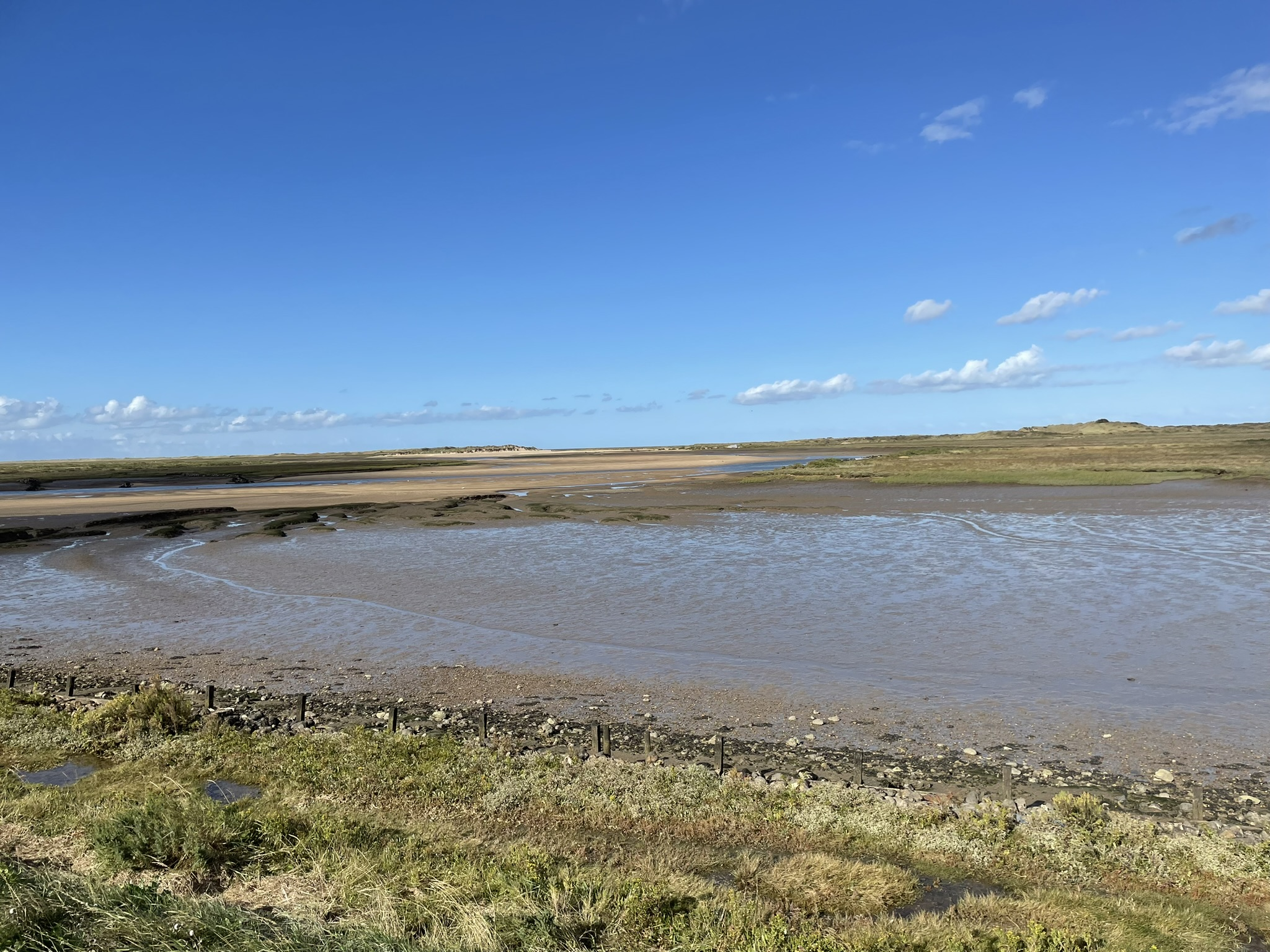
Burnham Overy Staithe harbour. My photo.

Yes, but how’s the book coming, you ask? I’m about 30,000 words into the first draft of what’s going to be the most complex book(s) I’ve ever tackled. It’s already clear it isn’t one book. I thought there were four point-of-view characters. Ha! I’ll be lucky to get through the story without adding at least another four. I’m borrowing from the Hanseatic League, medieval universities, Byzantium-North African-Arabic interaction, 12th C silk roads trade, intellectual exchange around the entire Mediterranean, the Mongol invasion of both the middle east and eastern Europe, Genoa’s near trade monopoly in the eastern Med, and the first crusade. All I can do is trust the process – do the research, let it marinate, and write down the words my characters dictate.

This are the tentative covers for the first two books. If it turns out to be more than a duology, the theme is easy to work with.

You may have noticed I’m not doing many updates here now. I will try to do monthly ones, but a much easier way to keep up with what I’m writing – short stories, poetry, non-fiction and a chance to read Empress & Soldier for free as a serialized novel – is to join me on Substack. My fiction site is History & Imagination; my non-fiction site is Landscapes of Memory.

Until November (I hope).

Marian

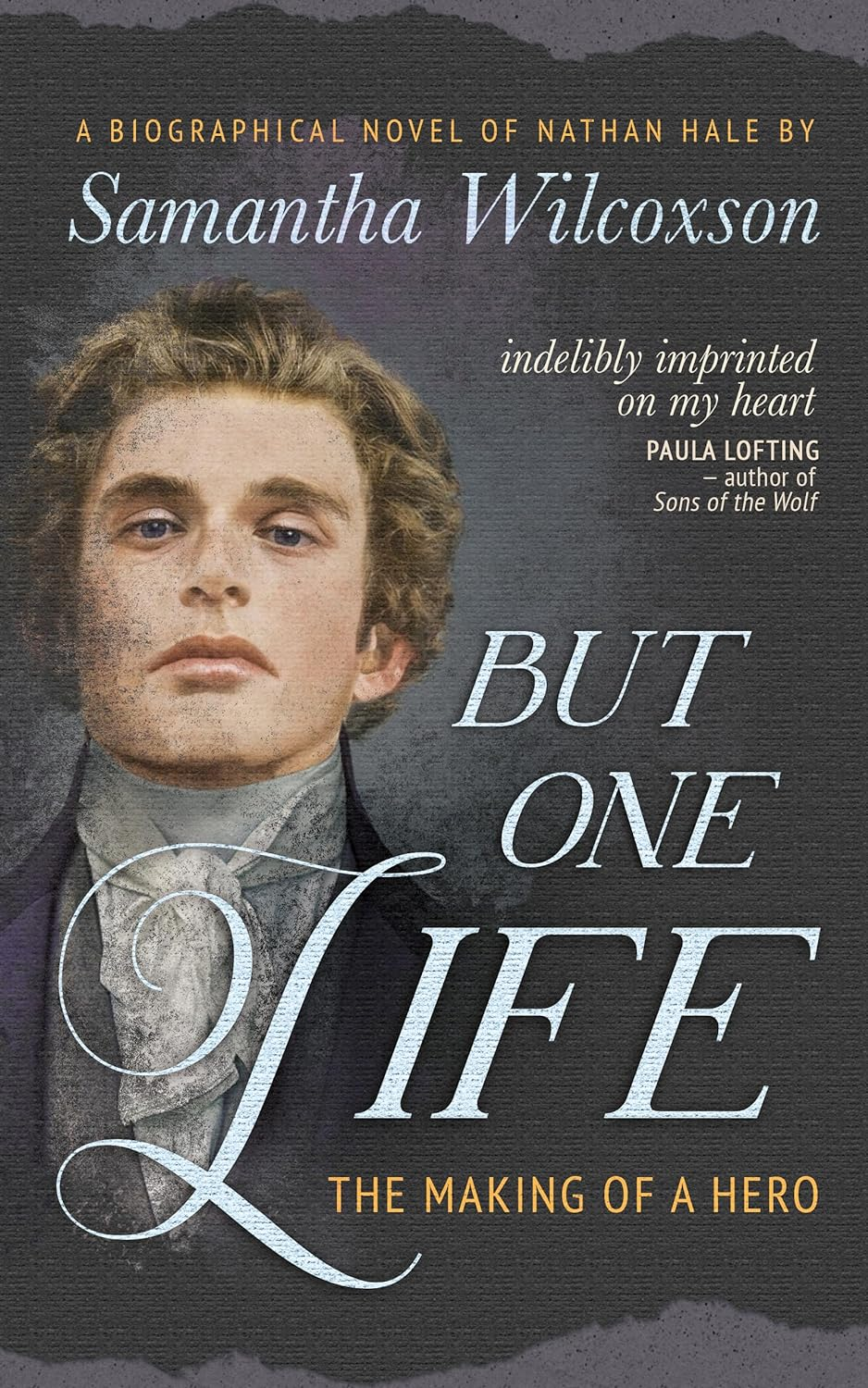
But One Life, by Samantha Wilcoxson

“If I had ten thousand lives, I would lay them all down.”

In the early 1770’s, Nathan Hale is a young philosophy student at Yale. There, he, his brother, and their friend, Ben Tallmadge, are busying themselves with intellectual debate and occasional mischief.

Only too soon, their patriotic ideals of revolution and liberty would be put to the test. Forced to choose between love and duty, young Nathan has to face the harsh personal cost of deeply held beliefs as he leaves to become Washington’s spy.

In this powerful novel of friendship and sacrifice, Samantha Wilcoxson paints a vivid portrait of a young man’s principled passion and dedication to his ideals, turning the legend into flesh and blood.

This is the touching and thought-provoking story of how an ordinary boy grew into an extraordinary man – an American hero.

My Review

Samantha Wilcoxson’s But One Life, a biographical novel of Nathan Hale, is thoroughly and deeply researched, immersing the reader in a convincing, detailed recreation of late 18th century colonial life in the United States. The influences on Hale’s life are clearly delineated: faith, bolstered by his brother Enoch’s even deeper religious conviction; classical thought (translated through a popular play of the time, Joseph Addison’s Cato), and the beliefs fostered and developed through debate and discussion during his years at Yale, especially in the Linonian Society.

Hale is a hero to many citizens of the United States, for his actions and his attributed last words: I only regret that I have but one life to give to my country – but he is also a tragic figure, a young man who allowed his impatient desire to contribute to the colonists’ War of Independence against Great Britain to be his downfall.  Unsuited for the role he takes on, untrained and working against his friends’ advice, his bold gesture of patriotism results in his death by hanging. Wilcoxson does not shy away from this interpretation, showing Hale’s actions in his last days as they were: naïve and bound to fail.

Wilcoxson’s novel fleshes out Hale’s life with a writer’s imagination, although only a failed romance strays far from the established facts. Hale’s life may have been one lived in a limited geography, but the ideas of thinkers and statesmen travelled to his world, as did news of the clashes between colonists and British troops even as early as his years at Yale. Here lies my only quibble with But One Life: other than reports of two uprisings involving violence, very little background into the causes of the growing frustration of the colonists with Britain is given: the Stamp and Townsend acts, resulting in taxation without representation; the Port Act, and the insistence by the British parliament that they had political control of the colonies. The discussions at Yale, especially in the Linonian Society, could have provided an ideal vehicle for background, which, while it may be familiar to readers educated in schools in the United States, may not be to readers from other countries.

Nonetheless, But One Life is a solid, well written biographical novel of a man seen by many as an American hero. Recommended.

ABOUT THE AUTHOR

Samantha Wilcoxson is an author of emotive biographical fiction and strives to help readers connect with history’s unsung heroes. She also writes nonfiction for Pen & Sword History. Samantha loves sharing trips to historic places with her family and spending time by the lake with a glass of wine. Her most recent work is Women of the American Revolution, which explores the lives of 18th century women, and she is currently working on a biography of James Alexander Hamilton.

Try the Leopard’s Mouth, by Charles Moberly: A Review

Try the Leopard’s Mouth is the story of a man with two dangerous obsessions: one with a country, and one with a woman. Tom Etheridge is a young man who takes a job in Rhodesia towards the end of Ian Smith’s government, at first working as a salaried farm manager but quickly wanting to become his own man and farm his own land. He lacks the capital to do so, but through the intervention of a friend is introduced to the daughter of the owner of the local hotel, the informal club of the white population of the area. Rapidly becoming obsessed with Briony, he trusts her when she tells him she can, through family connections, arrange financing for his farm.

While Tom falls in love with both the land and the woman, both are becoming increasingly dangerous. Briony has her secrets, and between his obsession with her and his desire to farm, he ignores the inconsistencies and nagging doubts, and becomes the owner—perhaps—of Chingwele.

Among the more typical crops of a Rhodesian farm, Tom and Briony are also growing tancava, a (fictional) local plant known as goat’s ear which, when ingested, allows people to function without food or drink for many days. Locally used during illnesses to mitigate dehydration, its use by military or para-military organizations means a potentially large market, one Briony appears eager to pursue.

As the battle for what will become Zimbabwe heightens, Tom is caught in the middle. Slowly he realizes Briony is not who she seems to be, nor is his friend Jamie, not entirely. But just who, exactly, are they?

Moberly neatly parallels Tom’s two obsessions. The white population of Ian Smith’s Rhodesia were said to be ‘more English than the English”, clinging to ideas and behaviours already disappearing in the ‘mother country’. Briony is fixated on her dead mother, wanting to emulate her and her relationship with Briony’s godfather, a man slowly revealed to be both controlling and corrupt. Like the beautifully described Zimbabwean landscape, Tom can wish to be fully a part of her life, but neither she nor the land can truly belong to him.

Sympathetic to the injustices of colonialism but acknowledging the problems and divisions of establishing self-government, Charles Moberly creates a fairly balanced view of a country in a time of reluctant and sometimes violent transition. Tom is both a perpetrator and a victim, a man caught in events and in relationships more complex than he can navigate. Fans of Wilbur Smith are likely to enjoy Try the Leopard’s Mouth.

About the author

Charles Moberly’s novels are different from one another in style and genre. He likes to push boundaries, and to address subjects rarely covered by other writers. If there is a common theme, it is tension arising from misunderstandings.

His blog is https://charlesmoberlyauthor.blogspot.com.

Moberly has written three novels to date: The Scrotum Toad, a satirical comedy (Winner of A Chill with a Book Reader Award); The Corncrake, a historical novel set in 1909-10 and 1914-15, (Winner of a Chill with a Book Premier Award); and Try the Leopard’s Mouth, a romantic thriller with a firm historical base (Winner of a Highly Recommended Award by The Historical Fiction Company).

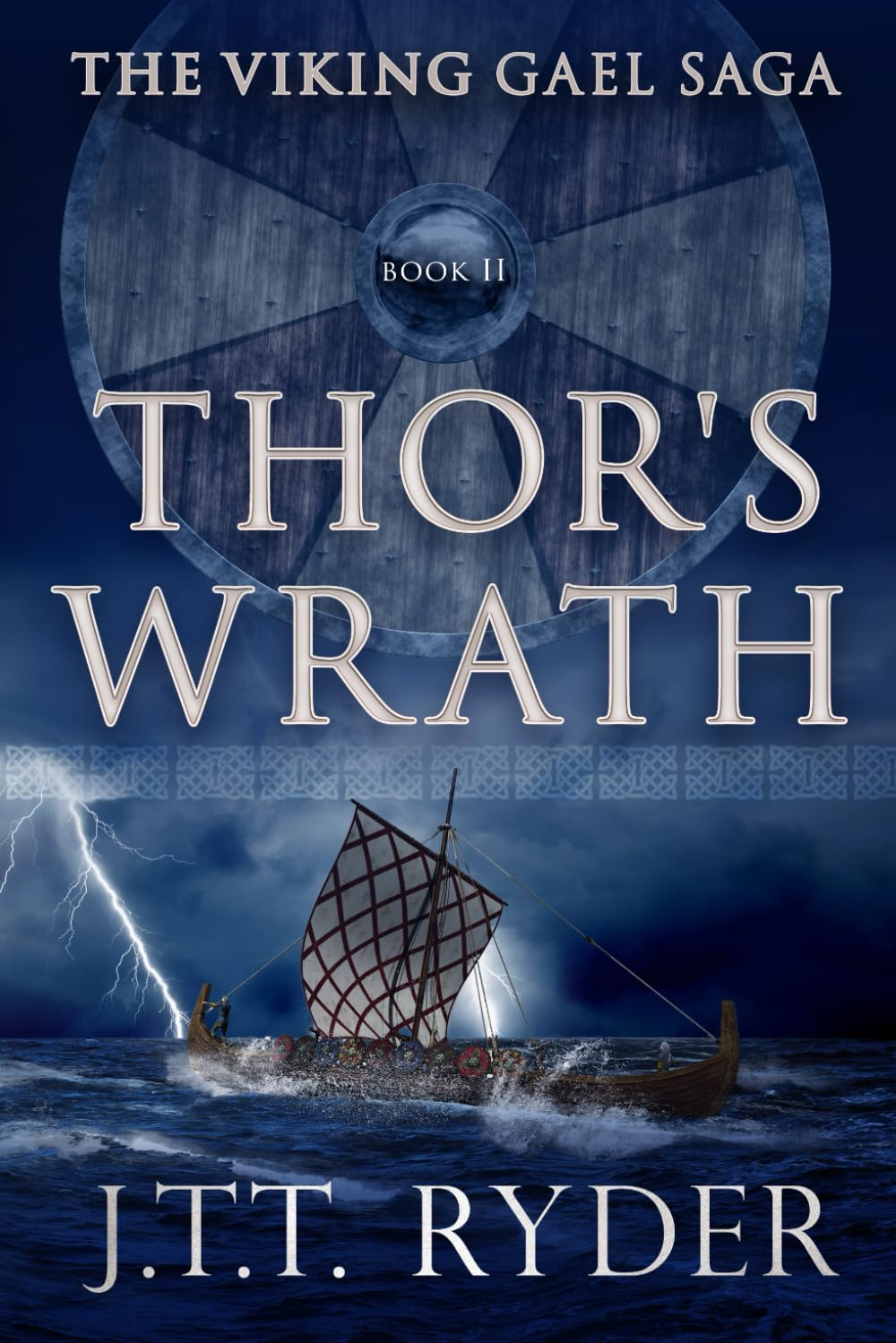
Thor’s Wrath: Book II of the Viking Gael Saga, by J. T. T. Ryder: A Review

When we left Asgeir in book 1, he had saved his life (and his cat) but lost his honour. Now, as Harold Finehair works to unite Norway, Asgeir lands in the Orkneys, into conflict and battle: a chance for Asgeir to overcome his shame and redeem himself in his eyes and his gods.

J.T.T. Ryder continues to draw on his extensive knowledge of the history and archaeology of the setting – both time and place – in recreating a 9th century north-western European world. While Asgeir (and his compatriots) worldview is not ours, it is convincing: enmity and friendship flipping back and forth; the importance of personal honour; the role of single combat over warfare. This is a world of foresight, of visits from gods, of visions and portents–all are real, all are to be taken seriously.

The story moves quickly; the reader and Asgeir together are given little respite as threats are overcome, peace is agreed, only for another threat or a betrayal to begin the action again. Ryder’s writing is sometimes lyrical, especially in his place-based descriptions: ‘A whirlwind of puffins blackened the sky over the rocky, chilly islet… Mist shrouded the horizon like unspun wool, and the wind bit as remorseless as a fox…” In other places it echoes the alliteration of the sagas: ‘shocked him with sleet sideways.’ Even the occasional unusual word choice adds to the story, creating a sense of a world different from ours, refracted through time and distance.

The story is perhaps Ryder’s best, the complexity of Asgeir’s choices and of his thinking deepening as the youth matures into manhood. The telling is excellent. The editing, I am sorry to say, is less so.

(I dislike on-screen reading, so whenever possible I buy the paperback, so these comments pertain to the first paperback edition published in 2023.) I am tolerant of a certain number of typographical errors: they appear in even the best edited books, traditionally published or independent. But repeated sentences, repeated scenes, should not. Nor should a leg of lamb in one paragraph become a leg of pork in another. These errors spoke of a rushed production, an incomplete editing process, and one, inevitably, that jolts the reader out of the story. A second, corrected edition* is strongly suggested.

But! Thor’s Wrath is still well worth reading, and I look forward to the next book in Asgeir’s saga. (And yes, the cat is still Asgeir’s companion at the end of this installment.)

*Update: correspondence with the author assures me these errors have been or are in the process of being corrected.

The Arrow of Exile

Whether in Rome or a dystopian future, from Norwegian falconers to princes, exile can be a choice for survival, or a forced exodus from everything that is loved. Thirteen stories by thirteen historically-inspired writers (including me), newly out in paperback and Amazon e-book.

‘a delightful collection….I highly recommend’ – Amazon reviewer

WRITING A SERIES by Helen Hollick

What could be easier? You have an idea for a new book, it doesn’t matter what genre – historical fiction, romance, fantasy, crime…The basic plot has popped into your mind and the characters come trooping into your life: the protagonists, the good guys, the bad guys. You start writing, the plot flows and the first draft is done. Then the editing, the cover design, the formatting. The excitement of publication day. Maybe an online launch and a book tour. And then you realise exactly what you have. The first part of a potentially cracking good series.

Now you wish you’d kept notes, details of what your characters were like – in looks and mannerisms. Eye colour, hair colour, tall, short, fat, thin? Their quirks and foibles. Maybe you should have delved into their backstories a bit more? Oh heck – I should have made a note of locations, of the little details. Believe me, unless you intentionally set out to write a series from the very beginning, all these possible continuity pitfalls suddenly appear like wasps at a summer picnic.

Readers notice, or at least, they will when your wonderful series takes off and the demand comes for ‘More!’

When I wrote Sea Witch, the first of my Captain Jesamiah Acorne nautical adventure voyages, I intended it to be a one-off tale, (not helped by my ex-agent who had no faith in it  – hence the ‘ex’!) But readers loved it (and Jesamiah,) so I had to write another adventure for him, then a third… I’m in the process of starting the seventh full length yarn. And I wish I’d made more notes along the way.

Lesson learned, I keep notes for my Jan Christopher Cosy Mystery series (that’s coZy in US spelling). The location for the episodes set in the north-east London suburb of Chingford are not a problem as it’s where I used to live and work in the public library back in the 1970s. Apart from the roads where murders happen, all the streets and places are the real thing. (I’ve made the murder locations up, though, in case of any residents’ sensitivity.) The library itself, South Chingford, was an actual place. The building still exists but the local council closed it as a library several years ago (shame on them!) and it is now used as offices. I’ve quite enjoyed bringing the old place back to life; remembering all the goings-on during the thirteen years I worked there. The characters, however, are entirely made up – although several of Jan’s anecdotes are partially biographical.

I decided to deliberately alternate location settings between each book, primarily because I was torn between writing about Chingford as it was, and my present life here in glorious North Devon … so episode 2 (A Mystery of Murder) saw Jan and boyfriend Detective Sergeant Lawrence Walker visiting his parents for Christmas 1971, who live in the fictional village of Chappletawton. Based on my village – but not quite the same.

All well and good, but by the time I got to episode 4 –which again sees a return to Devon, I had to ensure I had the right place names, the right village residents … was Bess, the dog, a black or golden labrador? What had I called the neighbouring farmer? And even more important, which characters leant themselves to becoming possible murder suspects and which ones were reliable witnesses?

I think I’ve managed to tie everything together in A Meadow Murder, introducing new characters, revisiting previous friends, and remembering to make notes for the next planned instalments…

ABOUT A MEADOW MURDER

A Meadow Murder is the fourth tale in the Jan Christopher cosy murder mystery series, the first three being A Mirror Murder, A Mystery of Murder and A Mistake of Murder… see what I’ve done there? Yes, I’ve created a proper puzzle for myself because now every tale in the series will have to follow the same title pattern of ‘A M-something- of Murder’ (Suggestions welcome!)

Based on working as a library assistant during the 1970s for almost thirteen years, the mysteries alternate between the location of Chingford, north-east London, where the real library I worked in used to be, (the building is still there, but is, alas, now offices) and my own North Devon village, but slightly fictionized. Chappletawton, for instance, is much larger than my rural community and has far more quirky characters, (and we haven’t had any real murders!)

The main characters, however, remain the same: Jan Christopher is the niece, and ward, of Detective Chief Inspector Toby Christopher and his wife, her Aunt Madge. In A Mirror Murder, Jan (short for January, a name she hates) meets her uncle’s new driver, Detective Constable Lawrence Walker. Naturally, it is love at first sight … but will an investigation into a murder affect their budding romance?

We find out as the series continues: Episode Two takes the young couple to spend Christmas at Laurie’s parents’ old farmhouse in Devon, while Episode Three sees us back at work at the library in the north-east London suburb of Chingford. We yet again travel to Devon for Episode Four – A Meadow Murder. And no spoilers, but the title is a little bit of a giveaway!

I had the idea for A Meadow Murder during the summer of 2022, while watching our top meadow being cut for hay. The cover photograph for A Meadow Murder is my field – a real Devonshire hay meadow, and the scenes in the story about cutting, turning and baling the hay are based on how we really do it. (Even down to the detail of the red Massey Ferguson tractor.)

In fact, I’m very glad that we cut and brought in our 480 bales of hay this year back in June when it really was a case of ‘make hay while the sun shone.’

I am relieved to say, however, that we didn’t find a body…

“As delicious as a Devon Cream Tea!author Elizabeth St John


“Every sentence pulls you back into the early 1970s… The Darling Buds of May, only not Kent, but Devon. The countryside itself is a character and Hollick imbues it with plenty of emotion” author Alison Morton


*
Make hay while the sun shines? But what happens when a murder is discovered, and country life is disrupted?


Summer 1972. Young library assistant Jan Christopher and her fiancé, DS Lawrence Walker, are on holiday in North Devon. There are country walks and a day at the races to enjoy, along with Sunday lunch at the village pub, and the hay to help bring in for the neighbouring farmer.

But when a body is found the holiday plans are to change into an investigation of murder, hampered by a resting actor, a woman convinced she’s met a leprechaun and a scarecrow on walkabout…

Buy Links – Paperback or e-book, including Kindle Unlimited

Amazon Universal Link: this link should take you direct to your own local Amazon online store https://mybook.to/AMeadowMurder

Also available worldwide, or order from any reliable bookstore

All Helen’s books are available on Amazon: https://viewauthor.at/HelenHollick

ABOUT THE AUTHOR: HELEN HOLLICK

First accepted for traditional publication in 1993, Helen became a USA Today Bestseller with her historical novel, The Forever Queen (titled A Hollow Crown in the UK) with the sequel, Harold the King (US: I Am The Chosen King) being novels that explore the events that led to the Battle of Hastings in 1066. Her Pendragon’s Banner Trilogy is a fifth-century version of the Arthurian legend, and she writes a nautical adventure/supernatural series, The Sea Witch Voyages. She has also branched out into the quick read novella, ‘Cosy Mystery’ genre with her Jan Christopher Murder Mysteries, set in the 1970s, with the first in the series, A Mirror Murder incorporating her, often hilarious, memories of working as a library assistant.

Her non-fiction books are Pirates: Truth and Tales and Life of A Smuggler.

She lives with her husband and daughter in an eighteenth-century farmhouse in North Devon, enjoys hosting author guests on her own blog ‘Let Us Talk Of Many Things’ and occasionally gets time to write…

Website: https://helenhollick.net

Subscribe to her Newsletter:  https://tinyletter.com/HelenHollick

Main Blog:  https://ofhistoryandkings.blogspot.com/

Facebook: https://www.facebook.com/helen.hollick

Twitter: @HelenHollick  https://twitter.com/HelenHollick

An Imagined History

The Scots of Dalriada: Fergus Mór by Rowena Kinread

Feargus Mòr Mac Earca may have been a 5th century ruler of Dál Riata, the Gaelic kingdom that encompassed parts of modern-day Scotland and Ireland. While there are doubts about his historical authenticity – think of him as somewhat more historical than Arthur and at about the same level as Ragnar Lodbrok—the kings of Scotland from Kenneth MacAlpin onward claim descent. With few contemporary records to go by—most of what is written about Fergus Mòr is from many generations later—author Rowena Kinread is free to imagine and enlarge his story.

The jealousies and conflicts among the rulers and potential heirs to various 5th century kingdoms are believable, a portrait of the complex and shifting loyalties among the boys of one family, when any one of them could be determined to inherit the kingdom: it went to the most worthy, not the oldest, by the decision of a council. Brother could turn against brother—or stand by his side in support. Nor does Kinread shy away from the violence and brutality of the time, whether in war or in casual violence against both men and women—and from both men and women.

The book’s style is unusual, passages of present-tense, omniscient narration interspersed with scenes that are largely dialogue. (I did wonder if Kinread was attempting to echo the way some English translations of the Ulster cycle are presented, the way Dorothy Dunnett echoed first the sagas and then ecclesiastic writings in King Hereafter, her imagined history of Thorfinn, Earl of Orkney.) Within the narration are some lovely descriptions: ‘the leather bridles…polished until they shine like dogs’ noses.’ While most of the book’s action unfolds in a linear timeline, the first eight chapters do not follow this pattern—pay attention to the chapter headings! 

The Scots of Dalriada: Fergus Mór is published by Vanguard Press, one of the imprints of Pegasus, a hybrid publisher in the UK. Their editorial team has done the author no favours. Typographical errors are too frequent – I counted six within seventeen pages. The use of modern or otherwise anachronistic terms—a pregnant character refers to ‘the first trimester’—jolted me out of the story many times, as did inaccuracies in the setting: ‘vultures circling’. (Ravens, yes. Vultures in the northern UK, no.)  

Kinread’s imagined history of Fergus Mòr’s rise to power and the eventual kingship of Dalriada has a good story at its heart, in places effectively told. A better editor could have made it shine.

The Abdication, by Justin Newland: A Review

Justin Newland’s The Abdication is a complex, layered, philosophical novel. Like Philip Pullman’s His Dark Materials, it explores the concept of free will against obedience to an authoritarian higher power: the protagonist, Tula, is seeking the guidance of the angels of the town of Unity in her quest for a spiritual life. To reach Unity, across the forbidden Via Angelica bridge, she must first pass through the human town of Topeth, ruled by avarice and corrupt religious leaders.

The Abdication is deceptively simple, seen through the eyes of a young woman on a journey to understand the visions she has and the voices she hears. The town – Topeth – she believes a haven is instead a place of terror and corruption, turned away from its founder’s vision of a community where human free will can be allowed to grow and develop. The proper expression of free will, she learns, is hard; it is easier to obey a set of rules, even when they are the rules of a vindictive, false religion in league with a destructive, profit-driven elite.

Newland has created a world that feels both familiar and strange. Tula inhabits a world that seems to be ours: there are references to ancient Earth cultures; the flora and fauna are real. The mythology of Unity and Topeth is based, in my limited recognition and understanding, on Abrahamic teachings – pre-Christian interpretations of both gods and angels and the powers of both.

Aspects of The Abdication reminded me of two books from my childhood: a youth’s version of The Pilgrim’s Progress, and Charles Kingsley’s The Water Babies: the former for the allegorical obstacles the protagonist must overcome on the journey to the city of their desire and enlightenment; the latter for the motif of the shedding of skins on the way to becoming the purest self.  Throughout the book, the image of winged beings, both helpful and threatening, repeats, reinforcing and reflecting the idea of angels as many people imagine them, and perhaps also suggesting the revelations of the ending.

If I have one niggle with The Abdication, it is the almost non-stop action of the last chapters. For a book asking hard questions about the balance – in a world where gods and angels are real and powerful – between blind obedience and the exercise of free will, there was little time for the reader to contemplate what Tula has learned and the choices she makes. It felt a little like the last chapters of a thriller, where, as the protagonists reach the climax of the plot, rapid reversals leave the reader barely able to draw breath.

Overall, The Abdication is an intriguing book, leaving me with the feeling that if my understanding of the religious underpinnings of its world-and-mythology building was better, I would have found it even more captivating. Even without that, its questions about what free will means and the choices made in its pursuit made it both challenging and compelling.

Justin Newland was born in Essex, England, three days before the end of 1953. He lives with his partner in plain sight of the Mendip Hills in Somerset, England.
Justin gives author talks in libraries and does books signings in Waterstones, WH Smiths and indie bookshops. He has appeared at literary festivals and regularly gives media interviews.
He writes secret histories in which real events and historical personages are guided and motivated by numinous and supernatural forces – that’s history with a supernatural twist.

https://www.justinnewland.com/

Creating King Arthur – in Post-Roman Britain

By Helen Hollick

Pendragon’s Banner Celebration Tour April 2023

Thirty years ago in April 1993, one week after my 40th birthday, I was accepted by William Heinemann (now a part of Random House UK) for the publication of my Arthurian The Pendragon’s Banner Trilogy. It had taken me more than ten years to reach that stage of my dream to become a real writer – more than that if you count that I had been scribbling stories since the age of thirteen.

So why King Arthur? I had never liked the Medieval tales of knights in armour, the Holy Grail and courtly chivalry – I couldn’t stand Lancelot (what on earth did Guinevere see in him?) Why did Arthur go off on a religious quest for so many years? For me, none of those tales had the believability that writers today create in their novels of historical fiction. Arthur and the people of his court, if they existed, (and it’s a very big IF!) had no place in factual history after the Norman conquest of England. Those Medieval tales are merely entertaining stories, with the Holy Grail quest perceived, perhaps, to encourage men to join the Holy Crusades, and maybe the Arthur story mirrors the fact that Richard I spent many years away on his own ‘quest’ and very little time in his kingdom of England.

I was intrigued, therefore, when I discovered that there were earlier tales of Arthur, not only pre-Norman but pre-Anglo-Saxon. These were the Welsh legends, stories and poems of a warlord who fought against the incoming Germanic tribes. To place an Arthur figure during the upheaval and chaos of fifth-century Britain made sense. The period is not known as The Dark Ages for nothing, for written evidence, the whys and wherefores, are few and far between – we are, very much, ‘in the dark’ for the years around 430-550 AD.

So this is when I set my Arthurian tale, it is fiction – let’s face the fact, ‘Arthur’ as a king did not exist. (Sorry!) But even if he didn’t exist the earlier stories about him are wonderfully exciting.

I researched, as well as I could, the detail of post-Roman Britain (no internet back in the 1970s/’80s!) using archaeological evidence to add into the many, many imagined fictional bits, which include the Welsh tales and writing of clerics such as Nennius, who mentioned twelve battles that Arthur (supposedly) fought.

My character of Arthur, therefore, is a fifth-century warlord, passionate about fighting for his rightful place as King, and fighting as hard to keep it. As passionate, is the love of his life, Gwenhwyfar, who in my tale remains loyal to her lord, Arthur, despite their many ups and downs, hopes, fears, achievements and disappointments. Despite their laughter and tears.

I wrote my Arthur as a real man – warts an’ all. He is not the Christian king of the Medieval tales, he is a soldier, leader of the cavalry, the Artoriani, a man trying to sort the chaos Rome left behind, a man living in a world of upheaval, where Christianity is still in a state of embryonic flux, where pagan beliefs are still very much to the fore, and a world where Britain is changing, through battle and peaceful settlement, from a Province of Rome’s authority into the emerging kingdoms of Englalond – Anglo-Saxon England.

But maybe, just maybe, my story as told in the Pendragon’s Banner Trilogy is the base for how the enduring legend of King Arthur really happened…

© Helen Hollick

Helen’s new, self-published, editions with beautiful covers designed by Cathy Helms of www.avalongraphics.org are, alas, only available outside of USA and Canada, where the same books are published by Sourcebooks Inc. (The new covers were offered – free – to Sourcebooks, but the offer was declined.)

ABOUT THE KINGMAKING (Book 1)

The Boy Who became a Man:

Who became a King:

Who became a Legend… KING ARTHUR

There is no Merlin, no sword in the stone, and no Lancelot.

Instead, the man who became our most enduring hero.

All knew the oath of allegiance:

‘To you, lord, I give my sword and shield, my heart and soul. To you, my Lord Pendragon, I give my life, to command as you will.’

This is the tale of Arthur made flesh and bone. Of the shaping of the man who became the legendary king; a man with dreams, ambitions and human flaws.

A man, a warlord, who united the collapsing province of post-Roman Britain,

who held the heart of the love of his life, Gwenhwyfar – and who emerged as the most enduring hero of all time.

A different telling of the later Medieval tales.

This is the story of King Arthur as it might have really happened…

“Helen Hollick has it all! She tells a great story and writes consistently readable books” Bernard Cornwell

“If only all historical fiction could be this good.” Historical Novels Review

“… Juggles a large cast of characters and a bloody, tangled plot with great skill. ” Publishers Weekly

“Hollick’s writing is one of the best I’ve come across – her descriptions are so vivid it seems as if there’s a movie screen in front of you, playing out the scenes.” Passages To The Past

“Hollick adds her own unique twists and turns to the familiar mythology” Booklist

“Uniquely compelling… bound to have a lasting and resounding impact on Arthurian literature.” Books Magazine

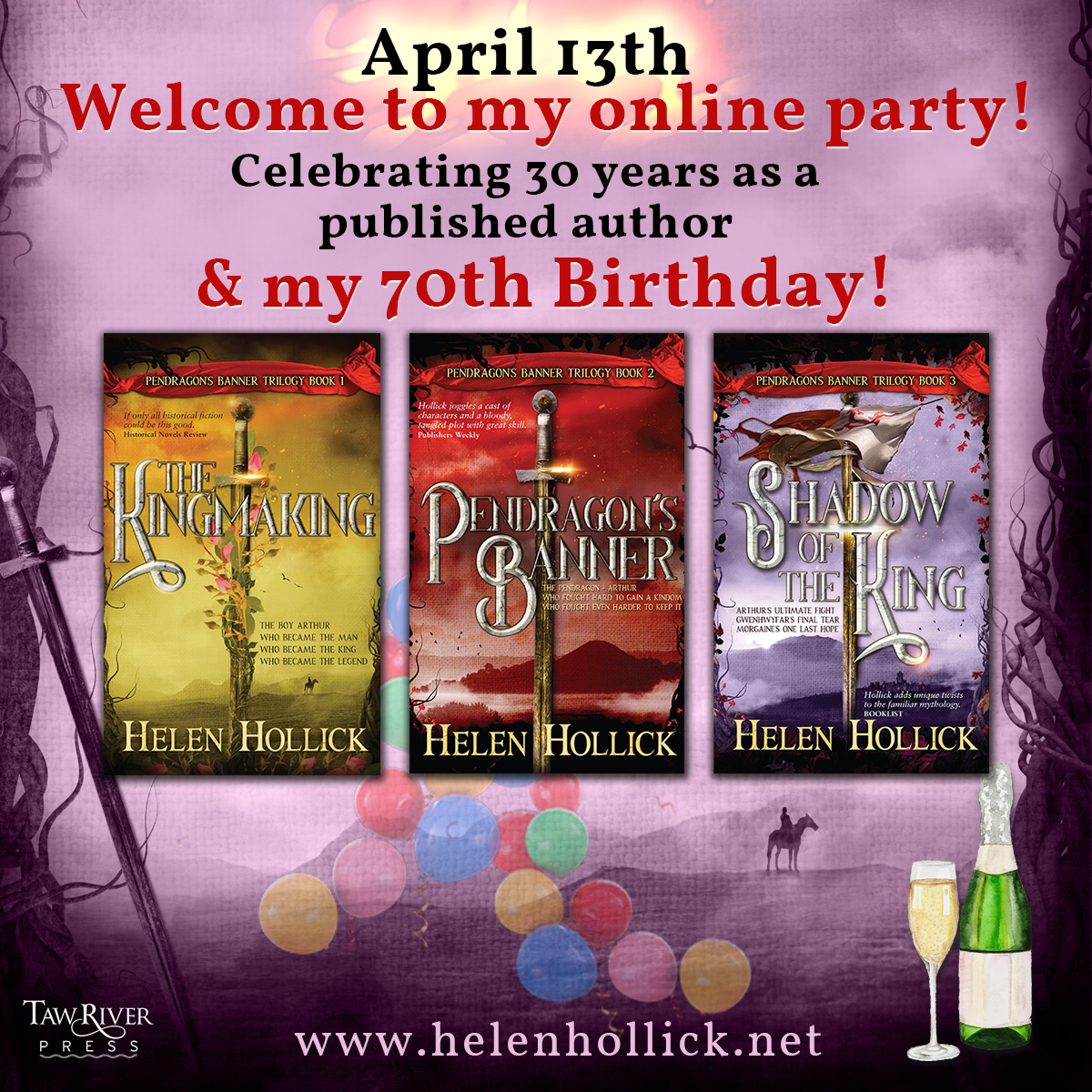
The Kingmaking: Book One

Pendragon’s Banner: Book Two

Shadow of the King: Book Three

(contains scenes of an adult nature)

BUY THE BOOKS:

THE PENDRAGON’s BANNER TRILOGY 

New Editions available worldwide except USA/Canada

https://mybook.to/KingArthurTrilogy

Available USA/Canada 

US TRILOGY: https://www.amazon.com/gp/product/B074C38TXN

CANADA TRILOGY: https://www.amazon.ca/gp/product/B074C38TXN

ABOUT HELEN:

First accepted for traditional publication in 1993, Helen became a USA Today Bestseller with her historical novel, The Forever Queen (titled A Hollow Crown in the UK) with the sequel, Harold the King (US: I Am The Chosen King) being novels that explore the events that led to the Battle of Hastings in 1066. Her Pendragon’s Banner Trilogy is a fifth-century version of the Arthurian legend, and she writes a nautical adventure/fantasy series, The Sea Witch Voyages. She has also branched out into the quick read novella, ‘Cosy Mystery’ genre with her Jan Christopher Murder Mysteries, set in the 1970s, with the first in the series, A Mirror Murder incorporating her, often hilarious, memories of working as a library assistant.

Her non-fiction books are Pirates: Truth and Tale sand Life of A Smuggler. She lives with her family in an eighteenth-century farmhouse in North Devon and occasionally gets time to write…

Website: https://helenhollick.net

All Helen’s books are available on Amazon: 

https://viewauthor.at/HelenHollick

Subscribe to Helen’s Newsletter:  https://tinyletter.com/HelenHollick

Her Blog: https://ofhistoryandkings.blogspot.com/

Facebook: https://www.facebook.com/helen.hollick

Twitter: @HelenHollickhttps://twitter.com/HelenHollick

Follow Helen’s Celebration Tour https://www.helenhollick.net/

The old order changeth…

Yesterday all the planters and garden statuary that my cousin and her partner had collected over their forty years in this house were removed, going to new homes. Nearly at the top of the long sloping garden, one remains, a Grecian figure carrying wine jugs. It draws the eye, now all the distractions are gone.

The house is free of boxes and much of the furniture, too, cleared two days past by the auctioneers. A door long blocked by a bookcase is now open, creating flow and light in the house. There isn’t a lot left to do, except some cosmetic improvements and the slow bureaucracy of probate.

And with the clutter, both mental and physical, gone, my mind is bubbling with ideas and dialogue and scenes for  the book I’ve had to put off for the last few months. There is flow and focus and illumination, thoughts pushing themselves out of my subconscious like the bulbs bursting into bloom in the garden.  

Empire’s Passing, I already know, is a complex, multi-layered book, not surprisingly. The last book of a long saga has a lot of threads to bring together, questions to answer, farewells to be made. The title is a deliberate nod to ‘This too will pass’, the adage that reminds us that all things, good or bad, are fleeting. “For one brief shining moment…” But there will be hope too, at the end.

It’s going to be a challenge. But one I can finally give the time and attention it needs.

Image by Greg Montani from Pixabay