Why I Don’t Write Actual Historical Fiction

In my work-in-progress, Empress & Soldier, the last third of its story overlaps with about a quarter of my third book, Empire’s Exile.  In Exile, we see this section through the eyes of the narrator, Lena, and the characters of the soldier Druisius and the Empress Eudekia are peripheral (although very important) to the story.

But Empress & Soldier is told through the alternating viewpoints of Eudekia and Druisius, and so we are seeing the same events through different eyes – and discovering some those events can have very different motivations and interpretations. That’s not the problem: I enjoy exploring the ‘what ifs’ of different perspectives. But everything that happens in this section of Empress & Soldier must fit the chronology of events in Exile. Actions must occur within a framework that is set. Just like a real historical novelist, I can’t change what has already happened.

For me, working within this constraint is a huge challenge. It’s not how my brain works. I’m used to saying ‘oh, look, I really like how The Battle of Maldon is described, so I’ll borrow that but change its outcome.’  Now I can’t even change a conversation, a dinner served, a walk through the city. At the same time, these things are now background events, most happening off-page. My focus is on what Druisius and Eudekia are thinking, doing, feeling, learning—from and alongside the actions and events that already exist.

Which is, of course, what writers of real historical fiction deal with, in every story—and the more recent the history, the more records of events, the more constraints there are. I am not sure I could do this for an entire book, let alone more than one!

This is how I’m handling it: by a detailed analysis of each chapter (and each scene) in Exile that is reflected in Empress & Soldier.  This is an exacting and layered process that is very different from the creativity of writing, and is remarkably tiring.  But it must be done, and once it is, my mind will switch back to writing mode—and another challenge: how much of Lena’s story do I retell? (Enough for a new reader to understand what’s going on. Not too much, or I risk boring a returning reader. A fine balance.)

I occasionally consider writing a novel based firmly in historical fact. To save my temper, my hair, my liver—and perhaps my marriage— I don’t think I will.

Lady, In Waiting, by Karen Heenan: A release day review.

Robin Lewis – a man who can handle the intrigue and diplomacy of the Tudor courts but prefers his books to people, is skilled enough with words to weave a web with them to save his life but can’t express his feelings, and is no one’s idea of either graceful or handsome – is by far my favourite fictional character from all the books I’ve read in the last few years. Robin is also a man for whom marriage is an unlikely union, especially in middle age, solitary and set in his ways.

But marry he has, to Margaery Preston, an unconventional young woman of intelligence and learning, at her proposal. A marriage of convenience, a compromise that allows Winterset, Margaery’s family estate in Yorkshire, to return to her while allowing Robin, who has rented it for some years, to continue to live there among his books and the isolation he craves.

Written in Heenan’s impeccable prose, Lady, in Waiting is told through Margaery’s eyes – and what a narrator she is!  Robin, many years older than his bride, has one idea of what this marriage should be: in name only. Margaery has another: she wants to be Robin’s wife in all ways. But this is far from the only tension between them: Robin is called back to the court to work for Queen Elizabeth’s principal secretary, William Cecil, and Margaery is to be one of her women, a chamberer, spending her days in the queen’s presence to do her – or her ladies-in-waiting’s – bidding. Neither should speak to the other of what they learn, but which vow takes precedence: the oath to the Queen, or the bonds of marriage?

Margaery’s doubts and fears, her determination, her joys, and her sometimes wry sense of humour: ‘my virginity lingered like a bad cough’ as she grows into both her roles make for compelling reading. As she comes to both understand and love the complex man she has married, she comes to understand herself, as well. As the years progress, Margaery’s life is not always easy. Trauma, loss and grief shape her life as certainly as love and politics, and growth and acceptance are sometimes very hard. Heenan neither glosses over this nor over-dramatizes it, but expresses Margaery’s reactions in a sensitive, realistic way.

The personal story  of Margaery and Robin’s marriage provides the window through which we see the politics of the day: Elizabeth’s possible (or impossible) marriage options ; the unwise, dangerous secret marriage of another Tudor descendent; the implications of Mary, Queen of Scots’ marriage to Lord Darnley. These were important decisions, choices made that had repercussions both personal and political.  The combination of the story that Margaery tells of her marriage and private life, contrasted with these acts on a larger stage, sets the story fully in its time, without robbing it of its intimacy and universality. Highly recommended.

Purchase link: http://Books2read.com/tudorlady

FebruarySheWrote Review Roundup 1

Historical Fiction Reviews (Feb 1 – 12)

A round up of the reviews I’ve reposted for the social media promotion #FebruarySheWrote, highlighting women writers. I’ve focused on historical fiction authors for this month (primarily), and these are all reviews I’ve written, either for this website, or for Discovering Diamonds.

The War In Our Hearts: WWI fiction. ‘The depiction of {Jamie’s} troubled, doubting soul and the courage and resilience of Aveline are the centrepieces of this debut novel’

Discerning Grace: 19th C High Seas adventure. ‘an admirable debut novel, and a beguiling blend of historical fiction and women’s fiction.’

Summer Warrior: 12th C Scotland. ‘both entertaining and informative; a book to be enjoyed.’

Dear Comrade Novak: 20th C Romania. ‘one of the most devastatingly honest and brutal books I have ever read, yet I could not put it down. ‘

The Unseen/The Jealous: ‘mystics and mysteries in 10th-century Baghdad’

A Wider World: Tudor.  ‘prose as close to perfect as it comes, and settings and history thoroughly researched but conveyed with a light touch,’

On Restless Pinions

Imagine, if you will, a child at a table, pen in hand. He, or possibly she, is learning to write a legible hand. But not on paper: on a thin sheet of wood, with ink made from carbon and gum Arabic and a pen with a metal nib.  One side of this sheet has been used, a letter begun and discarded, but the other side is fine for a child to use for practice.

Outside, the soldiers and officers of a Roman fort are going about their business. There are patrols to ride, to keep an eye on the Brittunculi, the soldiers’ derogatory nickname for the native inhabitants. Drills to practice, swords and armour to clean, cooking to be done, board games or dice to be played.

Would the child prefer to be out watching the soldiers drill on the practice field? Or perhaps hang around the stables, breathing in the scent of horse?  No such luck: not when you are the child of an officer. Restless or not, your education comes first.

So you write. Perhaps you are copying, perhaps you are writing from dictation. But here, in this northern fort at the edge of Empire, in the year 100, you are writing a line from Virgil:  interea pauidam uolitans pinnata perurbem (Aeneid 9:473). A line we know, can still read, can still write today. (On restless pinions to the trembling town had voiceful Rumour hied…)1

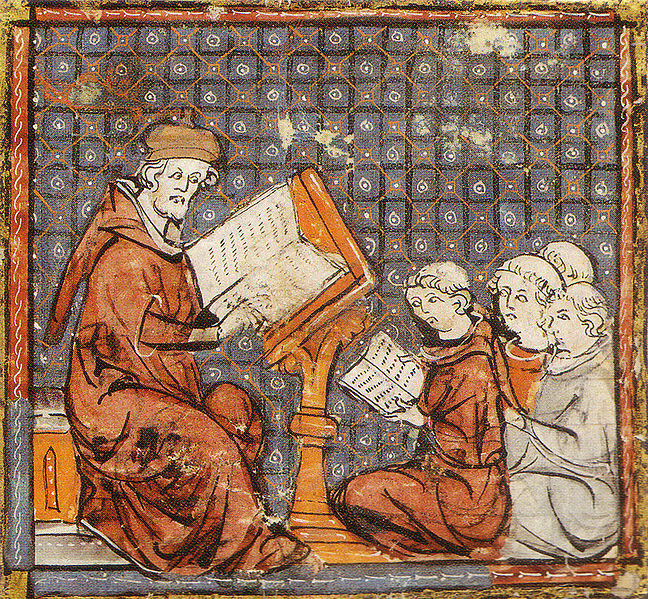
Fájl:Philo mediev.jpg
 Cours de philosophy du Paris; Grande Chroniques de France.  Public Domain

This fragment from Virgil, copied nearly two thousand years ago, is tablet 118 of the Vindolanda letters. From this brief glance into the (probable) life of a child, perhaps one of the children of the Prefect Flavius Cerialis, I have extrapolated: my characters Perras and Cillian use the ‘classics’ in this way as they teach; the children of my books, of the right rank, learn to write a fine hand, and know the words of my world’s equivalent of Virgil and others. Even at a northern fort at the edge of an Empire that never, quite, existed.

Sex and Sexuality in Ancient Rome, by L J Trafford: A Review

Many long years ago, I took courses from a Scottish Studies professor who, hands down, was the most entertaining lecturer I ever had. He combined serious scholarship with stories – sometimes scurrilous – that made us howl with laughter. L J Trafford’s Sex and Sexuality in Ancient Rome fits that model: solid research told in an accessible manner, and it too had me howling with laughter in places.

Divided into sixteen chapters covering everything from ideals of beauty, the sex lives of Emperors, and what constitutes good sex (from the point of view of a Roman male), this is all presented in a fairly light-handed manner. While Trafford does acknowledge that Roman morals and behaviour cannot always be judged by 21st century standards, she also does not shy away from pointing out the inequalities and lack of choice for many Romans, especially those who were enslaved.

I was pleased to see that women’s sexuality was not ignored, as it often is in books on this subject. The information (opinion) still comes from men, who were doing most of the writing at the time, and much of it is as eyebrow-raising as men’s thoughts on women’s sexuality often are…but then we have Ovid, who wrote that mutual pleasure was the goal of sex, and that women’s orgasms were important and desirable. I learned more about women’s sexuality in ancient Rome than any other topic, and for that alone the book was worth reading.

Trafford also shows how some things never change. The sex lives of prominent people, including (maybe particularly) the emperors and their wives, were topics of discussion, and the reputation of many an emperor was dragged in the dirt by the poets, satirists and orators of the day. What we would now view as homophobic slurs were common insults, but this isn’t how the Romans saw it. The gender of your sexual partner was (almost) irrelevant; what position you took – the active or passive partner – was. The passive role was unmanly, and Roman men could not be unmanly. Some of the insults remain the same to this day.

I read Sex and Sexuality in Ancient Rome as a novelist, judging it for its usefulness in world-building. It is full of tidbits that, judiciously adapted, would certainly add to the verisimilitude of historical fiction set in ancient Rome. That along the way I was entertained, educated, but also made to think reflects Trafford’s grasp of her subject as well as her skill as a writer. Highly recommended.

Spotlight on: The Sins of the Father, by Annie Whitehead

The Sins of the Father: Tales of the Iclingas Book 2 by [Annie Whitehead]

The Sins of the Father is out today, September 15th!                                        

Here’s the author to tell us a little about this long-awaited sequel to Cometh the Hour.

The Sins of the Father is the follow-up to my novel Cometh the Hour, about Penda, the last pagan king of Mercia, his struggles to achieve and maintain independence from the aggressive kingdom of Northumbria, and his quest to avenge his kin, especially his womenfolk.

Now, his sons have come of age, as have the children of Penda’s nemesis in Northumbria. All of them are affected by their fathers’ antipathy. The new novel tells the stories of the members of this next generation, and how they try either to emulate their fathers, or plough their own paths, and how this leads to tension and, ultimately, war.

Matters have been complicated by the fact that some of these children have married into the other family, thus blurring the lines of loyalty.

From this tangled web Ethelred, the youngest of Penda’s children, a boy when all the major battles of the first book occurred, feels he has less investment in the feud, but this leads to massive guilt on his part that he might let his kin down by his lack of ambition. He sees his warrior brother wearing their father’s mantle, feels cold in that large shadow, and all he really wants to do is live quietly with his Welsh love.

Fate intervenes when, just as in his father’s day, the womenfolk of Mercia must be avenged. Now Ethelred’s task is to end the feud, once and for all. Can he honour his father’s memory yet keep his conscience clear, and find his way back to his Welsh love?

What few have realised is that wars are not always fought by men on the battlefield, and the daughter of the Northumbrian king has been given a deadly task of her own. Will she become the murderer that her father and brother wish her to be, or can she turn away from her heritage? For all involved, the stakes are high and even victory demands a heavy price.

Available from Amazon