October Updates

This past month, when I wake in the night, there’s almost always a tawny owl calling outside – which is a hint that I’m not in Canada. Several things brought us to England in September, largely research for An Unwise Prince, my work-in-slow-progress: a chance to tour a medieval merchant’s house that’s only open a few times a year; the Silk Roads exhibition at the British Museum (and its medieval exhibits); Peterborough Cathedral, built as an abbey in the 13th C, which will become the physical model (more or less) for the school in the new book.

Peterborough Cathedral Precinct. My photo.

But also, of course, the birds, and the long walks, and in the four weeks we’ve been here we’ve had four days of serious rain. Most have been sunny. We caught the last of the summer birds, chiff-chaffs still singing, and the first of the winter migrants, pink-footed geese and redwings, as well as two birds new for the UK for us, yellow-browed warbler and cattle egret. The saltmarshes are washed pink with sea lavender, the hedges are bright with rose hips and hawthorn fruit and blackberries, and filled with red admiral and fritillary and cabbage white butterflies. Deer – roe and muntjac, fallow and Chinese water – browse field edges and park, and on the mud of the marshes probe godwit and golden plover, redshank and curlew.
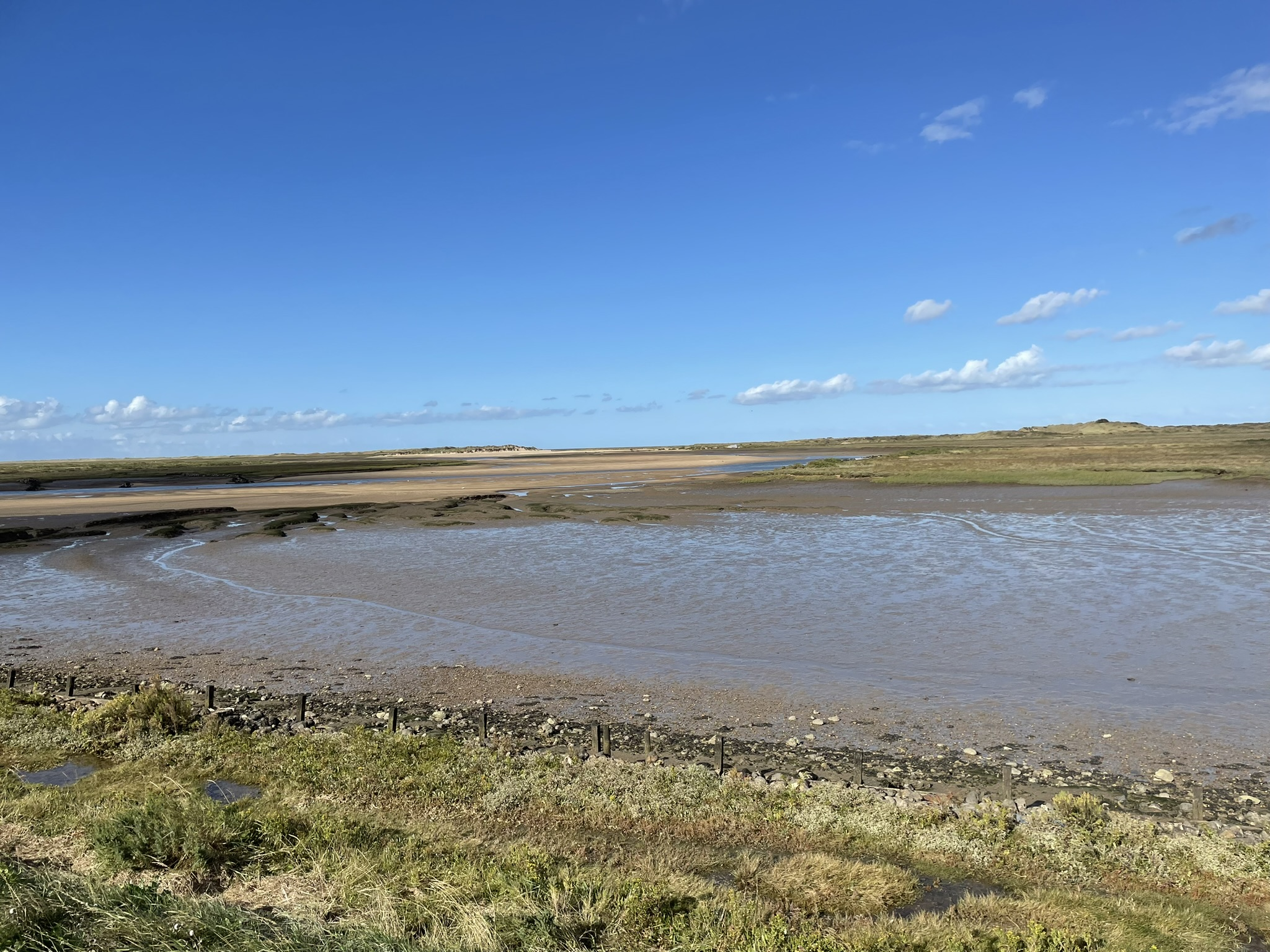
Burnham Overy Staithe harbour. My photo.

Yes, but how’s the book coming, you ask? I’m about 30,000 words into the first draft of what’s going to be the most complex book(s) I’ve ever tackled. It’s already clear it isn’t one book. I thought there were four point-of-view characters. Ha! I’ll be lucky to get through the story without adding at least another four. I’m borrowing from the Hanseatic League, medieval universities, Byzantium-North African-Arabic interaction, 12th C silk roads trade, intellectual exchange around the entire Mediterranean, the Mongol invasion of both the middle east and eastern Europe, Genoa’s near trade monopoly in the eastern Med, and the first crusade. All I can do is trust the process – do the research, let it marinate, and write down the words my characters dictate.

This are the tentative covers for the first two books. If it turns out to be more than a duology, the theme is easy to work with.

You may have noticed I’m not doing many updates here now. I will try to do monthly ones, but a much easier way to keep up with what I’m writing – short stories, poetry, non-fiction and a chance to read Empress & Soldier for free as a serialized novel – is to join me on Substack. My fiction site is History & Imagination; my non-fiction site is Landscapes of Memory.

Until November (I hope).

Marian

A Book Develops, Part VI

Pages from The Diwan of Al-Mutanabbi,
Khalili Collections / CC-BY-SA 3.0 IGO, CC BY-SA 3.0 IGO https://creativecommons.org/licenses/by-sa/3.0/igo/deed.en, via Wikimedia Commons

Inspiration and understanding can come from the most unexpected sources. In my other blog, which focuses mostly on writing – mine and others’ – about the natural world, I mentioned, a week or two ago, that I was reading a collection of essays about landscape and place called Going to Ground.  One of these essays is by Amina Khan, on the link between Islamic writing about nature and the Romantic movement in English poetry and prose.

My fictional world isn’t ours, but I can’t pretend it isn’t based on ours, and in the cultures I’m writing about, trade with my equivalent of North Africa and the Middle East is an important part of the story. In an earlier instalment of this series, I wrote about my youngest point-of-view character, Audun, and his love for the sea and sky and saltmarshes of Torrey, where he grew up. Audun is seventeen, academic, and of course he’s written some juvenile poetry.

Audun, being who he is, is expected to travel, to learn more of the world before he enters a life of teaching, his dream being to eventually be the head of my equivalent of a medieval university. His great-uncle, whom he hopes to emulate, spent a few years in his youth travelling east, gathering histories, settling down to a life of translation and comparison with the histories of the west. Luce, his aunt, is a doctor, much of her learning done in eastern lands as well.

But what Audun was going to learn in those travels (outside of life lessons, of course) I didn’t know. Until I was showering today (why do ideas so often arrive in the shower?) and my mind made the connection between Audun’s love for nature and the Islamic writing Amina Khan described in ‘A Wild Tree Toward the North’, her essay in Going to Ground.

Organized religions don’t exist in my books, replaced by philosophy and personal faiths in a wide range of deities.  But religious writing can also be read for its poetry, and that’s how I’ll approach this. The bonus here is I’ll read some poetry that I probably wouldn’t have otherwise, and my world, like Audun’s, will expand.

Planted in Pennies

‘I’ve been thinking about seeing. There are lots of things to see, unwrapped gifts and free surprises. The world is fairly studded and strewn with pennies cast broadside from a generous hand. But—and this is the point—who gets excited by a mere penny? If you follow one arrow, if you crouch motionless on a bank to watch a tremulous ripple thrill on the water and are rewarded by the sight of a muskrat kid paddling from its den, will you count that sight a chip of copper only, and go your rueful way? … if you cultivate a healthy poverty and simplicity, so that finding a penny will literally make your day, then, since the world is in fact planted in pennies, you have with your poverty bought a lifetime of days. It is that simple. What you see is what you get.’

Annie Dillard, Pilgrim at Tinker Creek

I was hoping for warblers. 8 a.m. May 9th, 15C —there should be migrant warblers feeding high up amongst the sun-warmed buds of maple and poplar. But there were none. The wood was quiet: too quiet, for a May morning.

I can give many reasons for the lack of songbirds – some of then depressing, some simply the nature of migration: after a week or more of rain and cold, we now have clear nights and a moon nearly full – and birds moving north as fast as possible. But my head and heart both know there are fewer birds every year.

I mourn this loss, deeply. I have found myself, this year, strangely reluctant to walk the woods and fields, to witness, aurally and visually, the declining number of birds. Late last year, I read Barry Lopez’s last book of essays, Embrace Fearlessly the Burning World. I was thinking of it as I walked the too-quiet paths this morning.

Because the world is still ‘planted in pennies’, and had I not been out this morning, I would have missed so much. A pair of spotted sandpipers, flying low over the water of the maple swamp, as graceful as swallows. The flash of green and copper of a wood duck; a brown creeper, probing for insects under bark. The osprey breaking off branches for its growing nest on a light standard over the soccer field; the crow devouring a frog (fresh road kill? or predated?) up in a dead tree. None of these sights are ‘chips of copper only’, but glints and glimpses to be treasured in the moment and in memory. Embraced, as Lopez says.

Image by brands amon from Pixabay 

There is no life without loss, whether it is the loss of bird species to destructive land use, pesticides, avian flu or climate change, or the loss of those we love to accident, disease, age or simply lives that converge. (This is much on my mind, largely, but not entirely, because it is the major theme of my novel-in-progress.)  But as abundance diminishes, should not the pennies matter more?

There will be warblers, one morning. I still have faith.

You might just like….

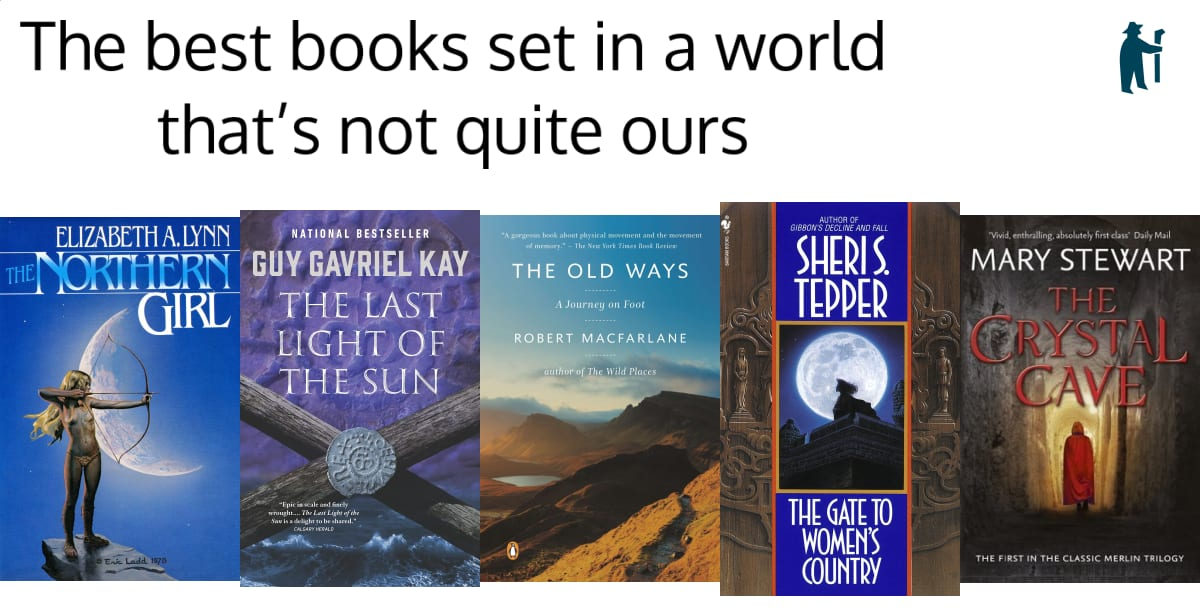
What are all these blue books?

This is my Shepherd.com list (find it at https://shepherd.com/best-books/set-in-a-world-thats-not-quite-ours)

(Hold on, you might be saying. What’s’ not our world’ about the non-fiction The Old Ways, by Robert Macfarlane? Well, it’s a way of seeing the world that isn’t, in my opinion, mainstream, although I wish it were, so I slipped it in. )

And if you’re a reader of my books, you probably think worldbuilding is important, so check out these other recommended books with outstanding worldbuilding.

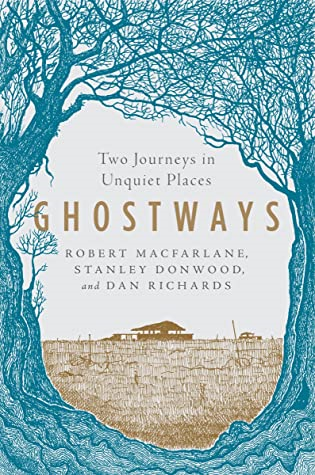
Ghostways: Two Journeys in Unquiet Places

Robert MacFarlane is among my top five favourite writers, fiction or non-fiction. The two pieces collected in Ghostways are very different: Ness, not-quite-a-play, not-quite-poetry, but to my mind meant to be read aloud, explores the depths and layers and secrets of Orford Ness, a shingle spit in Suffolk-a place I know as a birding site and nature reserve, but one that has another history. It is both haunting and disturbing, in the way T.S. Eliot’s Four Quartets are. Its imagery will stay with me a long time.

Holloway, a prose exploration of a deep-worn, sometimes hidden path of Dorset is both a personal journey, a memoriam for fellow author Roger Deakin, and a wider discourse on landscape and meaning. ”Stretches of a path might carry memories of a person just as a person might of a path.” MacFarlane writes, and “paths run through people as surely as they run through places….” As a writer exploring the meaning of memory and place as filtered through grief in my current book, and as a person with a deep interest in how landscapes shape both individual and collective consciousness, MacFarlane (and his co-authors) as always, challenges and inspires me.

Reflection

It’s cool the first morning of fall; 11 C, and cloudy. Yesterday at this time the temperature was rising into the 20s, and my shirt was sticking to me, the humidity was so high. But autumn blew in last night, right on schedule, and today is completely different.

On the banks of one of the ponds, where yesterday frogs made regular plops in the water as I walked, nothing moves. Too cold for frog activity; soon they’ll be burrowing into the mud on the pond’s bottom to hibernate. The woods are strangely silent, except for the calls of chickadees foraging overhead, whereas yesterday the screech of blue jays was about all I could hear.

Image by Brigitte Werner from Pixabay 

It wasn’t just me scaring frogs yesterday. A lone jay was feeding on the far bank of the pond, gleaning insects from fallen branches and the webs of caterpillars, sometimes dropping into the scatter of leaves to push them aside for whatever lived underneath them. When it got close to the water, a frog leapt, kaleidoscoping the reflection of sky and leaves for a minute before the ripples settled and the mirror returned.

The jay called, constantly. I wondered what it was saying: food here? Or, where is everyone? It’s rare for me to see a lone jay at this time of year; usually they’re in family groups, or even larger flocks, flying along fencerows from woodlot to woodlot, zig-zagging across a landscape, staying close to shelter. And not quietly.  The jay’s harsh call is a backdrop to most fall walks.

The foraging lone jay finished feeding and flew, its feathers refracting the sunshine as a brilliant blue. I watched its reflection in the dark water of the pond, then followed the real bird to where it landed: a maple branch overhanging the bank. It stopped calling then. I moved on.

Image by Brigitte Werner from Pixabay 

Years ago, I was at Point Pelee about this time of year, or perhaps a little earlier. The point is a sandspit jutting out into Lake Erie; it, and the presence of islands about halfway between Ontario and Ohio, make it a migration route for birds and butterflies. It must have been a weekday, because the park was nearly deserted. Along the beaches on either side of the point, the sand was littered with the wings of monarchs, torn off by jays as they fed. Among those red-gold wings were dozens of pairs of jay wings, torn off by Cooper’s hawks as they fed on the migrating jays.

“Cruelty is a mystery…” Annie Dillard wrote; then: “But if we describe a world to compass these things, a world that is a long, brute game, then we bump against another mystery: …beauty, a grace wholly gratuitous…”[1]

Jays as blue as the sky; dying leaves vividly reflected on still water. A red-tailed hawk gyring in the sky, its tail the exact rufous of the autumn oak below it. Scruffy juvenile cedar waxwings, swooping and calling like a gang of adolescent skateboarders as I walk along a gravel path. Grace, wholly gratuitous.


[1] Pilgrim at Tinker Creek