Uncharted Ways

Yesterday I had a discussion with someone regarding what my new book, Empire’s Reckoning, is really about: not its plot, but its theme. Its deeper story, if you will.  (There are no spoilers here; you can keep reading.) “Courage comes in many forms: a hero’s weapon is not always a sword,” I have written in the pre-publication advertising. But that could say: “Courage is seeing a life past betrayal,” because that is closer to the heart of the book.

By betrayal, I do not necessarily mean duplicity, or disloyalty (or not only), but also the tiny betrayals of expectation: expectations of others, of our governments, of our cultures and friends and loves, and, importantly, of ourselves. Of our own best intentions, of our belief in our own abilities and motives and actions. All my main characters but one– and there are five now, in one of the two timelines in the book – face this loss, this realization of imperfection in ourselves and those we love.

My characters react to those betrayals, large and small, external or internal, in different ways, and to say more would be spoiling the story. I began Empire’s Reckoning two summers ago, long before COVID, but I can’t help thinking about its theme now in the face of our collective confusion and sense of betrayal. I’ve written before about how the overall theme of the series is about the power and limits of love to provide shelter and sanctuary in a turbulent world. In Reckoning, I ask that question again, but this time the turbulence is mostly from within, from the breaking of implicit contracts and the shattering of beliefs.

We too have had beliefs shattered, implicit contracts broken as the world grapples with COVID. We too are facing loss, bewildered by the change in our lives. We are afraid, angry, confused, exhausted, but also compassionate, generous, altruistic. We focus on ourselves, and we worry for others. I’m not saying Reckoning is a guidebook to navigating the changed world we find ourselves in. But as I emerge from the cocoon of creating a book, and am thinking more about what the post-COVID world might be, I wonder. Can I be as brave as my characters, and find in this upheaval the guideposts to uncharted ways, to a different way of living in this world?

Moving On

In Neil Gaiman’s 8 Rules of Writing, the one that has always resonated with me is this one: “Remember that, sooner or later, before it ever reaches perfection, you will have to let it go and move on and start to write the next thing. Perfection is like chasing the horizon. Keep moving.”

The tendency to keep refining my work is there. I can agonize over ever word, moving them around, adding, subtracting, to see if my intent is better expressed, if the emotion is stronger, the scene more intense. But if I do that, my books will never see the light of day. And I have more writing to do.

Empire’s Reckoning is done. It’s been structurally-edited, line-edited, revised, copy-edited, beta-read, sensitivity read, revised again, and the first ARCs are out. Twenty-two months of the most difficult writing I’ve done. I threw out the first draft almost completely and began again after 80,000 words. I excised 45K to become the novella Oraiáphon. I had difficulty finding my protagonist’s voice; I had difficulty with the two-timeline structure. And I had difficulty telling the story, because to tell my characters’ stories honestly and authentically, I challenge perceptions and presumptions about them. Not all my readers will be comfortable with how the story unfolds, I think, and that too was another difficulty.

“Move on, and write the next thing,” Mr. Gaiman says, but I can’t, not yet. I need time to let these characters who have lived so intensely in my mind for up to twenty years step back. They’re not disappearing, but they are giving way to the next generation; they will become secondary characters over the next two books in the series. I need time to get to know my new protagonist as an adult, to hear her voice clearly. I know the major story arcs of the next book, political and personal – or at least I think I do – but she needs to be living those conflicts, not being a puppet I move around within them.

I’ve lived, over the past almost-two years, a period of about eighteen months in my characters’ lives, a period for them of intense emotion, political intrigue, and personal growth. When I see them again, they’ll all be four years older, my original main characters feeling the aches – physical and spiritual – of middle age; the young ones the challenges and frustrations that come with taking their places in the world. It’ll be a bit like visiting friends or family you only see once or twice a decade, and get holiday and birthday cards from, but not much else: there will be a lot of catching up to do.

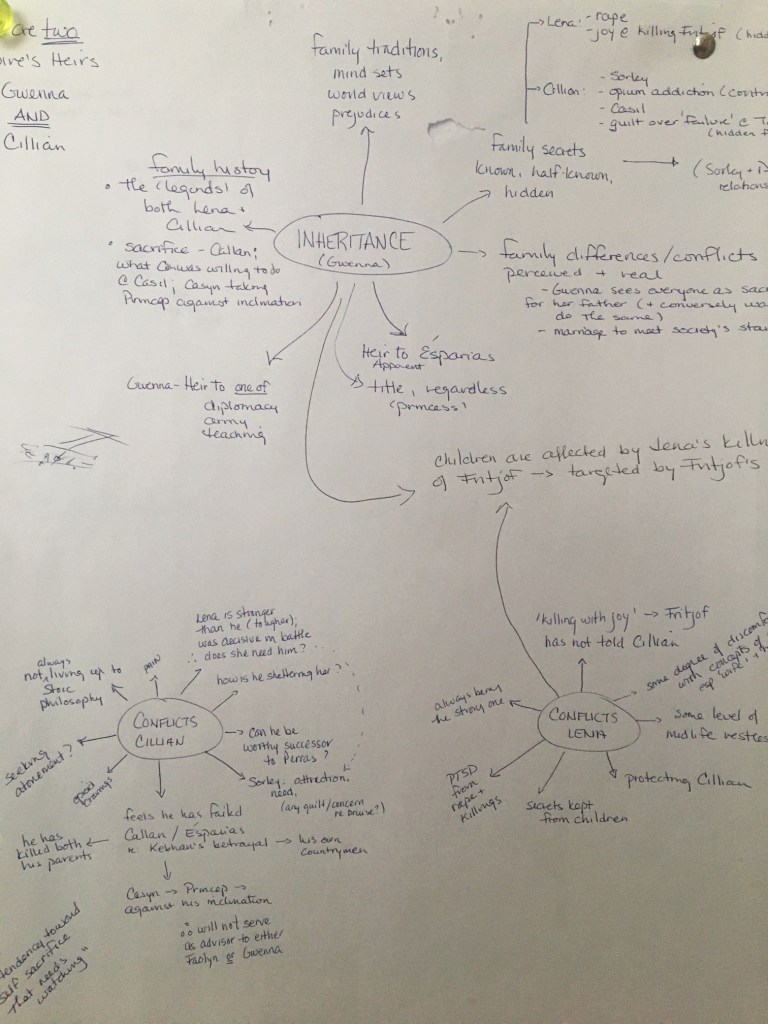
Sometime in the next week or two, I’ll clean up my study. I’ll take down the pictures of the actors that represent my characters at the stage of life they were at in Reckoning, and the pictures of northern Scotland and Vindolanda and Hadrian’s Wall and the Caledonian Forest that have kept me in the landscape of my book. The mindmaps and charts and even the song lyrics that line my study wall will go in a banker’s box and be relegated to the basement. I’ll back up all the files.

And then, in a few weeks, I’ll start replacing them: I’ll find pictures of my new protagonist as a young woman, not the girl she is in Reckoning. I’ll find the pictures of Rome that will inform the streets of Casil, its analogue city in my series and where most of the story of Empire’s Heir will take place. Empire’s Reckoning will be out in the world, for better or worse, and it will really be time to move on. Knowing that, following one more of Neil Gaiman’s rules, I’ve written my story as it needed to be written, honestly, and as best I can.

Empire’s Reckoning releases May 30.

Success & Failure as a Writer

Every so often, usually on Twitter, someone asks the question, “As an author, what do you consider success?”  The answers range from thousands of sales to those who just want to sell a book to someone who isn’t family or a friend.

Pondering the question as I was walking this morning, I realized what success is for me: I no longer feel like a fraud. Writing is my third career. I spent a decade in research; for a short while I was doing cutting-edge research into plant enzymes. I was good at it. I felt like a fraud.

Then I moved to education, and into special education specifically, and for almost twenty-five years that’s what I did. I liked teaching, and I liked (most) of what I did as a special education consultant. I was good at it. I felt like a fraud.

Looking back, I know why. My heart was never in any of it, not truly. I wanted to write. I always wanted to write. I did write, but fear of failure and fear of what – condescension? pity? – kept me from submitting anything. Until somewhere in my late 30’s, when I was mature enough to say, ‘I’m doing this.’

My first small successes came as a poet, with acceptances to little journals. Then the first novel, accepted by a small publisher. My fifth title comes out at the end of May. The books have a niche audience and moderate sales. That doesn’t matter: that’s not how I measure success. Failure was ignoring what my heart told me I should be doing.

And I haven’t felt like a fraud since Empire’s Daughter went out to the world in 2015.

No End of Things in the Heart

…And the wind lifting the song, and interrupting it,
Tossing it up under the clouds.

And all this comes to an end,
And is not again to be met with…

Exile’s Letter, by Li Po ( c.760 AD), translation by Ezra Pound

I’ve been thinking, perhaps not surprisingly in a life where we are all estranged from normalcy just now, about the concept of exile.  It is the dominant theme in my series Empire’s Legacy, although it is explored most strongly in Empire’s Exile and the upcoming Empire’s Passing. I read a number of poems and stories about exile while I was writing Empire’s Exile; about physical banishment, but also about spiritual and psychological exile, because the book isn’t just about being physically outcast. Some of those expressions of exile stayed with me more than others, no more so than a small excerpt from the Chinese poet Li Po’s greatest poem: the idea of a random wind, a random act, (a random virus?) interrupting an idea or a life, ending joy. Very close to the end of my book, I echoed his thoughts in these lines:

A gust of wind rattled the grasses. If he replied, I did not hear the words. I raised my head for one last, long kiss, and then he stood, holding out his hand.

“Time does not stop,” he said, “for all we wish it might.”

Homage to a great poet, but also a purposeful echo. Not one I expect one reader in a thousand to hear, but that’s all right. Sometimes the influences are more obvious; sometimes they’re subtle.

In my 2020 release, Empire’s Reckoning, there is a stronger echo of a classic tale of exile, purposely done. I was acknowledging the importance of a certain – what? – story, mythology, archetype? – in my soul, when I chose to do this. In this case – and I’m not going to tell you what it is – it influenced both how the plot develops and a specific setting in the story. Some readers will see it. Some with recognize a familiarity but won’t quite identify its source. Some may do neither. All of this is, again, all right. Books speak to us on different levels, and writers write on different levels, too, and sometimes we don’t fully know what those are. But it too is about exile.

Edward Said, in Reflections on Exile and Other Essays, wrote

“exile is…the unhealable rift forced between a human being and a native place, between the self and its true home: its essential sadness can never be surmounted. And while it is true that literature and history contain heroic, romantic, glorious, even triumphant episodes in an exile’s life, these are no more than efforts meant to overcome the crippling sorrow of estrangement.” 

“Homesickness swept through me, a wave of longing: cianalas, in my tongue,” my narrator Sorley tells us in Empire’s Reckoning. The crippling sorrow of estrangement; the unhealable rift that only compromise and perhaps a reluctant acceptance can even begin to bridge.

I didn’t know I’d release this book into a world forced into involuntary separation and distance, ravaged by political differences, challenged by climate change. We all became homesick now, longing for the world we had.  In Li Po’s translated words, again:

If you ask how I regret that parting?

It is like the flowers falling at spring’s end,

Confused, whirled in a tangle.

What is the use of talking? And there is no end of talking—

There is no end of things in the heart.

Featured Image: Marram Grass & Heather: By Peter Standing, CC BY-SA 2.0, https://commons.wikimedia.org/w/index.php?curid=12285747

Time & Project Management: #authortoolboxbloghop

I used to work in a job so multi-faceted and complex that when I left, I was replaced by two people. I had dozens of projects on the go, several teams of people to oversee, and a huge budget to manage. There is no doubt I worked too hard and too long, and I left burnt out, but I also learned some very valuable lessons in managing time and projects that I still use today in my third career as a writer, editor and the coordinator of a small indie collective press.

I’ll throw in my usual caveats here: I’m in my 60s; no children, and this is what I do full time. I’m not balancing another job, children, elderly parents, house renovations, commuting…life. (I did, though, minus the children, and that’s why my first book took 12 years to write.)

I recognized my lack of organizational skills somewhere in grad school. I have ADHD, which has both its own challenges and its own rewards, the ability to hyperfocus for long periods of time on certain things being the most obvious positive feature (for me). But I needed processes to replace my poor executive function, because without them, it was and is all too easy to be overwhelmed with the amount of work in front of me. And if I get overwhelmed, I simply do nothing.

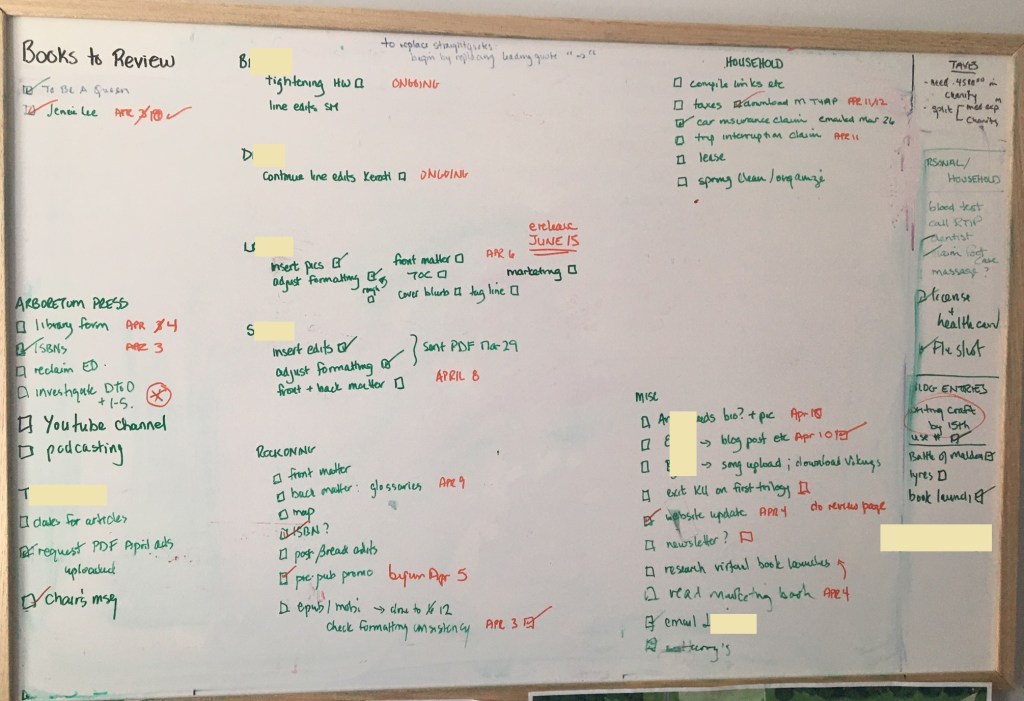
I won’t bore you with a list of the books I read and the methods I tried. Most didn’t work; they required too much time and focus. But I took bits from most of them, and now I have a system that works fairly well. It’s quick and it’s visual, both requirements for me.

As you can see, I use a series of checklists, and a forward-projection of the dates on which each project needs to be completed. This allows me to then subdivide the project into chunks, and schedule those, as well, working backwards from the completion date.

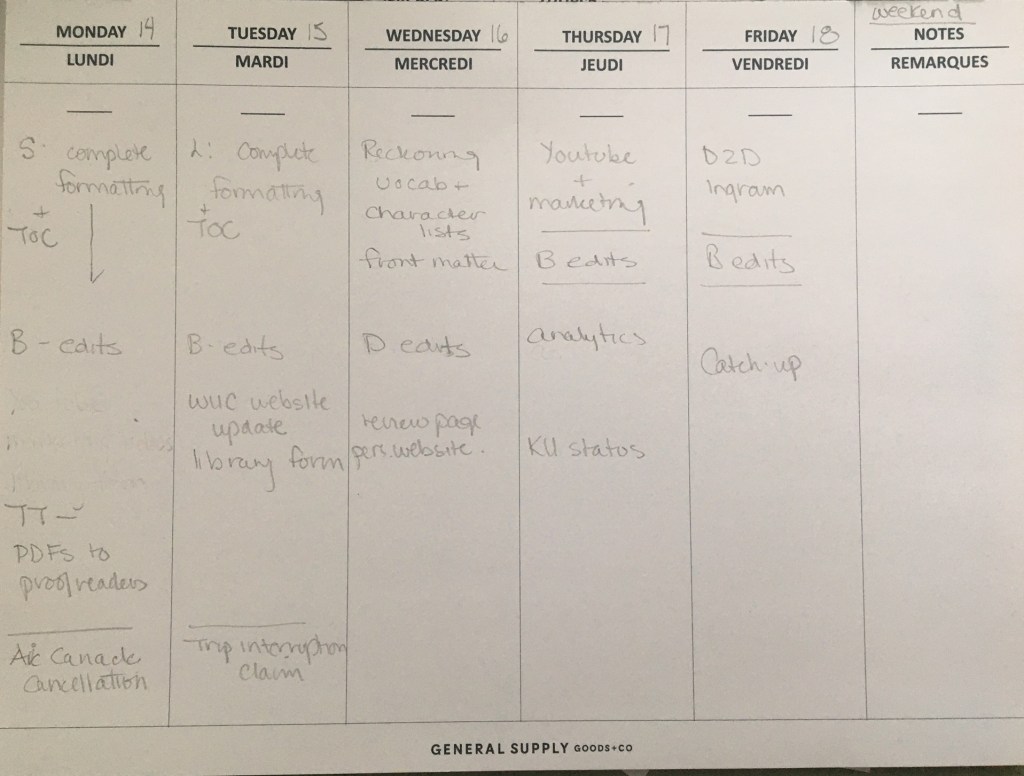
Then I use a daily planner. I know I’m most productive in the mornings, so between 8:30 and 11:30 is my intensive work time. That’s my time to work on my own book, when I have one in progress – and when I am actively writing, it’s nearly every day. I don’t wait for creativity to strike: most of the time, once I start, the words will flow. Perhaps not as well as I’d like, but as the saying goes, you can’t edit a blank page.  

When I’m not actively writing, this is the time I use to learn something new or do in-depth research: whatever the big tasks are that the board shows me I need to complete.  I take a couple of breaks, for movement and coffee, usually sneaking in a load of laundry or some other household chore.

After lunch I’ll generally check emails & social media, deal with anything important (or amusing) and then work on non-writing projects (that includes editing other people’s work or doing video meetings with other writers) for an hour or two. Exercise next, a walk or cycling for at least an hour and then another hour or so on ‘little’ things, tasks that don’t take a lot of creativity, such as updating websites, checking analytics, filling out forms, sending information out. But even most of those – barring an urgent response – have been scheduled, again to prevent me from feeling overwhelmed by the sheer number of them. Then I settle down with a cup of tea and read – books for review and/or pleasure – for 15 minutes to half an hour.

A few nights a week I work between about 10 and midnight: that’s a different sort of creative time for me, the time I write scenes that never make it into the book, but teach me about my characters and their responses; the time I do mindmaps of the major themes and conflicts of the story, the free-flowing ‘right brain’ associations and lateral thinking taking over. I’m about half-way between the poles of pantser and plotter, and this time is completely necessary to my writing process, and very different from the task-oriented approach I use the rest of the time. I’ll likely have music on, songs that relate to my work-in-progress in some manner. I might read poetry, looking for epigraphs or just for the expression of emotion I too am looking to convey.

Of course, life gets in the way of any schedule. One of the best pieces of advice I ever read was to not overschedule your day, so that there is room for the interruptions and minor ‘emergencies’. Friday afternoons are unscheduled, for catch-up, and my weekends look different from Monday to Friday: I may work for myself, but I still get weekends! Groceries and cleaning and movie matinees and dinners with friends (well, not the two last ones just now, in the middle of COVID-19 social distancing) are all part of the week too.

Does it work perfectly? Of course not. I have days when I’m just too scattered, and that’s likely a day I choose to do something that I know I will hyperfocus on – designing ads, doing layout, or very detailed editing on my own work  –  and sometimes I just need to walk away from everything. But when I come back, the structure is there to guide me as to priorities: I don’t have to reinvent them. It keeps my mind calmer, and when my mind is calm, I’m productive.

Oh, and I have one other necessary ingredient in all this: coffee!

Escape: A Short Story

This vignette was my response to a challenge from one of my writers’ groups: write a piece about hope. For those of you who have read the Empire’s Legacy trilogy, this narrator will be familiar: Jordis, who was at the Ti’ach when Lena was sent there in Empire’s Hostage. If you haven’t read Book III, Empire’s Exile, this will give away some of the plot, and it also hints at events in the upcoming release, Empire’s Reckoning. But if you’ve read the trilogy, or you don’t mind knowing a little of what happens, read on!

Escape

By Marian L Thorpe

© 2020

So many people!  In the fifteen years and more since the Marai had taken me and Niav, Eluf had kept me on his farmstead, several days inland and many hours’ ride from the next settlement. Once Niav had died, her babe with her, there was no-one to speak to, not in my language. And Eluf forbade me teach it to Elsë, the daughter I bore him.

But now Elsë was adult, by the Marai way of reckoning, and betrothed to a fish merchant’s son, and we were here at the coastal steading for the celebration. I had a new dress, just the one, and new shoes and a new light shawl. Elsë had several dresses, and fine silver bracelets and a brooch, part of her bride-price. With the ceremony done, the drinking had begun, and Eluf had not noticed – or not cared – when I left his side to wander around the hall.

One or two women spoke to me: captive I may be, but I was also Elsë’s mother, and Eluf’s wife. That I was – or had been – the lady Jordis of Eganstorp – mattered not at all to them. Likely they didn’t know. I made polite conversation, talking of the lavishness of the feast and the decoration of the hall, and the advantageous marriage my daughter was making. I was fluent in their language: had been, even before the Marai had come, and so some, perhaps, had no idea I was Linrathan-born.

I inclined my head to the last group of women, making my excuses. “My throat is dry,” I told them, turning toward the long table where the ale jugs were. As I accepted a cup from the serving girl, a snatch of a tune floated above the voices: not from the musicians, but from the man close by. He was humming.

The words came to me unsought: War in winter brings sorrow soaring…I knew the poem, and I knew the tune. The poem was Halmar’s, but the tune—the tune was Sorley’s. My classmate, my friend, all those long years ago under Dagney’s tutelage. A Linrathan tune.

I took a step sideways. The man – he was young, eighteen, perhaps – glanced at me. “War in winter,” I murmured, in Linrathan. “I know the tune.”

His eyes widened, momentarily, surprise quickly mastered. He turned, bowed, took my arm. “The hall is warm,” he said. “Would you like an escort, my lady?” Loud enough for the serving girl to hear, and in her language: a polite exchange, and a courtesy offered to an older woman.

“I would,” I said.  Others walked in the cool evening air, the salt smell of the sea sharpening the air, and the slap of waves muffling words spoken low. When he judged we could not be overheard, he stopped.

“How do you know the tune?”  

“It’s Sorley’s. Sorley of Gundarstorp’s. We were learning together, before the Marai. Why do you know it?”

“He was my tutor for a winter. I am Dugi, heir to Dugarstorp. But who are you?”

I told him. In the light of the long summer evening I saw his jaw tighten. “We thought you dead,” he said.

“As you can see, I am not. It is my daughter who has been betrothed tonight. Why are you here?”

“We trade in fish with the merchants here. I arrived yesterday and was invited to the celebration.” The northern landholders had always traded with the Marai, and many had sided with them in the war. I had no idea which side this man’s father had supported.

“When was Sorley your tutor?” I asked, as casually as I could.

“A decade past, now.” He grinned. “That song was one of the first he taught us.”

I bit back the impulse to ask what Sorley was doing now; if he knew who at my school had lived or died. “Were you pleased when Ruar married Helvi?” I asked. That piece of news had reached our remote farm, the marriage of the Earl Olavi’s daughter to the leader of Linrathe. The bride-price she had taken south half a dozen years past was the return of Sorham, the northern province, to Linrathe: the dowry and the alliance not popular among a faction of Marai men.

“I was,” he said evenly. “My father, too.” It was the answer I’d needed. Or was it? He traded with this steading…but I would never have this chance again. I took a breath.

“Can you take us home, Lord Dugar?”

He chewed his lip. “Us?” he said. “Both of you?”

“Yes. I will not leave Elsë.”

He shook his head. “She is Marai. It’s a good marriage. I can’t risk the trading.”

I closed my eyes. Part of my heart knew he was right: Elsë had no objection to this marriage, not that she had voiced to me. She would be gone from my life, either way. But still…

Dugi glanced up at the first stars. “The night is fair,” he said. “About midnight, I’m going to worry if my boat is tied well enough and go to the jetty to check. And I might take her out, to clear my head. I do that, sometimes.” Louder, and not in our common language, he added, “Shall we return to the hall, my lady?”

Eluf hadn’t noticed I’d gone; he was too far into the ale. I filled his cup, just to be seen and perhaps remembered, before going to my daughter. Tonight had been only the start of the celebrations: the wedding was in three days. I fussed over Elsë, tucking her hair into its pins. “I will miss you,” I whispered to her. Tears stung my eyes.

“Who were you with?” she asked.

“I don’t know,” I said. “I was feeling a little faint, from the crowds, I suppose, and he offered to take me out into the air. I didn’t ask his name.” She nodded and turned back to her new sisters. I wandered away to join another group of women, to talk of trade and fabrics and jewelry, and who would marry whom, this year.

When I judged the time had passed I excused myself, wandering out to the latrines and then beyond, circling down to the water. I took off the new shoes: my feet were used to being bare, and it was quieter. I pulled my shawl up over my light hair, and slipped onto the jetty. I could just see Dugi on his boat.  Eganstorp, where I’d grown up, was a coastal holding. I knew boats. I slid over the gunwales, barely rocking the little craft.

Dugi didn’t look at me. He was humming, the same tune, casually undoing knots and readying the boat to sail. I sat low, hugging my knees. He’d just reached for the oars when I heard running feet. I sat up. Dugi swore, reaching for the jetty with one oar. Elsë ran along the boards, scrambling into the boat.

“I asked who he was,” she gasped, “and I worked it out, when you didn’t come back into the hall. I’m coming too.”

I pulled her to me. There wasn’t time for questions. Dugi swore again. “I’ll pay for this,” he muttered, and pushed the boat away from the jetty. He rowed in silence until we were free of the breakwalls. Then he set the sails, and under the stars and a risen moon he steered us south, to Sorham, to home, to hope.
Writing in a Time of Uncertainty

Like many of us (all if us?) I’m having trouble concentrating right now. There’s nothing surprising in this: our world has been turned upside down; many of the things we took for granted are on hiatus; some of us are losing jobs; some of us are losing family or friends. We’re frightened and confused.

What I’m going to talk about in this blog post is what worked for me in a similar situation before. It won’t work for everyone, so let me say that right at the beginning. I have no experience in dealing with the added stresses of having kids at home, or not being able to pay the bills. I’m not pretending these ideas will work for everyone – I’m not even sure they’ll work for me this time. But for what it’s worth, these were (and are) my coping mechanisms.

Six years ago I was diagnosed with a stage 3, high grade cancer. A terrifying diagnosis, and a shattered world. I had a 50% chance of survival. But: in the first year of treatment  – major surgery, chemo, and radiation – I retrieved my first book from its bankrupt publishers, got it out to the world, began the second book.  How?

  1. Accept that your mind is not working at its full capacity. Don’t expect it to,  but help it out. In my case, and to this day, this means starting each day with a set of goals. Not just for writing, I will add, but with all the things I both want to do, and need to do. (In that first year of anxiety and chemo brain, it included things like ‘shower’ and ‘get dressed’.)
  2. Be gentle with your writing goals. Don’t overschedule. Give yourself time to relax, too, however you can: watch half an hour of tv; play a video game; read, draw, bake, play music – and schedule that in as often as you need it. Schedule exercise too; outdoors if you can, indoors if you can’t. Even if you only write for half-an-hour a day, you’re still writing.
  3. Accept that things will take longer, and you will find yourself scattered and losing your train of thought. This is normal. Don’t beat yourself up over it.
  4. Accept you may not produce your best work. (Or maybe you will, through channeling your emotions into your writing.)
  5. Consider exploring other forms of writing: poetry, creative non-fiction, short stories: the challenge distracts the mind. I wrote a creative non-fiction blog for about two years, which was really about finding gratitude in little things, like baking bread. I may go back to it. It helped ground me, and everything we write hones our craft.
  6. Share. That was partly what my creative non-fiction blog was about, too. Talk about your writing to someone who cares, if you can; it solidifies it as important, and helps you with perspective.

I lived with uncertainty for the five years for ‘official’ survival, and I continue to live with uncertainty, because cancer could well still be lurking somewhere in my cells, waiting. I am at a higher risk with COVID-19 because of my medical history and my age. But as my character Casyn tells the young Lena in the first book of my series: “We cannot shape the circumstances to fit our lives, only our lives to fit the circumstances. What defines us, as men and women, is how we respond to those circumstances.” There’s no one right response, but for me, it is taking control of those factors in my life I can, but being gentle with my expectations of myself, both as a writer and a human being. We’re all in this together. Hang in there.

Critique Partner, Life Partner: A Risky Proposition? #AuthorToolBoxBlogHop

When I tell other writers that my critique partner is also my life partner, reactions tend to fall into two categories: ‘how wonderful’, or, ‘OMG, that would split us up!’. It works well for us, but why?

Just so we’re all on the same page, here’s the definition of a critique partner that I’m using here: A critique partner is a fellow writer with whom you exchange critiques of your manuscripts.[1] In the marvellous article by K.M. Weiland that I borrowed this definition from, she goes on to list and discuss the qualities a writer should look for in choosing a critique partner. I’m not going to reiterate them – you can read the article! Instead, I’m going to look at what matters in the relationship between critique partners, and how we’ve developed these.

  1. Respect

Brian and I are both writers, in different stages of our profession. But our respect for each other’s abilities goes way beyond writing. We’ve been together for 42 years; we met in university. We both did advanced degrees in related subjects, and worked together on research, even co-authoring research articles. My expertise there was more technical; his was more theoretical. We complemented each other. Our next careers, both in education, were again different but complementary. Finally, we share a major hobby: birding. Again, we know our skills support each other. Seeing a bird in flight, I can identify bird families easily; given that, he can narrow down species faster than I can, usually.

Important in this was watching each other (and helping each other) learn, as scientists and teachers and birders. We have confidence in each other’s ability to grow in a field, to take theoretical knowledge and translate it to action. So as we learn and develop as writers, together and separately, we strengthen each other’s writing. For example, he’s a much better plotter than I am, and quick to point out where my plot is weak or inconsistent. I’m a better stylist, hearing the cadence and flow of words better than he can.

Respect for differing skills is an advantage I’ve heard from other writers, too. At Maple Mystery Games, co-creators Jan and her husband John work together. John is best at plot twists, while she is the detail person. “I tend to brainstorm ideas with hubby at the start of writing a murder mystery game and also when I first work on creating characters. His brain works in a different way to mine,” Jan said.

  • Trust

We’re not competing. I write adult alternate-world historical fiction, character-driven books focused on personal choices in difficult times. He writes plot-driven young adult fantasy. But we are both committed to helping each other write the best books we can, and we know how to separate the building blocks of craft from the emotional attachment to the stories we are writing.

An advantage of your life partner as your critique partner is that in the middle of brushing your teeth you can say to them, ‘Do you think Character A would react in this way?’ (While our books aren’t the only subject of conversation between us, it does sometimes sound that way.) We know each other’s world and characters very, very well, but without the same degree of emotional attachment. So when Brian told me a while back that in my latest book (where the previous MC is now a supporting character) that he didn’t like how I was portraying her, I knew he had a valid point. When I told him I thought a supporting character in his series needed a larger role (and why) he agreed, after consideration.

This advantage can also be a disadvantage. Sometimes we’ve had enough of each other’s world and characters, especially if we’re working on a tough plot point, or an external worry or commitment has to take priority – or we just want to shut up and watch television. Trust here means knowing the other one will get back to that question, just not right now.

  • Communication

This is not always easy!  I am the world’s worst verbal communicator, especially off-the-cuff, and on top of that, much of what I know about writing – especially style – is instinctive. Often, I don’t know how to explain my suggestions. Add to that my tendency to pick up terms and jargon quickly, and my explanations to Brian are often sources of frustration. He is much more precise. We can both be very blunt.

But we listen to each other, even when the instinctive reaction is ‘no’. Sometimes the first reaction is right, but most of the time the other person’s opinion needs serious consideration. Mostly we discuss the differing viewpoints, searching out the reasons behind the suggestions and critiques.

Is there a down side? Only, I think, that by the time the work-in-progress reaches the end of the first draft, we each know plot twists and reveals so well it’s hard to read with fresh eyes. But even then, Brian’s read-through of the latest version of Empire’s Reckoning, my WIP, resulted in thoughtful, appropriate and necessary criticisms, which I am in the process of addressing. Then it’ll be on to the beta-readers.

Oh, and yes, Brian critiqued this blog post, too.


[1] https://www.helpingwritersbecomeauthors.com/how-to-find-the-right-critique-partner/

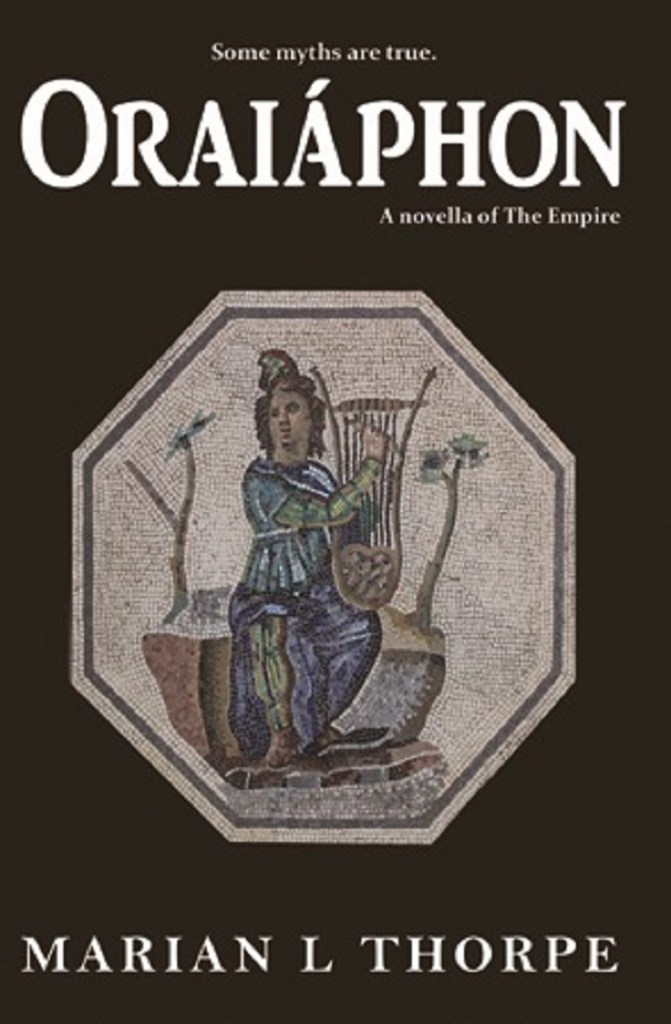
Oraiáphon

Some myths are true

Orpheus with his lute made trees,

and the mountain tops that freeze,

bow themselves when he did sing:

To his music plants and flowers

ever sprung; as sun and showers t

here had made a lasting spring.

Every thing that heard him play,

even the billows of the sea,

hung their heads, and then lay by.

Shakespeare; Henry VIII

Without readers, where would writers be? We are storytellers, and while I like telling my characters’ stories to myself, I prefer telling them to other people. But some of those readers become highly invested in the characters, and want to know more.

The last book of the Empire’s Legacy trilogy ended on an ambiguous note, with an epilogue that makes things clearer (for most readers. Some truly didn’t get it, even then.) But between the end of the last chapter and the brief epilogue is a three-year gap, and some important things happened in that time. I might have just left them to the reader’s imagination, except three things happened.

One was that in beginning the next, related trilogy, I realized there were a couple of major backstory pieces that had to be explained, and two, quite a few of my readers begged to know what happened in those missing years. The third consideration was that I was switching narrators (I write in 1st person), and while readers knew my new MC as a supporting character from the first trilogy, I thought they needed an opportunity to get to know him a bit better.

So I wrote those loyal readers a story that I hope meets their wishes, explains the backstory, and moves the character Sorley from supporting actor to a leading role. It launches February 29th in all markets. Here are the links:

Amazon US

Amazon Canada

Amazon UK

Amazon AU

World-building through Historical Characters: Gnaius and Galen

“Exactly so,” Gnaius agreed. “May I say more? I have lived in many of Casil’s provinces over the years. A physician travels with the army, if he wishes to become a skilled surgeon.”

– from Oraiáphon: A Novella of the Empire, 2020.

In my Empire’s Legacy series and its sequels (both completed and planned), the supporting character Gnaius plays, and will play, an important role. Gnaius is a physician, erudite and highly skilled, who has held many positions with both the army and to the Empress of Casil. He is a product of my imagination, of course, but he is based on the historical physician Claudius Galenus, best known to the modern West as Galen.

Galen (public domain)

I want to talk about Galen not so much in terms of the historical person, but as an example of how, in my alternate-world historical fiction, I use history to inform my world without being bound by it. The city in my world, Casil, is physically based on 4th century Rome, but politically it’s a blend of Rome and Byzantium. However, many of the conflicts that occur are from later in Europe’s history, between about 600 and 1000.

Galen lived in the 2nd century of the common era, at the same time as the emperor Marcus Aurelius, who appears as a figure from the past in my series (under a different name, of course). But this doesn’t matter: I’m not writing history. What matters is that Galen did almost everything I wanted Gnaius to have done: travelled extensively, learned about surgery and wound treatment in the field, practiced medicine in the capital city and became the personal physician to Emperors. So I have, effectively, lifted Galen out of the 2nd century and inserted him into my world at a later date.

There are both pros and cons to doing this. Readers will fall roughly into three categories: those who know nothing about early-medieval medicine, and will assume I’ve made Gnaius up entirely; those who have some knowledge of Galen, may well recognize consciously or unconsciously that Gnaius seems familiar, or right for the times; and those who know a fair bit about the subject, and may object to him being dragged forward several centuries.

My goal throughout the series has been to create a world that feels familiar to a reader brought up on the history of Britain and northern Europe, but has enough dissonance to make readers think about the questions raised by the conflicts with which the characters must deal, both personal and political. The real-life Galen fits neatly into the world, he’s just in the wrong century. (Certain readers may throw the book across the room in disgust at recognizing Gnaius as more-or-less Galen, although if they are that wedded to historical accuracy, they’ve probably given up on the series long before Gnaius makes his appearance 2/3 of the way through the third book.)

By some combination of serendipity and synchronicity, I learned in my research trip to Rome last week that Galen had lectured extensively at The Temple of Peace in the Forum, and indeed had stored his writings there for safekeeping. This plays right into the plot outline for the book (#5) I was there to research…and then I learned a fire at the Temple destroyed a fair number of those works. I’d already considered a fire in that general location as a plot device; now I have a historical occurrence to build around. The fire is not just plausible, it happened, and the destruction of some of Galen/Gnaius’s writings may well feed part of the plot of book #6, which is now little more than a concept.

The Temple of Peace in 1749 (public domain)

Gnaius is a minor character, although an important one. But by using Galen’s life as the basis for his, the verisimilitude of setting, character and plot is strengthened. Reviewers frequently comment on the depth and quality of world-building in my books: this is one way I do it. What are your methods for creating believable worlds?