In my monthly newsletter, News from the Empire, I’ve started a new section on historical dramas and books that complement them. I’ll be reposting those to my blog occasionally. This is the first.
I watch a lot of historical dramas, although ‘historical’ should often be taken with a grain of salt. (Or a bag of salt, in some cases.) Right now we’re watching Marco Poloon Netflix, and I’m finding it – regardless of its poor reviews – both entertaining and beautiful. Partly this is because I was in Mongolia in 2019, and while the show is filmed in Kazakhstan, the terrain is nearly identical, the horses actually look like the thousands of Mongolian steppe horses we saw, and I slept in a ger (yurt) camp for 5 nights. (We were in the Altai mountains, looking for – and finding – a snow leopard.) So it’s very familiar in terms of landscape, which is always my anchor.
Some companion reading from the Mongol viewpoint can be found in Bryn Hammond’s books. A good place to start would be withAgainst Walls, described by the Asian Review of Books as ‘Total and instant immersion… thoroughly compelling and powerful.’
Here is what Bryn answered when I asked her what she thought of Marco Polo:
I think John Fusco’s Marco Polo on Netflix had an odd reception. It seemed to me audiences weren’t ready for these Mongols. I watched in frustration as reviewers who had little exposure to Mongol history suspected historical license and didn’t see the truths the series told. Scholars of the Mongols didn’t necessarily like it either, because of its fictional strategies.
It got a few big things right. It presented real Mongol culture. It acknowledged the freedoms and political agency of Mongol women. It did justice to the cosmopolitan court of Khubilai Khan. Hands down, these were the most authentic Mongols we’ve seen on screen from the US.
Khubilai – performed with human substance by Benedict Wong – perhaps should have been the titular character. As seen in the series, he staffed a poly-ethnic government, in resistance to pressures to become fully Confucian. He was a conscious innovator in the old world of China. For example, he introduced a universal script, Phagspa. It didn’t outlive its sponsor, but nevertheless was a great experiment in change. Imagine if the script to write all languages, functional and effective as it was, had been more easily accepted, instead of rejected by conservatives.
There are different ways to understand ‘accuracy’ in historical fiction. I have my own creed by which to write my novels, in that I treat my origin text, the Secret History of the Mongols, as sacred, nothing to be changed or omitted if it’s in there. But the Secret History is as much a work of art as of history-writing. So, I try to be true to Mongol artistry, as well as Mongol self-portrayal. Is that the same as ‘history’? Yes and no. History’s a slippery animal.
Like what you read? You can sign up for my newsletter here:
In last week’s post about the key lessons I’ve learned from years of project-based work, one raised questions in several readers’ minds:
Don’t wait for inspiration. Do whatever rituals you need to get yourself out of one space and back into the new one (for me it’s a 10 minute break to do a chore or two, then coffee and a read-through of the last thing I did on the project) and get to work. It may not be the best work you’ve done, but it will be a foundation, and, as the saying goes, you can’t edit a blank page.
People were curious about the concept of rituals to prepare the mind for a new task. There are two ideas from educational theory and psychology embedded here, so let’s look at them one at a time.
In a 2017 article, Alison Wood Brooks, the O’Brien Associate Professor of Business Administration at Harvard Business School, studied the effect of a series of planned behaviours (a ritual) on the performance of people facing a stressful task. Her findings indicated ‘performing a ritual before entering a stressful situation can reduce feelings of anxiety and improve performance.’ Add to that the idea of giving your mind a bit of time to move from one area of focus to another, plus the benefits of movement on creativity (for more detail, read this paper by Stanford University researchers Marily Oppezzo and Daniel Schwartz), and you have some of the science behind the idea of the planned transition from one task to the other. (If you think back to your high school days, this is pretty much what the break between classes was for: move a bit, go to you locker, switch textbooks/notebooks – telling your brain that chemistry is done, now it’s time for history.)
The second part of this is ‘activating prior knowledge’. There are a lot of ways for a writer to use this concept of building on what you already know, but in this specific example, it’s again part of the transition. Once the transition activities (the ritual) are done, you bring yourself back into the work by reading the last 500 words you wrote, or your notes, or your outline. This is pretty much the writing equivalent of the recap scenes at the beginning of some television series. (Those of us who don’t binge watch are very appreciative of these. After a week away from a show, I need those reminders!)
In my house, we use the shorthand ‘switching brains’. Time to write the weekly grocery list just after I’ve finished an editing session? ‘Wait till I switch brains’, I’ll say to my husband. Then I walk around a bit, stretch, water plants, pick up the cat – that sort of thing – before I look at the menu board, and the whiteboard that has all the things we’ve scrawled down that we need during the week (activating prior knowledge again), find paper and pen, and begin the list with a mind ready to focus on it, and not wondering if that last paragraph still needs refining.
These are some of the things that keep my ADHD brain, which is easily overwhelmed by cognitive load, productive. They won’t work for everyone, and like all habits, they take time and commitment to develop. What techniques do you use to help with balance and focus when juggling a multitude of tasks?
A writing friend, who will remain unnamed (but he knows who he is) suggested the idea of an anthology of novellas the other day, an idea which immediately intrigued me. But I have a book to finish, and a lot of other projects and responsibilities: editing for a client, reading for blog tours and a review site, marketing (my own books plus our press’s), research, the community newsletter for which I’m the chair, a local writers’ group, and then all those things that are not work but life. How do I fit in a novella?
Most of the work I did in my previous professional lives, which spanned roughly thirty-five years, was project based. As a research associate, I juggled lab and field research for several professors and graduate students. As a special education consultant for our school district, I was responsible for special education services to 15 schools, K – 12; two teams of itinerant teachers, and the entire design and implementation of assistive technology services and training for the whole district, as well as many other required responsibilities. I had to visit my schools regularly, consult with and train teachers and educational assistants, liaise with parents….the list was endless. And yet, somehow, it all got done.
Reflecting on all those years of project-based work, what did I learn that now helps me?
Taking time to plan is a necessity. Not only that, plan backwards from hard deadlines. If I must have X ready on Feb 28th, what do I need to do to be there? How much time do I need to do it? Schedule that time plus 10%. Plan yearly, monthly and weekly, and revisit your plans every morning to tweak as necessary.
Be firm with yourself. If you schedule 2 hours to work on something, give it the two hours. At 1 hr 45, stop. Write the notes you need to pick up on it again, but that’s it. Move on to the next thing.
Have a system for notes, so when an idea for project X pops into your head when you’re working on Y, record it, in whatever way works for you, and go back to project X.
Don’t wait for inspiration. Do whatever rituals you need to get yourself out of one space and back into the new one (for me it’s a 10 minute break to do a chore or two, then coffee and a read-through of the last thing I did on the project) and get to work. It may not be the best work you’ve done, but it will be a foundation, and, as the saying goes, you can’t edit a blank page.
Schedule down time, when your brain can just ponder on things. In my scientist days, that was either the walk between home and the university, which took about forty minutes each way, or the time spent driving out to research plots. In my special ed days, the schools I was responsible for were anywhere from a half hour to an hour’s drive from my office. (I drove a lot.) Good mulling-over time. Now it’s my daily walk, or my weekly get-out-of-the-city drive, or just my armchair in the late evening with a whisky and music.
Do what’s most important first. I write between 8 and 10 in the morning: I may write more, but I get those two hours in at least 5 days a week. Then I work on other things scheduled by deadlines and importance. And don’t forget to schedule exercise and meals!!! (For a more detailed look at this, see this earlier post.)
Be realistic, and do not spread yourself too thin – that way lies burnout. Say no to things, both to things your own writer’s brain offers you, and external things. Do they fit right now? If marketing and branding matter to you, do they increase your exposure and promote your brand to the right market? If they fit, but you don’t have time for them, take an hour, write some notes, and file it for when you’re finished what you’re doing now.
Know when you need a break. For those of us who work full time from home, either as a result of COVID or because that’s what you always did, it’s really easy for the days to just blur and to work every single one of them. I mentioned my get-out-of-the city drives; I do these alone, with a packed lunch and a thermos of coffee in these COVID days, and I’m gone for 4 – 6 hours. Just me, the road, and music. If I don’t do this, I get very, very grumpy.
Ask for help. No one else can write for you, but can they take something else off your plate to give you a little more time? Or give you feedback on a plot point or structure? I’m blessed with a husband who’ll do all these things. If the project is externally driven, ask for extensions, or submit drafts for feedback before you get too far into it.
Build in time for emergencies. This was the best piece of advice anyone ever gave me. They will happen, whether it’s as simple as a jammed printer or as serious as a visit to the emergency room. Nothing ever goes as planned. Equipment breaks, someone phones, a child or pet is sick, you’re unwell. Effectively, this means I leave one full day in my week unscheduled (separate from my driving day) – a catch up day if I need it, a day to do what I want if I don’t.
Gods, you may be thinking, I just like to write. What I’m reading here feels like a JOB. I write when I can, or when inspiration strikes, and I’m happy with that. If you are, that is wonderful, and I mean that wholeheartedly. I know my situation – my time is my own, without pressing family responsibilities just now – isn’t everyone’s. But if you’re struggling a bit with getting everything done, perhaps what I gleaned from decades in project-based work can help.
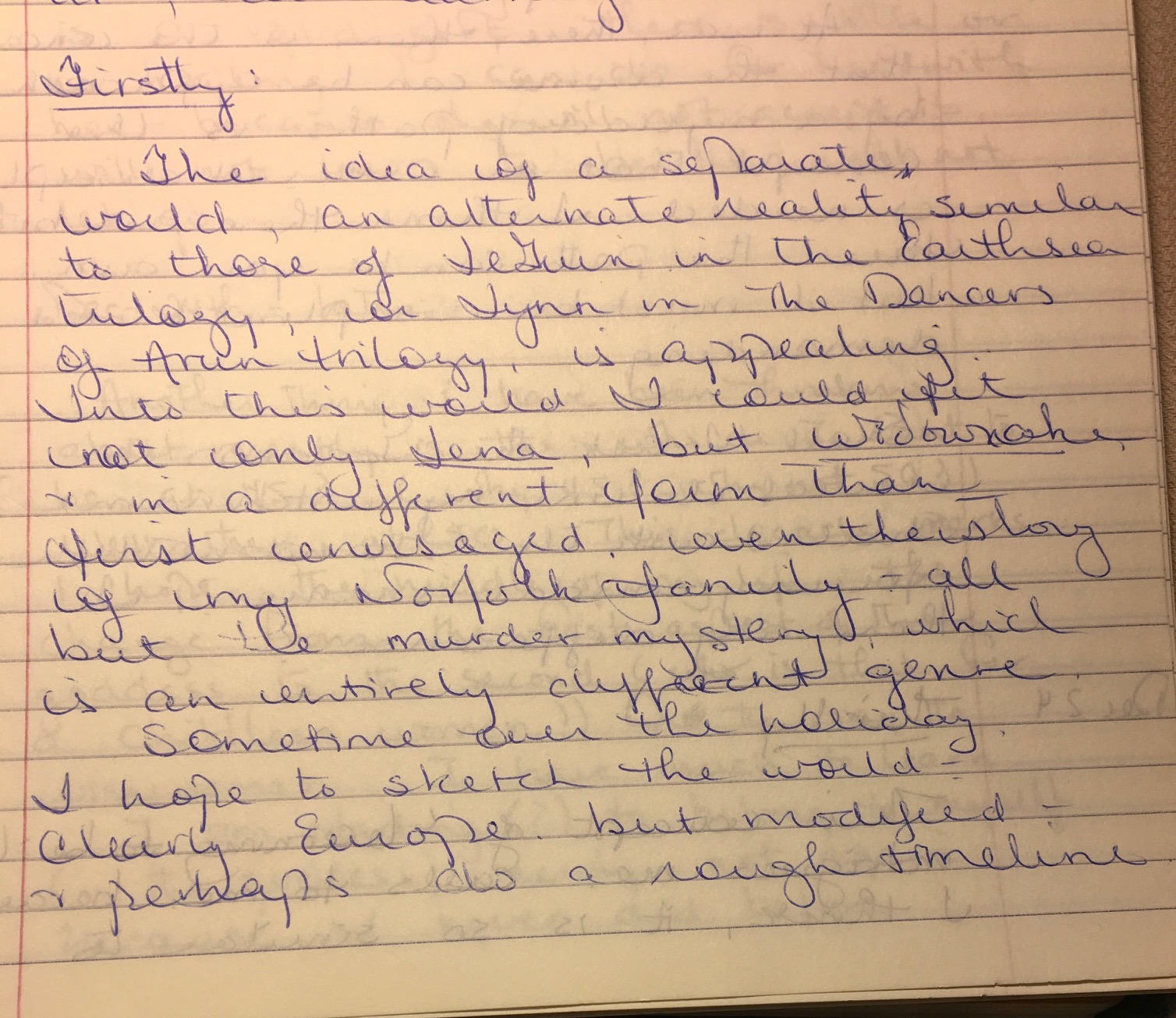
Yesterday, I was tidying shelves in my study. I found a spiral-bound notebook, a multiple-subject one with interior dividers, rather old and battered. For some reason, I leafed through it, checking to see if it was unused, I think.
Most of it was. But in the third section, there were a few pages of notes. The date on the top of the page was December 22, 1997. Twenty-three years ago, plus a few days. The first part of the entry was banal, comments on the weather (cold). But then:
The idea of an alternate world, a separate reality, similar to those of LeGuin in the EarthSea trilogy or Lynn, in the Dancers of Arun trilogy, is appealing. Into this world I could fit not only Lena, but Widowmaker, and, in a different form than first envisaged, even the story of my Norfolk family – all but the murder mystery, which is an entirely different genre.
Sometime over the holiday I hope to sketch the world, clearly Europe but modified – and perhaps do a rough timeline.
I just stared at it for a minute. I was 39 when I wrote those words; I’m 62 now. In that brief paragraph is the genesis of the world and characters that have lived in my mind for over two decades, and an acknowledgment of the two major influences in my world-building, Ursula LaGuin and Elizabeth A. Lynn. I felt like a historian of my own mind.
Several reactions occurred. (One of which was ‘good gods, my handwriting was nearly legible back then’.) Surprise was dominant: surprise that Lena – my MC of the Empire’s Legacy trilogy – had a name, a presence, as early as 1997. There must have been some work done, some notes or early paragraphs, because I’d treated Lena as a title, underlining it as academia taught me to (a habit I’ve never broken.) Another surprise was that my decision to create an alternate world, my analogue post-Roman northern Europe, was a conscious choice: I thought it had just emerged as I’d written.
And then there was the mystery: what was Widowmaker? Again, underlined, so a title. Of what? I had no memory at all of it…but as the afternoon progressed, and I thought about the word’s connotations for me (not the gun, nor the video-game character): a storm and fishing fleets, I remembered. At the time of Kenneth McAlpine, king of the Scots in the mid 9th century, the Picts ‘disappear’ from history. A theory proposed was the loss of most of their men in a ‘widowmaking’ storm while they were out fishing, leaving the women to be subsumed into the Gaelic culture. Clearly, I’d meant to do something with this concept.
Which, I believe, I did, because Empire’s Daughter opens with Lena, in her fishing boat, returning to a village devoid of men. For very different reasons…but was that seed of the idea that grew into my gender-divided world? I can’t know, so many years later. But I suspect so.
Then, of course, I spent some time leafing through other partly-filled notebooks, looking for more entries like this one, but without success. They must have existed, but in one bout of tidying up or another, they’ve been lost. Not that it matters: none would hold the wonder for me this one did, this glimpse into the birth of the alternate reality that I live in for at least part of each and every day.
I used to work with a man who had all his best ideas in the shower. Others find running sparks creativity. For me, it’s driving. Not city driving, or bumper-to-bumper freeway driving, but long, mostly empty back roads (Blue highways, William Least-Heat Moon called them in his book about travel and place and belonging).
I was stuck, in my current work-in-progress, with a plot not complex enough for characters who are diplomats, subtle and devious. I needed a central conflict to have more layers to disguise a character’s behaviour. Pacing around the house didn’t help. So this morning, I went driving.
I’d gone perhaps 10 kilometers when something began to take shape, an idea rooted in a past book in the series and paralleling another subplot. Hmmm, I thought, this has potential. So what if…? By 30 km from the house, I had the outline. At about 50 km, I pulled over into a church parking lot in a tiny village, took my notebook out of my bag, and wrote notes for twenty minutes.
What is it about easy driving (or showering, or running)? I think it’s the repetitious, known activity that frees part of your mind to wander; the motor function taking its needed neurons, and leaving the rest to be creative. (And for me, at least, I can talk aloud to myself when driving, and that seems to help.)
This has, I think, roots in my childhood, when we’d drive to see an aunt a few hours away, or even into the city to shop, a shorter trip. I couldn’t read in the car; it made me carsick, so I’d look out the windows and make up things about what I saw: if this were my farm, I’d paint the fences white, and have ponies. Maybe that road leads to an abandoned village, the houses still standing. I’ll bet owls live in that old barn. Daydreams, but also stories.
I wish cleaning shook loose creativity in the same way; then I’d be doing something else useful at the same time. But sadly it doesn’t. I need a passing landscape: flying doesn’t have the same effect, nor does night driving. Trains are wonderful, but I haven’t much call to take trains in Canada. And the car does need to be taken out occasionally.
The results of today’s drive will keep my work-in-progress focused for some time. But sooner or later I’ll bump up against another problem that will need solving, and off I’ll go.
Dawn at Wood Buffalo National Park comes at about 4:30 am in mid-July, and with birdsong resounding through the trees, sleep is over. “Pure sweet Canada-Canada-Canada,” the white-throated sparrows sing, over and over.
It’s 1993, and we’re two weeks into the longest road trip we’ll ever do: 71 days across Canada in a Ford Escort, with a tent, a portable barbecue, and not much else. I love road trips: of all the things I couldn’t do because of the pandemic, this is probably the one I felt the most. We’ve done endless trips – all 50 states, many several times (we drove to California from Ontario three times); all Canadian provinces and two of the three territories (Nunavut didn’t exist when we did the big cross-Canada trip.) Most of Australia. All of New Zealand. England, Scotland, Wales. Costa Rica, Belize, Japan, Taiwan, too many Caribbean islands to count. Mostly the two of us together, but I’ve gone on my own, too.
The mosquitoes are horrendous, which is why we’re the only people in the campsite at Wood Buffalo, maybe the only people camping in a park the size of Switzerland. We run from the tent to the lake to swim (it’s COLD) and back to the tent to dry off. Later this day we’ll walk for hours, plagued by flies, following wolf tracks and buffalo hoofprints in the dried mud of the trail.
But this isn’t a travel memoir. I wasn’t writing my series yet: that would begin a few years later. But so much of this trip is in my books, even though I was traveling in North America in the last decade of the 20th century, and my characters are in a fictional 7th century analogue European world. The memory of that plunge, naked (there was no one around, after all) into the lake at Wood Buffalo became a lake in a plain in Empire’s Exile. The flies are in the same book. So, too, is the experience of standing on a ridge in the Richardson Mountains in Yukon, and looking east, and seeing nothing but endless peaks and valleys, snowcapped even in July, hearing the whistles of marmots and the cries of golden eagles. If we’d travelled east through that wilderness, were it possible, the first significant population centre we would have come to would be Trondheim, Norway.
Richardson Mountains from the Dempster Highway. Wikipedia, public domain.
That memory became the Durrains, the mountain range thought uncrossable that divides Lena’s land from whatever lies east, and that she and Cillian must attempt to cross, or die trying. But not just the physical geography, but the sense of a vast expanse of unknown territory, unknown people, unknown dangers…and somewhere, very far to the east, perhaps civilization.
The books are full of these landscape and place memories: someday perhaps I’ll go through and annotate them, just for fun. I have a strong suspicion that almost nothing in the landscape of my world is invented; I think they’re all just taken from one trip or another; in mountains or on coasts, the sounds of fishing villages, the crowds of a city, the ice on the wash water in the morning at a campsite.
Write what you know. So I write what I’ve experienced; weaving together memories from a thousand times and places; remembering the smells, the feel of the breeze, the flies and the birdsong – and how I felt: joy, exhaustion, irritation, fear. The blisters, the aching shoulders; thirst, hunger, desire. I give all those to my characters: my experiences become theirs.
But there is something I think is key to this: I was in those moments. I wasn’t photographing, or texting, or videoing; I wasn’t digitizing them or filtering them for someone’s consumption. I was there, fully. I was paying attention. Not because I knew I wanted them for a book, later – because that too is a filter. I was – on that trip and many others – simply experiencing the world I was in at that moment, creating memories that transfer themselves to words thirty years or more later almost effortlessly. So I guess that’s the answer – or one of them – to the question I’m asked most frequently: how do I build a world that feels so real? By remembering it.
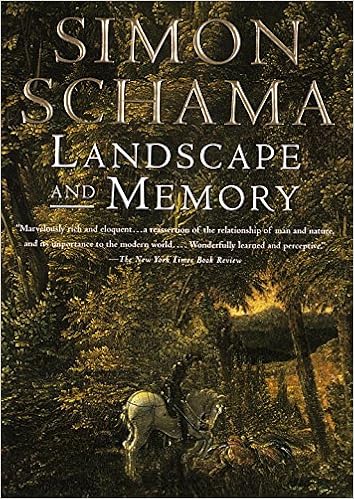
(With apologies to Simon Schama for borrowing the title of his marvellous 1996 book.)
Featured image: White Throated Sparrow by Becky Matsubara: Flickr. CC 2.0 licenses
This scene didn’t make it into the final version of Empire’s Reckoning, mostly because the book was already long, and while this added to character- and world-building, it didn’t feed the plot. But I awoke to snow today, and was reminded of it, so here it is. If you’re in the middle of the Empire’s Legacy trilogy, there are spoilers here.
“Teannasach, may I go?” I asked formally. He stepped forward, offering an arm and the kiss of farewell. Our lips brushed for the briefest of moments. I wondered if knowing what I was made him uncomfortable, but if it did, he did not show it.
“Go safely, Lord Sorley,” he said. I swung up onto my horse and turned its head south.
I’d woken with a scratchy throat, but we’d talked and sung into the small hours, so I thought little of it. But as I rode through the morning, I reluctantly admitted to a cold. My throat was painfully sore now, and my nose alternately running and blocked.
Ingoldstorp was some distance away yet, but they would give me soup and fuisce, and a warm bed, and perhaps a night’s sleep would chase the illness away. I found my hat in the saddlebags and wrapped my scarf a little tighter around my neck. The day was getting colder, I was sure.
An hour later the snow began. Big flakes, wet and heavy, at first: then, when the wind picked up, smaller and denser. The world around me turned white, and still the snow fell, thick and fast and rapidly shrinking the visible world to no more than a few arms’ lengths in front of me. I started to shiver. I couldn’t see the road now; all I could do was trust my horse to seek shelter.
I let the reins lie slack. The gelding plodded steadily forward, its head low against the wind. My fingers were numb, and my toes. The snow stung the exposed skin of my face. I closed my eyes.
Random thoughts: lambs would die in this. Had I wrapped my ladhar properly? Druise would be so angry with me. I drifted into a daze, time and the white world passing without sense or recognition.
My horse roused me, swinging his head and snorting. I looked around me, slowly realizing we stood in the lee of a building. I pushed myself up in the stirrups, my right leg dragging over the saddle as I dismounted, feet sinking into snow well over my ankles.
I fumbled along the wall of the building, looking for a door. I found one, but its latch resisted my stiff fingers. Swearing loudly, I pulled a glove off with my teeth and tried again. The horse pushed up against me, wanting cover.
On the fourth try I got the latch and the door open. I stumbled in, the horse following. A cattle byre, I could tell, from the smell and the heat, although almost no light found its way into the building. A cow lowed, and another. Probably the torp’s milk cows, I thought muzzily. I hoped so.
My hands were too cold to remove my horse’s bridle, or its saddle, even with both hands bare. He stood placidly enough, so I left him, moving towards the cattle. A warm, heavy body loomed in front of me. I put a hand on its side; it didn’t flinch. Slowly I moved around it until I was among the cows. I leaned up against one, almost hugging it. Apart from a flick of her tail, she didn’t object. Milk cows, as I had hoped, accustomed to being handled.
The heat radiating off the animals warmed me, even though the strong smell of urine in the byre made my eyes water. I would stink of cow, I thought, but I didn’t care. The cattle chewed and belched and shuffled, and one nosed me, its hot breath scented with hay. I’d never liked cattle much, before.
Warmed, I went back to my horse, removing his tack. He’d find hay and water, although the cows might kick him. By feel I found the bread and cheese in one saddlebag. Then I sat down to eat and wait.
The food tore at my sore throat, but I made myself swallow it, in small mouthfuls. I sat as close to the cattle as I safely could, and at some point, exhausted, I fell asleep.
A man’s voice woke me. Concerned, not angry: no torp or house would turn away a traveller in this weather. He knelt. “Are you well?”
I tried to speak, coughed instead. “Well enough,” I managed. “My horse brought me here. Where am I?”
“Ingoldstorp. Who are you?”
“Sorley.” A bout of coughing racked me. “Toscaire to the young Teannasach. I was riding south from Dun Ceànnar.”
“Well, sit quiet while I give hay to the kyne and your horse. I’ll take you up to the house, after.”
He was quick with the feeding. Then he piled the water trough high with snow, the byre door letting in blasts of cold as he went back and forth. It would melt soon enough from the animals’ body heat. Then he gave me a hand up, threw my saddlebags over his own shoulder, and took me to the house.
Winter Sheep Herd: Scott Payne, Pixabay
The snow and my cold ran their course together. Ingold—or rather his Konë—distractedly welcomed me, found me a bath and a bed, fed me, and sat me by the fire when I coughed. I had been lucky: I could well have died, had my horse not brought me to the cattle-byre. But my cold remained only a cold, preventing me from singing to repay my hosts’ hospitality, nothing more.
Not that the Eirën was often present. Ingold, a handful of years older than I, spent all the daylight hours out with his men and the sheepdogs, digging ewes and lambs out of drifts. I offered to help, but he refused. “I don’t doubt your skill with sheep, Sorley,” he said. “But you’ve work to do for the young Teannasach, and that can’t be risked.” So instead I fed the penned and stabled animals, and warmed half-dead lambs by the hearth of the house, with the Konë and the torpari women.
The weather changed on the fifth day, the wind shifting south, warm on the skin. Snow melted rapidly, turning the yard and the track to muck. “I’ll turn the sheep out in the morning,” Ingold told me, as we shared fuisce that night. I had played for them earlier; I couldn’t sing, but music of any sort was always welcomed. “You’ll be on your way, no doubt?”
“I will. If this weather reached south, the Casilani ships will have been delayed, but if not, they could be in harbour already. I have letters to go to Casil, from Ruar and the Raséair, and I must stop at the Ti’ach na Perras on the way.”
I had been gone well over two weeks. Ingold sipped his fuisce. “What are they like, these Casilani?” he asked.
“Wily. Sophisticated, and skilled with words and subtlety. At least the officials. The soldiers,” I shrugged, thinking of Druise, “are not so different from any men.”
“You’ll need all your wits about you, if you’re to ensure they treat us fairly,” he commented. “But the same was needed with the Marai. I suppose it’s no different. But we’ll be hard-pressed to pay tribute this year.” The talk drifted to the effect of this unseasonal snow, and how many lambs had been lost. “We’ll have been better off than most,” Ingold said. “I had enough men to rescue most of them. Some of the torps will have lost almost all, I’d think.”
“Why did the Marai leave you alone?” Had he supported them?
He snorted. “I’m a practical man, Sorley. I sent my wife and children to Dun Ceànnar, and then I went too, but later. I told the torpari I’d gone south to fight at the Wall, for the Marai, and I left them orders to cooperate. We lost a lot of animals to feed the raiders. There’s some pale-haired babies born this year, and they took a few girls, and a boy or two, as slaves, but they didn’t burn the byres, or the cottages. A small price to pay for our lives, I’d say.”
I couldn’t argue. I toasted him silently, and he grinned and drank his fuisce down. “Bedtime,” he said. “I’ll be out at dawn tomorrow, so I’ll say goodbye now. Safe travels, Sorley.”
(c) 2020 Marian L Thorpe
Featured Image: Beneath The Snow Encumbered Branches, Joseph Farquharson. Public Domain
Being interviewed as an author is one of those love/hate situations. We’d probably all be happy to talk about our books and characters – but not about ourselves! But we also know we shouldn’t turn down the chance to promote our work.
Here’s my latest author interview, from A Muse Bouche, an Ottawa-based writing site:
My current work-in-progress, Empire’s Heir, is probably the most planned book I’ve ever begun. I’m moved from complete pantser to at least acknowledging that an outline isn’t a bad idea. With Heir, I did a really detailed outline. I know my themes and my subplots, and where I was introducing a new twist to support the saggy middle – all before I began to write.
I got 50K words in, and I stopped writing. Not because I didn’t know what came next, but because I was both bored and frustrated by my own writing. Bored because I’d already done ‘young woman coming of age under challenging circumstances’ story with my protagonist’s mother – it’s what my whole first trilogy is about. Frustrated, because some of the themes and subplots meant I was stretching credulity to have my MC present for some of the conversations and action, but without them, the book would be too simplistic.
My last book, Empire’s Reckoning, also challenged me in different ways, and I found having a playlist for it helped keep me focused. Maybe that would help, I thought, and went looking for (and soliciting) ideas for songs. And I gave my playlist for Reckoning one more listen.
One of the songs on that playlist is Crosby, Stills, Nash & Young’s Teach Your Children, one of the anthems of my youth. I listened to it, and sang (ok, that too is stretching credulity – let’s say I vocalized) along with it, and then I went to bed.
To wake up early the next morning hearing, very clearly, the voice of my protagonist’s father, a voice I’ve never heard, although he’s been a central character in all books but one – and the solution to both my problems with the story. Switching its focus just a little, creating a two point-of-view story that contrasts Gwenna’s youth and naivete with Cillian’s wisdom and experience, adding a ‘passing of the torch’ theme – all those made the story so much more interesting. Situations central to overarching themes in the series can unfold without Gwenna directly observing them.
I should know by now that linear planning doesn’t work for me. I’m a mind-mapper on paper, a doodler, working with free-flowing thought and image, creating lateral connections – and I think that’s what ‘pantsing’ is about: letting the subconscious make those connections and drive the story. “Feed them on your dreams…” Graham Nash wrote, fifty years and more ago…and it seems it’s still the best advice for my writing.






 marianlthorpe.com
You must be logged in to post a comment.