Ghost Encounters: The Lingering Spirits of North Devon

By Helen Hollick (With daughter Kathy Hollick)
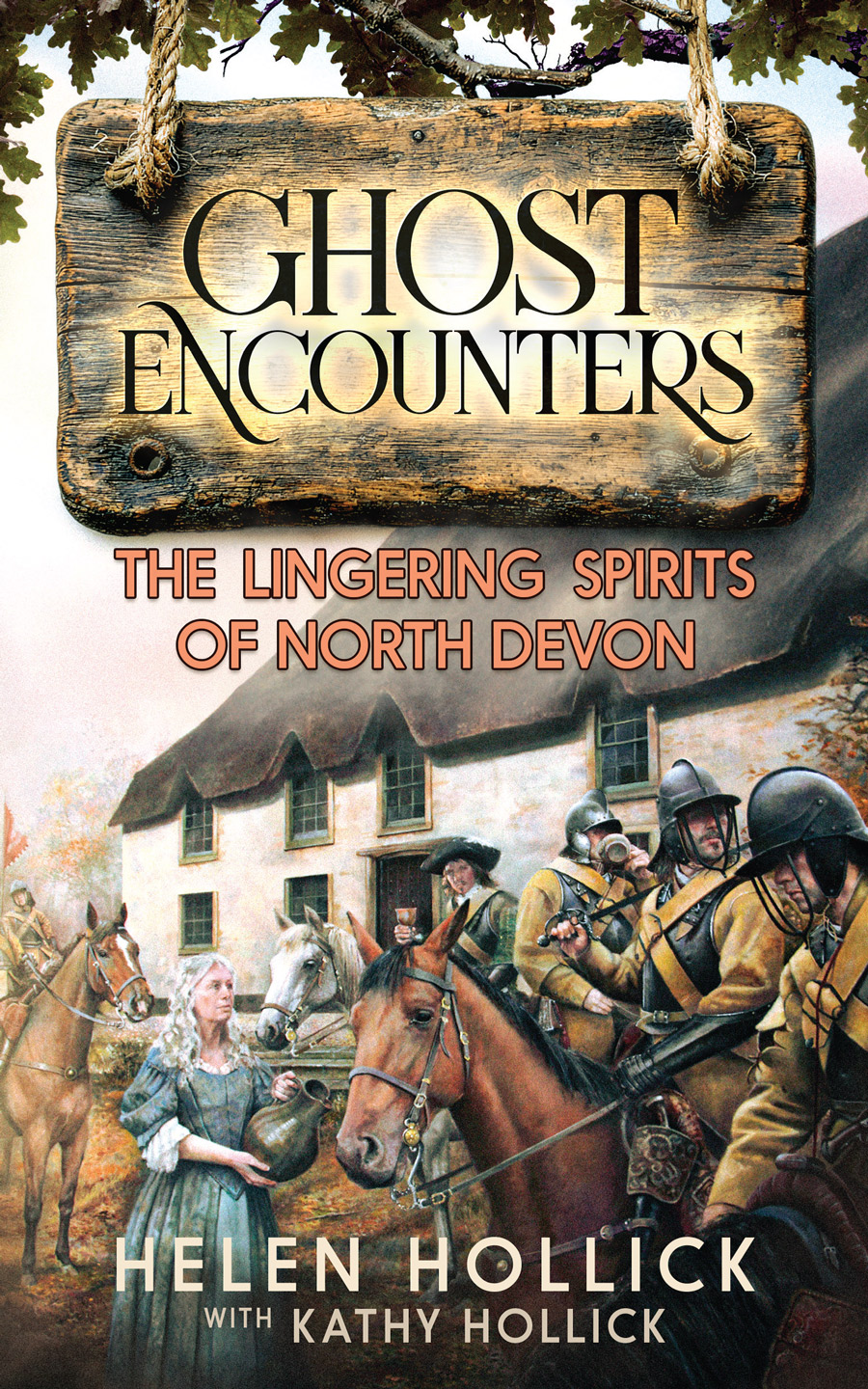
Everyone assumes that ghosts are hostile. Actually, most of them are not.

You either believe in ghosts or you don’t. It depends on whether you’ve encountered something supernatural or not. But when you share a home with several companionable spirits, or discover benign ghosts in public places who appear as real as any living person, scepticism is abandoned. In GHOST ENCOUNTERS: The Lingering Spirits Of North Devon, mother and daughter share their personal experiences, dispelling the belief that spirits are to be feared.

Ghost Encounters will fascinate all who enjoy the beautiful region of rural South-West England, as well as interest those who wish to discover more about its history… and a few of its ghosts.

(Includes a bonus of two short stories and photographs connected to North Devon)

Book Links:
Pre-order the e-book on Amazon
https://mybook.to/GhostEncounters

Paperback published February 28th – e-book will also be available on Kindle Unlimited

WHAT’S ALL THIS ABOUT GHOSTS?

I wrote Ghost Encounters with my dyslexic daughter because we wanted to show that not all ghosts are hostile, because there are animal ghosts as well as people – and because we wanted to share this beautiful part of England’s West Country – and some of its history – in a slightly different (maybe quirky!) way!

A ‘ghost’ is quite possibly only the remnant of some sort of past energy, something relayed as a hologram-like YouTube-type video that can only be viewed by those who can access the correct wavelength. If you don’t have the right frequency, all you get is nothing or static. What created this ‘energy’, no one knows, it’s inexplainable, which is why the subject is so controversial. What chance do poor old ghosts have when their is no fact, scientific or otherwise, to support their existence?

Many accounts claim that ghosts are deceased people bent on revenge against some misdeed committed against them during life, or they are souls imprisoned on earth for foul things they did to others. Or maybe a ghost haunts a certain location because that is where a violent or unnatural death occurred. My personal belief against this last: while there are ghosts lingering near battlefields (I’ve had personal experience) how come there are not hundreds – even thousands – of ghosts sitting around at known battle sites? Waterloo, Agincourt, the Somme… if this theory was right these places would be akin to a London or New York rush hour!

APPEARANCE

Misty shadows, a vague blur, maybe a hovering orb? Perhaps merely a feeling of a sudden ice coldness or a brief breeze across the cheek? A sound, a moan, a wheezed breath; or a sigh or something knocked over when no one was near to knock it. All must, of course, be ghosts.

Many female ghosts are described as being a ‘Lady in White’. White ladies seem to appear in rural areas, died tragically, experienced trauma, or tragically lost a child or husband.

Birds were often thought to be returning ghostly spirits, especially the Barn Owl, its white (though sometimes light brown) shape gliding soundlessly as dusk settles. Cats have spiritual connections, again, probably because they are often silent, can appear from nowhere and, apparently, have nine lives.

To many, though, a ghost appears in body form with clear features, including the clothing worn at the time of death. The Egyptian Book of the Dead, shows the deceased in the afterlife as they were before death.

My adult daughter, Kathy, sees ghosts as clear as living people, often not realising she’s seeing someone who is dead unless she knows they have died, or are dressed in period costume. Anyone walking along our farm lane would not be likely to wear Georgian or Tudor costume! Often, though, she will only see part of a person, which is a bit of a giveaway. Or more frequently, she gets a glimpse only. The moment they realise they have been seen, they disappear. These ghosts, I am convinced, vanish because they are startled to be seeing her. In their eyes, she is the ghost to be frightened of.

Our frequent ‘visitors’ to our house are, however, aware of us and are seen clearly. Occasionally even heard, passing comment or remarks. Our ‘Maid’ (we’re not certain if her name is Milly or Molly) has been known to announce her disapproval of building work within the house (because of the mess, I suspect,) or that I chatter a lot. Another visitor, seen from the waist up with three-corner hat, neat-tied cravat and a waistcoat, likes watching our horses. He is, we have discovered, the Georgian equivalent of the modern Amazon Delivery. In his case, bringing goods shipped to the nearby trade ports of Barnstaple or Bideford here in North Devon.

My daughter, Kathy, (and many other ‘ghost-seers’ also encounter animals. Dogs are the most common apparitions, perhaps because dogs have an especial affinity with us humans? For ourselves, we have lost horses in the past, both Saffie and Franc, mother and son, who died within two months of each other, (now very much missed by us) have been seen grazing in our fields.

Kathy has also seen a bear and another beast from the very distant past in our woods – she’s not too keen on ever seeing a dinosaur, though, so hopes they stay firmly on the ‘other side’.

Discover more in Ghost Encounters!

ABOUT HELEN

Known for her captivating storytelling and rich attention to historical detail, Helen might not see ghosts herself, but her nautical adventure series, and some of her short stories, skilfully blend the past with the supernatural, inviting readers to step into worlds where the boundaries between the living and the dead blur.

Her historical fiction spans a variety of periods and her gift lies in her ability to bring historical figures and settings to life, creating an immersive experience that transports readers into the past. Her stories are as compelling as they are convincing.

Helen started writing as a teenager, but after discovering a passion for history, was published in the UK with her Arthurian Trilogy and two Anglo-Saxon novels about the events that led to the 1066 Battle of Hastings, one of which became a USA Today best-seller. She also writes the Jan Christopher cosy mystery series set during the 1970s, and based around her, sometimes hilarious, years of working as a North London library assistant.

Helen, husband Ron and daughter Kathy moved from London to Devon in January 2013 after a Lottery win on the opening night of the London Olympics, 2012. She spends her time glowering at the overgrown garden and orchard, fending off the geese, helping with the horses and, when she gets a moment, writing the next book…

ABOUT KATHY

When not encountering friendly ghosts, Kathy’s passion is horses and mental well-being. She started riding at the age of three, had a pony at thirteen, and discovered showjumping soon after. Kathy now runs her own Taw River Equine Events, and coaches riders of any age or experience, specialising in positive mindset and overcoming confidence issues via her Centre10 accreditation and Emotional Freedom Technique training to aid calm relaxation and promote gentle healing.

Kathy lives with her farmer partner, Andrew, in their flat adjoining the main farmhouse. She regularly competes at affiliated British Showjumping, and rides side-saddle (‘aside’) when she has the opportunity. She produces her own horses, several from home-bred foals.

She also has a fun diploma in Dragons and Dragon Energy, which was something amusing to study during the Covid lockdown.

SOCIAL MEDIA LINKS

Website: https://helenhollick.net/
Amazon Author Page: https://viewauthor.at/HelenHollick
Bluesky: @helenhollick.bsky.social
Blog: supporting authors & their books https://ofhistoryandkings.blogspot.com/
Monthly newsletter : Thoughts from a Devonshire Farmhouse
https://ofhistoryandkings.blogspot.com/2024/01/thoughts-from-devonshire-farmhouse.html

Kathy’s Official Website:
https://www.white-owl.co.uk/

Cover design: Avalon Graphics https://avalongraphics.org/
Cover image: Chris Collingwood Historical Artist
http://www.collingwoodhistoricart.com/

Necessary Busyness

Watching the penultimate episode of Doctor Who last night, I realized (afterwards) that it was a rare hour in which my brain was totally engaged with story as it was unfolding. I wasn’t analyzing structure, looking for breaks in continuity or… well, I was going to say things that didn’t make sense, but then again, it was Doctor Who. Nonetheless, this is a rare occurrence now, my writer-and-editor’s brain always weighing if the narrative works, if it could be improved.

My brain is rarely still. It never was, but as a child my (undiagnosed) ADHD, of the day-dreaming, messy, begin-something-and-not-finish-it sort found what it needed by discovering new worlds in books. I once read six library books in a day (and they weren’t children’s books.) The Lord of the Rings was swallowed in three. Either that, or I was inventing my own elaborate worlds based on Star Trek or The Man from Uncle, or out in the fields and woods learning trees and birds and wildflowers. And like most people with ADHD, I could focus on a preferred subject for hours.

Somewhere in my sixty-six years, I learned to control my unquiet brain to some extent. But it can’t stand to be idle: I’m less obviously day-dreamy now, because that’s been channeled into the imaginary world of my books. But even though it’s a ‘preferred subject’ I can only write or plan for a few hours a day. And if I don’t have something else to focus on, I get bored. Moody. Unproductive. ‘Give me work!’ brain demands. (It doesn’t mean cleaning the cupboards, of course.)

Busy-ness is necessary for me. (And deadlines.) So, brain, looking at the year ahead – researching and writing the next book, a few short stories to write, a couple of editing jobs, chairing the community newsletter, said, ‘nope, this isn’t enough. Remember that creative writing group you were asked to lead?’  

I live in a 55+ community of active, retired adults. How many want to try creative writing?  Thirty. An impossible number for one group. Or even two. It’ll be four, occupying my Tuesday afternoons for the foreseeable future. Mostly beginners – but some novelists and poets already-published or agented-and-querying as well, people who have more formal education in writing than I do. I’ll get to learn, as well as teach, which is a bonus. But – the moment I agreed to do this, brain, which had been futzing around with character vignettes and some plot outlines for the next book, but no serious writing, said, ‘All right! Now it’s time to write! Fingers on keyboard, please!’  and began to unroll the story.

As perhaps I had secretly hoped it would. Maybe I do understand my brain a bit after sixty-six years. I will no doubt swear and whine and growl at it over the next months – but I will be writing and teaching, and researching and learning – all the things I love to do – and I won’t be bored.

But the cupboards probably won’t get cleaned, either.


Featured : Image by Megan Rexazin Conde from Pixabay

A Book Develops, Part V

Trade routes from central Africa to the Mediterranean, c 12-13th C. Illustration Cleveland Museum of Art. My photo.

Inspiration comes from many places, some random, serendipitous, some sought out. This week I drove the 1000+ km to and from Cleveland, to see an exhibition at the Cleveland Museum of Art called ‘Africa & Byzantium’, an exploration of mostly religious art produced in or resident in the lands of North and East Africa influenced by Byzantium.

But there’s no religion in your books, you might say. This is true – or rather, there are no large organized religions; personal faith is another matter – but it’s not religion per se that matters here. It was the communication, the translation of concepts and ideas I was interested in. The icon pictured below was possibly gifted to its Sinai monastery by Emperor Justinian himself, as he endowed the monastery in the mid-500s. It – and many other pieces of ancient art and writing – have been a part of the library of the Holy Monastery of St. Catherine since then.

In the new series set in my fictional world, the role of monasteries as repositories of knowledge and houses of learning is replaced by what the Ti’acha, the schools, of the Empire series have evolved into – the equivalent of the medieval universities not just of Europe but of the middle East and north Africa as well. So what writings – of philosophers from Casil and Heræcria and lands further east and south; of Heræcrian and Ikorani and Marai travellers, or even, at a more personal (for my new characters) level, of Cillian’s or Colm’s, Lena’s or Tarquin’s or Gnaius’s – might have found there way there, in original or copy, for Gerhart or Luce or Kirt to discover and learn from in their travels? Trade, medicine, history, mathematics, music, science: the knowledge held, exchanged, sometimes forgotten, the disciplines and interpretation of thought and ideas – all that still holds, even removing organized religion from the world.

I learned more practical, tangible things, too: the gifting of large brass trays, beautifully inscribed, as diplomatic gifts from the Mamluk sultanate; that a written language called Old Nubian existed; the trade routes from central Africa to the Mediterranean (invaluable); what block-printed linen of the period looked like; the three sources of treasured ivory. All useful things to be tucked away and possibly used, if and when they fit.

And, with pure serendipity, wandering the galleries before my entrance time to the exhibition, I walked into a room and saw – whatever the artist intended nearly 200 years ago – a portrait of my character Luce as a young student, studying medicine in an eastern school.

The Young Eastern Girl, Friedrich Amerling, 1838. Cleveland Museum of Art.
My photo.

Driving home along Interstate 90, I could feel this information slotting into the background of my world, hear the characters taking it in, shaping it to their experiences (and being shaped by it), becoming part of the world and character building. Both the book(s) and I are richer for it.

A Book Develops, Part III

A novel – or its components: character, theme, plot, setting, language – has  many sources, many experiences, real and imagined, that work together to create something whose whole is greater than its parts. I am a writer of place, of landscape, and of characters who are shaped by the places they call(ed) home. Many of those places are drawn from my own experiences.

In An Unwise Prince, one of my characters, Cenric, has stuck close to home, a medieval trading centre. Kirt, his partner, has travelled widely, an explorer, a risk taker. Luce has travelled too, but in pursuit of her education in medicine. Then there’s the fourth—young Audun, Cenric’s son, seventeen or eighteen, just finished what might be considered his secondary education, hoping to go home for a while before his next term of study.

I knew Audun was from Torrey, a coastal village (it has a few brief mentions in the Empire series) where his mother runs a workshop making baskets from the reeds and willows of the marshes. I’ve been reading pretty widely on the pre-drainage landscape and ways of life in the fen country of England—not so much for research but because it’s a landscape I love, a love that perhaps has its roots in my genes—or at least in family stories. I’d had a few thoughts about how to use this information to flesh out Audun’s character a little, but they hadn’t coalesced.

Then I started to read Nick Acheson’s The Meaning of Geese, a book about the flocks of geese that return each year to north and west Norfolk to escape the Icelandic and Scandinavian and Russian winters. Acheson—who is a friend of the friend who insisted I needed to read this book—writes in part about his own teenage experiences in the coastal marshes of north Norfolk; about places I know, have walked, can picture in detail. I can hear and feel and smell and see the birds, the wind, the salt in the air, the long views. And suddenly, I had my key to Audun.

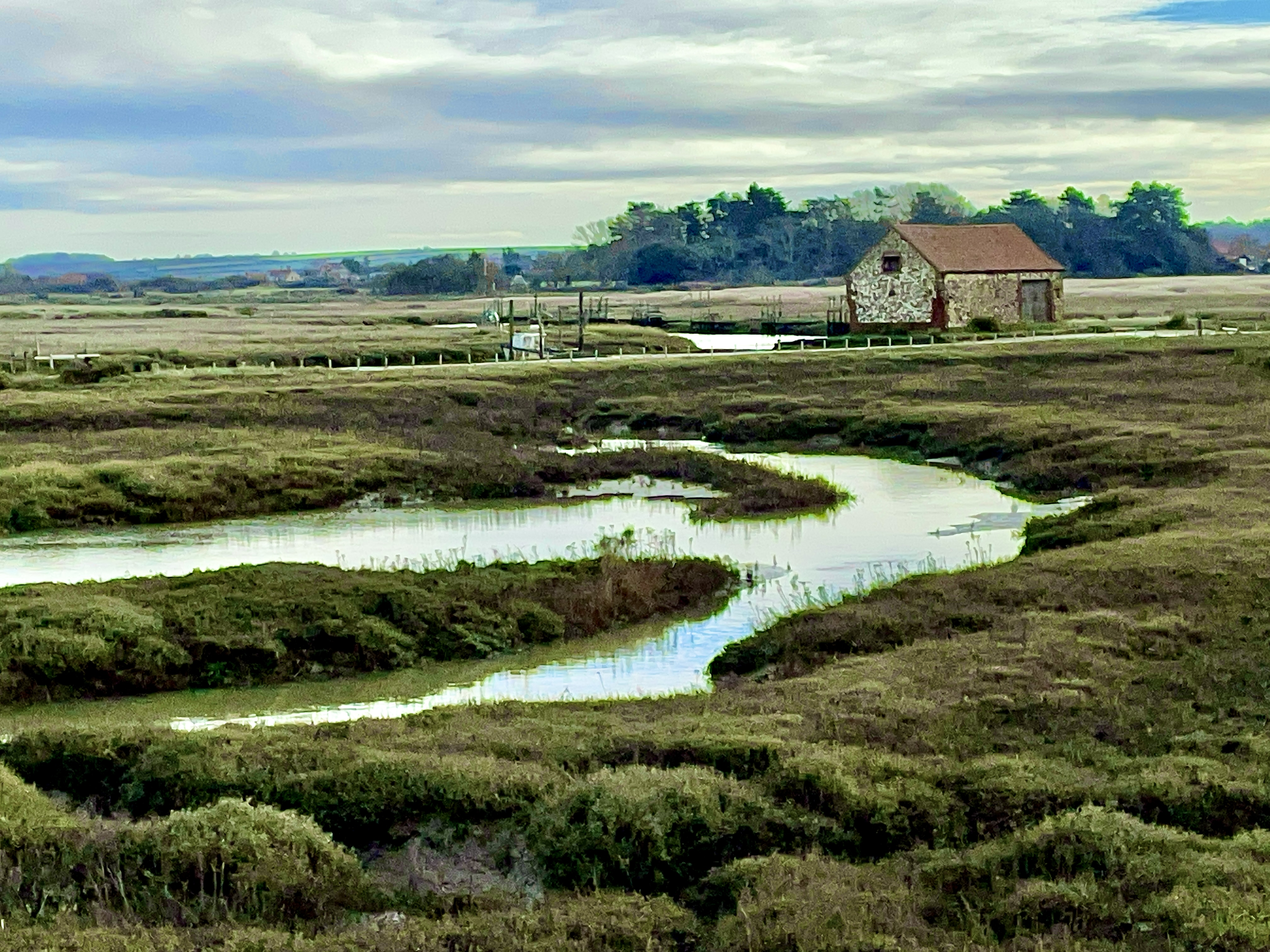
The Coal Barn, Thornham Staithe. My photo.

It’s not all there is to Audun, of course, but it lies at the heart of who he is. And gives him a knowledge that may prove useful, later in the story. Or so I think, at this moment in time!

A Book Develops, Part II

Well, I didn’t expect it to be almost three months before I had anything more to say about the next novel! (The first part of this occasional series is here.) January, though, was mostly taken up with finishing other tasks, primarily getting Empire’s Passing ready for release and completing a contracted edit. February took us to Spain, a road trip for birds and Roman ruins and medieval city centres; one of the things I wanted to experience was how remnants of the Roman Empire (or the Eastern Empire, in my fictional world) appeared in a countryside that wasn’t Britain. Something beyond the familiar, to make me see.

Sadly, I don’t have a photo of the image that had the most impact: part of an aqueduct in a random field, and in that field, a man walking his dog. Living with this ancient piece of infrastructure as background to his everyday life. That was the sense I wanted; it will metamorphose, by whatever alchemy happens in a writer’s mind, into what it’s like, 500 years after we last saw my world, to live with the remnants — tangible and intangible –of a past empire.

One of the hardest things I had to find was some scholarly books with a good overview of European history of the later middle ages – roughly 1000 to 1400. Eventually, through discovering the online syllabus to a university course covering that period, and checking its reading list, I ordered two books:

I’ve also signed up for a six-week online course on medieval universities, as the Ti’acha of the first series have developed into something fairly similar (but without the religious context).

I’m still writing exploratory short stories, which can be found, one a month from January onward, on the A Muse Bouche Review. This is a way for me to get to know my characters, and some of the conflicts that the story will be based around.

As my research and character development continues, I’ve realized there are two big challenges ahead of me: which bits of European history to cherry-pick for the books (there’s a LOT going on in Europe and around the Mediterranean in these centuries), and, maybe even harder, to write a novel or novels with at least four POV characters. Two is the most I’ve done before.

But as the book gestates, moving from concept to reality, its lack of a working title was nagging at me. (Titles and book covers make an idea more solid, at least for me.) So here’s a cover mock-up: a place-holder image, and the working titles for both the book and the (presumed) series: All of which may change between now and publication!

‘A wise prince should establish himself on that which is in his own control and not in that of others; he must endeavour only to avoid hatred.’
The Prince, Chapter XVII
Niccolò Machiavelli

Varril, the elected Princip of Ésparias when the story opens (at this point, at least!) is not a wise prince. Not at all. And on that, it seems, will hang the tale.

(As for the Casillard Confederacy – think of the Hanseatic League, often simply called the Hansard.)

More when there’s more to say!

A Book Develops: Part I

Even before Empire’s Passing, the last book in the Empire’s Legacy series, was partially written, people were asking ‘what’s next?’ To be fair, I had a glimmer of an idea – the same world, about 500 years later, with some aspect of the story derived from the trade alliance of the Hanseatic League.

Passing is done now; I’m just awaiting the paperback proof. It’ll be out in February. I’m in no hurry to write this next book, for many reasons. Key among them is that I know little of 13-14th C history, so I have a lot of research to do. But books evolve not just from plot but from characters—after all, it is the characters’ responses to the problems and conflicts they are faced with that makes a book interesting. And for me as a writer, characters simply appear, with much of their personalities in place, immutable except through personal growth, their responses to the circumstances of their lives.

Over the next—how long?—year? more?—I plan to record the development of this next book, as much to see if I can elucidate my own process as for anyone else. But you’re welcome to come along on the journey as this yet-without-a-working-title book emerges from research and imagination and craft.

So: where am I now?

Five characters of some importance, so far; one minor ones. Who do we have?

Cenric bé Casille, who describes himself as ‘a man of mature years and a merchant of standing and not insignificant influence’. He’d be about forty.

Kirthan del Candre de Guerdián en Leste, more usually known as Kirthan de Guerdián, another merchant, described by Cenric as ‘made of autumn oak leaves, shades of gold and brown from the short curls of his hair to the tips of his polished boots.’  A few years older than Cenric, known to his intimates as Kirt.

Luce bé Casille, Cenric’s sister. Physician, musician, mid-thirties.

Of some importance is Cenric’s son, Audun, who is about seventeen, and currently attending the equivalent of a cathedral school (equivalent because organized religion continues to play no part in my world) at which his great-uncle (Cenric and Luce’s uncle) teaches. The so far unnamed great-uncle will be an important secondary character, I think.

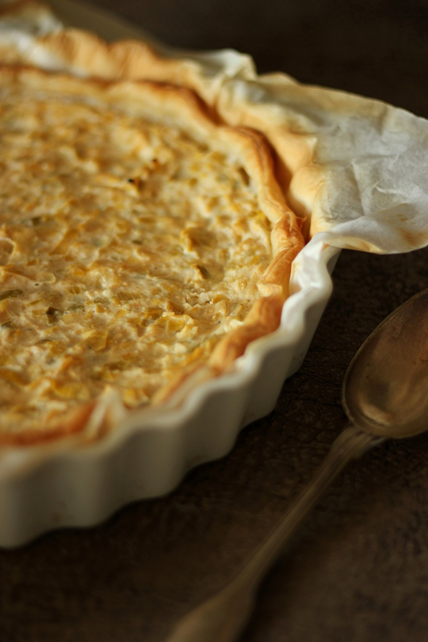
The first three characters (and the minor one of Cenric’s housekeeper) are introduced in an exploratory short story called The Onion Tart, published this month in A Muse Bouche Review. There will be more of these character-exploring stories: some may become part of the book, some won’t. I don’t think The Onion Tart will, but its description of the meeting of Cenric and Kirt will be background (and canon!).

Image by magdus from Pixabay

Meanwhile, while Cenric and Kirt and others tell me little bits about themselves, my first research book is Seb Falks’s The Light Ages: The Surprising Story of Medieval Science. Its focus is the 14th C, but the advantage of writing historically inspired speculative fiction is I can borrow from adjacent centuries, as long (my own rule) I’m not blatantly anachronistic with technology.

More to come, when there’s more to say!

Part II is here.

Creating King Arthur – in Post-Roman Britain

By Helen Hollick

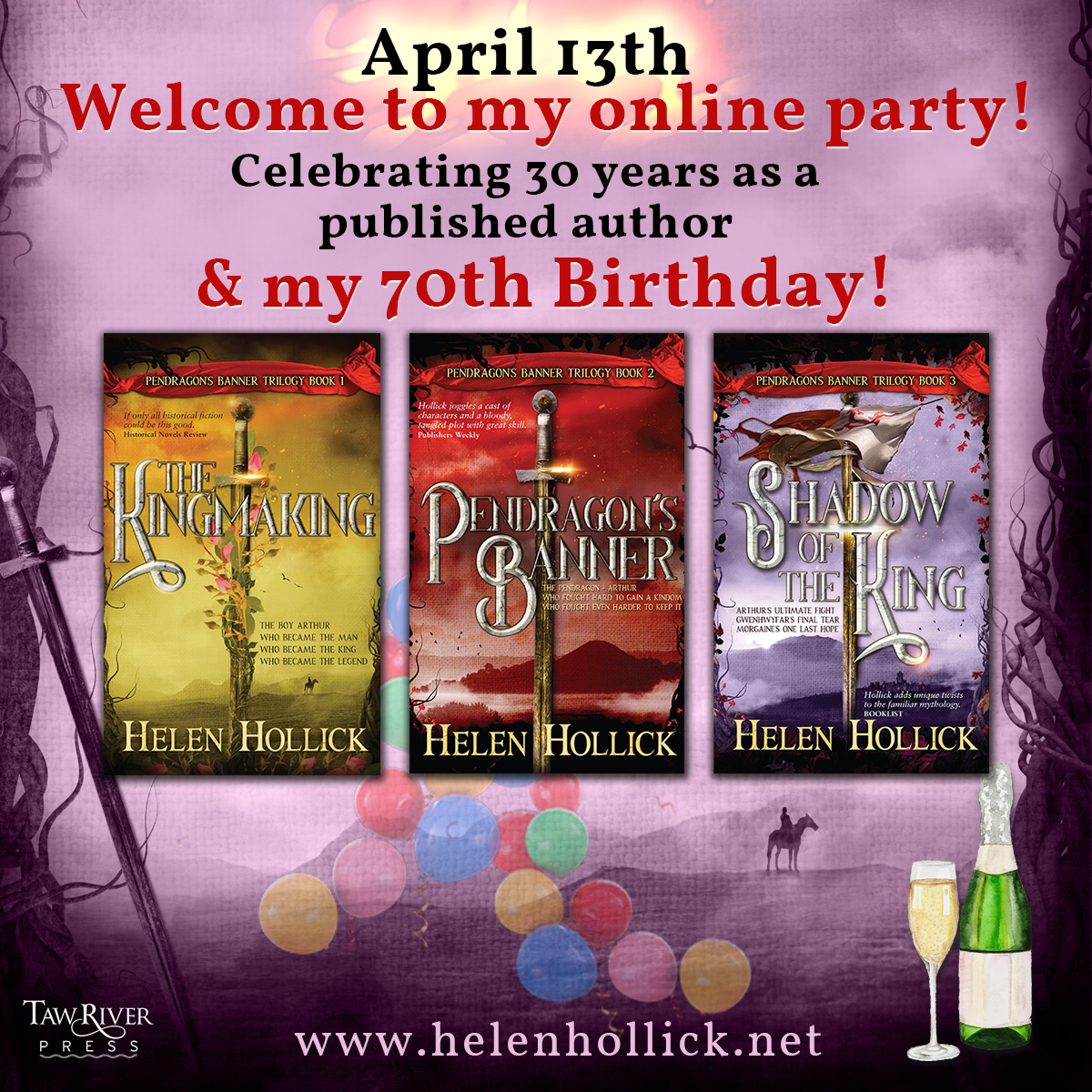
Pendragon’s Banner Celebration Tour April 2023

Thirty years ago in April 1993, one week after my 40th birthday, I was accepted by William Heinemann (now a part of Random House UK) for the publication of my Arthurian The Pendragon’s Banner Trilogy. It had taken me more than ten years to reach that stage of my dream to become a real writer – more than that if you count that I had been scribbling stories since the age of thirteen.

So why King Arthur? I had never liked the Medieval tales of knights in armour, the Holy Grail and courtly chivalry – I couldn’t stand Lancelot (what on earth did Guinevere see in him?) Why did Arthur go off on a religious quest for so many years? For me, none of those tales had the believability that writers today create in their novels of historical fiction. Arthur and the people of his court, if they existed, (and it’s a very big IF!) had no place in factual history after the Norman conquest of England. Those Medieval tales are merely entertaining stories, with the Holy Grail quest perceived, perhaps, to encourage men to join the Holy Crusades, and maybe the Arthur story mirrors the fact that Richard I spent many years away on his own ‘quest’ and very little time in his kingdom of England.

I was intrigued, therefore, when I discovered that there were earlier tales of Arthur, not only pre-Norman but pre-Anglo-Saxon. These were the Welsh legends, stories and poems of a warlord who fought against the incoming Germanic tribes. To place an Arthur figure during the upheaval and chaos of fifth-century Britain made sense. The period is not known as The Dark Ages for nothing, for written evidence, the whys and wherefores, are few and far between – we are, very much, ‘in the dark’ for the years around 430-550 AD.

So this is when I set my Arthurian tale, it is fiction – let’s face the fact, ‘Arthur’ as a king did not exist. (Sorry!) But even if he didn’t exist the earlier stories about him are wonderfully exciting.

I researched, as well as I could, the detail of post-Roman Britain (no internet back in the 1970s/’80s!) using archaeological evidence to add into the many, many imagined fictional bits, which include the Welsh tales and writing of clerics such as Nennius, who mentioned twelve battles that Arthur (supposedly) fought.

My character of Arthur, therefore, is a fifth-century warlord, passionate about fighting for his rightful place as King, and fighting as hard to keep it. As passionate, is the love of his life, Gwenhwyfar, who in my tale remains loyal to her lord, Arthur, despite their many ups and downs, hopes, fears, achievements and disappointments. Despite their laughter and tears.

I wrote my Arthur as a real man – warts an’ all. He is not the Christian king of the Medieval tales, he is a soldier, leader of the cavalry, the Artoriani, a man trying to sort the chaos Rome left behind, a man living in a world of upheaval, where Christianity is still in a state of embryonic flux, where pagan beliefs are still very much to the fore, and a world where Britain is changing, through battle and peaceful settlement, from a Province of Rome’s authority into the emerging kingdoms of Englalond – Anglo-Saxon England.

But maybe, just maybe, my story as told in the Pendragon’s Banner Trilogy is the base for how the enduring legend of King Arthur really happened…

© Helen Hollick

Helen’s new, self-published, editions with beautiful covers designed by Cathy Helms of www.avalongraphics.org are, alas, only available outside of USA and Canada, where the same books are published by Sourcebooks Inc. (The new covers were offered – free – to Sourcebooks, but the offer was declined.)

ABOUT THE KINGMAKING (Book 1)

The Boy Who became a Man:

Who became a King:

Who became a Legend… KING ARTHUR

There is no Merlin, no sword in the stone, and no Lancelot.

Instead, the man who became our most enduring hero.

All knew the oath of allegiance:

‘To you, lord, I give my sword and shield, my heart and soul. To you, my Lord Pendragon, I give my life, to command as you will.’

This is the tale of Arthur made flesh and bone. Of the shaping of the man who became the legendary king; a man with dreams, ambitions and human flaws.

A man, a warlord, who united the collapsing province of post-Roman Britain,

who held the heart of the love of his life, Gwenhwyfar – and who emerged as the most enduring hero of all time.

A different telling of the later Medieval tales.

This is the story of King Arthur as it might have really happened…

“Helen Hollick has it all! She tells a great story and writes consistently readable books” Bernard Cornwell

“If only all historical fiction could be this good.” Historical Novels Review

“… Juggles a large cast of characters and a bloody, tangled plot with great skill. ” Publishers Weekly

“Hollick’s writing is one of the best I’ve come across – her descriptions are so vivid it seems as if there’s a movie screen in front of you, playing out the scenes.” Passages To The Past

“Hollick adds her own unique twists and turns to the familiar mythology” Booklist

“Uniquely compelling… bound to have a lasting and resounding impact on Arthurian literature.” Books Magazine

The Kingmaking: Book One

Pendragon’s Banner: Book Two

Shadow of the King: Book Three

(contains scenes of an adult nature)

BUY THE BOOKS:

THE PENDRAGON’s BANNER TRILOGY 

New Editions available worldwide except USA/Canada

https://mybook.to/KingArthurTrilogy

Available USA/Canada 

US TRILOGY: https://www.amazon.com/gp/product/B074C38TXN

CANADA TRILOGY: https://www.amazon.ca/gp/product/B074C38TXN

ABOUT HELEN:

First accepted for traditional publication in 1993, Helen became a USA Today Bestseller with her historical novel, The Forever Queen (titled A Hollow Crown in the UK) with the sequel, Harold the King (US: I Am The Chosen King) being novels that explore the events that led to the Battle of Hastings in 1066. Her Pendragon’s Banner Trilogy is a fifth-century version of the Arthurian legend, and she writes a nautical adventure/fantasy series, The Sea Witch Voyages. She has also branched out into the quick read novella, ‘Cosy Mystery’ genre with her Jan Christopher Murder Mysteries, set in the 1970s, with the first in the series, A Mirror Murder incorporating her, often hilarious, memories of working as a library assistant.

Her non-fiction books are Pirates: Truth and Tale sand Life of A Smuggler. She lives with her family in an eighteenth-century farmhouse in North Devon and occasionally gets time to write…

Website: https://helenhollick.net

All Helen’s books are available on Amazon: 

https://viewauthor.at/HelenHollick

Subscribe to Helen’s Newsletter:  https://tinyletter.com/HelenHollick

Her Blog: https://ofhistoryandkings.blogspot.com/

Facebook: https://www.facebook.com/helen.hollick

Twitter: @HelenHollickhttps://twitter.com/HelenHollick

Follow Helen’s Celebration Tour https://www.helenhollick.net/

Water and Blood, by Rik Lonsdale

A Review

When disaster strikes, you want your family around you—don’t you?

When the collapse of an Antarctic ice sheet causes catastrophic, world-wide flooding and the disintegration of society, Lucy Marchand thinks she’s safe on her family’s smallholding in the west of England. But family tensions that could be ignored when they were buffered by a larger society begin to become evident when her older brother Ben flexes his way to a position of power within the family.

Set against a dystopic world all too easy to imagine—and already real in parts of the globe—Water and Blood is a psychological study of narcissism, manipulation, and the responses of a family trying to survive, and trying too to believe that one of their own has their best interests in heart.

The choices made by each individual in on the smallholding are distinct, and the reasons behind their decisions believable and layered. Each person has a point at which they either say ‘no more’ or embrace the philosophy of the leader. Many things influence that choice, especially when it becomes a question of your own life or death. As winter deepens and starvation threatens, does morality matter at all?  

I read Water and Blood in two days, and found it hard to put down. Well-paced, it asks some probing questions about how societies, even in microcosm, work. A solid debut novel, Water and Blood is out March 22. My thanks to the author for an advance review copy.

All purchase links at https://linktr.ee/riklonsdale

The Call of Home

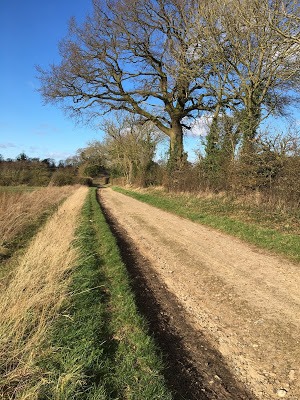
I walk steadily up the slight incline, my boots thumping rhythmically on the hard soil. Nearly two millennia past, Roman troops were doing the same: the track follows the line of a Roman road. It’s likely older than that; bronze age barrows lie to either side, on the high ground above the river valley below, and it ends very close to the place the wooden circle of uprights known as Seahenge was uncovered.

Within a few miles of my temporary, inherited house are three ringed enclosures (hillforts, as they’re generally known, whether or not they’re on a hill) that date to Iceni times. One corresponds with Tacitus’s description of the Iceni defensive structures during Boudicca’s rebellion. The line of another Roman road which approaches that hillfort lies to its south, perhaps a response to the Iceni uprising, perhaps part of the Saxon Shore defenses.

The Romans stayed another four hundred years, before Rome’s wars and finances made them withdraw. More invaders – or migrants – arrived from the continent, the people we call Saxon and Angles. They built in wood, not stone, except for the round towers of a few churches, leaving their mark in place names, a few roads, and moot hills. The Vikings arrived in the 800s and were ousted – at least in rule – in the 900s. The settlers stayed, though, and both archaeological finds and place names attest to this. And then it’s 1066 and William of Normandy winning at Hastings, and the rulers – not just the king, but the landholders and princes of the church – change again.

After that, sheep bring wool-wealth to Norfolk, huge churches in every village, and a Hanseatic port at King’s Lynn. The plague arrives, some medieval villages disappear, and the population plummets. In the 17th century agricultural improvement – fen drainage and sea-wall construction, then the work of ‘Turnip’ Townsend and Coke of Norfolk in crop rotation and soil improvement – slowly move Norfolk from grazing to crop production. The Enclosure Act changes who has access to land, and where. Hedges are planted. More medieval villages disappear,  because major landowners move them off their deer parks. New roads are built, others disappear, to become bridleways and footpaths.

Because of all this, and my family’s long connection (on one side) with west Norfolk, I love this place. I could claim it’s in my DNA, which reflects the series of migration – violent and peaceful – that I’ve encapsulated here, but the scientist I once was raises an eyebrow at that statement. It is, I think, more about stories: my grandmother’s, my father’s, the cousin who made me her executor and beneficiary. Environment, too: I was brought up in a house where history mattered.

I’ve been here eight weeks; I’ll be here just about another two. It’s not the first long stay – we wintered here after retirement until the pandemic, January to March of every year, trading Ontario’s snow and ice and cold for the relative warmth and good walking of west Norfolk. But it’s the first time I’ve been here alone, my husband staying, for good reasons, in Canada.

I find myself like my character Sorley, torn between who he loves and where he loves. Because part of me wants to stay. This land and its long history is the wellspring of my creativity, the source of my invented lands and their histories and the details of worldbuilding readers love. I lay my fiction lightly on this place, seeing it reflected all around me.

But in Canada are the people I love: my husband, my extended family, my friends. And, a city I love in a different way, for its cafes and bookshop and trails for bike and foot; for its university and the two rivers and the farmers’ market, and for the writing community I’m part of.  So in 12 days, I will go home, both gladly and sadly.

The question of what and where home is echoes through my books, one of the themes of the series. In the work-finally-in-progress, Empire’s Passing, it will be a key question for my MC Lena. “I had always turned for home. But where is home for the tamed falcon, when there is no falconer to hold out his arm?” Some of the intricacies of that question – and its answer – will be shaped by my own divided heart.