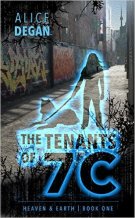
The Tenants of 7C, by Alice Degan: A Review

tenants 7cThere is something about urban fantasy that takes place in a city well-known to the reader that adds a level of charm and attraction. The Toronto setting of The Tenants of 7C was a bonus for me, but even without knowing the Kensington Market district, this is a delightful collection of connected short stories.

Above the Heaven & Earth Bakery, in an obscure back alley, the tenants of apartment 7C are an eclectic mixture of decidedly non-human characters: a young werewolf, a Japanese demon, and a very young satyr. They share the rooms of 7C: rooms that aren’t in the same dimension as the actual building, and frequently don’t stay in one place. The bakery itself isn’t really meant for humans either, its breads and cinnamon rolls providing sustenance to a wide range of supernatural creatures. How these three co-exist and survive in a their dual world, both with other “others” and with humans are the central conflict of each story.

While in some ways reminiscent of Charles deLint’s books, especially his early work set in Ottawa, The Tenants of 7C focuses on the lives of the ‘others’, not the lives of humans who interact with them. The characters of the werewolf Nick, Takehiko, the Japanese demon, and Yiannis, the satyr child, are not just stereotypes, but dimensioned individuals whose personalities develop over the collection. Nick, who is the protagonist, is especially well-realized, completely believable as a seventeen-year old who doesn’t fit in but is doing his best to manage his life, attending an alternative high-school, worried about his relationship with his parents, wishing his life were easier. It’s just that his problems, unlike most troubled adolescents, involve him turning into a wolf.

Degan’s writing is polished and competent and the tone and structure fits the action and mood of each story appropriately. She can switch the mood from light-hearted or contemplative to frightening in a few sentences, and uses enough manga, gaming and Doctor Who connections to make the stories attractive to a young adult/new adult audience (I verified this with a early-twenties friend), but the stories are also deeply rooted in, and consistent with, older traditions of fantasy. Degan blends these strands of different fantasy genres and traditions well, not an easy feat.

I had only a couple of niggles. Because the stories in The Tenants of 7C are not a linear narrative, but rather vignettes and episodes in a larger world-under-construction, there are some loose ends, sub-plots that arise but are not completed in this volume, and some inconsistencies. I wanted to know what happened in those subplots and to those characters that are introduced but disappear. I guess I’ll just have to wait for the next book!

Overall, 4 stars. If you’re a fan of urban fantasy, The Tenants of 7C is definitely worth your time.
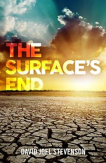
The Surface’s End, by David Joel Stevenson: A Review

The Surface's EndJonah, a young man in late adolescence, is responsible for providing his family with game, the major source of meat in their post-apocalyptic world. He’s found good hunting grounds at the edge of the dead zone, the desert known as the Deathlands, but even there the game is growing thin.
A wounded buck, fleeing the pain of Jonah’s arrow, leaves the shelter of the woods to run into the desert; Jonah, who cannot waste the kill, follows. Near where the buck finally falls, he finds a metal wheel…a wheel which is opens a door into another world – not a magical world: this is no rabbit-hole – but an underground city, peopled with the descendants of those who fled a ravaged Earth many generations earlier.

This is the premise of The Surface’s End, a young-adult dystopic science-fiction novel by David Joel Stevenson. I finished the book over two days: it’s short, at about 139 pages on my Kindle app, but it was also compulsively readable. Both the homesteading world of Jonah and his family and their fellow villagers, and the mole-rat like existence of the underground inhabitants were internally consistent and plausible, although both were slightly too one-dimensional, with no hint of strife or disagreement within the homesteaders and no positive aspects to the underground world.

SPOILERS AFTER THIS POINT!

Having the ‘wildlands’ adolescent discover the ‘city’, rather than the other way around, was a nice twist on the young-adult dystopic meme. The inevitable romance between Jonah and Talitha, the girl from underground, is handled sweetly, Jonah’s uncertainty and awkwardness particularly.

For the most part Stevenson’s writing flows smoothly (and occasionally brilliantly, as in the line, referring to the Deathlands: ‘He took his first step into the undiscovered lands.’, an echo of Hamlet describing death as ‘the undiscovered country.’). A minor niggle was that I found the tone and pacing of the narrative did not always reflect the tension and action of the story.

My only other niggle with the story was the scene in which Jonah and Talitha watch a digital feed of the deathbed confession of one of the original founders of the underground city. While it is important, a turning point in the story, the confession goes on too long, unbroken by the reactions and emotions of the two young people watching it.

All in all, though, I’m giving The Surface’s End four stars. It’s a worthy addition to the young adult dystopia genre (personally, I think it would make a good film), and it has enough originality to make it stand out from the crowd.

The author provided me with a copy of the book in exchange for an honest review. All opinions here are mine alone.

Books of Influence: An Occasional Series

This is the first in an occasional series of posts about the books – mostly classic fantasy and science fiction – that have most greatly influenced my own writing and world-building.  First among these are The Chronicles of Tornor, by Elizabeth A. Lynn.

The Chronicles of Tornor, published in the late 1970’s and early 1980’s, consist of three books: Watchtower, The Dancers of Arun, and The Northern Girl. All take place in Arun, a land of city-states and northern keeps, grasslands and mountains, a land where certain psi powers, dance and warfare as two faces of one discipline, and a wider acceptance of differing forms of sexuality and love evolve over the several hundred years separating the three books. The first book in the series, Watchtower, won the World Fantasy Award in 1979.

Hailed at the time of publication as “an adventure story for humanists and feminists” (Joanna Russ) author Elizabeth A. Lynn’s spare, evocative prose and finely tuned characters made me long to be in Arun, but more importantly taught me how less is more in writing. The facets of sexuality revealed in her characters in this trilogy (and in two other of her books from the same general time, The Sardonyx Net and A Different Light), while common-place now, were still challenging readers at the time they were published. Important to her world (and ours), the sexuality of her characters is not an issue; it is an unremarkable part of the society and culture of Arun.

Each book can stand alone, but all are linked by the land in which they take place, the lineage of the characters, and a set of cards resembling Tarot cards. While there is physical action in all three books, it takes a back stage to the psychological and emotional change and growth that happens in the protagonists; it is these battles that are the focus of the stories, and hold the meaning. Lynn brings the story full-circle over the three books, beginning and ending at the northern keep of Tornor.

I first read this series in my early-to-mid twenties – now over thirty years ago- and of all the books I have read and will write about in this occasional series, The Chronicles of Tornor had the most direct influence on my own fictional land and some of the themes explored in the Empire’s Legacy series.  My paperbacks are tattered and torn, and one is a replacement, but they are books that will always have a place on my shelves.

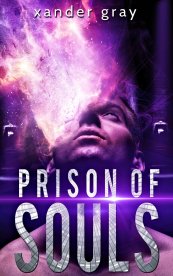
Prison of Souls, by Xander Gray: A Review

Prison of SoulsStephen Hawking, Ray Kurzweil, Randal Koene: all these scientists believe, to differing degrees, that it may (or will) be possible to upload the human mind to a computer. And what then?

One answer – one terrifying and convincing answer – to that question is the central premise of Xander Gray’s complex and intricate science-fiction novel Prison of Souls. Based on cutting-edge actual and theoretical research in quantum physics and mind uploading, Prison of Souls challenged me to believe the science and its implications, and yet at the same time proposed a logical and frightening outcome. This duality – fitting for a novel based on quantum research – kept me turning pages long after I should have put the book down and gone to sleep.

Prison of Souls received top rankings in all the categories I use to review books. Gray writes very well: his prose flows naturally, and his skill in describing everyday scenes, and contrasting them with the unreality of what is happening to the protagonist adds to the sense that what is real in this book is fractured and fluid, not conforming to commonly accepted versions of reality, like the particle/wave duality of light.

If I have one reservation about Prison of Souls, it is that the science is complex and difficult, but Gray uses dialogue to explain it in ways that make it reasonably comprehensible. The moral questions raised in Prison of Souls are real ones, and if Koene and Kurzweil are right in their belief that the uploading of human minds to computer networks will occur in the lifetimes of those who are now under fifty, then they are moral questions for which we currently have no answers, and have barely begun to consider.

I’m giving Prison of Souls five stars; it’s an outstanding debut novel. Available from Amazon.

The author provided me with a copy of this book in return for an honest review. The opinions stated here are mine alone.

A Sincere Thank You

Do what you love, and the work will come your way.

In the months that have passed since I officially retired from my salaried job (as opposed to the previous eight months, when I was off on medical leave), I’ve gone from a part-time writer, struggling to find the time to work with my editor and get Empire’s Daughter published, to a full-time writer, or, at least, someone involved in the indie writing world full-time.

I soon learned after retirement that I wasn’t cut out to do nothing but work on my own book. Perhaps because of years of having to juggle different projects, my ability to concentrate on one thing is limited to a couple of hours. After that, whatever I do probably isn’t worth the time it takes. So I gave it some thought: what aspects of my previous job(s) had I really enjoyed? What could I transfer to my new life?

The common themes going back through two different careers were these: writing, editing and reviewing. Over those careers, I’d written, reviewed, and critiqued everything from applications for hundreds of thousands of dollars worth of grants for scientific research, various master’s and doctoral theses (my husband’s M.Sc. thesis was classic, with the opening sentence going on for a page and half; luckily for our marriage, he’s a quick learner), and papers for submission to scientific journals. When I switched careers into education, I did the same for curriculum, writing prompts, policy and procedure documents, more grant applications, major reports to the government….But all this was non-fiction. Could it be transferred to fiction?

I’ve been reading since I was three, and have read (and continue to read) everything from classics to cyberpunk, from literary fiction to Lovecraft, and everything in-between. There is no better way to learn to write well – or recognize good writing – than to read and read and read. So, yes, I thought I could recognize good writing (and good storytelling, not always the same thing), and offer both fair and useful critiques.

So, as regular readers of this blog know, I started to write reviews. I offered editorial services, either beta-reads or full edits. Six weeks later, and my days (and both my review and editorial lists) are full. I spend my working hours in chunks of reading, reviewing, editing, and my own writing (plus a university course in a completely different area, to keep my scientific mind alive).

My own writing benefits greatly from this. Both in the reviewing and editing I am constantly reminded of what is good writing, what moves stories along, gives insight into characters, describes a situation or a location effectively. In looking at other writer’s work with a critical eye, I’ve become a better critic of my own work. In reading sentences or paragraphs or whole books that delight me, I learn more about what makes good writing – in my mind, that’s an apprenticeship without an end date.

So, to all of you who have offered me books to review, or trusted me with editorial services, thank you. I hope what I’m giving back is of value, but please know: you’re giving me work I love, and work I learn from. It’s very much appreciated.

Reviewers wanted!

This may be an odd request from someone who reviews indie books, but I’m having a very hard time finding people to review my young adult/new adult e-book, Empire’s Daughter. In part, this may be because it doesn’t fit into any major genre and is difficult to classify. It takes place in a world inspired by Britain after the fall of Rome, but is not historically, geographically, or socially a direct copy. There is no magic. Human relationships cover all pairings, but there is no explicit sex.

You can check it out here:

http://www.amazon.com/Empires-Daughter-Legacy-Book-ebook/dp/B00TXFTZ3G/ref=asap_bc?ie=UTF8

https://www.goodreads.com/book/show/24979052-empire-s-daughter?from_search=true

If you’d like to give it a try in exchange for an honest review on Amazon and/or Goodreads, let me know and I’ll send you the electronic file of your choice for Kindle, iBooks, or Kobo (basically, any of .mobi, e-pub, or PDF).

Thanks, and keep sending me review requests for your indie work (review policy here).

Marian

Magic of the Gargoyles, by Rebecca Chastain: A Review

Magic of the Gargoyles (1)

Mika Stillwater is a mid-level earth elemental adept, specializing in quartz working. Moonlighting from her unfulfulling quarry job, she is desperately working late into the night to finish a commission that will finally fund her own shop, when a frantic, terrified baby gargoyle arrives on her balcony. Seeking help in rescuing its kidnapped siblings, new hatchlings that have been taken for black-market sales, the gargoyle has been attracted by the strength of Mika’s magic.

The opening scenes of Magic of the Gargoyles grabbed my interest and attention immediately. Nor did either wane throughout the novella. Well-paced action, interesting and strong female characters, and a fresh and imaginative take on a magical world all contribute to the strength of this story. Chastain’s writing is crisp, with enough description to flesh out her world and the people and creatures that inhabit it, and her descriptions of Mika’s magic are tactile and convincing.

I had only one tiny niggle, and that was the description of a captured hatchling as “a gross mimicry of a Thanksgiving dinner plate”. To me, the inclusion of Thanksgiving into this magical world, clearly not our own, jarred, and it took me a few minutes to return to the state of disbelief (or belief) needed to thoroughly enjoy this urban fantasy.

I would recommend this book to good readers over the age of twelve (there is some violence, no love or sex scenes). Girls especially will enjoy it, but it shouldn’t be limited to a female readership. It is also completely appropriate for adults who enjoy urban fantasy…I’m well into my sixth decade but read it in one day with great enjoyment. Magic of the Gargoyles is available from Amazon. Five stars.

The author provided me with a free copy in exchange for an honest review. The opinions here are completely my own.

The Quantum Door by Jonathan Ballagh: A Review

The door into another world is as old as Alice in Wonderland and as new as Neil Gaiman’s Coraline, with many many interpretations and reiterations in between (and since). In The Quantum Door, Jonathan Ballagh’s debut novel, it is given a familiar yet fresh treatment in this middle-grades science fiction story set a very few years in the future.

Brothers Brady and Felix are attracted by a faint light in the forest behind their Vermont home, a forest that has recently been purchased and fenced with No Trespassing signs. Felix, the younger and more technologically-oriented brother, attempts to investigate with a drone, leading to the discovery of the quantum door, a door into a parallel universe fraught with menace and danger.

The door has been constructed by Nova, a strong, resourceful female character who appears to be roughly the same age as the boys. With her robotic, AI dog – a canidroid? – Achilles, she is attempting to find a safe place away from the Elder Minds, the artificial, evolving intelligences that now rule her world.

The Quantum Door is imaginative and fast-paced, introducing young readers to many of the classic science fiction themes. The science and the technology is realistic and feasible, building on current knowledge, devices and systems. The scenes of the underworld where the Neurogeists, constructed creatures that house the reprogrammed minds of transgressors of the Elder Minds’ rules, are resonant of many dystopias portrayed in text and film, and yet manage to be fresh horror.

A mention must be given to the outstanding illustrations by Ben J. Adams. Dark and fractured, they convey the dystopian side of this novel perfectly.

The reading level and story complexity are also worthy of mention: they are appropriate to the age group to which this book is aimed, without talking down in any way. This is a book that in my previous career in education I would have been recommending to middle-grade teachers without hesitation. Five stars to this outstanding debut novel, and here’s hoping for a sequel.

This is an independent review of copy of the book provided by the author. The opinions stated here are mine alone.

Book Review Policies

I’ll post this on the book review page on my website as well.

For everyone who has asked (and those who might wish to) I review published or pre-publication work from indie authors.  My preference is for young-adult fantasy/dystopia/sci-fi but will consider other work.  I do accept e-books (actually, I prefer them).

My practice is to share the review with the author before I post to anywhere except my website.  As well as my website, I post reviews to the following sites:  Goodreads, Amazon in the UK, Canada, and the US, and Kobo and Smashwords – but don’t unless the author requests it.

My contact details are marianlthorpe at gmail.com.