October Updates

This past month, when I wake in the night, there’s almost always a tawny owl calling outside – which is a hint that I’m not in Canada. Several things brought us to England in September, largely research for An Unwise Prince, my work-in-slow-progress: a chance to tour a medieval merchant’s house that’s only open a few times a year; the Silk Roads exhibition at the British Museum (and its medieval exhibits); Peterborough Cathedral, built as an abbey in the 13th C, which will become the physical model (more or less) for the school in the new book.

Peterborough Cathedral Precinct. My photo.

But also, of course, the birds, and the long walks, and in the four weeks we’ve been here we’ve had four days of serious rain. Most have been sunny. We caught the last of the summer birds, chiff-chaffs still singing, and the first of the winter migrants, pink-footed geese and redwings, as well as two birds new for the UK for us, yellow-browed warbler and cattle egret. The saltmarshes are washed pink with sea lavender, the hedges are bright with rose hips and hawthorn fruit and blackberries, and filled with red admiral and fritillary and cabbage white butterflies. Deer – roe and muntjac, fallow and Chinese water – browse field edges and park, and on the mud of the marshes probe godwit and golden plover, redshank and curlew.
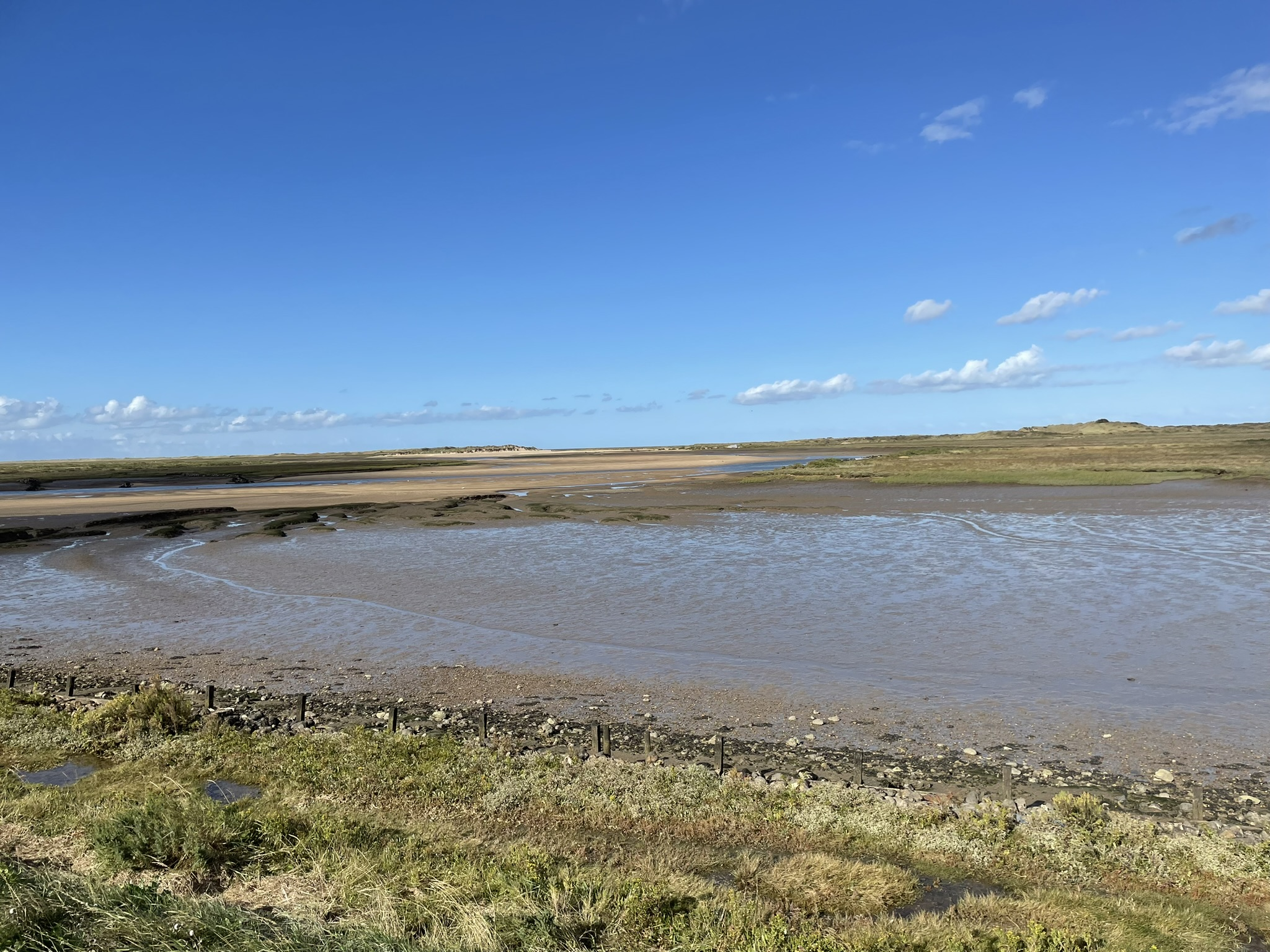
Burnham Overy Staithe harbour. My photo.

Yes, but how’s the book coming, you ask? I’m about 30,000 words into the first draft of what’s going to be the most complex book(s) I’ve ever tackled. It’s already clear it isn’t one book. I thought there were four point-of-view characters. Ha! I’ll be lucky to get through the story without adding at least another four. I’m borrowing from the Hanseatic League, medieval universities, Byzantium-North African-Arabic interaction, 12th C silk roads trade, intellectual exchange around the entire Mediterranean, the Mongol invasion of both the middle east and eastern Europe, Genoa’s near trade monopoly in the eastern Med, and the first crusade. All I can do is trust the process – do the research, let it marinate, and write down the words my characters dictate.

This are the tentative covers for the first two books. If it turns out to be more than a duology, the theme is easy to work with.

You may have noticed I’m not doing many updates here now. I will try to do monthly ones, but a much easier way to keep up with what I’m writing – short stories, poetry, non-fiction and a chance to read Empress & Soldier for free as a serialized novel – is to join me on Substack. My fiction site is History & Imagination; my non-fiction site is Landscapes of Memory.

Until November (I hope).

Marian
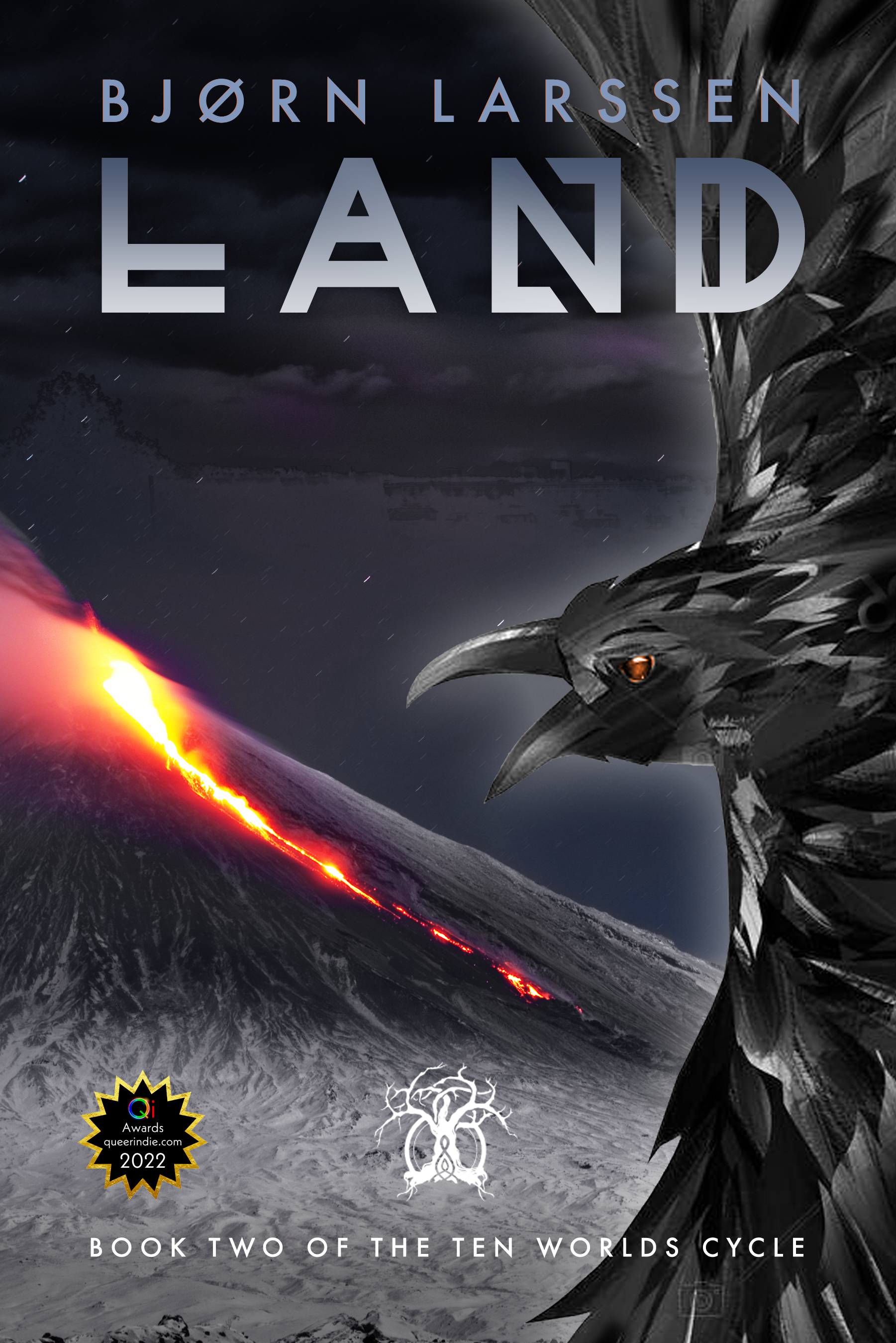
Cover Reveal!

The Ten Worlds #2: Land, by Bjørn Larssen

Loss. Love. Land. Happy Never After. (A grimdark retelling of the discovery of Iceland. )

The truth Maya fought for all her life turns out to be a lie a thousand years long. She neither understands nor knows how to wield her hidden power, simultaneously endless and limited, forcing her to face responsibility for the harm she causes and parry countless questions she has no answers to. Neither time nor space can stop her – but can she stop herself?

Bound with an unbreakable love spell, Magni and Thorolf, both raised in darkness and pain, only share one thing: the fear of revealing their truths. One was born to be a God; the other only knows a slave’s life. One craves peace and quiet; the other believes peace is a brief reprieve between wars. As they mourn those they have lost, the constant war of their own threatens to destroy all they have left – each other.

Haunted by Gods old and new, in the shadow of Odin’s raven, they head to conquer the new Ásgard. Apart from their demons, nothing and nobody is what it seems. Unwilling to give up love, freedom, or land they’re fated to live happily never after… unless destiny can be altered after all?

The book includes strong language, depictions of sexual, physical, and emotional violence. Full list of triggers, which may contain minor spoilers, will be provided.

Preorder link:
https://www.books2read.com/thetenworlds2

Website link:
https://www.bjornlarssen.com/land/

Goodreads link:
https://www.goodreads.com/book/show/217183142-land

Social media:
https://www.bjornlarssen.com/sm/

Bio:

Bjørn Larssen is an award-winning author of historical fiction and fantasy, dark and funny in varying proportions. His writing has been described as ‘dark,’ ‘literary,’ ‘cinematic,’ ‘hilarious,’ and ‘there were points where I was almost having to read through a small gap between my fingers.’

His debut novel, Storytellers, won a Readers’ Favorite Gold Medal (Best Historical Fiction Novel) and was shortlisted for Eric Hoffer Grand Prize Award. His fantasy works, Children and Why Odin Drinks have been shortlisted for eleven (11) Indie Ink Awards – so far; Children was also nominated for a Stabby Award (Best Indie Novel of 2020). Bjørn is a Queer Indie Award laureate (best speculative fiction author) and very proud of it.

Bjørn has a Master of Science degree in mathematics, and has previously worked as a graphic designer, a model, a bartender, and a blacksmith (not all at the same time). He currently lives with his husband in Almere, which is unfortunately located in The Netherlands, rather than Iceland.

He has only met an elf once. So far.

His upcoming release, the second book in The Ten Worlds cycle – Land – is coming out on November 5, 2024.

What if the world you create becomes real?

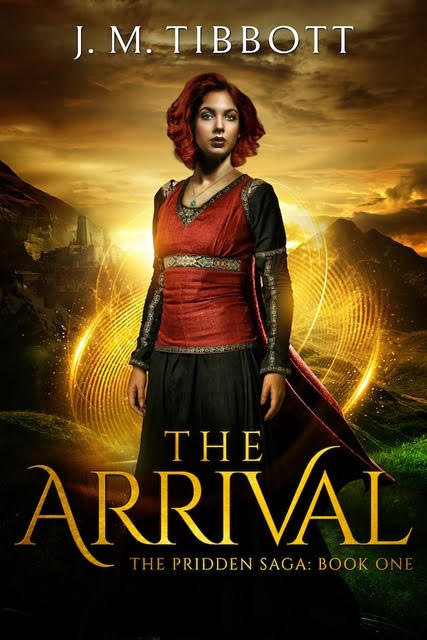
A spotlight on J.M. Tibbott’s fantasy series, The Pridden Saga.

A prickly young game designer finds herself in a medieval world reminiscent of the video games she creates. Magic, dangerous creatures, and political intrigue were fine as a fantasy, but navigating them all in real life is a different challenge. Will Kat find her way through the maze of this new existence?

An enchanting adult fantasy, The Arrival is Book I of The Pridden Saga. Six books are published; the seventh has a planned release of autumn 2024. Find out more at the author’s website:

https://jmtibbott.com/books/


 J. M. Tibbott is a prize-winning author, a writing instructor and editor. J.M. has been writing since grade school, and continues to study literature and the English Language. She believes there is always something new to learn. 

Her works include magazine and newspaper articles, newsletters, online blogs, and story collections. With the 6th book of The Pridden Saga published, J.M is deep into the final conclusion in Book 7. Another couple of series are tucked up her sleeve, the first with a decided Detective bent. After that, more are planned but only her muse is in on the secrets. 


A Book Develops, Part V

Trade routes from central Africa to the Mediterranean, c 12-13th C. Illustration Cleveland Museum of Art. My photo.

Inspiration comes from many places, some random, serendipitous, some sought out. This week I drove the 1000+ km to and from Cleveland, to see an exhibition at the Cleveland Museum of Art called ‘Africa & Byzantium’, an exploration of mostly religious art produced in or resident in the lands of North and East Africa influenced by Byzantium.

But there’s no religion in your books, you might say. This is true – or rather, there are no large organized religions; personal faith is another matter – but it’s not religion per se that matters here. It was the communication, the translation of concepts and ideas I was interested in. The icon pictured below was possibly gifted to its Sinai monastery by Emperor Justinian himself, as he endowed the monastery in the mid-500s. It – and many other pieces of ancient art and writing – have been a part of the library of the Holy Monastery of St. Catherine since then.

In the new series set in my fictional world, the role of monasteries as repositories of knowledge and houses of learning is replaced by what the Ti’acha, the schools, of the Empire series have evolved into – the equivalent of the medieval universities not just of Europe but of the middle East and north Africa as well. So what writings – of philosophers from Casil and Heræcria and lands further east and south; of Heræcrian and Ikorani and Marai travellers, or even, at a more personal (for my new characters) level, of Cillian’s or Colm’s, Lena’s or Tarquin’s or Gnaius’s – might have found there way there, in original or copy, for Gerhart or Luce or Kirt to discover and learn from in their travels? Trade, medicine, history, mathematics, music, science: the knowledge held, exchanged, sometimes forgotten, the disciplines and interpretation of thought and ideas – all that still holds, even removing organized religion from the world.

I learned more practical, tangible things, too: the gifting of large brass trays, beautifully inscribed, as diplomatic gifts from the Mamluk sultanate; that a written language called Old Nubian existed; the trade routes from central Africa to the Mediterranean (invaluable); what block-printed linen of the period looked like; the three sources of treasured ivory. All useful things to be tucked away and possibly used, if and when they fit.

And, with pure serendipity, wandering the galleries before my entrance time to the exhibition, I walked into a room and saw – whatever the artist intended nearly 200 years ago – a portrait of my character Luce as a young student, studying medicine in an eastern school.

The Young Eastern Girl, Friedrich Amerling, 1838. Cleveland Museum of Art.
My photo.

Driving home along Interstate 90, I could feel this information slotting into the background of my world, hear the characters taking it in, shaping it to their experiences (and being shaped by it), becoming part of the world and character building. Both the book(s) and I are richer for it.

A Book Develops, Part II

Well, I didn’t expect it to be almost three months before I had anything more to say about the next novel! (The first part of this occasional series is here.) January, though, was mostly taken up with finishing other tasks, primarily getting Empire’s Passing ready for release and completing a contracted edit. February took us to Spain, a road trip for birds and Roman ruins and medieval city centres; one of the things I wanted to experience was how remnants of the Roman Empire (or the Eastern Empire, in my fictional world) appeared in a countryside that wasn’t Britain. Something beyond the familiar, to make me see.

Sadly, I don’t have a photo of the image that had the most impact: part of an aqueduct in a random field, and in that field, a man walking his dog. Living with this ancient piece of infrastructure as background to his everyday life. That was the sense I wanted; it will metamorphose, by whatever alchemy happens in a writer’s mind, into what it’s like, 500 years after we last saw my world, to live with the remnants — tangible and intangible –of a past empire.

One of the hardest things I had to find was some scholarly books with a good overview of European history of the later middle ages – roughly 1000 to 1400. Eventually, through discovering the online syllabus to a university course covering that period, and checking its reading list, I ordered two books:

I’ve also signed up for a six-week online course on medieval universities, as the Ti’acha of the first series have developed into something fairly similar (but without the religious context).

I’m still writing exploratory short stories, which can be found, one a month from January onward, on the A Muse Bouche Review. This is a way for me to get to know my characters, and some of the conflicts that the story will be based around.

As my research and character development continues, I’ve realized there are two big challenges ahead of me: which bits of European history to cherry-pick for the books (there’s a LOT going on in Europe and around the Mediterranean in these centuries), and, maybe even harder, to write a novel or novels with at least four POV characters. Two is the most I’ve done before.

But as the book gestates, moving from concept to reality, its lack of a working title was nagging at me. (Titles and book covers make an idea more solid, at least for me.) So here’s a cover mock-up: a place-holder image, and the working titles for both the book and the (presumed) series: All of which may change between now and publication!

‘A wise prince should establish himself on that which is in his own control and not in that of others; he must endeavour only to avoid hatred.’
The Prince, Chapter XVII
Niccolò Machiavelli

Varril, the elected Princip of Ésparias when the story opens (at this point, at least!) is not a wise prince. Not at all. And on that, it seems, will hang the tale.

(As for the Casillard Confederacy – think of the Hanseatic League, often simply called the Hansard.)

More when there’s more to say!

A Book Develops: Part I

Even before Empire’s Passing, the last book in the Empire’s Legacy series, was partially written, people were asking ‘what’s next?’ To be fair, I had a glimmer of an idea – the same world, about 500 years later, with some aspect of the story derived from the trade alliance of the Hanseatic League.

Passing is done now; I’m just awaiting the paperback proof. It’ll be out in February. I’m in no hurry to write this next book, for many reasons. Key among them is that I know little of 13-14th C history, so I have a lot of research to do. But books evolve not just from plot but from characters—after all, it is the characters’ responses to the problems and conflicts they are faced with that makes a book interesting. And for me as a writer, characters simply appear, with much of their personalities in place, immutable except through personal growth, their responses to the circumstances of their lives.

Over the next—how long?—year? more?—I plan to record the development of this next book, as much to see if I can elucidate my own process as for anyone else. But you’re welcome to come along on the journey as this yet-without-a-working-title book emerges from research and imagination and craft.

So: where am I now?

Five characters of some importance, so far; one minor ones. Who do we have?

Cenric bé Casille, who describes himself as ‘a man of mature years and a merchant of standing and not insignificant influence’. He’d be about forty.

Kirthan del Candre de Guerdián en Leste, more usually known as Kirthan de Guerdián, another merchant, described by Cenric as ‘made of autumn oak leaves, shades of gold and brown from the short curls of his hair to the tips of his polished boots.’  A few years older than Cenric, known to his intimates as Kirt.

Luce bé Casille, Cenric’s sister. Physician, musician, mid-thirties.

Of some importance is Cenric’s son, Audun, who is about seventeen, and currently attending the equivalent of a cathedral school (equivalent because organized religion continues to play no part in my world) at which his great-uncle (Cenric and Luce’s uncle) teaches. The so far unnamed great-uncle will be an important secondary character, I think.

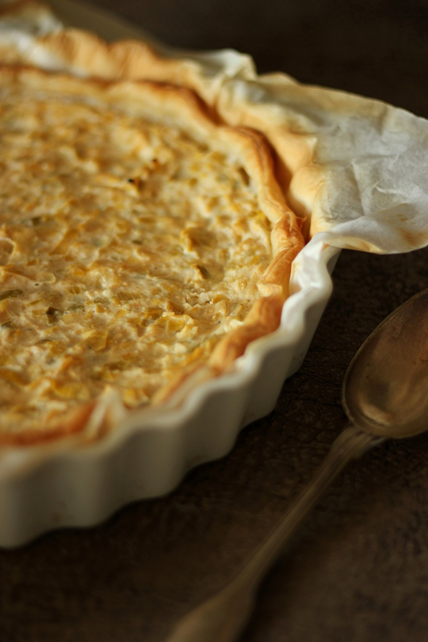
The first three characters (and the minor one of Cenric’s housekeeper) are introduced in an exploratory short story called The Onion Tart, published this month in A Muse Bouche Review. There will be more of these character-exploring stories: some may become part of the book, some won’t. I don’t think The Onion Tart will, but its description of the meeting of Cenric and Kirt will be background (and canon!).

Image by magdus from Pixabay

Meanwhile, while Cenric and Kirt and others tell me little bits about themselves, my first research book is Seb Falks’s The Light Ages: The Surprising Story of Medieval Science. Its focus is the 14th C, but the advantage of writing historically inspired speculative fiction is I can borrow from adjacent centuries, as long (my own rule) I’m not blatantly anachronistic with technology.

More to come, when there’s more to say!

Part II is here.

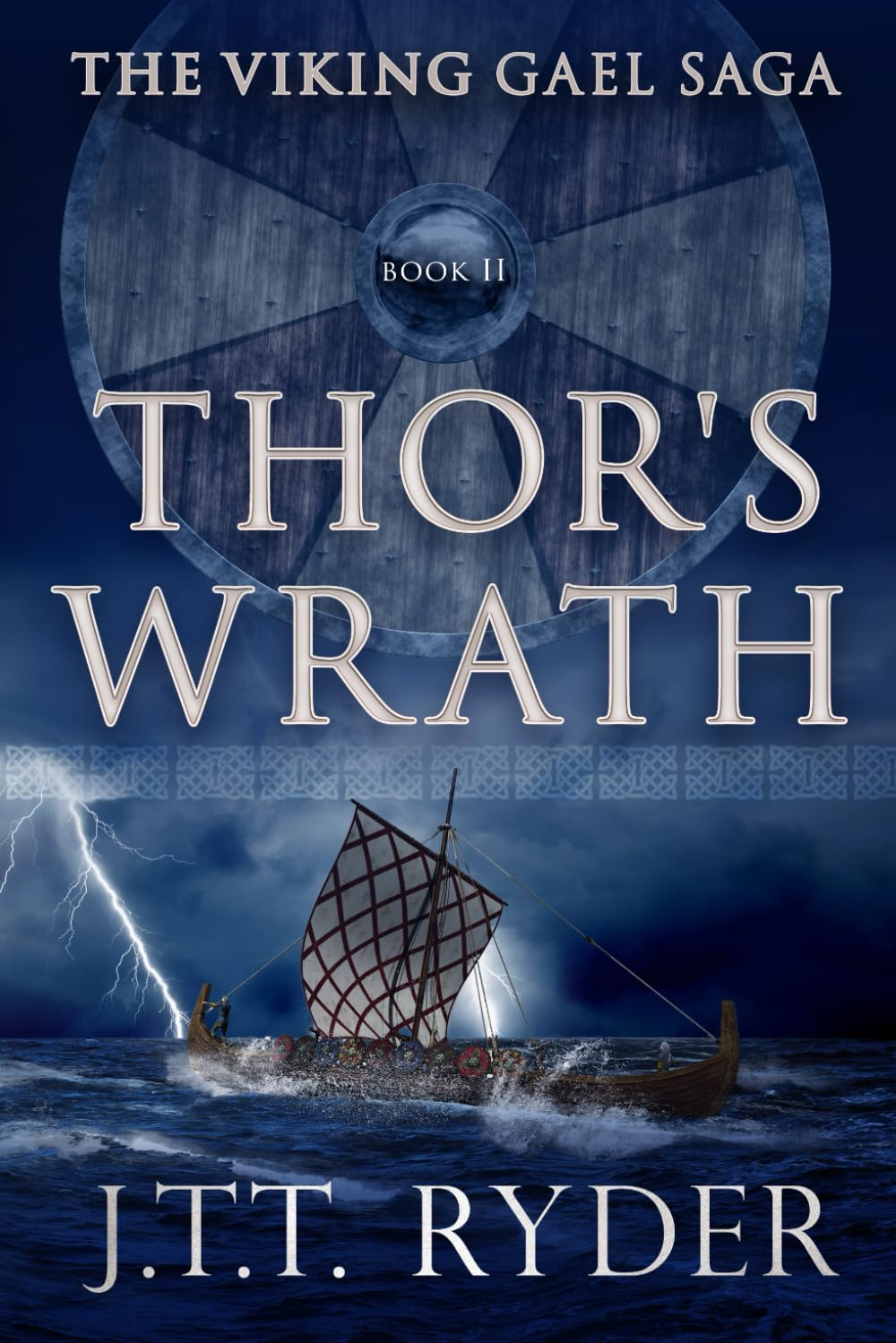
Thor’s Wrath: Book II of the Viking Gael Saga, by J. T. T. Ryder: A Review

When we left Asgeir in book 1, he had saved his life (and his cat) but lost his honour. Now, as Harold Finehair works to unite Norway, Asgeir lands in the Orkneys, into conflict and battle: a chance for Asgeir to overcome his shame and redeem himself in his eyes and his gods.

J.T.T. Ryder continues to draw on his extensive knowledge of the history and archaeology of the setting – both time and place – in recreating a 9th century north-western European world. While Asgeir (and his compatriots) worldview is not ours, it is convincing: enmity and friendship flipping back and forth; the importance of personal honour; the role of single combat over warfare. This is a world of foresight, of visits from gods, of visions and portents–all are real, all are to be taken seriously.

The story moves quickly; the reader and Asgeir together are given little respite as threats are overcome, peace is agreed, only for another threat or a betrayal to begin the action again. Ryder’s writing is sometimes lyrical, especially in his place-based descriptions: ‘A whirlwind of puffins blackened the sky over the rocky, chilly islet… Mist shrouded the horizon like unspun wool, and the wind bit as remorseless as a fox…” In other places it echoes the alliteration of the sagas: ‘shocked him with sleet sideways.’ Even the occasional unusual word choice adds to the story, creating a sense of a world different from ours, refracted through time and distance.

The story is perhaps Ryder’s best, the complexity of Asgeir’s choices and of his thinking deepening as the youth matures into manhood. The telling is excellent. The editing, I am sorry to say, is less so.

(I dislike on-screen reading, so whenever possible I buy the paperback, so these comments pertain to the first paperback edition published in 2023.) I am tolerant of a certain number of typographical errors: they appear in even the best edited books, traditionally published or independent. But repeated sentences, repeated scenes, should not. Nor should a leg of lamb in one paragraph become a leg of pork in another. These errors spoke of a rushed production, an incomplete editing process, and one, inevitably, that jolts the reader out of the story. A second, corrected edition* is strongly suggested.

But! Thor’s Wrath is still well worth reading, and I look forward to the next book in Asgeir’s saga. (And yes, the cat is still Asgeir’s companion at the end of this installment.)

*Update: correspondence with the author assures me these errors have been or are in the process of being corrected.

The old order changeth…

Yesterday all the planters and garden statuary that my cousin and her partner had collected over their forty years in this house were removed, going to new homes. Nearly at the top of the long sloping garden, one remains, a Grecian figure carrying wine jugs. It draws the eye, now all the distractions are gone.

The house is free of boxes and much of the furniture, too, cleared two days past by the auctioneers. A door long blocked by a bookcase is now open, creating flow and light in the house. There isn’t a lot left to do, except some cosmetic improvements and the slow bureaucracy of probate.

And with the clutter, both mental and physical, gone, my mind is bubbling with ideas and dialogue and scenes for  the book I’ve had to put off for the last few months. There is flow and focus and illumination, thoughts pushing themselves out of my subconscious like the bulbs bursting into bloom in the garden.  

Empire’s Passing, I already know, is a complex, multi-layered book, not surprisingly. The last book of a long saga has a lot of threads to bring together, questions to answer, farewells to be made. The title is a deliberate nod to ‘This too will pass’, the adage that reminds us that all things, good or bad, are fleeting. “For one brief shining moment…” But there will be hope too, at the end.

It’s going to be a challenge. But one I can finally give the time and attention it needs.

Image by Greg Montani from Pixabay 

You might just like….

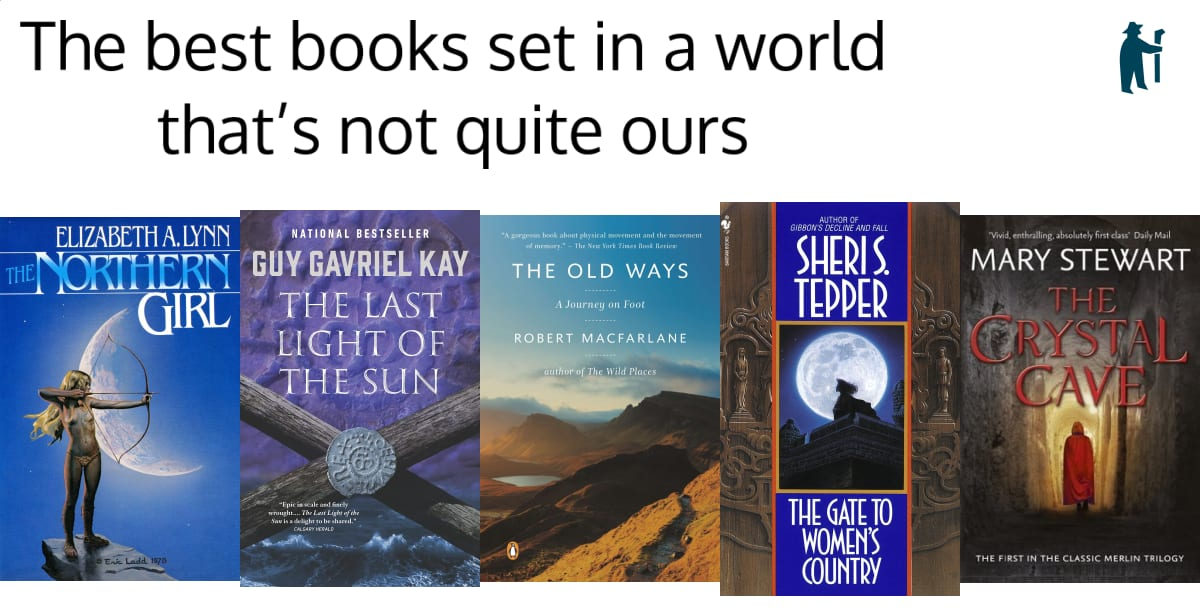
What are all these blue books?

This is my Shepherd.com list (find it at https://shepherd.com/best-books/set-in-a-world-thats-not-quite-ours)

(Hold on, you might be saying. What’s’ not our world’ about the non-fiction The Old Ways, by Robert Macfarlane? Well, it’s a way of seeing the world that isn’t, in my opinion, mainstream, although I wish it were, so I slipped it in. )

And if you’re a reader of my books, you probably think worldbuilding is important, so check out these other recommended books with outstanding worldbuilding.