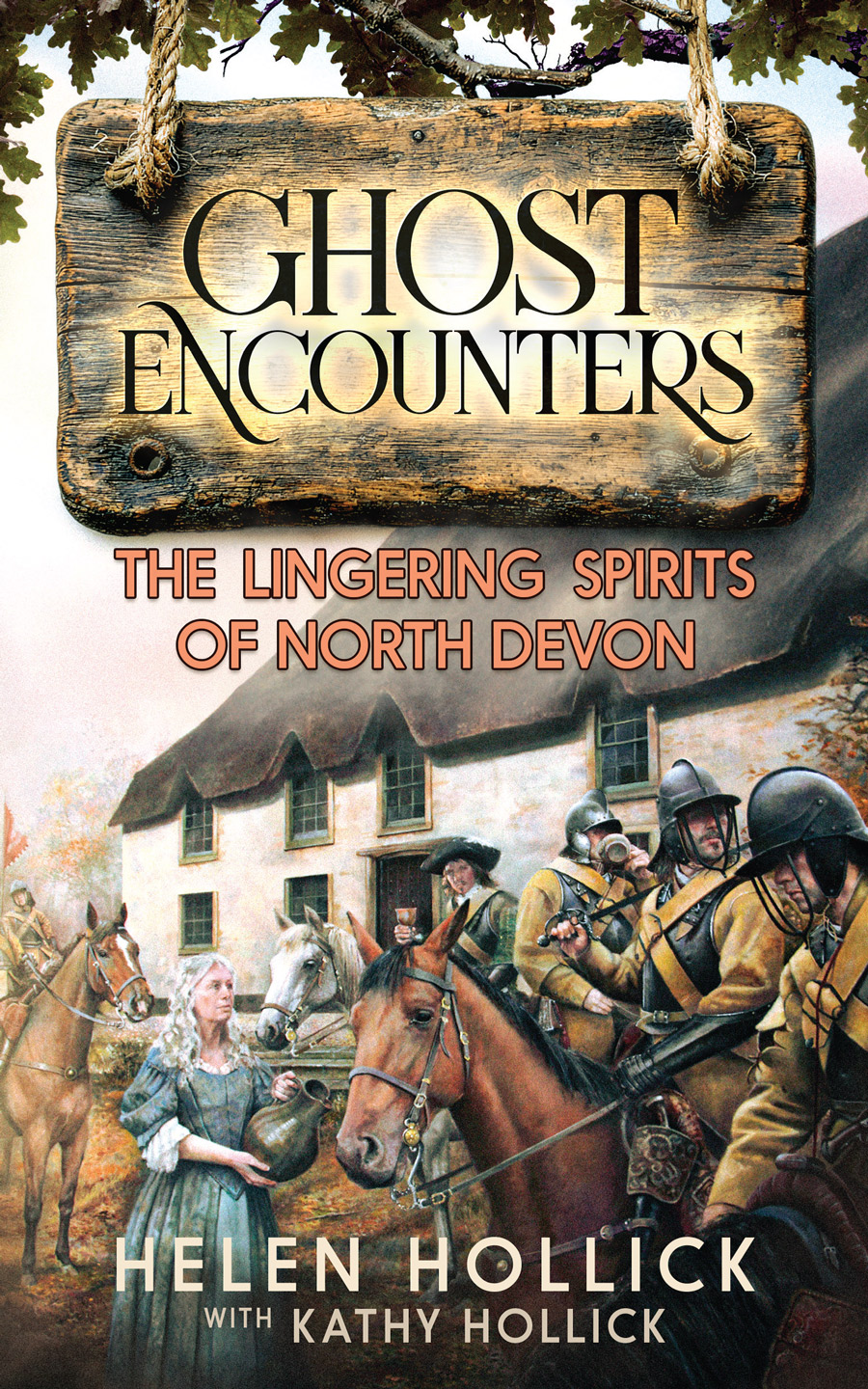
Ghost Encounters: The Lingering Spirits of North Devon

By Helen Hollick (With daughter Kathy Hollick)
Everyone assumes that ghosts are hostile. Actually, most of them are not.

You either believe in ghosts or you don’t. It depends on whether you’ve encountered something supernatural or not. But when you share a home with several companionable spirits, or discover benign ghosts in public places who appear as real as any living person, scepticism is abandoned. In GHOST ENCOUNTERS: The Lingering Spirits Of North Devon, mother and daughter share their personal experiences, dispelling the belief that spirits are to be feared.

Ghost Encounters will fascinate all who enjoy the beautiful region of rural South-West England, as well as interest those who wish to discover more about its history… and a few of its ghosts.

(Includes a bonus of two short stories and photographs connected to North Devon)

Book Links:
Pre-order the e-book on Amazon
https://mybook.to/GhostEncounters

Paperback published February 28th – e-book will also be available on Kindle Unlimited

WHAT’S ALL THIS ABOUT GHOSTS?

I wrote Ghost Encounters with my dyslexic daughter because we wanted to show that not all ghosts are hostile, because there are animal ghosts as well as people – and because we wanted to share this beautiful part of England’s West Country – and some of its history – in a slightly different (maybe quirky!) way!

A ‘ghost’ is quite possibly only the remnant of some sort of past energy, something relayed as a hologram-like YouTube-type video that can only be viewed by those who can access the correct wavelength. If you don’t have the right frequency, all you get is nothing or static. What created this ‘energy’, no one knows, it’s inexplainable, which is why the subject is so controversial. What chance do poor old ghosts have when their is no fact, scientific or otherwise, to support their existence?

Many accounts claim that ghosts are deceased people bent on revenge against some misdeed committed against them during life, or they are souls imprisoned on earth for foul things they did to others. Or maybe a ghost haunts a certain location because that is where a violent or unnatural death occurred. My personal belief against this last: while there are ghosts lingering near battlefields (I’ve had personal experience) how come there are not hundreds – even thousands – of ghosts sitting around at known battle sites? Waterloo, Agincourt, the Somme… if this theory was right these places would be akin to a London or New York rush hour!

APPEARANCE

Misty shadows, a vague blur, maybe a hovering orb? Perhaps merely a feeling of a sudden ice coldness or a brief breeze across the cheek? A sound, a moan, a wheezed breath; or a sigh or something knocked over when no one was near to knock it. All must, of course, be ghosts.

Many female ghosts are described as being a ‘Lady in White’. White ladies seem to appear in rural areas, died tragically, experienced trauma, or tragically lost a child or husband.

Birds were often thought to be returning ghostly spirits, especially the Barn Owl, its white (though sometimes light brown) shape gliding soundlessly as dusk settles. Cats have spiritual connections, again, probably because they are often silent, can appear from nowhere and, apparently, have nine lives.

To many, though, a ghost appears in body form with clear features, including the clothing worn at the time of death. The Egyptian Book of the Dead, shows the deceased in the afterlife as they were before death.

My adult daughter, Kathy, sees ghosts as clear as living people, often not realising she’s seeing someone who is dead unless she knows they have died, or are dressed in period costume. Anyone walking along our farm lane would not be likely to wear Georgian or Tudor costume! Often, though, she will only see part of a person, which is a bit of a giveaway. Or more frequently, she gets a glimpse only. The moment they realise they have been seen, they disappear. These ghosts, I am convinced, vanish because they are startled to be seeing her. In their eyes, she is the ghost to be frightened of.

Our frequent ‘visitors’ to our house are, however, aware of us and are seen clearly. Occasionally even heard, passing comment or remarks. Our ‘Maid’ (we’re not certain if her name is Milly or Molly) has been known to announce her disapproval of building work within the house (because of the mess, I suspect,) or that I chatter a lot. Another visitor, seen from the waist up with three-corner hat, neat-tied cravat and a waistcoat, likes watching our horses. He is, we have discovered, the Georgian equivalent of the modern Amazon Delivery. In his case, bringing goods shipped to the nearby trade ports of Barnstaple or Bideford here in North Devon.

My daughter, Kathy, (and many other ‘ghost-seers’ also encounter animals. Dogs are the most common apparitions, perhaps because dogs have an especial affinity with us humans? For ourselves, we have lost horses in the past, both Saffie and Franc, mother and son, who died within two months of each other, (now very much missed by us) have been seen grazing in our fields.

Kathy has also seen a bear and another beast from the very distant past in our woods – she’s not too keen on ever seeing a dinosaur, though, so hopes they stay firmly on the ‘other side’.

Discover more in Ghost Encounters!

ABOUT HELEN

Known for her captivating storytelling and rich attention to historical detail, Helen might not see ghosts herself, but her nautical adventure series, and some of her short stories, skilfully blend the past with the supernatural, inviting readers to step into worlds where the boundaries between the living and the dead blur.

Her historical fiction spans a variety of periods and her gift lies in her ability to bring historical figures and settings to life, creating an immersive experience that transports readers into the past. Her stories are as compelling as they are convincing.

Helen started writing as a teenager, but after discovering a passion for history, was published in the UK with her Arthurian Trilogy and two Anglo-Saxon novels about the events that led to the 1066 Battle of Hastings, one of which became a USA Today best-seller. She also writes the Jan Christopher cosy mystery series set during the 1970s, and based around her, sometimes hilarious, years of working as a North London library assistant.

Helen, husband Ron and daughter Kathy moved from London to Devon in January 2013 after a Lottery win on the opening night of the London Olympics, 2012. She spends her time glowering at the overgrown garden and orchard, fending off the geese, helping with the horses and, when she gets a moment, writing the next book…

ABOUT KATHY

When not encountering friendly ghosts, Kathy’s passion is horses and mental well-being. She started riding at the age of three, had a pony at thirteen, and discovered showjumping soon after. Kathy now runs her own Taw River Equine Events, and coaches riders of any age or experience, specialising in positive mindset and overcoming confidence issues via her Centre10 accreditation and Emotional Freedom Technique training to aid calm relaxation and promote gentle healing.

Kathy lives with her farmer partner, Andrew, in their flat adjoining the main farmhouse. She regularly competes at affiliated British Showjumping, and rides side-saddle (‘aside’) when she has the opportunity. She produces her own horses, several from home-bred foals.

She also has a fun diploma in Dragons and Dragon Energy, which was something amusing to study during the Covid lockdown.

SOCIAL MEDIA LINKS

Website: https://helenhollick.net/
Amazon Author Page: https://viewauthor.at/HelenHollick
Bluesky: @helenhollick.bsky.social
Blog: supporting authors & their books https://ofhistoryandkings.blogspot.com/
Monthly newsletter : Thoughts from a Devonshire Farmhouse
https://ofhistoryandkings.blogspot.com/2024/01/thoughts-from-devonshire-farmhouse.html

Kathy’s Official Website:
https://www.white-owl.co.uk/

Cover design: Avalon Graphics https://avalongraphics.org/
Cover image: Chris Collingwood Historical Artist
http://www.collingwoodhistoricart.com/

WRITING A SERIES by Helen Hollick

What could be easier? You have an idea for a new book, it doesn’t matter what genre – historical fiction, romance, fantasy, crime…The basic plot has popped into your mind and the characters come trooping into your life: the protagonists, the good guys, the bad guys. You start writing, the plot flows and the first draft is done. Then the editing, the cover design, the formatting. The excitement of publication day. Maybe an online launch and a book tour. And then you realise exactly what you have. The first part of a potentially cracking good series.

Now you wish you’d kept notes, details of what your characters were like – in looks and mannerisms. Eye colour, hair colour, tall, short, fat, thin? Their quirks and foibles. Maybe you should have delved into their backstories a bit more? Oh heck – I should have made a note of locations, of the little details. Believe me, unless you intentionally set out to write a series from the very beginning, all these possible continuity pitfalls suddenly appear like wasps at a summer picnic.

Readers notice, or at least, they will when your wonderful series takes off and the demand comes for ‘More!’

When I wrote Sea Witch, the first of my Captain Jesamiah Acorne nautical adventure voyages, I intended it to be a one-off tale, (not helped by my ex-agent who had no faith in it  – hence the ‘ex’!) But readers loved it (and Jesamiah,) so I had to write another adventure for him, then a third… I’m in the process of starting the seventh full length yarn. And I wish I’d made more notes along the way.

Lesson learned, I keep notes for my Jan Christopher Cosy Mystery series (that’s coZy in US spelling). The location for the episodes set in the north-east London suburb of Chingford are not a problem as it’s where I used to live and work in the public library back in the 1970s. Apart from the roads where murders happen, all the streets and places are the real thing. (I’ve made the murder locations up, though, in case of any residents’ sensitivity.) The library itself, South Chingford, was an actual place. The building still exists but the local council closed it as a library several years ago (shame on them!) and it is now used as offices. I’ve quite enjoyed bringing the old place back to life; remembering all the goings-on during the thirteen years I worked there. The characters, however, are entirely made up – although several of Jan’s anecdotes are partially biographical.

I decided to deliberately alternate location settings between each book, primarily because I was torn between writing about Chingford as it was, and my present life here in glorious North Devon … so episode 2 (A Mystery of Murder) saw Jan and boyfriend Detective Sergeant Lawrence Walker visiting his parents for Christmas 1971, who live in the fictional village of Chappletawton. Based on my village – but not quite the same.

All well and good, but by the time I got to episode 4 –which again sees a return to Devon, I had to ensure I had the right place names, the right village residents … was Bess, the dog, a black or golden labrador? What had I called the neighbouring farmer? And even more important, which characters leant themselves to becoming possible murder suspects and which ones were reliable witnesses?

I think I’ve managed to tie everything together in A Meadow Murder, introducing new characters, revisiting previous friends, and remembering to make notes for the next planned instalments…

ABOUT A MEADOW MURDER

A Meadow Murder is the fourth tale in the Jan Christopher cosy murder mystery series, the first three being A Mirror Murder, A Mystery of Murder and A Mistake of Murder… see what I’ve done there? Yes, I’ve created a proper puzzle for myself because now every tale in the series will have to follow the same title pattern of ‘A M-something- of Murder’ (Suggestions welcome!)

Based on working as a library assistant during the 1970s for almost thirteen years, the mysteries alternate between the location of Chingford, north-east London, where the real library I worked in used to be, (the building is still there, but is, alas, now offices) and my own North Devon village, but slightly fictionized. Chappletawton, for instance, is much larger than my rural community and has far more quirky characters, (and we haven’t had any real murders!)

The main characters, however, remain the same: Jan Christopher is the niece, and ward, of Detective Chief Inspector Toby Christopher and his wife, her Aunt Madge. In A Mirror Murder, Jan (short for January, a name she hates) meets her uncle’s new driver, Detective Constable Lawrence Walker. Naturally, it is love at first sight … but will an investigation into a murder affect their budding romance?

We find out as the series continues: Episode Two takes the young couple to spend Christmas at Laurie’s parents’ old farmhouse in Devon, while Episode Three sees us back at work at the library in the north-east London suburb of Chingford. We yet again travel to Devon for Episode Four – A Meadow Murder. And no spoilers, but the title is a little bit of a giveaway!

I had the idea for A Meadow Murder during the summer of 2022, while watching our top meadow being cut for hay. The cover photograph for A Meadow Murder is my field – a real Devonshire hay meadow, and the scenes in the story about cutting, turning and baling the hay are based on how we really do it. (Even down to the detail of the red Massey Ferguson tractor.)

In fact, I’m very glad that we cut and brought in our 480 bales of hay this year back in June when it really was a case of ‘make hay while the sun shone.’

I am relieved to say, however, that we didn’t find a body…

“As delicious as a Devon Cream Tea!author Elizabeth St John


“Every sentence pulls you back into the early 1970s… The Darling Buds of May, only not Kent, but Devon. The countryside itself is a character and Hollick imbues it with plenty of emotion” author Alison Morton


*
Make hay while the sun shines? But what happens when a murder is discovered, and country life is disrupted?


Summer 1972. Young library assistant Jan Christopher and her fiancé, DS Lawrence Walker, are on holiday in North Devon. There are country walks and a day at the races to enjoy, along with Sunday lunch at the village pub, and the hay to help bring in for the neighbouring farmer.

But when a body is found the holiday plans are to change into an investigation of murder, hampered by a resting actor, a woman convinced she’s met a leprechaun and a scarecrow on walkabout…

Buy Links – Paperback or e-book, including Kindle Unlimited

Amazon Universal Link: this link should take you direct to your own local Amazon online store https://mybook.to/AMeadowMurder

Also available worldwide, or order from any reliable bookstore

All Helen’s books are available on Amazon: https://viewauthor.at/HelenHollick

ABOUT THE AUTHOR: HELEN HOLLICK

First accepted for traditional publication in 1993, Helen became a USA Today Bestseller with her historical novel, The Forever Queen (titled A Hollow Crown in the UK) with the sequel, Harold the King (US: I Am The Chosen King) being novels that explore the events that led to the Battle of Hastings in 1066. Her Pendragon’s Banner Trilogy is a fifth-century version of the Arthurian legend, and she writes a nautical adventure/supernatural series, The Sea Witch Voyages. She has also branched out into the quick read novella, ‘Cosy Mystery’ genre with her Jan Christopher Murder Mysteries, set in the 1970s, with the first in the series, A Mirror Murder incorporating her, often hilarious, memories of working as a library assistant.

Her non-fiction books are Pirates: Truth and Tales and Life of A Smuggler.

She lives with her husband and daughter in an eighteenth-century farmhouse in North Devon, enjoys hosting author guests on her own blog ‘Let Us Talk Of Many Things’ and occasionally gets time to write…

Website: https://helenhollick.net

Subscribe to her Newsletter:  https://tinyletter.com/HelenHollick

Main Blog:  https://ofhistoryandkings.blogspot.com/

Facebook: https://www.facebook.com/helen.hollick

Twitter: @HelenHollick  https://twitter.com/HelenHollick

Creating King Arthur – in Post-Roman Britain

By Helen Hollick

Pendragon’s Banner Celebration Tour April 2023

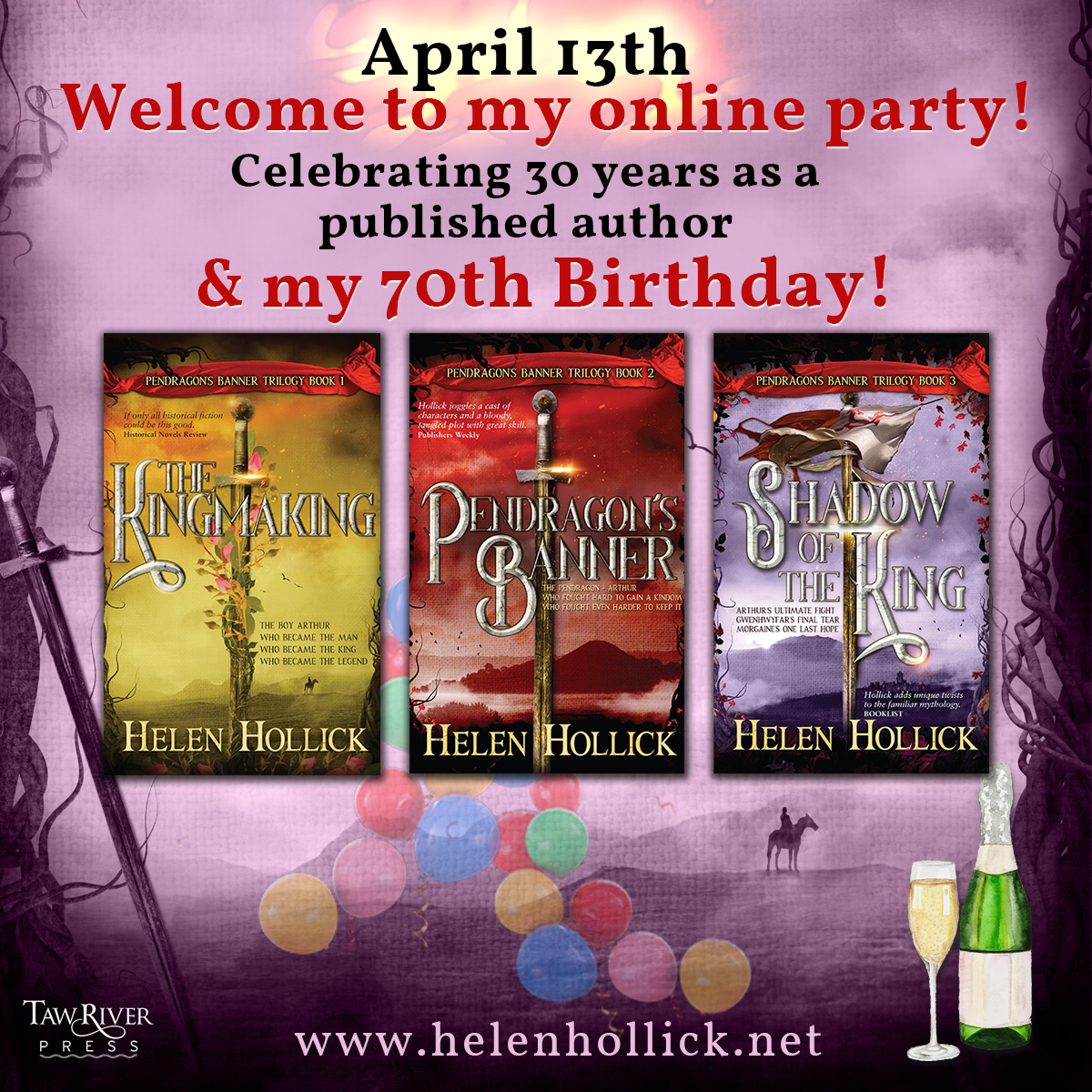
Thirty years ago in April 1993, one week after my 40th birthday, I was accepted by William Heinemann (now a part of Random House UK) for the publication of my Arthurian The Pendragon’s Banner Trilogy. It had taken me more than ten years to reach that stage of my dream to become a real writer – more than that if you count that I had been scribbling stories since the age of thirteen.

So why King Arthur? I had never liked the Medieval tales of knights in armour, the Holy Grail and courtly chivalry – I couldn’t stand Lancelot (what on earth did Guinevere see in him?) Why did Arthur go off on a religious quest for so many years? For me, none of those tales had the believability that writers today create in their novels of historical fiction. Arthur and the people of his court, if they existed, (and it’s a very big IF!) had no place in factual history after the Norman conquest of England. Those Medieval tales are merely entertaining stories, with the Holy Grail quest perceived, perhaps, to encourage men to join the Holy Crusades, and maybe the Arthur story mirrors the fact that Richard I spent many years away on his own ‘quest’ and very little time in his kingdom of England.

I was intrigued, therefore, when I discovered that there were earlier tales of Arthur, not only pre-Norman but pre-Anglo-Saxon. These were the Welsh legends, stories and poems of a warlord who fought against the incoming Germanic tribes. To place an Arthur figure during the upheaval and chaos of fifth-century Britain made sense. The period is not known as The Dark Ages for nothing, for written evidence, the whys and wherefores, are few and far between – we are, very much, ‘in the dark’ for the years around 430-550 AD.

So this is when I set my Arthurian tale, it is fiction – let’s face the fact, ‘Arthur’ as a king did not exist. (Sorry!) But even if he didn’t exist the earlier stories about him are wonderfully exciting.

I researched, as well as I could, the detail of post-Roman Britain (no internet back in the 1970s/’80s!) using archaeological evidence to add into the many, many imagined fictional bits, which include the Welsh tales and writing of clerics such as Nennius, who mentioned twelve battles that Arthur (supposedly) fought.

My character of Arthur, therefore, is a fifth-century warlord, passionate about fighting for his rightful place as King, and fighting as hard to keep it. As passionate, is the love of his life, Gwenhwyfar, who in my tale remains loyal to her lord, Arthur, despite their many ups and downs, hopes, fears, achievements and disappointments. Despite their laughter and tears.

I wrote my Arthur as a real man – warts an’ all. He is not the Christian king of the Medieval tales, he is a soldier, leader of the cavalry, the Artoriani, a man trying to sort the chaos Rome left behind, a man living in a world of upheaval, where Christianity is still in a state of embryonic flux, where pagan beliefs are still very much to the fore, and a world where Britain is changing, through battle and peaceful settlement, from a Province of Rome’s authority into the emerging kingdoms of Englalond – Anglo-Saxon England.

But maybe, just maybe, my story as told in the Pendragon’s Banner Trilogy is the base for how the enduring legend of King Arthur really happened…

© Helen Hollick

Helen’s new, self-published, editions with beautiful covers designed by Cathy Helms of www.avalongraphics.org are, alas, only available outside of USA and Canada, where the same books are published by Sourcebooks Inc. (The new covers were offered – free – to Sourcebooks, but the offer was declined.)

ABOUT THE KINGMAKING (Book 1)

The Boy Who became a Man:

Who became a King:

Who became a Legend… KING ARTHUR

There is no Merlin, no sword in the stone, and no Lancelot.

Instead, the man who became our most enduring hero.

All knew the oath of allegiance:

‘To you, lord, I give my sword and shield, my heart and soul. To you, my Lord Pendragon, I give my life, to command as you will.’

This is the tale of Arthur made flesh and bone. Of the shaping of the man who became the legendary king; a man with dreams, ambitions and human flaws.

A man, a warlord, who united the collapsing province of post-Roman Britain,

who held the heart of the love of his life, Gwenhwyfar – and who emerged as the most enduring hero of all time.

A different telling of the later Medieval tales.

This is the story of King Arthur as it might have really happened…

“Helen Hollick has it all! She tells a great story and writes consistently readable books” Bernard Cornwell

“If only all historical fiction could be this good.” Historical Novels Review

“… Juggles a large cast of characters and a bloody, tangled plot with great skill. ” Publishers Weekly

“Hollick’s writing is one of the best I’ve come across – her descriptions are so vivid it seems as if there’s a movie screen in front of you, playing out the scenes.” Passages To The Past

“Hollick adds her own unique twists and turns to the familiar mythology” Booklist

“Uniquely compelling… bound to have a lasting and resounding impact on Arthurian literature.” Books Magazine

The Kingmaking: Book One

Pendragon’s Banner: Book Two

Shadow of the King: Book Three

(contains scenes of an adult nature)

BUY THE BOOKS:

THE PENDRAGON’s BANNER TRILOGY 

New Editions available worldwide except USA/Canada

https://mybook.to/KingArthurTrilogy

Available USA/Canada 

US TRILOGY: https://www.amazon.com/gp/product/B074C38TXN

CANADA TRILOGY: https://www.amazon.ca/gp/product/B074C38TXN

ABOUT HELEN:

First accepted for traditional publication in 1993, Helen became a USA Today Bestseller with her historical novel, The Forever Queen (titled A Hollow Crown in the UK) with the sequel, Harold the King (US: I Am The Chosen King) being novels that explore the events that led to the Battle of Hastings in 1066. Her Pendragon’s Banner Trilogy is a fifth-century version of the Arthurian legend, and she writes a nautical adventure/fantasy series, The Sea Witch Voyages. She has also branched out into the quick read novella, ‘Cosy Mystery’ genre with her Jan Christopher Murder Mysteries, set in the 1970s, with the first in the series, A Mirror Murder incorporating her, often hilarious, memories of working as a library assistant.

Her non-fiction books are Pirates: Truth and Tale sand Life of A Smuggler. She lives with her family in an eighteenth-century farmhouse in North Devon and occasionally gets time to write…

Website: https://helenhollick.net

All Helen’s books are available on Amazon: 

https://viewauthor.at/HelenHollick

Subscribe to Helen’s Newsletter:  https://tinyletter.com/HelenHollick

Her Blog: https://ofhistoryandkings.blogspot.com/

Facebook: https://www.facebook.com/helen.hollick

Twitter: @HelenHollickhttps://twitter.com/HelenHollick

Follow Helen’s Celebration Tour https://www.helenhollick.net/