Broken: Book III of the Cage of Lies series by Susanne Valenti: A Review

Broken is the third book in Susanne Valenti’s dystopian Cage of Lies series. Packed with action, the book continues the story of Maya and Taylor in the world beyond The Wall as the battle for independence and freedom intensifies.

Over the series Valenti has found a better balance for the intersecting stories of Maya and Taylor and their new compatriots. The characters have developed and their motivations, strengths and weaknesses are clearer than in the first book. The writing is competent and the action nearly non-stop; there is little time for contemplation or explanation in Maya’s world. As a dystopian action-adventure story, it delivers all the right goods. I found the plot a little predictable – no spoilers, but I’d worked out the end by about half way through.

In my review of Chained I commented that I felt the world-building was insufficient. While more background has been given over the series, I still find myself unclear as to where some of the items these people have access to – coffee, especially– actually come from. But that is a feature common to more than one dystopian novel or series I have read, and actually doesn’t diminish the action unless the reader allows it to.

Overall, 4 stars for Broken. Cage of Lies is an action-rich series that will appeal to many readers of young-adult dystopias looking for entertainment and the challenge of wondering what they would do in the same situations.

The author provided me with a copy of the book in exchange for an honest review.

Sapphire Hunting, by J SenGupta: A Review

sapphire huntingJames is a math/physics student at an unnamed university somewhere in England. He’s likely a genius, or at least a savant; concepts, equations and theories of energy flow come easily to him; he likes the challenge but knows he can find the solutions. Other facets of university life are less attractive, but he’s coping.

But it’s not just the theoretical concepts of energy flow that James understands almost intuitively and without effort. There are other sorts of energy flow, a flux of darkness, destruction, focusing in on his world, something James can sense, something perhaps attracted to him. Others know only the frightening results of this dark power; James is caught up in its forces. Trying to escape, yet strangely attracted to this force, James steps through a doorway into another world, to find he is not alone in his fight against this dark vortex.

Sapphire Hunting is not a typical young adult fantasy novel. Written in a detached, dream-like style, bordering on prose poetry, Sapphire Hunting demands a lot of its readers. Action is fairly minimal; descriptions are long and lyrical, focusing on feelings, emotions, impressions, mood: “…a spark discharged from his forefingers, like winter, into the mantis-shaped thing, the fog, the flying rags looming over.” The words flow and pattern like the energy that fascinates and focuses James.

I read Sapphire Hunting in small chunks, both because it demanded close attention and because I wanted to draw out the experience. The closest other reading experience I can remember was that of reading Joyce’s Ulysses. So, for a reader who is looking for a book where the focus is on the action and the plot, one that reflects others in its genre, this may not be the book for you. But it is one whose imagery and language will stay with me for a very long time.

Did I have any niggles? One or two….there were sentences, that, despite their overall beauty, I would have restructured, changed the punctuation. There were one or two small typos. Neither issue detracted from my overall impression. Is it a young adult book? I wonder: probably for a few – I would have swallowed it whole at fourteen or fifteen – but it might be better directed to the New Adult readership. Five stars for a unusual and memorable book.

The author provided me with a copy of the book in exchange for an honest review.

The Tenants of 7C, by Alice Degan: A Review

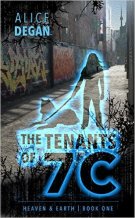
tenants 7cThere is something about urban fantasy that takes place in a city well-known to the reader that adds a level of charm and attraction. The Toronto setting of The Tenants of 7C was a bonus for me, but even without knowing the Kensington Market district, this is a delightful collection of connected short stories.

Above the Heaven & Earth Bakery, in an obscure back alley, the tenants of apartment 7C are an eclectic mixture of decidedly non-human characters: a young werewolf, a Japanese demon, and a very young satyr. They share the rooms of 7C: rooms that aren’t in the same dimension as the actual building, and frequently don’t stay in one place. The bakery itself isn’t really meant for humans either, its breads and cinnamon rolls providing sustenance to a wide range of supernatural creatures. How these three co-exist and survive in a their dual world, both with other “others” and with humans are the central conflict of each story.

While in some ways reminiscent of Charles deLint’s books, especially his early work set in Ottawa, The Tenants of 7C focuses on the lives of the ‘others’, not the lives of humans who interact with them. The characters of the werewolf Nick, Takehiko, the Japanese demon, and Yiannis, the satyr child, are not just stereotypes, but dimensioned individuals whose personalities develop over the collection. Nick, who is the protagonist, is especially well-realized, completely believable as a seventeen-year old who doesn’t fit in but is doing his best to manage his life, attending an alternative high-school, worried about his relationship with his parents, wishing his life were easier. It’s just that his problems, unlike most troubled adolescents, involve him turning into a wolf.

Degan’s writing is polished and competent and the tone and structure fits the action and mood of each story appropriately. She can switch the mood from light-hearted or contemplative to frightening in a few sentences, and uses enough manga, gaming and Doctor Who connections to make the stories attractive to a young adult/new adult audience (I verified this with a early-twenties friend), but the stories are also deeply rooted in, and consistent with, older traditions of fantasy. Degan blends these strands of different fantasy genres and traditions well, not an easy feat.

I had only a couple of niggles. Because the stories in The Tenants of 7C are not a linear narrative, but rather vignettes and episodes in a larger world-under-construction, there are some loose ends, sub-plots that arise but are not completed in this volume, and some inconsistencies. I wanted to know what happened in those subplots and to those characters that are introduced but disappear. I guess I’ll just have to wait for the next book!

Overall, 4 stars. If you’re a fan of urban fantasy, The Tenants of 7C is definitely worth your time.

The Surface’s End, by David Joel Stevenson: A Review

The Surface's EndJonah, a young man in late adolescence, is responsible for providing his family with game, the major source of meat in their post-apocalyptic world. He’s found good hunting grounds at the edge of the dead zone, the desert known as the Deathlands, but even there the game is growing thin.

A wounded buck, fleeing the pain of Jonah’s arrow, leaves the shelter of the woods to run into the desert; Jonah, who cannot waste the kill, follows. Near where the buck finally falls, he finds a metal wheel…a wheel which is opens a door into another world – not a magical world: this is no rabbit-hole – but an underground city, peopled with the descendants of those who fled a ravaged Earth many generations earlier.

This is the premise of The Surface’s End, a young-adult dystopic science-fiction novel by David Joel Stevenson. I finished the book over two days: it’s short, at about 139 pages on my Kindle app, but it was also compulsively readable. Both the homesteading world of Jonah and his family and their fellow villagers, and the mole-rat like existence of the underground inhabitants were internally consistent and plausible, although both were slightly too one-dimensional, with no hint of strife or disagreement within the homesteaders and no positive aspects to the underground world.

SPOILERS AFTER THIS POINT!

Having the ‘wildlands’ adolescent discover the ‘city’, rather than the other way around, was a nice twist on the young-adult dystopic meme. The inevitable romance between Jonah and Talitha, the girl from underground, is handled sweetly, Jonah’s uncertainty and awkwardness particularly.

For the most part Stevenson’s writing flows smoothly (and occasionally brilliantly, as in the line, referring to the Deathlands: ‘He took his first step into the undiscovered lands.’, an echo of Hamlet describing death as ‘the undiscovered country.’). A minor niggle was that I found the tone and pacing of the narrative did not always reflect the tension and action of the story.

My only other niggle with the story was the scene in which Jonah and Talitha watch a digital feed of the deathbed confession of one of the original founders of the underground city. While it is important, a turning point in the story, the confession goes on too long, unbroken by the reactions and emotions of the two young people watching it.

All in all, though, I’m giving The Surface’s End four stars. It’s a worthy addition to the young adult dystopia genre (personally, I think it would make a good film), and it has enough originality to make it stand out from the crowd.

The author provided me with a copy of the book in exchange for an honest review. All opinions here are mine alone.

Master, by Thomas M. Watt: A Review

What happens when dream and reality become one and the same, and you have no control over either?master

Ex-footballer Phil Gordon has chosen a life as husband, father, and pool cleaner over the possibility of NFL fame and fortune. He’s doing ok with the inevitable negative comments this decision engenders, but when a figure calling himself Master invades his dreams, making the same negative comments and threatening Phil’s wife, he begins to be frightened. In quickly escalating action, it becomes clear that Master has control of Phil and his family in his waking life as well as in his dreams, but is he real, or a construction of Phil’s subconscious, channelling repressed doubts and regrets about his life choices?

Master is a short book, 139 pages, with rapid, sometimes violent action, told from the first-person viewpoint of the protagonist. Its tone fits the confusion and fragmentation of Phil’s sudden immersion into a world gone mad, a writing style that is the equivalent of the hand-held camera effects of various recent films. In many ways, the book reminded me of a film script, strong on dialogue and descriptions of action, brief in descriptions of setting and characters, and bringing the action to a finale that completes the story but allows for a sequel.

Phil’s actions – and those of Master – unfortunately do not strain credibility in today’s world; the almost casual violence Master demands of Phil and practices himself exists in headlines weekly. Phil’s insistence that he is not a man of violence has little influence on his actions when his family is threatened; his motivation is clear. I had more difficulty fully understanding the motivation and behaviour of Ashley, an old girlfriend of Phil’s who is enmeshed in the unfolding events.

SPOILERS BEYOND THIS POINT!

My niggles? The technology that lies behind Master’s manipulation of Phil’s dreams is not really fully explained, and I felt was glossed over; a more detailed explanation of the technology and its effects could have added to the tension and drama of the narrative. The first half of the penultimate chapter reads more as an epilogue, tying up loose ends in brief explanatory paragraphs, before returning to the story. In addition, there were a few small production errors in the copy I was sent, but no more than are found in many books, both traditionally and electronically published.

Master will appeal to readers who like fast-paced thrillers with a strong psychological aspect. My rating is three stars. Master is available from Amazon.

The author provided me with a copy of the book in exchange for an honest review. The opinions expressed here are mine alone

A Sincere Thank You

Do what you love, and the work will come your way.

In the months that have passed since I officially retired from my salaried job (as opposed to the previous eight months, when I was off on medical leave), I’ve gone from a part-time writer, struggling to find the time to work with my editor and get Empire’s Daughter published, to a full-time writer, or, at least, someone involved in the indie writing world full-time.

I soon learned after retirement that I wasn’t cut out to do nothing but work on my own book. Perhaps because of years of having to juggle different projects, my ability to concentrate on one thing is limited to a couple of hours. After that, whatever I do probably isn’t worth the time it takes. So I gave it some thought: what aspects of my previous job(s) had I really enjoyed? What could I transfer to my new life?

The common themes going back through two different careers were these: writing, editing and reviewing. Over those careers, I’d written, reviewed, and critiqued everything from applications for hundreds of thousands of dollars worth of grants for scientific research, various master’s and doctoral theses (my husband’s M.Sc. thesis was classic, with the opening sentence going on for a page and half; luckily for our marriage, he’s a quick learner), and papers for submission to scientific journals. When I switched careers into education, I did the same for curriculum, writing prompts, policy and procedure documents, more grant applications, major reports to the government….But all this was non-fiction. Could it be transferred to fiction?

I’ve been reading since I was three, and have read (and continue to read) everything from classics to cyberpunk, from literary fiction to Lovecraft, and everything in-between. There is no better way to learn to write well – or recognize good writing – than to read and read and read. So, yes, I thought I could recognize good writing (and good storytelling, not always the same thing), and offer both fair and useful critiques.

So, as regular readers of this blog know, I started to write reviews. I offered editorial services, either beta-reads or full edits. Six weeks later, and my days (and both my review and editorial lists) are full. I spend my working hours in chunks of reading, reviewing, editing, and my own writing (plus a university course in a completely different area, to keep my scientific mind alive).

My own writing benefits greatly from this. Both in the reviewing and editing I am constantly reminded of what is good writing, what moves stories along, gives insight into characters, describes a situation or a location effectively. In looking at other writer’s work with a critical eye, I’ve become a better critic of my own work. In reading sentences or paragraphs or whole books that delight me, I learn more about what makes good writing – in my mind, that’s an apprenticeship without an end date.

So, to all of you who have offered me books to review, or trusted me with editorial services, thank you. I hope what I’m giving back is of value, but please know: you’re giving me work I love, and work I learn from. It’s very much appreciated.
Immaculate Conception by Guilherme Solari: A Review

Immaculate ConceptionImmaculate Conception (Cybersampa #1) is a cyberpunk novella by Brazilian journalist Guilherme Solari. The setting is the megalopolis of Megasampa, a couple of hundred years in the future, a sprawling, dystopic city that has swallowed Rio and Sao Paulo, ruled by corporations, dark and divided. A brutal murder introduces us to Cascavel, the protagonist, a man with a mysterious past, multiple synthetic parts, and a film-noir-detective attitude.

Immaculate Conception is in part an homage to the cyberpunk world of Philip K. Dick, and references to Do Androids Dream of Electric Sheep (the story on which the film Blade Runner is based) are embedded in the story, as are references to other dystopic classics. These references help ground the story in a classic cyberpunk world without detracting from the new creation of Megasampa.

The world-building is solid, pulling from established cyberpunk and other dystopic themes, but the South American setting gives it a different life. The characters are not quite three-dimensional, but are as developed as many characters in this genre. The plot is a mix of film noir, classic horror, and dystopian sci-fi, and for the most part maintains its momentum and tension well. Descriptions of the locations effectively evoke the desolation of Novo Bronx as well as the shiny artificiality of corporate headquarters.

English, I assume, is not Solari’s first language, and while most of the writing is competent, there are enough mistakes in spelling, grammar and voice to detract from the flow of the prose. These could be easily corrected in a second edition of the e-book. My other quibble is the description of the novella on Amazon as meant for the 12-18 age group; the subject of the book and its violent murders, as well as the reading level, suggest to me the lower age limit here is too low. This may be a difficulty with Amazon’s classifications and not the author’s intent, to be fair.

Overall, I am giving Immaculate Conception three stars; it would have been 3 1/2 except for the language errors. I should say cyberpunk is not a genre I have read widely, and most of what I have read is by either Dick or William Gibson, so I may be a bit out of date with the evolution of this type of writing. Immaculate Conception is the first in a planned series called Cybersampa, and I believe they will find a satisfied readership.

The author provided me with a copy of the book in exchange for an honest review. The opinions here are mine alone.

Book Review Policies

I’ll post this on the book review page on my website as well.

For everyone who has asked (and those who might wish to) I review published or pre-publication work from indie authors.  My preference is for young-adult fantasy/dystopia/sci-fi but will consider other work.  I do accept e-books (actually, I prefer them).

My practice is to share the review with the author before I post to anywhere except my website.  As well as my website, I post reviews to the following sites:  Goodreads, Amazon in the UK, Canada, and the US, and Kobo and Smashwords – but don’t unless the author requests it.

My contact details are marianlthorpe at gmail.com.