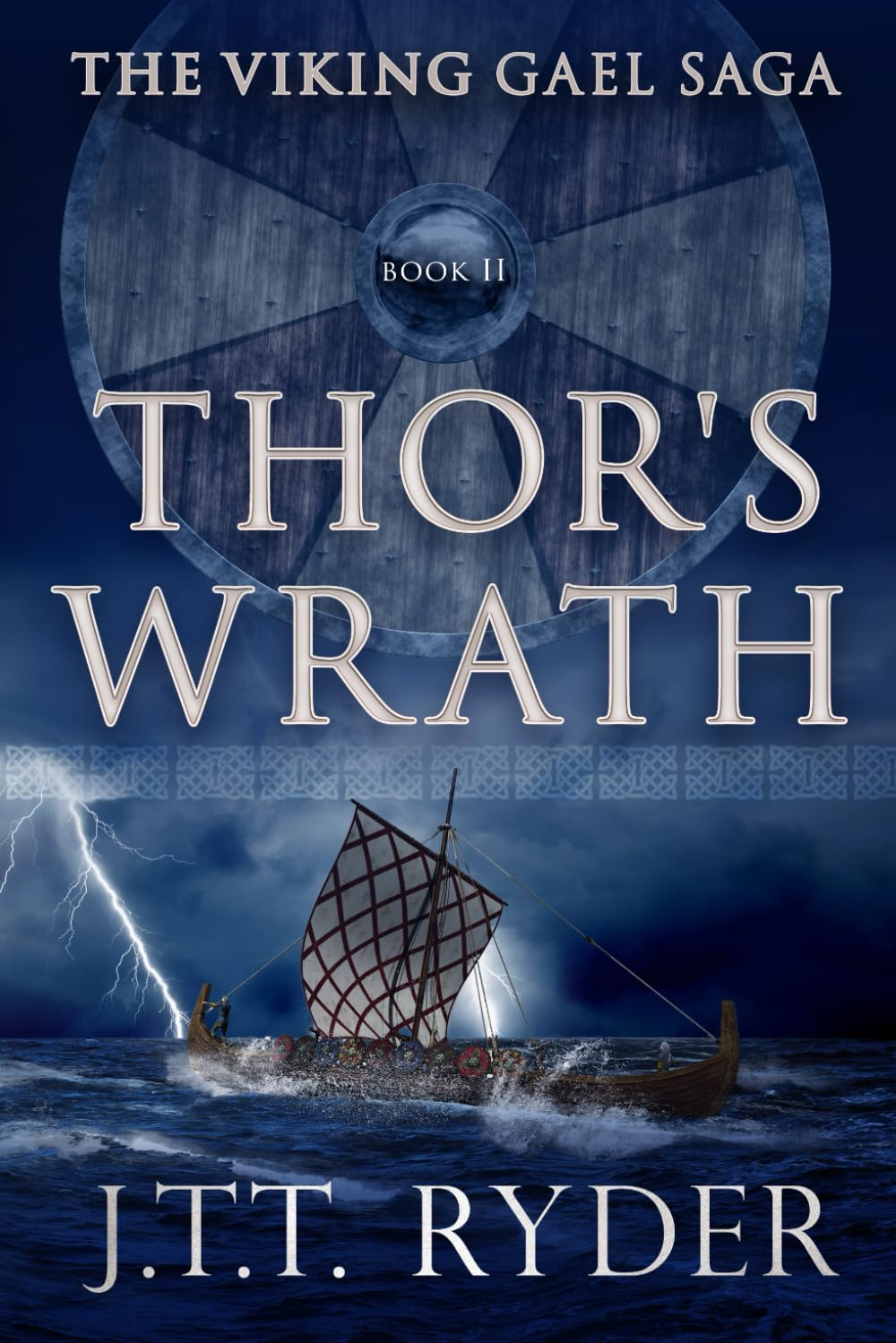
Thor’s Wrath: Book II of the Viking Gael Saga, by J. T. T. Ryder: A Review

When we left Asgeir in book 1, he had saved his life (and his cat) but lost his honour. Now, as Harold Finehair works to unite Norway, Asgeir lands in the Orkneys, into conflict and battle: a chance for Asgeir to overcome his shame and redeem himself in his eyes and his gods.

J.T.T. Ryder continues to draw on his extensive knowledge of the history and archaeology of the setting – both time and place – in recreating a 9th century north-western European world. While Asgeir (and his compatriots) worldview is not ours, it is convincing: enmity and friendship flipping back and forth; the importance of personal honour; the role of single combat over warfare. This is a world of foresight, of visits from gods, of visions and portents–all are real, all are to be taken seriously.

The story moves quickly; the reader and Asgeir together are given little respite as threats are overcome, peace is agreed, only for another threat or a betrayal to begin the action again. Ryder’s writing is sometimes lyrical, especially in his place-based descriptions: ‘A whirlwind of puffins blackened the sky over the rocky, chilly islet… Mist shrouded the horizon like unspun wool, and the wind bit as remorseless as a fox…” In other places it echoes the alliteration of the sagas: ‘shocked him with sleet sideways.’ Even the occasional unusual word choice adds to the story, creating a sense of a world different from ours, refracted through time and distance.

The story is perhaps Ryder’s best, the complexity of Asgeir’s choices and of his thinking deepening as the youth matures into manhood. The telling is excellent. The editing, I am sorry to say, is less so.

(I dislike on-screen reading, so whenever possible I buy the paperback, so these comments pertain to the first paperback edition published in 2023.) I am tolerant of a certain number of typographical errors: they appear in even the best edited books, traditionally published or independent. But repeated sentences, repeated scenes, should not. Nor should a leg of lamb in one paragraph become a leg of pork in another. These errors spoke of a rushed production, an incomplete editing process, and one, inevitably, that jolts the reader out of the story. A second, corrected edition* is strongly suggested.

But! Thor’s Wrath is still well worth reading, and I look forward to the next book in Asgeir’s saga. (And yes, the cat is still Asgeir’s companion at the end of this installment.)

*Update: correspondence with the author assures me these errors have been or are in the process of being corrected.
Of Bere and Beer

I demand historical accuracy of my alternate-Europe: its geography, social constructs, and history may differ somewhat from the real world, but the background is as correct as my research allows. (And my interpretation of that research, of course.) But this conversation between two characters in my fifth book, Empire’s Reckoning, led me down a research path I hadn’t expected.

 “Should I put the meadows along the water to the plough, if I can find seed? They’ve been grazed, but we’ll not have sheep in numbers for a few years yet.”

“If those meadows are like the Ti’ach’s, they’re wet,” I said. “Better leave them to the sheep, and plough better drained land, if you can.”  He’d be late getting the barley in…

And then I stopped. This scene is taking place in early May, in a land that is an analogue of lowland Scotland, in more-or-less the 7th century.  Was this TOO late to plant barley?  Would it mature before winter came? (I have a graduate degree in crop science, and so I think about these sorts of things.)

I googled  ‘medieval Scotland planting date barley’…and discovered something I didn’t know. (Not terribly surprising, that, except that due to the aforementioned graduate degree in crop science, I actually do know a fair bit about the origins of cereal grains. And the professor who taught that bit was not only a Scot, but a whisky aficionado…which will become relevant.)

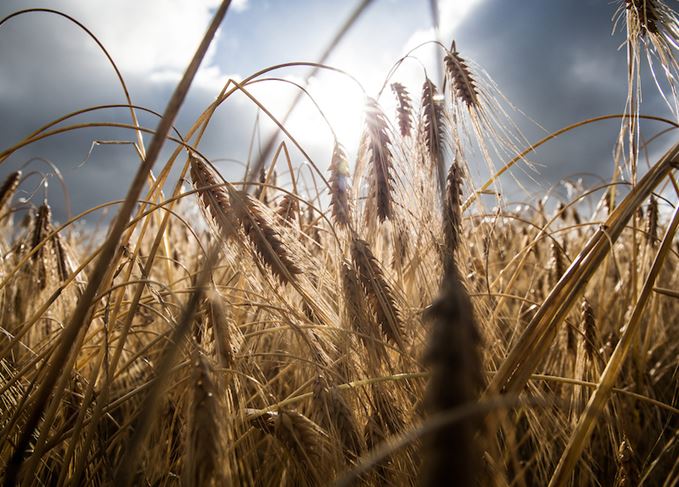
What I discovered was ‘bere’ (pronounced bear): a barley race introduced to northern Scotland by the Vikings in the 8th century or earlier (earlier was good). Peter Martin, director of the Agronomy Institute at Orkney College, part of the University of the Highlands and Islands (UHI), says, ‘Bere is probably the oldest cultivated barley, definitely in Britain and probably one of the oldest still in cultivation in Europe.’ Adapted to the climate and soils of the far north, it matures in 90 days. Plenty of time for my character to plant it in lowland Scotland in mid-May (or even June by the time he gets those fields under plough) and harvest it in late summer.

It’s also taller than modern varieties, which means it has an unfortunate tendency to lodge, or fall flat on the ground near to harvest in heavy rain or wind. I knew this about older barley varieties, so I’d already written this later scene, a different landholder and a different year than the earlier one.

In the long summer twilight, the clouds and rain now blown eastward, we walked up to the barley fields. Much of the grain lay flat. Roghan clicked his tongue. “Harder work for the men,” he said. At the greener field, he shook his head. “It will mould before it ripens. We’ll try to rake it, but likely I’ll turn the cattle out on it in the end.”

At the start of this century, there may have been less than 10 hectares of bere left in Scotland, grown only in small fields in the far northern and western islands. What has saved it is its unique flavour when used to brew beer or whisky. Small breweries and small distilleries produce short-run, expensive beverages with it, aimed at the increasing market for local-provenance food and drink. Barony Mill, a watermill on Orkney, produces flour (beremeal) from it as well. It’s a tough grain, difficult for modern machinery to handle — and would likely have ground down the teeth of people who ate it regularly (that and the flakes of stone from the grinding).

I’m visiting Orkney  in April, too early to see bere growing. I’ll look for the whisky, if it doesn’t break the bank. Well, maybe one glass, somewhere on that northern island, in honour of my constructed world and the real one it’s based on.

(Well, that visit didn’t happen, because COVID did. Still hoping to get there someday!)