The Bull-Headed Lyre of Ur: A Masterwork of Ancient Mesopotamian Music

A Guest Post by Stephanie Churchill

The Masterworks Blog Tour
Osama Shukir Muhammed Amin FRCP(Glasg), CC BY-SA 4.0 https://creativecommons.org/licenses/by-sa/4.0, via Wikimedia Commons

How many of us have wandered through an art gallery and daydreamed about a painting that catches our eye or an intriguing sculpture on the plinth? I definitely do. So the idea of coming up with a short story based on this premise didn’t require me to consider for long.

I had been researching Mesopotamia, particularly the foundation of the Akkadian Empire, when I learned about the discovery of the Bull-Headed Lyre of Ur. I have been trying for several years to write a work of fantasy using the Akkadians as an anchor for the setting of my fictitious world, but the final form of that book has been elusive. When I was invited to write a piece of short fiction, I realized that using this lyre would be a great way to use my research on the Akkadians even if my longer novel is proving difficult to finish.

The Bull-Headed Lyre of Ur is one of the most iconic and well-preserved artifacts from ancient Mesopotamia. It is also one of the oldest string instruments ever discovered, dating back to around 2550-2450 BC. The lyre was unearthed in 1926 by British archaeologist Leonard Woolley, during his excavations of the Royal Cemetery at Ur in what is now southern Iraq.

Woolley and his team had been excavating the Royal Cemetery at Ur for several years when they came across tomb PG779 which was (they later decided) the burial place of Queen Puabi, a Sumerian queen who lived during the Early Dynastic III period. The tomb produced a treasure trove of grave goods, including gold jewelry, weapons, and pottery.

The lyre was found in a wooden coffin, along with the bodies of several attendants. Made of gold, silver, lapis lazuli, and shell, the lyre is decorated with intricate carvings and inlays, depicting a variety of scenes from Mesopotamian mythology and everyday life. The most striking feature of the lyre is its bull’s head, which is attached to the front of the soundbox.

Music was very important in ancient Mesopotamian civilization and was played during a variety of occasions, including religious festivals, royal banquets, and military campaigns. It was also used to accompany poetry, dance, and storytelling. For my story, I envisioned its use in private homes as well, even if occupants couldn’t afford anything as luxurious as the Bull-headed Lyre from Ur.
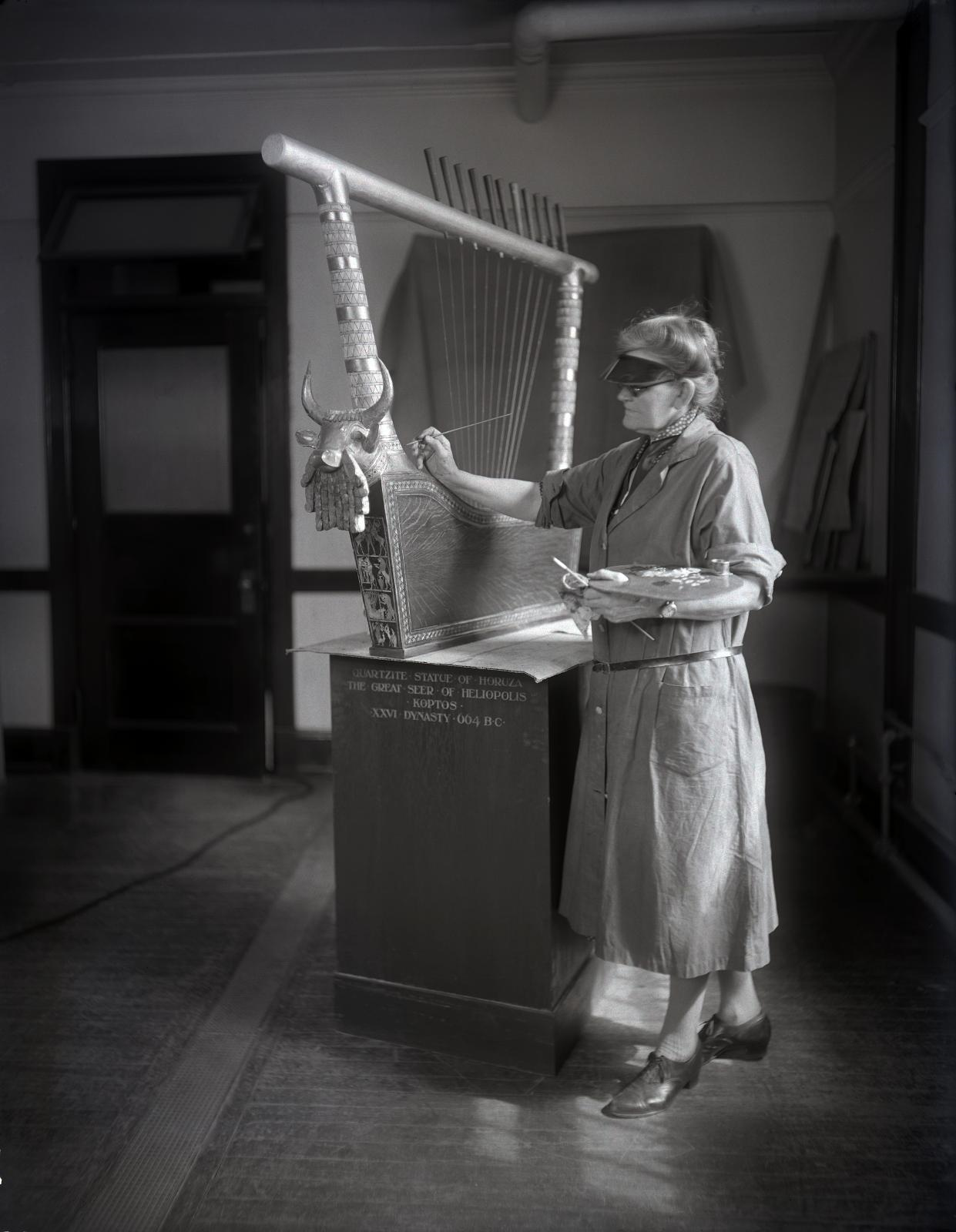
What would life have been like for the person who played such an exquisite instrument? Particularly for one who played in the court of a queen? To make my story work, I moved the lyre from its actual, historic era forward a couple hundred years to the reign of Sargon of Akkad, placing it in the Ekishnugal Temple in Ur where Sargon’s own daughter, Enheduanna, served as En, or high priestess, to the moon god Nanna. Enheduanna had her own court musicians, so I simply needed an individual to fit the role. From there, I simply told the story of how a girl with a passion for music ended up serving as music-giver for Enheduanna, the historic lyre her instrument of music-weaving.

I’d love for you to discover the inspiration of these pieces of art for yourself. Look for Masterworks on Amazon, available now.

About Stephanie Churchill

Being first and foremost a lover of history, Stephanie’s writing draws on her knowledge of history even while set in purely fictional places existing only in her imagination. Filled with action and romance, loyalty and betrayal, her writing takes on a cadence that is sometimes literary, sometimes genre fiction, relying on deeply drawn and complex characters while exploring the subtleties of imperfect people living in a gritty, sometimes dark world. Her unique blend of non-magical fantasy fiction inspired by real history ensures that her books are sure to please fans of historical fiction and epic fantasy literature alike.

After graduating college, she worked as an international trade and antitrust paralegal in Washington, D.C. and then in Minneapolis, Minnesota. It was only at the suggestion of New York Times best-selling author, Sharon Kay Penman, that Stephanie began to write. She has since written three novels loosely inspired by the Wars of the Roses: The Scribe’s Daughter, The King’s Daughter, and The King’s Furies. Her first short story, Shades of Awakening, originally appeared in the Historical Writers Forum anthology, Hauntings. A Našû for Ilu, part of the Masterworks anthology, was published November 1, 2023.

Media:

Website: www.stephaniechurchillauthor.com

Facebook: www.facebook.com/StephanieChurchillAuthor

X: https://twitter.com/WriterChurchill  

Robert of Gloucester

Royal bastard, powerful magnate, capable commander – King Stephen’s man?


By Cathie Dunn

What if…Robert of Gloucester had not supported his half-sister, the Empress Matilda?
Would the mid-12 th century civil war that ravaged much of England, and Normandy by
association, have happened at all?


A Race against Time, my short story in the wonderful anthology, Alternate Endings,
published through the Historical Writers Forum, is set just before the period now widely
known as The Anarchy. It begins on December 1st , 1135, with the death of King Henry I at
his hunting lodge at Lyons-la-Forêt in Normandy.


Henry’s illness appeared quite suddenly, made worse by a meal of lamprey eels, apparently,
that didn’t do his constitution any good, and it didn’t give his administrators enough time to
consider the serious matter of a successor. Henry refused any discussions on the subject.
So the status quo remained that, as designated heiress, Matilda, Countess of Anjou and
former Holy Roman Empress, was considered Henry’s heir as his only surviving legitimate
child. But she was, of course, a woman, and one married to a rather unpopular and ambitious
young noble, Geoffrey of Anjou. It didn’t help matters that Henry had been quarrelling with
the couple before his untimely death. In short, the situation was a mess.


In A Race against Time, Robert of Gloucester, illegitimate eldest son of King Henry I, seeks
to scupper Stephen of Blois’ rushed accession to the English throne (and you’ll have to read
the story to find out what happened!), but what if Robert had stayed on at Stephen’s side, for
good?


After all, with Hugh Bigod claiming that Henry had released the barons from their oath of
fealty to Matilda on his deathbed, he opened the door for an alternative candidate – one more
suited to the responsibilities of kingship than a mere woman. It was a view that was shared
widely amongst the English nobles. Very few were surprised when Stephen – Matilda’s
cousin through his mother’s side – made a dash to Westminster and had himself crowned
with unseemly haste. Very likely, they approved of his ’decisive’ action.

The effigy of Robert of Gloucester’s tomb by: George Hollis, The Monumental Effigies of Great Britain, Public Domain.


As did Robert of Gloucester at the time, it would appear. Early on, the Empress’ older half-brother, a highly valued commander and astute politician, pledged his allegiance to Stephen. But by 1138, he’d seen enough, and was easily persuaded to pursue his sister’s claim to the
throne.


There were rumours of a strong dislike between the two men, and that Robert did not hide his disappointment in the new king. But how could Stephen have kept this man, whose sweeping lands in the west country stretched into south Wales, on his side?


With Robert covering his back, Stephen could have pacified the squabbling nobles. They’d have toed the line rather than challenge him and doing pretty much what they wanted. Perhaps Robert could even have kept Stephen’s brother Henry, Archbishop of Winchester, from scheming. He’d have had a task at hand to convince Matilda’s supporters to give up any hopes of her becoming queen, but they would likely have heeded his guidance.

But how could Stephen have ‘bribed’ this man who did not seek the highest power, who was no backstabbing traitor? Perhaps if Robert had been granted a position of high power, and in particular support against his enemies in the ranks of the barons, he may have stayed. If Stephen had been less dithering, less of a ‘good guy’, but come down harsh on the troublemakers, Robert would have supported him. If Stephen had been a decisive king, hard but fair, a medieval ruler not relying on his popularity amongst the peers, and if he’d not given in to their increasing demands. If…


Without Robert, Matilda’s chances would have been close to nil. She had friends, barons in
the west and south-west of England. But with her husband’s focus on reining in the small
uprisings in Normandy, she wouldn’t have had the influence or the manpower to stage an
attempt at claiming her throne. Without Robert, she’d never have made it to England. Perhaps
as a visitor, but never as a potential queen in her own right.


This would have also meant England and Normandy remaining divided – England firmly in
Stephen’s hand and Normandy in Matilda’s and Geoffrey’s. Normandy was her true home,
but her husband’s campaigns to consolidate his power and defend Normandy against raids
from the French may have counted for nothing without the backing of powerful magnates
such as Robert. A small duchy with a large, greedy kingdom on its doorstep, snapping at its
heel.


Matilda may have lost everything.


And Robert? Well, he’d have been in a high position of power, possibly responsible for
defence of the kingdom, or even for the upbringing of Stephen’s son, Eustace. Perhaps the
boy may have turned out a nicer character than he so clearly was. And maybe, then, he’d
have survived his father…


The balance of power would have shifted, had Robert of Gloucester remained at Stephen’s
court and in the king’s favour. The good folk of England wouldn’t have seen nearly two
decades of fighting, particularly across the south and west. There wouldn’t have been all the
burnt crops and destroyed fields and castles. And there wouldn’t have been all that needless
bloodshed.


But then, Robert of Gloucester was a man of principle, of loyalty and honour. Any personal
ambition of his never made him aim for top job itself, as he knew it to be wrong. Times had
changed. Also, it would appear, he didn’t suffer fools gladly, in that he preferred to see his
headstrong sister accede to the throne of England, rather than malleable, indecisive Stephen.
He gave the man the benefit of a doubt early on, and then chose his side, never again
wavering in his support for Matilda.


It is, perhaps, for those reasons that Robert, earl of Gloucester, is my favourite historical
character. And I dare say, he’d have made a fine King of England, even if he was born on the
wrong side of the blanket…


A Race Against Time, my short story in Alternate Endings


The King is dead. Long live the…Queen?

A Race against Time begins with the news of the death of Henry I, King of England and
Duke of Normandy. His illegitimate son, Robert, earl of Gloucester, has expected the news.
Like the other lords, he has sworn allegiance to his half-sister, Matilda, Henry I’s only
legitimate heir. But she is a woman!


When word reaches him that their cousin, Stephen of Blois, is on his way to London to seize
the throne, Robert and his fellow lords must decide how to proceed, fast.
Should they put a woman on the throne, after all, in her own right and with an ambitious
husband no one can control? Or is there perhaps another contender?

International buy link for Alternate Endings: https://mybook.to/AltEnd


About Cathie Dunn:

Cathie Dunn writes historical fiction, mystery, and romance. The focus of her current historical fiction projects is on strong women through time.


For many years, Cathie has been intrigued by the period in English history now known as The Anarchy, the mid-12th century civil war that affected England and Normandy. Although her current novel writing projects are set in other eras, she is planning to return to The Anarchy soon again, with a sequel to her romantic murder mystery, Dark Deceit.


In her spare time, Cathie loves to explore castles and ruins, allowing her to get ‘in the zone’ with her historical characters, fictional or real. She currently lives in the south of France with her husband and two rescue pets.


Website: https://www.cathiedunn.com
Twitter: https://twitter.com/cathiedunn
Review Blog: https://ruinsandreading.blogspot.com/
Facebook: https://www.facebook.com/CathieDunnAuthor
Amazon Author Page: https://www.amazon.com/author/cathiedunn

Points of Possibility, by Norman Turrell: A Review

Norman Turrell’s rich imagination encompasses pure science fiction, fantasy, steampunk points-of-possibilityand horror, and in his short story collection Points of Possibility he considers the world from all these viewpoints. Competently crafted, the stories range from brief vignettes (From the Grave to the Grave, Little Angel) to more traditionally structured stories (Paranoia, The Muse).

Several of the stories have complex societies, not our own, for their setting, and the events of the story are not always sufficient to answer the reader’s questions about that society. In itself that’s not a bad thing; a brief glimpse into a different world structure can be both tantalizing and thought-provoking, but in the story Court I found it insufficient to make the story satisfying, whereas in It Came from Pluto there was no such lack.

One other fairly minor niggle was a tendency in some stories (the final paragraph of Change of Mind, especially) to tell us, rather than show us, what is happening in the mind of the protagonist (compare its last paragraph with the last paragraph of Little Angel, where the words of the protagonist there serve to give full realization to the horror, rather than just describe it). But overall, this is a fine collection of short stories ranging through most aspects of the fantasy/sci-fi genres, perfect for Hallowe’en (or any other time). Four stars.

I received a copy of this book in exchange for an honest review.