Catching Up

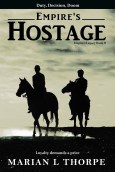
Posts have been few and far between recently….my apologies.  Here’s why.  I’ve just finished printing and framing twelve new versions of graphic prints, to be included in atepsave1 cutout351 display of eighteen of my works that I’m hanging next Wednesday.  I also completed Empire’s Hostage, Book II of the Empire’s Legacy Series, this week, prepped the files for printing, and sent them off – just waiting now to get the first proof edition. cover ebook under 2MB smaller This was also the last week of the on-line university course I’ve been taking, on the landscape archaeology of Britain…and then there’s been the community newsletter, the community herb garden, retirement parties to attend, books to edit, the kitchen cabinets to prep for painting (next week!), and all those little things – like grocery shopping and meal prep and time with friends – in-between.

“Retirement” still seems to involve twelve-hour days – I’m usually started on the day’s work a bit after 7 a.m…..and it generally continues on to about 7 p.m.  I’m still fairly reliant on my on-line calendar to remind me what’s next to be done. The huge difference is that I’m doing exactly what I want to, most of the time, and an hour-long bike ride to pick up my library books and a liter of paint is multi-tasking – exercise and errands in one – but it’s FUN.  And if I feel like taking a day (or more) off, there’s no-one to tell me I can’t, or shouldn’t…hence our week in Cape Cod and the White Mountains at the beginning of the month, a fairly last-minute decision. (But if we were ever going to see Bicknell’s Thrush, it had to be done. I’m pleased to say we were successful.)

I’m going to drop the pace for a few weeks, though: it is, after all, summer.  There are outdoor concerts to attend (weather permitting, in  changeable and stormy Ontario this year), books to read….and cupboards to paint. I need a break before I start writing Empire’s Exile, Book III, plus there are a few other projects that have been on the back burner…and in the fall I start a new university course that will help with the background for Exile.  I will, of course, keep everyone updated on the release and promotions for Empire’s Hostage, but also, I hope, some other posts…I miss it!

To my Canadian readers, have a safe and fun Canada Day weekend, remembering that Canada 150 is also Turtle Island 15,000. We have a lot to celebrate, some things not to, and a lot of work to do.  Happy July 4th to my US readers: stay safe:  Nolite te bastardes carborundorum; and to the rest of the world, whatever season it is, enjoy!


Rain

It’s been raining, hard, for several days now. In some areas of Ontario, and in neighbouring Quebec, flooding has become a serious issue.  My own issue is minor: I can’t write.

I can’t write – or more specifically, I can’t build plot and setting and action –  because I can’t go walking.  Walking is when my brain makes lateral connections, seeing relationships, making jumps of understanding. Treadmill walking doesn’t work: I’ve tried, but I need, it seems, to be outside, letting the wind and birdsong and all the other distractions of nature occupy enough of my active brain to let the ruminations occur behind the scenes, as it were, until something pops out. Once the understanding is there, I can put words to paper regardless of weather – but the understanding needs the walking.

I’ve got enough to occupy me, with the continuing copy-editing and formatting of Empire’s Hostage in preparation for publication, but Book III is bubbling somewhere in the depths of my subconscious, and it wants out.  It wants me to wander for hours along trails (which are currently mires of mud), looking for warblers, listening for catbirds, while synapses connect bits of ideas and previous knowledge and pure imagination to begin the next stages of Lena’s journey. The rain is due to stop tomorrow: a huge relief for those affected by flooding, and a different relief for me.

Rain photo:  By Juni from Kyoto, Japan (Flickr) [CC BY 2.0 (http://creativecommons.org/licenses/by/2.0)%5D, via Wikimedia Commons

Procrastination 101

I should be copy-editing and reformatting the e-book proofs of Empire’s Hostage, but I’m not. Instead, I’m finding lots of other things to do.procrastination

Most of my ‘other things’ are writing related.  I updated my website, I wrote a book review.  I worked on some of the editing work I do.  I worked on a presentation I’m assisting with on growing herbs.  Monday, a surprise acceptance to read at an event this coming Saturday arrived in my in-box, so I’ve polished that piece, and practiced it, and polished some more.  Now I’m writing this.

I tell myself the following excuses:  I’m waiting for the feedback from the beta-readers; I haven’t downloaded the latest copy to my ipad (it’s easier to find the errors working with both the ipad and the PC interface); I’ve got lots of time to get this done.; my hips hurt from sitting at my computer too long.  All these are true, but I think they aren’t really why I’m procrastinating.  I think I’m procrastinating because there is part of me that doesn’t want to let this book out to the wide world, to the ratings and reviews (or lack of them); to the marketing, to the mostly uncaring public…and then there is the fact that, once it’s out there, I need to start the extensive research needed for the third (and probably final) book.

On the other hand, I know there are people waiting impatiently for Empire’s Hostage.  I have a responsibility to those people, my public, if you like. It’s a good thing they’re out there: sometimes I need extrinsic motivation.  So, I’m going to make a cup of tea, and upload the newest proof to the ipad, and get going on those edits.

Or maybe tomorrow…..

Enhanced: Book 6 in the Freya Snow series: A Review

Enhanced, the sixth book of the Snowverse series by L.C. Mawson, is the most enhancedaccomplished and polished book of the series. Freya Snow, the magical, autistic, bi-sexual protagonist, has grown up; no longer a frightened and unsure teen, she’s a competent, capable woman no longer afraid to ask for help. And she falls in love for the first time.

Freya is still young, so she’s still growing into her powers, and still determining her place in the magical universe. Her self-understanding and her willingness to accept responsibility have matured along with her (or are those parts of the definition of maturity?). But she’s still making mistakes, of course, or there wouldn’t be much of a story!

I found this book to be tighter in terms of story structure and pacing than some of the earlier books, more focused and with some needed reminders of previous occurrences that influence the events in Enhanced. Freya’s central conflict regarding her Dark and Light bloodlines is furthered without dominating the story.

The author has created a complex and evolving world in the Snowverse, and I definitely recommend reading the books from the beginning to fully appreciate the character and conflict development. Five stars for Enhanced.

Introducing Geoffrey Saign

In today’s blog, I’m chatting with award-winning  author Geoffrey Saign, whose newest book, Wyshea Shadows, is the first in his new series, Divided Draghons. Geoff is, as well as a writer, a biologist, teacher and sailor…I’m not sure how he finds time to write! His first novel, WhipEye, won the International Book Award; Readers’ Favorite Children’s Fantasy; Outstanding Children’s Fiction in IAN Book of the Year Award; Top Choice, LitPick.com; a Bronze in the eLit awards; and Notable Indie—Best Indie Book, Shelf Unbound. His second novel in the WhipEye Chronicles, Gorgon, was selected as a Finalist, Midwest Book Award; Outstanding Children’s Fiction in IAN Book of the Year Award—third place in Book of the Year, and Top Choice, LitPick.com.wyshea-shadows

Geoff, tell us a bit about yourself. 

I love to bake/cook healthy food, hike, swim out to the center of lakes, snorkel, am a black belt in kung fu, and sail big boats, around 42’, to islands and beaches to swim. I don’t watch TV, but I love movies—stories. I spent 11/2 years traveling in the South Pacific, and it taught me that beauty is everywhere and you don’t have to go anywhere to find it—as long as nature is present. I teach in special education to very bright young adult students, which is both gratifying and worthwhile.

What is the premise of Wyshea Shadows?

Wyshea Shadows is an epic fantasy with three main women characters whose lives are intertwined with war, mystery, a common enemy, and love. As a thriller, it also has enough elements of romance, world building, and mystery that it probably is one of my best books. The wyshea are able to be around animals without scaring them—kind of like our world on the Galapagos Islands, and have a special relationship with nature. There are also elements of old mythology, like precursors to unicorns, wood sprites, and faeries that are only hinted at. The stories build dramatically, and the intertwining of characters is some of the best writing I have done. Each book (two others are written and will be released this year) has a very climactic ending, which always brings emotion out of me even after reading it 100 times. This is because the characters have so much at stake in the story, including protecting those they love. Nature and wildlife have major roles in all my writing.

Wow, that’s complex. How do you conceive your plot ideas?

Usually I think of one line, one situation. In WhipEye I imagined a boy walking into a pet store to talk to an animal. That became an 80,000 word award-winning fantasy novel. In Wyshea Shadows, I envisioned divided races, with good and evil in all the races, and the antagonist an evil that used individual weaknesses of greed and power to his advantage. Once I have a beginning, the rest seems to develop organically.

 Are any of your characters based on real people?

I have a character in WhipEye that reminds me of special needs young adults. All characters probably have bits and pieces of people I know. In WhipEye, the main character is grieving, and is in love with nature. I drew upon myself for both of those attributes at the time (I experienced a loss of not being able to be outside due to a difficult health problem for years, and when I got better, I grieved that loss.)

 Given how you describe Wyshea Shadows, you must have needed to do a fair bit of research!  Tell us about that. 

I usually have to research wildlife, nature elements, and also some of the weapons to understand limits and abilities. The world building is solid, and the magic in this world is concrete and explainable in a scientific kind of way. That doesn’t mean it’s based on science, but there is cohesion in understanding the underlying principles of energy in this world.


Do you outline your books or just start writing?

I write about 1/3-1/2 of the book, or at least the first few chapters, and then I might do a quick, one line outline for successive chapters to see where I’m going. It changes depending on the book and what type of story it is.

Given everything you do, how do you find time to write?

I write almost every day. Three hours or more in the evening after my education job, weekends 8 hour/day. There are breaks, friends, socializing, family, and play time. But I’m pushing 3 series now, plus 2 thrillers that I will come out with this winter, so 2017 will be a big year for me.

Is there a specific place in the house (or out of the house) that you like to write, or a specific mood you try to create with music?

The mood is in my head. I don’t mind listening to birds outside, or children playing, but music is distracting when I’m writing. Every writer is different in this aspect. I write at home, at my desk, and it’s comfortable and cozy.

Have you started your next project? If so, can you share a little bit about your next book?

I just finished 4 new books less than 2 months ago; Bubblegum Mike, Book 1, the YA epic fantasy, Wyshea Shadows, Divided Draghons, Book 1, the 3rd WhipEye Chronicles book, Drasine, and a stress reduction book (I teach that in my school)—so I’m taking a little break with marketing and rewriting an adult thriller. In the next 3-4 months I plan on finishing the 2nd Bubblegum Mike Book and 2nd Divided Draghons book, two thrillers, another young children’s book, and a nonfiction book. It’s a lot to do in one year. I also have some school visits in Minnesota and Chicago. It’s all very exciting!

And exhausting, I would think!  Links to Geoff’s social media and book sites are below. 


https://twitter.com/geoffreysaign?lang=en

https://www.goodreads.com/book/show/33259256-wyshea-shadows?from_search=true

https://www.facebook.com/geoffrey.saign

https://www.amazon.com/dp/B01NCQ0X8P/ref=dp-kindle-redirect?_encoding=UTF8&btkr=1

Empire’s Hostage: Status update and an excerpt.

Yesterday I typed the last words of the first draft of Empire’s Hostage, Book II of the Empire’s Legacy series. Beginning about eighteen months after the end of Empire’s Daughter, the book opens with Lena serving at the Wall, as the war with the north continues.

Now, finishing the first draft isn’t the same as having a publication-ready manuscript; there’s a lot of work to do still. I will now go through the book scene by scene, adding detail (or taking it away), delving further into the emotions and reactions of my characters. Then I’ll do an analysis of each scene: what purpose does it serve? Is it consistent with previous action, reaction, character traits? (including what happens in Empire’s Daughter) – and make the requisite changes. Have I carried themes and images through the book? Is Lena’s horse the same colour in every scene? Large things and small: they’re all important. Finally, I’ll do a copy-edit, looking for formatting errors.

Once I’ve done that – all on the laptop – I’ll print a copy, go through it at least twice, and then and only then, prepare the copies for my beta readers. I’m hoping to have that all done by April.

I’ll do a cover reveal in a couple of weeks (that’s a little dependent on my cover artist), but for now, here’s a look into the opening scenes of Empire’s Hostage.

Chapter 1

The rain slashed down unceasingly, half ice, stinging exposed skin and making it nearly impossible to see anything in the grey light. When the sun, hidden now behind the thick layer of clouds, set–not long now, I estimated–the stones of the Wall and the native rock would lose what warmth they held, and begin to ice over. Night watch would be treacherous, tonight. I counted it a small blessing that my watch had begun after the midday meal.

I wiped a gloved hand over my eyes yet again and scanned north and eastward, not focusing on anything, but looking for motion, or for something that didn’t belong, as Turlo had taught me; something that moved against the wind, or a shadow that hadn’t been there yesterday. I listened, too, to the sounds beyond the noises of the fort and the babble of the stream behind me: the hoarse cry of a raven, the soft chatter of sparrows settling into their roost: no alarm calls. I walked the few steps across the watchtower and began my scan again, to the northwest.

Footsteps sounded on the wooden steps. I did not turn; only when my relief stood beside me, looking out, could I look away.

“I think the minging gods have forgotten it’s the first day of spring,” Halle said. “Anything I should know?”

“There’s a raven in the usual tree,” I answered, still looking outward, “but it’s not alarmed, just making conversational croaks occasionally. I saw a fox about an hour ago, when I could still see, and its mind was on finding mice in the rocks. No owls today but maybe they’re not hunting in this rain. But there could be forty northmen out there, and as long as they moved with the wind and stayed low, I wouldn’t know. But I don’t think so; I’m guessing there is one, or maybe two, watching us, no more.”

“Wrapped up in their cloaks, under some rocks or furze,” Halle said. “I’d rather be here.”

“So would they,” I reminded her.

She laughed, but without mirth. “Go and get warm,” she said. “The hunting party brought back a deer, so there’s venison stew to be had.” I glanced over at her; her eyes were on the land beyond the Wall, watching.

“Good luck,” I said, and turned. I took the stairs down from the watchtower as quickly as I felt safe; the movement warmed me, slightly. At the bottom, I stepped over the gutter, running with rainwater, and onto the cobbled walkway that ran along the inner side of the Wall. The Wall itself broke the wind, and the rain fell with less force. Still, I pulled the hood of my cloak over my head as I walked to the camp.

All the discipline of the Empire could not build a finished fort in a time of war, and while the tents and a few stone and timber huts stood in orderly rows, the roads and pathways between mostly were earthen – or mud, right now. Since the skirmishes had died down, some weeks earlier, work had begun on paving the main thoroughfares through the camp. A narrow, cobbled track ran from the Wall to the centre of the encampment, just wide enough for two people to pass, and I noticed it extended a few feet further into the camp than it had when I had left for watch duty. I stepped off its comparatively clean cobbles onto the slick surface of the hard-packed earthen path. It had been built to drain, and two ditches ran on either side of it, but I could feel mud sticking to my boots.

At the kitchen tent, I scraped the mud off my boots on the iron blade mounted outside, and shook the worst of the rain off my cloak. Ducking inside, I met a blast of welcome heat. I stripped off my gloves and cloak, and the thick tunic I wore beneath the cloak and piled them on a bench. A gust of cold air told me someone else had come in; I turned to see Darel already loosening the clasps of his cloak. He’d been on watch duty at the tower east of the camp.

“Quiet?” I asked. He nodded, concentrating on pulling his tunic over his head.

“Very,” he answered, when his tunic was off. His red hair, streaked with rain, stood up in clumps. He sniffed the air. “I hear rumours of venison stew,” he said. Caro, on servery duty, spoke up.

“More like thick soup,” she said, “but, yes, it’s venison. With some root vegetables and barley in with it. Sit down, and I’ll bring it over.” We did as directed, and soon enough two bowls of soup, or stew, stood in front of us, with a loaf of dark, hard bread. Darel cut the loaf in half with his belt knife, and passed one piece to me. I ripped off a chunk, and dipped it in the soup, and ate hungrily.

Caro brought over two mugs of thin beer, and for a space of some minutes we did nothing but eat. Others had come in as we ate, and the smell of damp wool began to overpower the scent of venison stew in the tent. No-one said much; another day of rain and cold and mud dampened spirits as much as it did hide and stone. The rain drummed on the tent, ceaselessly.

Caro put more fuel in the brazier and then slipped onto the bench beside me. We had ridden north together, from Casilla, half a year earlier, when Dian had come south to requisition food and horses and other supplies for the army. I hadn’t really known her there; she had worked at one of the small food stalls near the harbour, and sometimes on my way to or from my work on the boats I had bought something from her.

“How’s the soup?” she asked.

“Fine,” I said. It was; thick enough to be satisfying, and reasonably spiced.

“It was only a yearling,” she said. “Not enough meat to go around, really, so we had to make soup.”

Food, I knew, was becoming a problem. At the end of the winter, with almost all the army ranged along the length of the Wall, game within a day or two’s hunting was scarce. Sending men – or more likely women – south to the villages for provisions meant fewer of us to defend the Wall if another raid occurred. The truce, called ten days ago, could end at any moment; the Emperor and his advisors spent their days at the White Fort, east of our camp, negotiating with the leaders of the northmen. Fifteen months of war: eight to drive the invaders back beyond the wall; another seven, now, keeping them there, until the ravages of winter, little food, and the deaths of so many, on both sides, had led to the request, and agreement, to parley.

“Who brought it in?” I asked idly.

“Dian,” Caro replied. “They got two, both yearlings, but one went to the White Fort. Have you had enough to eat?”

I shrugged. “Enough,” I said. “Is there any tea?” Darel looked up.

“I could eat more,” he said, “if there is any?” In truth, I could have too, but knew I shouldn’t. Darel was so young, and growing, and thin as a starveling cat. All the cadets looked the same.

“There’s a bit,” Caro said judiciously. “Give me your bowl, and I’ll bring it back, and your tea, Lena.” She slid off the bench and went back to the servery. Darel stretched. “Dice?” he suggested. “After we’re done eating?”

I shook my head. “Not tonight,” I said. “My tunic needs repairing; one of the shoulder seams is splitting.” Caro came back, and Darel fell on his bowl as if he hadn’t eaten the first helping. I curved my hands around the mug of tea. It smelled of fruit: rosehip, I thought.

I sat, sipping the tea. Darel finished his soup, wiping every trace of liquid from the bowl with the last piece of bread, and pushed his bench back. He took his beer and joined a pair of cadets at another table, pulling out his dice. They would sit here, playing, all the rest of the evening, if Caro let them; the servery tent was warmer than the barracks, and there was always the chance of some scraps of food.

I finished the tea, idly watching the dice game. “Minging dice,” one of the cadets growled.

“Language!” Caro warned. She allowed no obscenities in the kitchen tent: another slip and she’d make the cadets leave, and they knew it. I’d got used to the casual swearing among the troops; ‘minging’, a lewd term for urination, was one of the most frequently heard. I even said it myself, now. I stood to take the mug back to Caro, along with Darel’s forgotten bowl. Suddenly, the clatter of hooves on the cobbles rang out in the night. “Who?” Caro breathed. The cadets dropped the dice, and stood. The tent flap parted, and Turlo – General Turlo, now, and advisor to the Emperor – strode in. Darel straightened even more; the presence of his father always made him conscious of his decorum.

Turlo blinked briefly in the light of the tent. “General?” Caro said. “Would you like food, or drink?”

He smiled at her. “We ate well enough at the Fort,” he said, “but thank you. No, I came in search of two soldiers, and I’ve found them. Guard Lena; Cadet Darel: please go to your barracks; pack your possessions and come back here as quickly as you can. You two – Cadets Lannach and Samel, am I right? – go to the horse lines, please, and bring back two mounts. And then retire to your barracks,” he added. “Go!” he said, not unkindly; Lannach and Samel scurried to do his bidding.

Darel had not moved, but looked over at me. “General?” I said. “What is happening?”

“I will tell you,” he said, “when you return with your packs. Bring anything you cannot live without, and your warmest clothes and boots, if you are not already wearing them. Quickly, mind!” It was mildly said, but still an order. I glanced at Darel; he had already turned to put on his outdoor clothes. I did the same, conscious of the racing of my heart.

If this has piqued your interest, follow this blog for upcoming information on the release. The first book in the series, Empire’s Daughter, is available from Amazon as an e-book or paperback.
Lena’s World: MidWinter Celebrations (Empire’s Daughter Backgrounder 3)

The Empire is a northern nation, analogous to Britain or northern Europe.  In common with its real-world cultures, Midwinter is a time of celebration.

“…Midwinter’s Eve being a traditional time of fun and feasting. I thought about the games and song and food I would miss tonight in the meeting hall at Tirvan. Even the littlest babies came, and toddlers fell asleep on benches or the floor as the night progressed.”

While religion is a background element in Empire’s Daughter, not a component of the plot, its world would not have felt real to me without including some acknowledgements of how its culture marked the turning points of the year, especially Midwinter.  The darkest days of the year and the rebirth of the sun – far enough north, that’s literally true, as the sun disappears for several weeks – have been marked by cultures around the world: by Jul, or Yule in pre-Christian Germany and Scandinavia; by Saturnalia in Roman culture, and in the cult of the Roman ‘soldier’s god’, Mithras, as the birth of the Unconquered Sun. It is this god that the Emperor Callan addresses when he says “The god of soldiers receive you, my brother, or I will know the reason why when I stand before him myself.”

So, both the women’s villages and the military celebrate Midwinter, although the women’s celebrations have more in common with Jul, and the military’s with Mithraic ritual.  The Empire’s tradition of making major proclamations at Midwinter, however, is based on the later Christmas Courts of the monarchs of England, when many political decisions (including coronations, notably of William the Conqueror) occurred (but not necessarily so formally as at the Emperor’s Winter Camp proclamations).

And here it is December 21st….at home in Tirvan, Lena would be partying at the Meeting Hall, eating and drinking, dancing and singing.  The Jul log, a massive root, would be burning in the hearth, the fire started with a piece of last year’s log.  Some of the women would stay awake until dawn, to greet the newly-born sun.

The military too has its Saturnalia: food and drink, dance and song, which Lena is happy to participate in, but somewhere outside the camp, a more secret ritual is taking place, acknowledging the birth of the soldier’s god. (This is neither mentioned nor described in the book, by the way, as it had no place in the story. But likely both Casyn and Callan are there.  Turlo?  Probably not.  I think he’s out on the hills with Pan, personally.)

Of course, Midwinter is a plot device, in that it is a turning point in the year, and a turning point in the story, for both the Empire and for Lena. The book begins roughly on May 1, May Day, Beltane, traditionally the day when young women can see their future husbands by various divinations (or, in the book, meet the man who will change their lives) and ends at Midwinter and the dawning of a new year.

The land has its rhythms and pacings, its periods of calm and its periods of change, reflected and acknowledged in the rituals and celebrations of pre-Christian northern Europe, which in turn provides the background structure to the action in Empire’s Daughter. Did I set out to do this, consciously?  No.  It seems that my own internal rhythms, which are set far more by the natural world than by the artificial calendar we have imposed upon it, simply insinuated themselves into the writing.  That doesn’t surprise me: so much of what we write comes from places inside us we barely know.

Blessed Yule, Happy Solstice, Merry Christmas, Happy Hanukkah, Joyous Kwanzaa.  (If I’ve left your celebration out, it’s due to me not knowing about it, not a deliberate oversight, and I wish you joy.)

Sunrise photo: By Fabolu (selbst aufgenommen von Fabolu) [GFDL 1.2 (http://www.gnu.org/licenses/old-licenses/fdl-1.2.html)%5D, via Wikimedia Commons

Lena’s World: The Social Structure of Empire’s Daughter

In Empire’s Daughter, men and women lead very separate lives, the women living together, primarily in farming and fishing villages, the men in mandatory military service.  Male children are taken at age 7 to begin military training; girls are educated in their own villages, and then apprentice to a trade.  Where did these ideas come from?

There isn’t one source, one society that I borrowed from.  The idea of male children being taken at seven into military training is from the social structure of the ancient city-state of Sparta, where exactly that happened.  Spartan boys were basically cadets until age 20, when they took on greater responsibility in the military; they could marry at 30, but did not live with their wives, but stayed with their military comrades in barracks….and that was the germ of the idea of the men and women living almost completely separate lives, except for a couple of weeks each year.

The Roman Empire’s military structure also influenced how I envisioned the lives of menroman_soldiers_at_rest2 in the Empire. Roman soldiers served 25 years in the military, and could not (officially) marry unless they were of officer class, although they often formed permanent relationships with local women.  But again, it was that sense of a primarily masculine life that influenced how the men live in Empire’s Daughter.
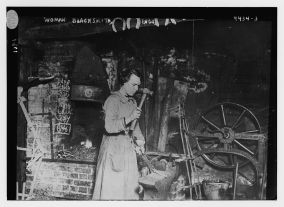
The lives of women were influenced by a number of sources: Icelandic and Viking women, for one, where women frequently were completely responsible for farming and fishing and all the other work woman_blacksmith_-_eng-_i-e-_england_loc_24225694456while the men were at sea, either fishing (Iceland) or raiding (Vikings).  The apprenticeship of girls at twelve to a trade is simply based on long practice throughout much of the world, for both boys and girls: even my own grandfather was apprenticed at age twelve to a coal merchant in England, in about 1896. (The photo is from England, c 1915-1920)

Now, as to why there is this tiny, isolated Empire at the edge of the world, underpopulated and ring-fenced by the Wall, the mountains and the sea….well, to say more would need a big SPOILERS alert.  You’ll have to read the books to find out!

Empire’s Daughter, book one of the Empire’s Legacy series, is currently available from Amazon in e-book format or paperback.  Look for book 2, Empire’s Hostage, around June of 2017!

Roman soldier picture: By Pablo Dodda (Flickr: Roman Soldiers) [CC BY 2.0 (http://creativecommons.org/licenses/by/2.0)%5D, via Wikimedia Commons

Woman blacksmith picture:  Bain News Service; taken in England c 1915-20; courtesy of Wikimedia Commons.  No known copyright restrictions.


Coffee, anyone?

It’s the first of the month, the day my Amazon payments show up in my bank account.  T.S. Eliot wrote “I have measured out my life in coffee spoons,”….well, I measure my royalties by how many cups of coffee I can buy.  This month it’s two, as long as they’re from Tim Horton’s or McDonalds, and nowhere fancier.

I’m not complaining…. I knew I’d never make a lot of money at this, and if a few people are still buying one of the books each month, that’s good.  There are a few more dollars trickling in from paperback sales at different sources too.  This afternoon I’m heading downtown to a couple of other stores that I’ve heard are open to carrying indie author books, and to give a few copies away to the annual books-for-kids (up to 18 years, so Empire’s Daughter, as a young adult book, qualifies).  And I’ll probably stop at my favourite coffee shop….and blow my entire month’s Amazon royalties on one cup of coffee!

Reblogged: Scene by Scene Revision of the Novel, by Robert Bruce Young

There are dozens (hundreds?) of writer’s how-to guides out there, but for the processes of editing and revision, this article from my friend and fellow writer Robert Bruce Young is one of the most concise yet informative pieces I’ve come across, and one I’m going to keep in my favourites for easy reference.  Take a look!

Scene-by-Scene Revision of the Novel

  In the iterative process of drafting a novel — and especially during the final draft — I’ve found editing at the scene level to be most comfortable and efficient.

That is, I proceed scene by scene, going through the following eagle-eye checks. This article presents a step-by-step guide to the elements you need to address….read more

View at Medium.com