It’s common knowledge that humans have access to more digital media than ever before. Five hundred television channels, streaming movies, You Tube, ebooks, music in mp3 format or from streaming services… it’s everywhere. It’s wonderful that we have such a huge number of choices but I think something happened along the way. The huge volume of available digital media has caused it to lose its perceived value. Today, people fully expect this type of media to be free to the public.
Want to listen to the latest Lady GaGa album? Don’t worry, someone has tossed it onto You Tube for everyone to enjoy free of charge. At least until You Tube discovers it and takes it down, soon to be replaced by someone else in no time. If you don’t want to use You Tube, there are a number of sites to pass music and movies free of charge. I can’t tell you how many times I have seen people watching newly released movies on their laptops that they received for free. Love to read books but have a small budget? Sure, you can go to your local library, but why? Jump onto Amazon and grab a free copy of something interesting. I’ve seen people with tens if not hundreds of e-books on their Kindle that they downloaded for free. How did this happen? Where did this way of thinking start?
Here’s my guess.
Technology has allowed artists (musicians, writers) to make themselves visible to the public with as little as a click of a mouse button. In the old days, record companies ruled the music industry with an iron fist. They determined which bands made it and which ones didn’t. The few that did make it, sold millions of albums and filled huge arenas and those that didn’t were left to play at the local bar on Saturday night. But today, a band can set up a website and promote their music to the entire world without the help of a record company.
The publishing business has followed the exact same route. An independent author can write a book and easily toss it onto his/her own website, Amazon or Smashwords without the help of a publishing company. And this is great. As mentioned, this gives the public a huge variety to choose from and allows artists to be discovered. But as time has progressed a pattern has appeared. Four or five years ago, you would see indie e-books on Amazon for $4.99 or $3.99 [U.S. Dollars], with main stream published e-books coming in around $7.99 or $8.99. This makes sense to me since the quality of the indie books might not match that of the mainstream books. OK… I get it. But as time has passed, the price of the indie books has dropped and today most indie books are $0.99 or free. If an indie author sticks his e-book onto Amazon for $4.99, forget it… no one is going to look at it, because the public knows they can get another book that may be just as entertaining for free.
Don’t get me wrong. I’m an indie author. I run promotions where I give away ten or fifteen e-books over a weekend to try and increase readership and get reviews. But I believe that authors (and musicians) that provide their work to the public free of charge on a permanent basis, send the wrong message. I personally don’t write books with the sole purpose of generating income. I enjoy writing and I like to see people enjoy what I write. But I firmly believe that there should be a value attached to my work. Even a program like “Kindle Unlimited” that gives the perception of a free service, puts a value on a book through a subscription fee. (On a side note – I think KDP Select which gives an author access to Kindle Unlimited is a bit too restrictive over the long haul, but could be used for a period of time when a book is first released to draw attention and get reviews.)
My hope for the future is for artists to realize that the way to increase readership is not to lower the price of their goods but to make them better. Come up with a really good song or a really good book and people will notice. I don’t expect to become wealthy selling the few books I have written, but I feel they have a value and the public should provide me with the small amount I am asking for, to enjoy my book.
Let me know what you think?
John A. Autero is an indie author of speculative and techno-thriller adventure novels. An
engineer by education, John employs a technical style of writing that combines existing technologies with those that are yet to be developed. John enjoys anything sci-fi, automotive, heavy metal and ballistic. Always a fan of government conspiracies and black-ops, stories like The Terminator and The X-Files are always on his list of favorites. John was born in the United States and has spent his entire life there, where he happily lives with his wife and pets. The Scorpion is his latest book.
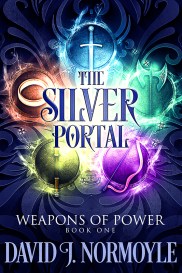 the weapons, five disparate young people from across the land become the weapons-bearers. Magically linked to the weapons, each must learn its powers and its responsibilities, evade those who want to use them for ill, and find each other across a wide and dangerous land. David J. Normoyle’s book The Silver Portal, the first book in a planned series, introduces us to the five protagonists: street urchin Twig; would-be-adventurer Lukin; noble Suma; Mortlebee, outcast from his religious community, and rebellious Simeon. Each character stands as individuals; each has their own difficulties with their unexpected weapons. Struggles with trust, ethics, personal convictions and the expectations of upbringing are central to each character’s growth and development through the story, but not in a heavy-handed or preachy way. Instead, these dilemmas are an integral part of the story, handled for the most part deftly and naturally.


 ometimes two parts of a life can collide unexpectedly. At my Monday morning writer’s group, which meets in the upstairs restaurant/bar of an independent bookstore, we had propped the patio doors open to let in the summer breezes. We’d all been working about an hour – this is a place for silent writing, not discussion or sharing – when I heard a high-pitched, rapid cry from the bar area. My writer’s brain disengaged, my birder’s brain engaged – that was the cry of a bird in fear of its life.
 marianlthorpe.com
You must be logged in to post a comment.