Latest Posts

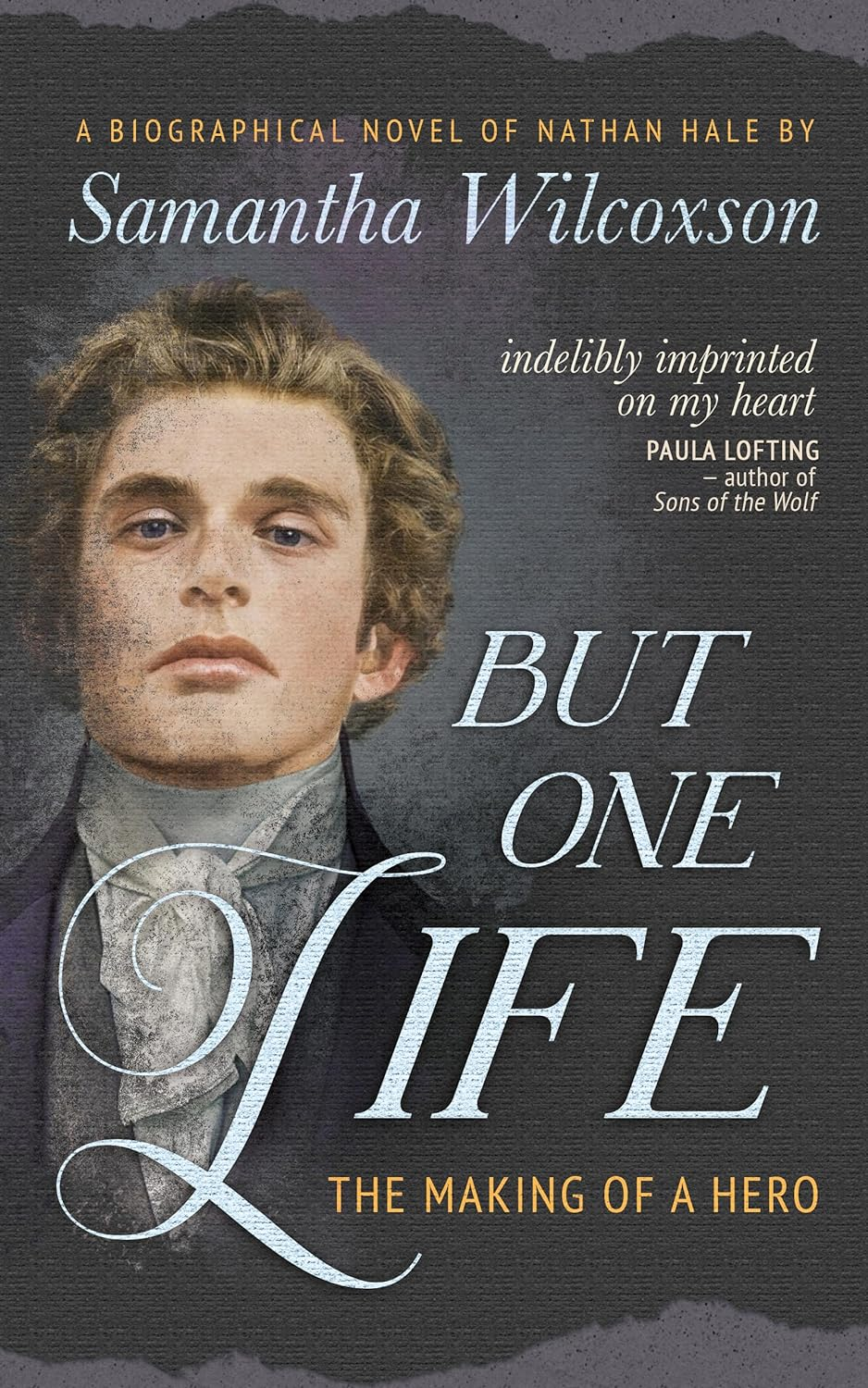
But One Life, by Samantha Wilcoxson

“If I had ten thousand lives, I would lay them all down.”

In the early 1770’s, Nathan Hale is a young philosophy student at Yale. There, he, his brother, and their friend, Ben Tallmadge, are busying themselves with intellectual debate and occasional mischief.

Only too soon, their patriotic ideals of revolution and liberty would be put to the test. Forced to choose between love and duty, young Nathan has to face the harsh personal cost of deeply held beliefs as he leaves to become Washington’s spy.

In this powerful novel of friendship and sacrifice, Samantha Wilcoxson paints a vivid portrait of a young man’s principled passion and dedication to his ideals, turning the legend into flesh and blood.

This is the touching and thought-provoking story of how an ordinary boy grew into an extraordinary man – an American hero.
My Review

Samantha Wilcoxson’s But One Life, a biographical novel of Nathan Hale, is thoroughly and deeply researched, immersing the reader in a convincing, detailed recreation of late 18th century colonial life in the United States. The influences on Hale’s life are clearly delineated: faith, bolstered by his brother Enoch’s even deeper religious conviction; classical thought (translated through a popular play of the time, Joseph Addison’s Cato), and the beliefs fostered and developed through debate and discussion during his years at Yale, especially in the Linonian Society.

Hale is a hero to many citizens of the United States, for his actions and his attributed last words: I only regret that I have but one life to give to my country – but he is also a tragic figure, a young man who allowed his impatient desire to contribute to the colonists’ War of Independence against Great Britain to be his downfall.  Unsuited for the role he takes on, untrained and working against his friends’ advice, his bold gesture of patriotism results in his death by hanging. Wilcoxson does not shy away from this interpretation, showing Hale’s actions in his last days as they were: naïve and bound to fail.

Wilcoxson’s novel fleshes out Hale’s life with a writer’s imagination, although only a failed romance strays far from the established facts. Hale’s life may have been one lived in a limited geography, but the ideas of thinkers and statesmen travelled to his world, as did news of the clashes between colonists and British troops even as early as his years at Yale. Here lies my only quibble with But One Life: other than reports of two uprisings involving violence, very little background into the causes of the growing frustration of the colonists with Britain is given: the Stamp and Townsend acts, resulting in taxation without representation; the Port Act, and the insistence by the British parliament that they had political control of the colonies. The discussions at Yale, especially in the Linonian Society, could have provided an ideal vehicle for background, which, while it may be familiar to readers educated in schools in the United States, may not be to readers from other countries.

Nonetheless, But One Life is a solid, well written biographical novel of a man seen by many as an American hero. Recommended.

ABOUT THE AUTHOR

Samantha Wilcoxson is an author of emotive biographical fiction and strives to help readers connect with history’s unsung heroes. She also writes nonfiction for Pen & Sword History. Samantha loves sharing trips to historic places with her family and spending time by the lake with a glass of wine. Her most recent work is Women of the American Revolution, which explores the lives of 18th century women, and she is currently working on a biography of James Alexander Hamilton.

A Book Develops, Part IV

I am deep into a book with the unprepossessing title of Trade and Institutions in the Medieval Mediterranean. It is, if I understand correctly, an adaptation of its author’s (Jessica Goldberg) Ph.D. thesis, and it is, for me, absolutely fascinating.

This is, in part, how the world – and sometimes the plots – of my books develop: I read a research book, and every few sentences I think, “Oh, I can use that!” There are four trade alliances in The Casillard Confederacy series (as I currently envision it): one based on the Hanseatic League, one on the Scandinavian Kalmar alliance , one (well, ok, this isn’t an alliance) based on a blend of the Italian city-states – think Genoa with some aspects of Venice – and one based in my equivalent of North Africa.

I had some varying degrees of knowledge about the Hanse and the city-states and the Scandinavian alliance. (They all still need research, though.) I had none at all about North African trade in the 11-13th centuries, except to know, barely, it existed. But in the Empire series, I’d made my character Druisius’s family traders and merchants operating both in my Rome analogue, Casil, and from the southern coast of the Nivéan Sea, which is, of course, basically the Mediterranean.  The Casillard Confederacy is the same world, 500 years later, and the major characters are descendants of my original cast. Druisius’s family – some of them, anyhow – are still merchants and traders. Hence my need to learn about how trade worked in that period.

There are aspects of this book that don’t fit my fictional world – the focus is on the trade networks of Jewish merchants – the Maghribi traders – operating primarily in the eastern end of the Mediterranean (for an overview of the documents this detailed analysis is based on, see https://en.wikipedia.org/wiki/Cairo_Geniza) – but the organization of trade, the commodities, the methods of communication and transport, the difficulties to be overcome, how merchant apprenticeships worked – I can use all these. (And tidbits like the fact Jewish bankers in Old Cairo in the 11th C were using a double-entry bookkeeping system, predating any known usage in the Italian city-state banking systems.  Maybe. If I can slip that in without it sounding like, look, I did my research!)

This is just one aspect of how I build both a world and a character. I immerse myself in the history – in this case the world of Mediterranean trade  that Goldberg has so masterfully laid out, and it becomes part of one or more character’s story. If I’m lucky, that transfer will happen naturally, shaping who the character is, how they think, their loyalties, their presumptions of how the world works, the conflicts and dissonances that happen when confronted with another way of thinking and doing business.

But it’s not the only aspect. People are shaped by their cultural environment, but as I alluded to in the last entry in this occasional series, they’re shaped by their landscape, too. That will require a different sort of research. Meanwhile, back to bales of indigo and flax, and the tribulations of weather, markets, and unreasonable customs charges.

A Book Develops, Part III

A novel – or its components: character, theme, plot, setting, language – has  many sources, many experiences, real and imagined, that work together to create something whose whole is greater than its parts. I am a writer of place, of landscape, and of characters who are shaped by the places they call(ed) home. Many of those places are drawn from my own experiences.

In An Unwise Prince, one of my characters, Cenric, has stuck close to home, a medieval trading centre. Kirt, his partner, has travelled widely, an explorer, a risk taker. Luce has travelled too, but in pursuit of her education in medicine. Then there’s the fourth—young Audun, Cenric’s son, seventeen or eighteen, just finished what might be considered his secondary education, hoping to go home for a while before his next term of study.

I knew Audun was from Torrey, a coastal village (it has a few brief mentions in the Empire series) where his mother runs a workshop making baskets from the reeds and willows of the marshes. I’ve been reading pretty widely on the pre-drainage landscape and ways of life in the fen country of England—not so much for research but because it’s a landscape I love, a love that perhaps has its roots in my genes—or at least in family stories. I’d had a few thoughts about how to use this information to flesh out Audun’s character a little, but they hadn’t coalesced.

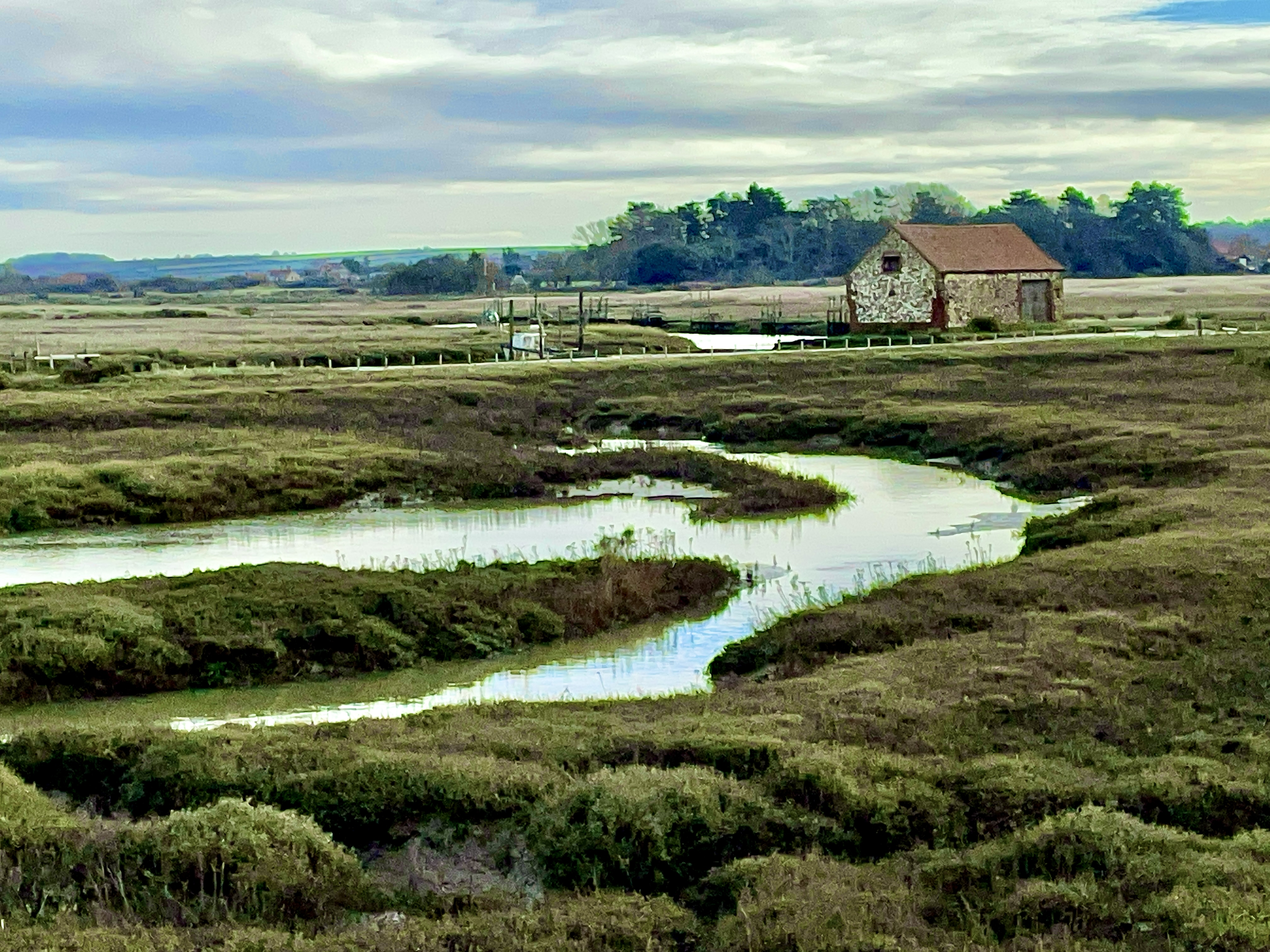
Then I started to read Nick Acheson’s The Meaning of Geese, a book about the flocks of geese that return each year to north and west Norfolk to escape the Icelandic and Scandinavian and Russian winters. Acheson—who is a friend of the friend who insisted I needed to read this book—writes in part about his own teenage experiences in the coastal marshes of north Norfolk; about places I know, have walked, can picture in detail. I can hear and feel and smell and see the birds, the wind, the salt in the air, the long views. And suddenly, I had my key to Audun.

The Coal Barn, Thornham Staithe. My photo.

It’s not all there is to Audun, of course, but it lies at the heart of who he is. And gives him a knowledge that may prove useful, later in the story. Or so I think, at this moment in time!

A Book Develops, Part II

Well, I didn’t expect it to be almost three months before I had anything more to say about the next novel! (The first part of this occasional series is here.) January, though, was mostly taken up with finishing other tasks, primarily getting Empire’s Passing ready for release and completing a contracted edit. February took us to Spain, a road trip for birds and Roman ruins and medieval city centres; one of the things I wanted to experience was how remnants of the Roman Empire (or the Eastern Empire, in my fictional world) appeared in a countryside that wasn’t Britain. Something beyond the familiar, to make me see.

Sadly, I don’t have a photo of the image that had the most impact: part of an aqueduct in a random field, and in that field, a man walking his dog. Living with this ancient piece of infrastructure as background to his everyday life. That was the sense I wanted; it will metamorphose, by whatever alchemy happens in a writer’s mind, into what it’s like, 500 years after we last saw my world, to live with the remnants — tangible and intangible –of a past empire.

One of the hardest things I had to find was some scholarly books with a good overview of European history of the later middle ages – roughly 1000 to 1400. Eventually, through discovering the online syllabus to a university course covering that period, and checking its reading list, I ordered two books:

I’ve also signed up for a six-week online course on medieval universities, as the Ti’acha of the first series have developed into something fairly similar (but without the religious context).

I’m still writing exploratory short stories, which can be found, one a month from January onward, on the A Muse Bouche Review. This is a way for me to get to know my characters, and some of the conflicts that the story will be based around.

As my research and character development continues, I’ve realized there are two big challenges ahead of me: which bits of European history to cherry-pick for the books (there’s a LOT going on in Europe and around the Mediterranean in these centuries), and, maybe even harder, to write a novel or novels with at least four POV characters. Two is the most I’ve done before.

But as the book gestates, moving from concept to reality, its lack of a working title was nagging at me. (Titles and book covers make an idea more solid, at least for me.) So here’s a cover mock-up: a place-holder image, and the working titles for both the book and the (presumed) series: All of which may change between now and publication!

‘A wise prince should establish himself on that which is in his own control and not in that of others; he must endeavour only to avoid hatred.’
The Prince, Chapter XVII
Niccolò Machiavelli

Varril, the elected Princip of Ésparias when the story opens (at this point, at least!) is not a wise prince. Not at all. And on that, it seems, will hang the tale.

(As for the Casillard Confederacy – think of the Hanseatic League, often simply called the Hansard.)

More when there’s more to say!

Try the Leopard’s Mouth, by Charles Moberly: A Review

Try the Leopard’s Mouth is the story of a man with two dangerous obsessions: one with a country, and one with a woman. Tom Etheridge is a young man who takes a job in Rhodesia towards the end of Ian Smith’s government, at first working as a salaried farm manager but quickly wanting to become his own man and farm his own land. He lacks the capital to do so, but through the intervention of a friend is introduced to the daughter of the owner of the local hotel, the informal club of the white population of the area. Rapidly becoming obsessed with Briony, he trusts her when she tells him she can, through family connections, arrange financing for his farm.

While Tom falls in love with both the land and the woman, both are becoming increasingly dangerous. Briony has her secrets, and between his obsession with her and his desire to farm, he ignores the inconsistencies and nagging doubts, and becomes the owner—perhaps—of Chingwele.

Among the more typical crops of a Rhodesian farm, Tom and Briony are also growing tancava, a (fictional) local plant known as goat’s ear which, when ingested, allows people to function without food or drink for many days. Locally used during illnesses to mitigate dehydration, its use by military or para-military organizations means a potentially large market, one Briony appears eager to pursue.

As the battle for what will become Zimbabwe heightens, Tom is caught in the middle. Slowly he realizes Briony is not who she seems to be, nor is his friend Jamie, not entirely. But just who, exactly, are they?

Moberly neatly parallels Tom’s two obsessions. The white population of Ian Smith’s Rhodesia were said to be ‘more English than the English”, clinging to ideas and behaviours already disappearing in the ‘mother country’. Briony is fixated on her dead mother, wanting to emulate her and her relationship with Briony’s godfather, a man slowly revealed to be both controlling and corrupt. Like the beautifully described Zimbabwean landscape, Tom can wish to be fully a part of her life, but neither she nor the land can truly belong to him.

Sympathetic to the injustices of colonialism but acknowledging the problems and divisions of establishing self-government, Charles Moberly creates a fairly balanced view of a country in a time of reluctant and sometimes violent transition. Tom is both a perpetrator and a victim, a man caught in events and in relationships more complex than he can navigate. Fans of Wilbur Smith are likely to enjoy Try the Leopard’s Mouth.

About the author

Charles Moberly’s novels are different from one another in style and genre. He likes to push boundaries, and to address subjects rarely covered by other writers. If there is a common theme, it is tension arising from misunderstandings.

His blog is https://charlesmoberlyauthor.blogspot.com.

Moberly has written three novels to date: The Scrotum Toad, a satirical comedy (Winner of A Chill with a Book Reader Award); The Corncrake, a historical novel set in 1909-10 and 1914-15, (Winner of a Chill with a Book Premier Award); and Try the Leopard’s Mouth, a romantic thriller with a firm historical base (Winner of a Highly Recommended Award by The Historical Fiction Company).

Exiles, by Miles Watson: A Review

One man: an unwanted, abused orphan who found an escape in books, and in a moment of danger decides to model himself on a fictional character.

One woman: sold to a whorehouse as a child who has found her escape in the discipline and ruthlessness needed to become a captain of a smuggling ship.

A second man: convinced of his superiority, admitting no morality or laws but his own, who has sworn to destroy the despotic government known as The Order.

Eniton Champoleon, Marguerite Bain, Magnus.

Marguerite Bain, Captain of the Sea Dragon, is hired by The Order to take food and water to a tiny island on which a man is exiled. She is to make no contact with them. But Marguerite is not of a mind to do as she is told, and she leaves writing materials in one shipment. The story she is given in return tells of the unwanted orphan who becomes a wanderer and a conman, a tramp – until the day he accepts a free meal in exchange for listening to a political speaker. Caught up in the movement against The Order, he invents a history for himself and a future for the revolutionaries: one that has no basis in reality. But his lies will have a price, when a rising revolutionary called Magnus reveals his hand.

Marguerite, her own past too painful to dwell on, finds herself questioning her own choices as she reads Champoleon’s autobiography. Drawn to him, her interest in his story becomes compulsive, and dangerous.

Written in the style of a political thriller, set in an alternative future Europe, Exiles is also a psychological study of exile both voluntary and involuntary. Champoleon and Marguerite are both set apart from others by the circumstances of their childhoods and the paths taken as adults, whether by choice or by fate. Neither have anyone to trust, or love. Magnus, who believes himself an Übermensch, to use Nietzsche’s term, has no use for humanity except as tools for his vow to overturn The Order. All three have fictionalized their own lives, shaping them into an image individual to each character, but separate, alone, untouchable.

Dante in Exile by Domenico Petarlini
Public domain, via Wikimedia Commons

The novella, while capable of being read as a standalone, is also backstory for Watson’s earlier book Deus Ex. Much of it is told in great detail through Champoleon’s biographical writing – a technique I found palled after a while. But it does have the effect of distancing the reader from Champoleon, leading to the question of whether or not any of what he writes is true, or simply another story.  

Exiles has many twists and reversals, in good thriller style, and the tension and action builds throughout. Character voices are distinct. Watson is a writer of talent and imagination, with deeper themes beyond the surface stories of his books.

Miles Watson holds undergraduate degrees in Criminal Justice and History and a Masters of Fine Arts in Writing Popular Fiction, and served in law enforcement for nearly ten years before moving to Los Angeles, where he has worked on over 200 episodes of television and half a dozen feature films. But his first and last passion is writing.

A Book Develops: Part I

Even before Empire’s Passing, the last book in the Empire’s Legacy series, was partially written, people were asking ‘what’s next?’ To be fair, I had a glimmer of an idea – the same world, about 500 years later, with some aspect of the story derived from the trade alliance of the Hanseatic League.

Passing is done now; I’m just awaiting the paperback proof. It’ll be out in February. I’m in no hurry to write this next book, for many reasons. Key among them is that I know little of 13-14th C history, so I have a lot of research to do. But books evolve not just from plot but from characters—after all, it is the characters’ responses to the problems and conflicts they are faced with that makes a book interesting. And for me as a writer, characters simply appear, with much of their personalities in place, immutable except through personal growth, their responses to the circumstances of their lives.

Over the next—how long?—year? more?—I plan to record the development of this next book, as much to see if I can elucidate my own process as for anyone else. But you’re welcome to come along on the journey as this yet-without-a-working-title book emerges from research and imagination and craft.

So: where am I now?

Five characters of some importance, so far; one minor ones. Who do we have?

Cenric bé Casille, who describes himself as ‘a man of mature years and a merchant of standing and not insignificant influence’. He’d be about forty.

Kirthan del Candre de Guerdián en Leste, more usually known as Kirthan de Guerdián, another merchant, described by Cenric as ‘made of autumn oak leaves, shades of gold and brown from the short curls of his hair to the tips of his polished boots.’  A few years older than Cenric, known to his intimates as Kirt.

Luce bé Casille, Cenric’s sister. Physician, musician, mid-thirties.

Of some importance is Cenric’s son, Audun, who is about seventeen, and currently attending the equivalent of a cathedral school (equivalent because organized religion continues to play no part in my world) at which his great-uncle (Cenric and Luce’s uncle) teaches. The so far unnamed great-uncle will be an important secondary character, I think.

The first three characters (and the minor one of Cenric’s housekeeper) are introduced in an exploratory short story called The Onion Tart, published this month in A Muse Bouche Review. There will be more of these character-exploring stories: some may become part of the book, some won’t. I don’t think The Onion Tart will, but its description of the meeting of Cenric and Kirt will be background (and canon!).

Image by magdus from Pixabay

Meanwhile, while Cenric and Kirt and others tell me little bits about themselves, my first research book is Seb Falks’s The Light Ages: The Surprising Story of Medieval Science. Its focus is the 14th C, but the advantage of writing historically inspired speculative fiction is I can borrow from adjacent centuries, as long (my own rule) I’m not blatantly anachronistic with technology.

More to come, when there’s more to say!

Part II is here.

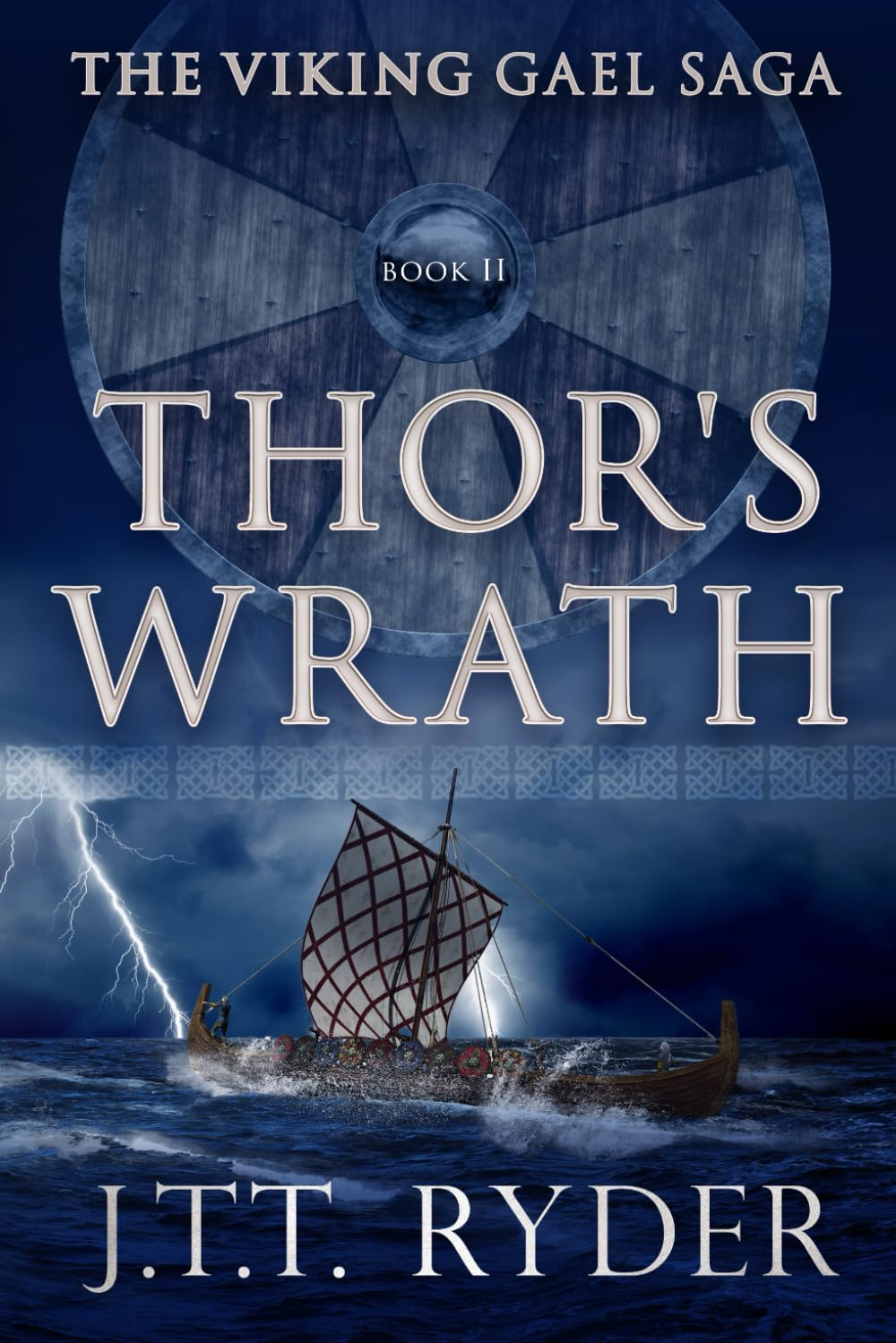
Thor’s Wrath: Book II of the Viking Gael Saga, by J. T. T. Ryder: A Review

When we left Asgeir in book 1, he had saved his life (and his cat) but lost his honour. Now, as Harold Finehair works to unite Norway, Asgeir lands in the Orkneys, into conflict and battle: a chance for Asgeir to overcome his shame and redeem himself in his eyes and his gods.

J.T.T. Ryder continues to draw on his extensive knowledge of the history and archaeology of the setting – both time and place – in recreating a 9th century north-western European world. While Asgeir (and his compatriots) worldview is not ours, it is convincing: enmity and friendship flipping back and forth; the importance of personal honour; the role of single combat over warfare. This is a world of foresight, of visits from gods, of visions and portents–all are real, all are to be taken seriously.

The story moves quickly; the reader and Asgeir together are given little respite as threats are overcome, peace is agreed, only for another threat or a betrayal to begin the action again. Ryder’s writing is sometimes lyrical, especially in his place-based descriptions: ‘A whirlwind of puffins blackened the sky over the rocky, chilly islet… Mist shrouded the horizon like unspun wool, and the wind bit as remorseless as a fox…” In other places it echoes the alliteration of the sagas: ‘shocked him with sleet sideways.’ Even the occasional unusual word choice adds to the story, creating a sense of a world different from ours, refracted through time and distance.

The story is perhaps Ryder’s best, the complexity of Asgeir’s choices and of his thinking deepening as the youth matures into manhood. The telling is excellent. The editing, I am sorry to say, is less so.

(I dislike on-screen reading, so whenever possible I buy the paperback, so these comments pertain to the first paperback edition published in 2023.) I am tolerant of a certain number of typographical errors: they appear in even the best edited books, traditionally published or independent. But repeated sentences, repeated scenes, should not. Nor should a leg of lamb in one paragraph become a leg of pork in another. These errors spoke of a rushed production, an incomplete editing process, and one, inevitably, that jolts the reader out of the story. A second, corrected edition* is strongly suggested.

But! Thor’s Wrath is still well worth reading, and I look forward to the next book in Asgeir’s saga. (And yes, the cat is still Asgeir’s companion at the end of this installment.)

*Update: correspondence with the author assures me these errors have been or are in the process of being corrected.