Latest Posts

The Bull-Headed Lyre of Ur: A Masterwork of Ancient Mesopotamian Music

A Guest Post by Stephanie Churchill

The Masterworks Blog Tour
Osama Shukir Muhammed Amin FRCP(Glasg), CC BY-SA 4.0 https://creativecommons.org/licenses/by-sa/4.0, via Wikimedia Commons

How many of us have wandered through an art gallery and daydreamed about a painting that catches our eye or an intriguing sculpture on the plinth? I definitely do. So the idea of coming up with a short story based on this premise didn’t require me to consider for long.

I had been researching Mesopotamia, particularly the foundation of the Akkadian Empire, when I learned about the discovery of the Bull-Headed Lyre of Ur. I have been trying for several years to write a work of fantasy using the Akkadians as an anchor for the setting of my fictitious world, but the final form of that book has been elusive. When I was invited to write a piece of short fiction, I realized that using this lyre would be a great way to use my research on the Akkadians even if my longer novel is proving difficult to finish.

The Bull-Headed Lyre of Ur is one of the most iconic and well-preserved artifacts from ancient Mesopotamia. It is also one of the oldest string instruments ever discovered, dating back to around 2550-2450 BC. The lyre was unearthed in 1926 by British archaeologist Leonard Woolley, during his excavations of the Royal Cemetery at Ur in what is now southern Iraq.

Woolley and his team had been excavating the Royal Cemetery at Ur for several years when they came across tomb PG779 which was (they later decided) the burial place of Queen Puabi, a Sumerian queen who lived during the Early Dynastic III period. The tomb produced a treasure trove of grave goods, including gold jewelry, weapons, and pottery.

The lyre was found in a wooden coffin, along with the bodies of several attendants. Made of gold, silver, lapis lazuli, and shell, the lyre is decorated with intricate carvings and inlays, depicting a variety of scenes from Mesopotamian mythology and everyday life. The most striking feature of the lyre is its bull’s head, which is attached to the front of the soundbox.

Music was very important in ancient Mesopotamian civilization and was played during a variety of occasions, including religious festivals, royal banquets, and military campaigns. It was also used to accompany poetry, dance, and storytelling. For my story, I envisioned its use in private homes as well, even if occupants couldn’t afford anything as luxurious as the Bull-headed Lyre from Ur.
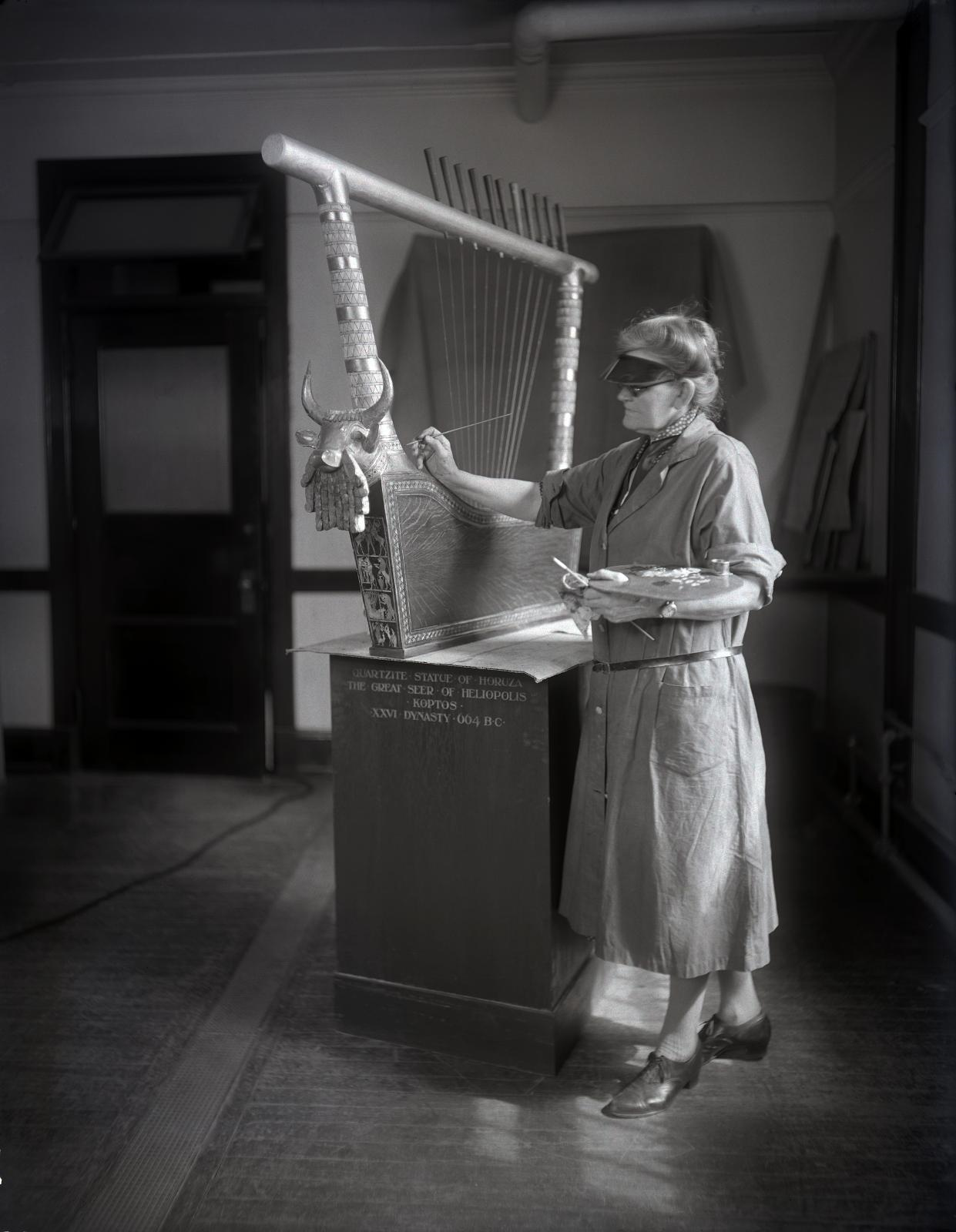
What would life have been like for the person who played such an exquisite instrument? Particularly for one who played in the court of a queen? To make my story work, I moved the lyre from its actual, historic era forward a couple hundred years to the reign of Sargon of Akkad, placing it in the Ekishnugal Temple in Ur where Sargon’s own daughter, Enheduanna, served as En, or high priestess, to the moon god Nanna. Enheduanna had her own court musicians, so I simply needed an individual to fit the role. From there, I simply told the story of how a girl with a passion for music ended up serving as music-giver for Enheduanna, the historic lyre her instrument of music-weaving.

I’d love for you to discover the inspiration of these pieces of art for yourself. Look for Masterworks on Amazon, available now.

About Stephanie Churchill

Being first and foremost a lover of history, Stephanie’s writing draws on her knowledge of history even while set in purely fictional places existing only in her imagination. Filled with action and romance, loyalty and betrayal, her writing takes on a cadence that is sometimes literary, sometimes genre fiction, relying on deeply drawn and complex characters while exploring the subtleties of imperfect people living in a gritty, sometimes dark world. Her unique blend of non-magical fantasy fiction inspired by real history ensures that her books are sure to please fans of historical fiction and epic fantasy literature alike.

After graduating college, she worked as an international trade and antitrust paralegal in Washington, D.C. and then in Minneapolis, Minnesota. It was only at the suggestion of New York Times best-selling author, Sharon Kay Penman, that Stephanie began to write. She has since written three novels loosely inspired by the Wars of the Roses: The Scribe’s Daughter, The King’s Daughter, and The King’s Furies. Her first short story, Shades of Awakening, originally appeared in the Historical Writers Forum anthology, Hauntings. A Našû for Ilu, part of the Masterworks anthology, was published November 1, 2023.

Media:

Website: www.stephaniechurchillauthor.com

Facebook: www.facebook.com/StephanieChurchillAuthor

X: https://twitter.com/WriterChurchill  

The Arrow of Exile

Whether in Rome or a dystopian future, from Norwegian falconers to princes, exile can be a choice for survival, or a forced exodus from everything that is loved. Thirteen stories by thirteen historically-inspired writers (including me), newly out in paperback and Amazon e-book.

‘a delightful collection….I highly recommend’ – Amazon reviewer

I Read Canadian

I Read Canadian Day is a day conceived as ‘a national celebration of Canadian books for young people, with the goal of elevating the genre and celebrating the breadth and diversity of these books.’  But in 2023, its own website acknowledges that it’s also  a day that celebrates the ‘richness, diversity and breadth of Canadian literature.’

As I walked this morning I thought about my own experience with Canadian writing, both as a child and an adult. I’m 65, so back in the early ‘60s, only a few  authors easily spring to mind:  Lucy Maud Montgomery, Morley Callaghan, and Farley Mowat. (Callaghan wasn’t primarily a children’s writer, but his young adult novel Luke Baldwin’s Vow was excerpted in one of our school readers.) A few years later, I read Who Has Seen the Wind by W.O. Mitchell.

All these books touch on what Margaret Atwood argued was the central theme of Canadian literature in the first half to 2/3 of the 20th century—survival. Sometime physical survival, as in Mowat’s Lost in the Barrens; sometimes psychological survival, finding one’s place, a theme in Montgomery and Callaghan and Mitchell. Survival isn’t a theme specific to Canadian literature, of course, and not every literary scholar agreed with Atwood, but it may be telling that when I was being interviewed by another Canadian about my own books last week, and I answered the question about deeper themes by saying that they were in part about the love of place, of a geography and landscape, his comment was, “That is SO Canadian.”

When Jack McClelland (and others) began to actively promote and publish Canadian authors telling Canadian stories in the 1970s, my earlier enjoyment of Mitchell and Callaghan and Mowat and Montgomery (a lot of ‘M’ s! – even Callaghan is ‘Morley” and prominent among Canadian writes of the time were Margaret Atwood and Margaret Lawrence….but I digress) made me predisposed to read what was being published. While those children’s books had been primarily rural stories, resonating with me and my own small farming town upbringing, I began to read of worlds I didn’t yet know: the Toronto-set books of Robertson Davies; the Montreal-set books of Mordecai Richler (another M!). And then into  worlds, too, that didn’t exist – Ottawa writer Charles deLint’s urban fantasies set in not-quite-Ottawa; Guy Gavriel Kay’s Fionavar Tapestry, that starts in Toronto but moves into another world altogether. At about the same time, British Columbia writer Wiiliam Gibson’s Neuromancer created language now part of our everyday speech (Gibson invented the term cyberspace in an earlier short story, but it was Neuromancer, his debut novel,  that brought it into common usage). Neuromancer is the only book to have ever won the Nebula Award, the Philip K. Dick Award, and the Hugo Award.

Perhaps a major turning point for Canadian children’s books came in  1979, Roch Carrier published Le chandail de hockey (The Hockey Sweater), a short story about a boy in rural Quebec who is sent the wrong hockey sweater – a Toronto Maple Leafs jersey instead of a Montreal Canadiens sweater.  Adapted by the National Film Board into a short film, then published as a picture book by Tundra in the early 80s, it is my impression that The Hockey Sweater helped change the demand for Canadian children’s stories, although the timing must also have helped!  The Canadian Children’s Book Centre had been created a few years earlier, and The Canadian Children’s Book News began publication in 1977.  Since then, organizations across Canada have sprung up to  promote Canadian writers of works for children and youth: the Forest of Reading program  run by the Ontario Library Association gives out 10 awards for Canadian children’s books yearly – and of course the  I Read Canadian organization’s mandate is to promote Canadian children’s books and reading.

Canadian children who read become Canadian adults who read (we hope!) and the breadth and depth of Canadian literature has never been wider. Indigenous voices, new-immigrant voices, voices of people marginalized for many and multiple reasons; memoir, poetry, fiction, non-fiction, graphic novels; short stories, novels, novellas, whether published traditionally (by big presses and small) or independently produced; verse on broadsheets, hand-sewn chapbooks and hand-bound books; limited editions and trade paperbacks, ebooks and internet serials – so much to explore, to enjoy, to learn from. And to contribute to, by so many talented, passionate Canadians.

Dying for Work

Luminous: The Story of a Radium Girl, by Samantha Wilcoxson.

Imagine you are a young working-class woman in 1920s USA. Imagine you have elderly relatives to help support, and are offered a well-paying job in your home town. You would, of course, take it.

Imagine that job will kill you. Not just you, but many of your friends. And the company will deny the dangers, smear your name, conduct false medical tests, and conceal others, while all the time ensuring that their lab personnel have all the protected equipment available at the time.

You and your friends were disposable.

This piece of history, played out in Illinois and New Jersey, is the focus of Samantha Wilcoxson’s Luminous: The Story of a Radium Girl: a fictionalized biography of Catherine Wolfe Donohue, a worker at the Ottawa, Illinois Radium Dial factory. Catherine and her coworkers, all young women, were hired to paint watch dials with radium paint, so that the numbers would glow in the dark. To create the fine point needed on the brush for the exacting, precise work, they were told to run the brush point, loaded with paint, between their lips. One by one, they began to sicken and die.

Wilcoxson begins Catherine’s story in the late summer of 1921, when she is nineteen. Fall is in the air, garden produce is being harvested, and the slow rhythms of small town life are evoked in a few brief, effective paragraphs. An advertisement for girls to work at Radium Dial is advertised in the local paper; Catherine applies and is hired.

For a while, the job seems wonderful. The pay is good and the camaraderie with other girls creates close friendships. But then the illnesses start, and the deaths: horrible deaths, in many cases.

Catherine is not one to rock the boat, but she begins to ask questions. The management of Radium Dial deny any relationship with the paint; a fact claimed in Ross Mulner’s book Deadly Glow but not mentioned in Wilcoxson’s is that in some cases the women’s symptoms were blamed on syphilis, effectively destroying both their credibility and their reputations.

When her friends continue to sicken and die, painfully and gruesomely, Catherine—now married—has also fallen ill. Wilcoxson does not shy away from the details of the illnesses, primarily bone cancers, that these women contracted. With the support of her husband, eventually she and others sue the company, a nearly hopeless cause.

The devastation that radium poisoning caused to women and their families is clearly told, and the ground-breaking fight for compensation that Donohue helped win with her deathbed testimony is an important part of the history of workers’ rights. But perhaps because the dialogue often didn’t quite ring true to me, or perhaps because the story is told over twenty years, and is therefore necessarily episodic, while I felt for the destruction of lives and the injustice of their treatment intellectually, I never quite connected emotionally with the character: I was observing Catherine’s life, not immersed in it.

Luminous: The Story of a Radium Girl is a solid work, historically accurate and a window into a terrible exploitation of workers in the name of profits and a fight for workers’ rights—rights which are under siege in many places today as profit, not people, remains the focus of too many companies. Could this happen again? Under a slightly different guise, I am afraid so.

Samantha Wilcoxson

At the End of All Things

Wolf Weather, by Miles Watson: A Review

Imagine if you had lived a life of cruel discipline from the time you were a child, and were constantly called upon to do battle for an emperor you had never seen. Now imagine that emperor orders you far off the map, into a frozen land where the sun never shines and the only light comes from the grinning moon. Imagine that once there, hundreds of miles from the warmth of civilization and the sun, you encounter supernatural beasts somewhere between wolf and man; cunning creatures who slaughter your comrades and lay siege to the fort you have built with your own hands. Imagine that one by one, your fellow legionnaires are torn to bits and consumed, or worse yet, turned into beasts themselves…until at last, only you remain. The sole survivor and inhabitant of Fort Luna. Now imagine that’s where the story begins.

I read most of Wolf Weather with a smile of appreciation on my face, and that is rare. Author Miles Watson’s ability to create a setting and a structured world in the first few pages of a very short novella was the start of that appreciation; he takes the familiar and modifies it just a bit, enough for you to know this is a fantasy world, but not so much you need pages of exposition or explanation to understand it. The character of Crowning, the narrator, is equally well-drawn: again, he is both familiar and unique.

But beyond my admiration for Watson’s deft, spare creation of another world was also respect for his ability to ask hard questions about what a man at the edge of existence might do, facing something unimaginable that his mind cannot fully realize. Crowning is a man defined by discipline; the tenets of the military to which he belongs are literally written on his skin: by discipline we live, by discipline we die. Even when he is the only soldier left alive, in a fortress under perpetual night at the arctic edge of the world, he maintains the discipline by which he lives. Even though a horror lives in the darkness, a horror that has taken all his companions. Some are dead. Some are not, but neither are they living men any longer.

But Crowning is only human, and when in exhaustion he forgets part of his routine in his endless battle against that horror,  that breach of discipline has consequences—and the central question of the novella is made clear: when we let go of the expectations of civilization, of the disciplines required by communal life, by society; when we embrace ‘at the end of all things’ the darkness and the desires that run in the tracings of our blood—what might happen? Unbridled passion can destroy, but it can also engender.

Deceptively simple, Wolf Weather is a story I won’t soon forget.

Miles Watson

WRITING A SERIES by Helen Hollick

What could be easier? You have an idea for a new book, it doesn’t matter what genre – historical fiction, romance, fantasy, crime…The basic plot has popped into your mind and the characters come trooping into your life: the protagonists, the good guys, the bad guys. You start writing, the plot flows and the first draft is done. Then the editing, the cover design, the formatting. The excitement of publication day. Maybe an online launch and a book tour. And then you realise exactly what you have. The first part of a potentially cracking good series.

Now you wish you’d kept notes, details of what your characters were like – in looks and mannerisms. Eye colour, hair colour, tall, short, fat, thin? Their quirks and foibles. Maybe you should have delved into their backstories a bit more? Oh heck – I should have made a note of locations, of the little details. Believe me, unless you intentionally set out to write a series from the very beginning, all these possible continuity pitfalls suddenly appear like wasps at a summer picnic.

Readers notice, or at least, they will when your wonderful series takes off and the demand comes for ‘More!’

When I wrote Sea Witch, the first of my Captain Jesamiah Acorne nautical adventure voyages, I intended it to be a one-off tale, (not helped by my ex-agent who had no faith in it  – hence the ‘ex’!) But readers loved it (and Jesamiah,) so I had to write another adventure for him, then a third… I’m in the process of starting the seventh full length yarn. And I wish I’d made more notes along the way.

Lesson learned, I keep notes for my Jan Christopher Cosy Mystery series (that’s coZy in US spelling). The location for the episodes set in the north-east London suburb of Chingford are not a problem as it’s where I used to live and work in the public library back in the 1970s. Apart from the roads where murders happen, all the streets and places are the real thing. (I’ve made the murder locations up, though, in case of any residents’ sensitivity.) The library itself, South Chingford, was an actual place. The building still exists but the local council closed it as a library several years ago (shame on them!) and it is now used as offices. I’ve quite enjoyed bringing the old place back to life; remembering all the goings-on during the thirteen years I worked there. The characters, however, are entirely made up – although several of Jan’s anecdotes are partially biographical.

I decided to deliberately alternate location settings between each book, primarily because I was torn between writing about Chingford as it was, and my present life here in glorious North Devon … so episode 2 (A Mystery of Murder) saw Jan and boyfriend Detective Sergeant Lawrence Walker visiting his parents for Christmas 1971, who live in the fictional village of Chappletawton. Based on my village – but not quite the same.

All well and good, but by the time I got to episode 4 –which again sees a return to Devon, I had to ensure I had the right place names, the right village residents … was Bess, the dog, a black or golden labrador? What had I called the neighbouring farmer? And even more important, which characters leant themselves to becoming possible murder suspects and which ones were reliable witnesses?

I think I’ve managed to tie everything together in A Meadow Murder, introducing new characters, revisiting previous friends, and remembering to make notes for the next planned instalments…

ABOUT A MEADOW MURDER

A Meadow Murder is the fourth tale in the Jan Christopher cosy murder mystery series, the first three being A Mirror Murder, A Mystery of Murder and A Mistake of Murder… see what I’ve done there? Yes, I’ve created a proper puzzle for myself because now every tale in the series will have to follow the same title pattern of ‘A M-something- of Murder’ (Suggestions welcome!)

Based on working as a library assistant during the 1970s for almost thirteen years, the mysteries alternate between the location of Chingford, north-east London, where the real library I worked in used to be, (the building is still there, but is, alas, now offices) and my own North Devon village, but slightly fictionized. Chappletawton, for instance, is much larger than my rural community and has far more quirky characters, (and we haven’t had any real murders!)

The main characters, however, remain the same: Jan Christopher is the niece, and ward, of Detective Chief Inspector Toby Christopher and his wife, her Aunt Madge. In A Mirror Murder, Jan (short for January, a name she hates) meets her uncle’s new driver, Detective Constable Lawrence Walker. Naturally, it is love at first sight … but will an investigation into a murder affect their budding romance?

We find out as the series continues: Episode Two takes the young couple to spend Christmas at Laurie’s parents’ old farmhouse in Devon, while Episode Three sees us back at work at the library in the north-east London suburb of Chingford. We yet again travel to Devon for Episode Four – A Meadow Murder. And no spoilers, but the title is a little bit of a giveaway!

I had the idea for A Meadow Murder during the summer of 2022, while watching our top meadow being cut for hay. The cover photograph for A Meadow Murder is my field – a real Devonshire hay meadow, and the scenes in the story about cutting, turning and baling the hay are based on how we really do it. (Even down to the detail of the red Massey Ferguson tractor.)

In fact, I’m very glad that we cut and brought in our 480 bales of hay this year back in June when it really was a case of ‘make hay while the sun shone.’

I am relieved to say, however, that we didn’t find a body…

“As delicious as a Devon Cream Tea!author Elizabeth St John


“Every sentence pulls you back into the early 1970s… The Darling Buds of May, only not Kent, but Devon. The countryside itself is a character and Hollick imbues it with plenty of emotion” author Alison Morton


*
Make hay while the sun shines? But what happens when a murder is discovered, and country life is disrupted?


Summer 1972. Young library assistant Jan Christopher and her fiancé, DS Lawrence Walker, are on holiday in North Devon. There are country walks and a day at the races to enjoy, along with Sunday lunch at the village pub, and the hay to help bring in for the neighbouring farmer.

But when a body is found the holiday plans are to change into an investigation of murder, hampered by a resting actor, a woman convinced she’s met a leprechaun and a scarecrow on walkabout…

Buy Links – Paperback or e-book, including Kindle Unlimited

Amazon Universal Link: this link should take you direct to your own local Amazon online store https://mybook.to/AMeadowMurder

Also available worldwide, or order from any reliable bookstore

All Helen’s books are available on Amazon: https://viewauthor.at/HelenHollick

ABOUT THE AUTHOR: HELEN HOLLICK

First accepted for traditional publication in 1993, Helen became a USA Today Bestseller with her historical novel, The Forever Queen (titled A Hollow Crown in the UK) with the sequel, Harold the King (US: I Am The Chosen King) being novels that explore the events that led to the Battle of Hastings in 1066. Her Pendragon’s Banner Trilogy is a fifth-century version of the Arthurian legend, and she writes a nautical adventure/supernatural series, The Sea Witch Voyages. She has also branched out into the quick read novella, ‘Cosy Mystery’ genre with her Jan Christopher Murder Mysteries, set in the 1970s, with the first in the series, A Mirror Murder incorporating her, often hilarious, memories of working as a library assistant.

Her non-fiction books are Pirates: Truth and Tales and Life of A Smuggler.

She lives with her husband and daughter in an eighteenth-century farmhouse in North Devon, enjoys hosting author guests on her own blog ‘Let Us Talk Of Many Things’ and occasionally gets time to write…

Website: https://helenhollick.net

Subscribe to her Newsletter:  https://tinyletter.com/HelenHollick

Main Blog:  https://ofhistoryandkings.blogspot.com/

Facebook: https://www.facebook.com/helen.hollick

Twitter: @HelenHollick  https://twitter.com/HelenHollick

The Real Rheged: A Guest Post from Maria Johnson

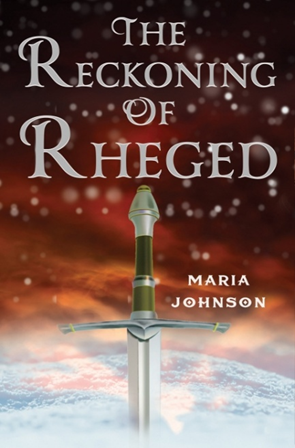
Maria’s newest book, The Reckoning of Rheged, is newly out, so I invited her to talk about her books, set in northern Britain in the early-medieval period.

Hi all, today on this guest blog post (thanks again Marian!) I thought I’d talk about the real history behind the kingdom of Rheged.

The series began in 2018 with my debut novel, The Boy from the Snow.  It’s the story of my main character Daniel, a warrior who must choose who his friends and foes really are when he discovers a truth about his past. The sequel The Veiled Wolf was published in 2019.

The Reckoning of Rheged, the third novel in the series, was just published last week, so I thought it would be an apt time to revisit the historical backdrop.

The Real Rheged – the setting

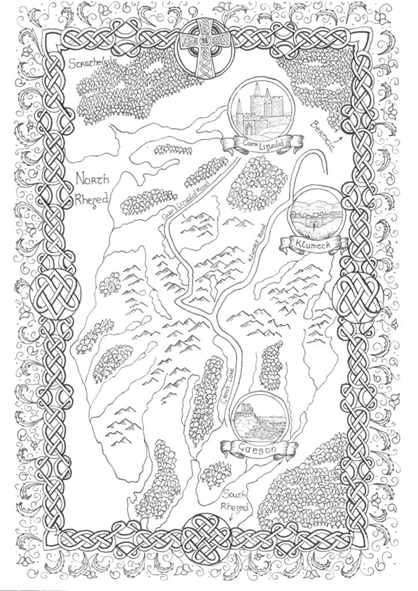
Allow me to share a bit more about the historical world of Rheged. This map of North Rheged was designed by my friend Beth Baguely.

As you’ll see on the map, the Kingdom of Rheged was a real Brittonic Kingdom that spanned much of Cumbria, Lancashire and into Cheshire, stretching as far east as the Pennines. The capital city of the kingdom was Caer Ligualid, based in modern day Carlisle. King Urien, Rheged’s most famous king who ruled over the entire kingdom, really did exist, as did his son Prince Owain.

While the kingdom of North Rheged and its city Caer Ligualid really existed, the smaller kingdoms of Gaeson and Klumeck are purely fictional. I set Gaeson at Gummer’s How, a hill near Lake Windermere at the heart of the Lake District. The kingdom of Klumeck is much further to the east, at the border to the kingdom of Bernicia. I imagine it would be based in the Pennines, perhaps Cross Fell.

The Real Rheged – the History

When writing this history of kings and war and Daniel going on a quest or two, it really can feel like a fantasy, especially with the main characters being fictional. However, I have also really tried to intertwine the fictional story with the historical, from large-scale battles recorded, to small little details like what my characters would have eaten and worn during this time.

One of my most enjoyable aspects of writing historical fiction is to have Daniel meet the real historical figures of Rheged. Another one of the most famous characters Daniel encounters is King Urien’s bard, Taliesin. Taliesin was one of North Rheged’s most famous poets, whose work is still read today. In fact, his writings are a substantial part of Welsh classic/historical literature, as well as recording much of the primary sources that we have for the period.

Not to spoil things too much, but the antagonist in the third novel is also based on a real historical figure who opposed Rheged’s kings. A lot of my research was done online. The early writings of Taliesin, as well as the monk Bede, have been crucial to research. I also have a one or two historical reference books I go back to again and again that cover the era as a whole.

After deciding on the era for the story, it took a lot of research to understand the way people would have lived. Details like what they would have eaten, how they would have dressed and what names people would have had were frequent Google searches, as well as the religious scene/worldview of the time. The worldview of Celtic Rheged is predominantly Christian, due to the Roman influence from when they occupied Britain a couple of centuries before.

The Real Rheged – the worldview

As a Christian myself, being able to have my faith naturally bleed into my writing was another reason for picking the era I did. Although the book is not specifically Christian fiction, Daniel talks openly about his faith and I do pick up on some Christian themes. This is one of the reasons my MC is called Daniel, as well as another few side characters (Sarah, John, Joshua, Rachel, Ruth). I tried to have a few names that were biblical in origin, due to the Roman influence. The vast majority of names, though, are Brittonic Celtic.

Whilst I’m by no means a historical expert on the era, I’m hoping that through telling Daniel’s story – and now Imogen’s – it sheds some light (no pun intended) onto the Dark Ages. Hopefully it will spark imagination of what this world was really like. Ultimately, I hope you enjoy reading about Rheged as much as I have done writing about it.

If you’re interested in checking out my historical fiction, all three of my books are available on Amazon, as either Ebook or paperback. They’re also in KU.

The Boy from the Snow

The Veiled Wolf

The Reckoning of Rheged

Why not sign up to my newsletter? You’ll get a free copy of an Edwardian historical mystery romance The Oak Tree Calls, exclusive to subscribers.

Thanks for having me!

Maria

An Imagined History

The Scots of Dalriada: Fergus Mór by Rowena Kinread

Feargus Mòr Mac Earca may have been a 5th century ruler of Dál Riata, the Gaelic kingdom that encompassed parts of modern-day Scotland and Ireland. While there are doubts about his historical authenticity – think of him as somewhat more historical than Arthur and at about the same level as Ragnar Lodbrok—the kings of Scotland from Kenneth MacAlpin onward claim descent. With few contemporary records to go by—most of what is written about Fergus Mòr is from many generations later—author Rowena Kinread is free to imagine and enlarge his story.

The jealousies and conflicts among the rulers and potential heirs to various 5th century kingdoms are believable, a portrait of the complex and shifting loyalties among the boys of one family, when any one of them could be determined to inherit the kingdom: it went to the most worthy, not the oldest, by the decision of a council. Brother could turn against brother—or stand by his side in support. Nor does Kinread shy away from the violence and brutality of the time, whether in war or in casual violence against both men and women—and from both men and women.

The book’s style is unusual, passages of present-tense, omniscient narration interspersed with scenes that are largely dialogue. (I did wonder if Kinread was attempting to echo the way some English translations of the Ulster cycle are presented, the way Dorothy Dunnett echoed first the sagas and then ecclesiastic writings in King Hereafter, her imagined history of Thorfinn, Earl of Orkney.) Within the narration are some lovely descriptions: ‘the leather bridles…polished until they shine like dogs’ noses.’ While most of the book’s action unfolds in a linear timeline, the first eight chapters do not follow this pattern—pay attention to the chapter headings! 

The Scots of Dalriada: Fergus Mór is published by Vanguard Press, one of the imprints of Pegasus, a hybrid publisher in the UK. Their editorial team has done the author no favours. Typographical errors are too frequent – I counted six within seventeen pages. The use of modern or otherwise anachronistic terms—a pregnant character refers to ‘the first trimester’—jolted me out of the story many times, as did inaccuracies in the setting: ‘vultures circling’. (Ravens, yes. Vultures in the northern UK, no.)  

Kinread’s imagined history of Fergus Mòr’s rise to power and the eventual kingship of Dalriada has a good story at its heart, in places effectively told. A better editor could have made it shine.

Myths in the Making: The Winter Knight by Jes Battis

Myths are mutable things, changing, overlapping, blurring—but persistent. They shape tropes and memes, underlie both the stories we tell ourselves and the stories we are told, and may create, at a level we may only barely understand,  our expectations of the world.

But what if you are a myth?

In a Vancouver where not all places (or inhabitants) belong to the world-as-we-know-it, myths live. Valkyries, Norns, the men and women of Arthurian legend. They are college students, translators, administrators, musicians, living, on the surface, apparently normal 21st century lives. But they have not forgotten who they are, their past lives recalled in snatches of memory and dream and stories told, and their power remains.

A series of grisly murders leads Wayne and Hilde deeper into their family stories, the repeating patterns that have shaped each iteration of their lives. Not every recurring story is the familiar one—Vancouver is not Camelot, but something closer to the castles and forest and lakes of medieval poems like Gawain and the Green Knight, with their potent, obscure symbols, multiple interpretations, and characters largely forgotten in recent retellings. And like those medieval stories, The Winter Knight is both a story of a surface quest, a tangible challenge, and a story we’d now call ‘coming of age’, of internal battles and internal change.

There’s always someone who goes after the beast and tries to tame it. Some knight who thinks they’ll turn it into a trophy. But you can’t. It’s as old as shadows, as old as flickers on the cave wall, as old as graves. You can’t bind that. Only live with it.

Battis creates moods and settings with a light touch, using a few words masterfully – and creates both a contemporary and a timeless sense to the story. Battles are fought with both the tools of the past and the tools of the present, and the two are sometimes melded into one. Ultimately, The Winter Knight is a hopeful story, for all its deep understanding of the difficulties and compromises of accepting the expectations of family, the stories that shape us and the pieces of each we keep and discard. Myths are mutable: perhaps, even when we are the myth, fate is not all.

The Winter Knight is published by ECW Press: https://ecwpress.com/products/the-winter-knight

Planted in Pennies

‘I’ve been thinking about seeing. There are lots of things to see, unwrapped gifts and free surprises. The world is fairly studded and strewn with pennies cast broadside from a generous hand. But—and this is the point—who gets excited by a mere penny? If you follow one arrow, if you crouch motionless on a bank to watch a tremulous ripple thrill on the water and are rewarded by the sight of a muskrat kid paddling from its den, will you count that sight a chip of copper only, and go your rueful way? … if you cultivate a healthy poverty and simplicity, so that finding a penny will literally make your day, then, since the world is in fact planted in pennies, you have with your poverty bought a lifetime of days. It is that simple. What you see is what you get.’

Annie Dillard, Pilgrim at Tinker Creek

I was hoping for warblers. 8 a.m. May 9th, 15C —there should be migrant warblers feeding high up amongst the sun-warmed buds of maple and poplar. But there were none. The wood was quiet: too quiet, for a May morning.

I can give many reasons for the lack of songbirds – some of then depressing, some simply the nature of migration: after a week or more of rain and cold, we now have clear nights and a moon nearly full – and birds moving north as fast as possible. But my head and heart both know there are fewer birds every year.

I mourn this loss, deeply. I have found myself, this year, strangely reluctant to walk the woods and fields, to witness, aurally and visually, the declining number of birds. Late last year, I read Barry Lopez’s last book of essays, Embrace Fearlessly the Burning World. I was thinking of it as I walked the too-quiet paths this morning.

Because the world is still ‘planted in pennies’, and had I not been out this morning, I would have missed so much. A pair of spotted sandpipers, flying low over the water of the maple swamp, as graceful as swallows. The flash of green and copper of a wood duck; a brown creeper, probing for insects under bark. The osprey breaking off branches for its growing nest on a light standard over the soccer field; the crow devouring a frog (fresh road kill? or predated?) up in a dead tree. None of these sights are ‘chips of copper only’, but glints and glimpses to be treasured in the moment and in memory. Embraced, as Lopez says.

Image by brands amon from Pixabay 

There is no life without loss, whether it is the loss of bird species to destructive land use, pesticides, avian flu or climate change, or the loss of those we love to accident, disease, age or simply lives that converge. (This is much on my mind, largely, but not entirely, because it is the major theme of my novel-in-progress.)  But as abundance diminishes, should not the pennies matter more?

There will be warblers, one morning. I still have faith.