This is the creative non-fiction piece I read at the Guelph Spoken Word evening, Grounded, on April 22nd. The theme of the call for submission was ‘exploring our relationship with our landbase’ (in honour of Earth Day).
A roddon, also written as rodham, is the dried raised bed of a watercourse such as a river or tidal-creek, especially in the Fen District of East Anglia in England. (Wikipedia)
Beyond the village, west towards that great bay of the North Sea called The Wash, flat fields of barley and wheat, latticed with ditches, lie on either side of the right-of-way out to the water. Once, this was marsh, and from the satellite images on Google Earth, the patterns of waterflow can still be seen, like a ghost, or a memory, held in the soil. Roddons, they are called, these traceries remembered in the land.
I grew up with stories of this landscape, knowing the names of streets and lanes, buildings and fields: before I could read, or understand a map, they had substance in my imagination, places with a separate reality from the fields and woodlands and streets of southern Ontario. Here my father lived as a child and early teenager; here his mother’s family had lived and worked for generations uncounted. His grandfather, a cabinet-maker, came here from London to work at the manor house, lodged at the pub, fell in love with the publican’s daughter, and stayed. The village I ‘knew’ from the stories, the village I saw in my mind, was the village seen through the eyes of a child in the 1920’s, roaming widely, roaming freely, through the west Norfolk countryside.
One name recurred in the stories: the Drift. A drift, in Norfolk vernacular, is a droveway, a wide green lane, to move sheep on and off the marshes; it was also my father’s access to those same marshes, a paradise for a small boy. I imagine the marsh as mix of rush and sedge and ling, cut with hundreds of channels and small ponds, rich with wildfowl, water vole and waders. Perhaps not, though; perhaps it was grazing marsh, diked and drained, wet meadow. And perhaps it was a mix of the two; I suspect this is the most likely.
My instinct when walking is always to go west, out into the fields, or the remnant fen, towards the Wash. I am drawn to this flat and open land. I watch buzzards hunting, one coming down repeatedly into the uncut hayfield beside me. A kestrel hovers over the same grasses but does not dive. In the distance a cuckoo calls, and the ubiquitous wood pigeons beat across the fields. I access these fields from the Drift, in my father’s footsteps, ninety years later. The Drift runs, for much of its length, between a thick hedge or woodland on the south and a ditch on the north, edged first with houses and then with fields. Before it was a droveway, it may have been the path that led to the salt-making works of the Romans, in the first few centuries of the common era; at the Norman invasion, in the 11th century, it led to the harbour where the village fisherman kept their boats.
Where the Drift ends now at a cross lane, I stop, and look west, thinking of a story. A century ago my great-grandfather built a tiny wooden bungalow, a beach cottage, on the shingle beach at the edge of the sea, beyond the marshes. I do not know exactly where. One summer’s day, my grandfather and two of his wife’s brothers decided to walk from the village to the beach cottage. There were at least three waterways to be crossed: Boathouse Creek, a drain, and the River Ingol, challenges in themselves, but also a vast web of minor channels between them. They made it, wet and muddy, smelling of the marsh, soaked to the waist and the skin, to a thorough scolding from their wives. I’d like to recreate that walk, but it can’t be done: the land is drained now and farmed, and there is no public access except the bridleway.
But while the land has changed, from Iceni to Roman to Saxon to Norman times, and from my father’s childhood to my middle age, two things have not: the sky and the sea. The vast Norfolk skies, the ebb and flow of the tide over the sands of the Wash, and the birds that belong to both: in May, oystercatchers, dunlin, knot and grey plover, feeding at the edge of the sands, moving with the tide, or taking to the skies in huge wheeling flocks, sometimes put up by a peregrine, sometimes by seemingly nothing. In the winter months, the flocks of geese, pink-footed and white-fronted, greylag and brant, coming south from Scandinavia and Russia to feed on the fields and marshes.
A gamekeeper and his black lab begin to walk a field north of me, paralleling the Drift. As I turn and walk east again, we keep pace with each other. When he reaches a small woodland, I hear the shotgun. I can’t determine what he’s after – possibly wood pigeon, more likely crow or magpie. I hear half a dozen shots as I continue east. I watch a family of robins in one clump of birches, and a single female blackcap. The path branches and I cross the road and enter woodland, immediately turning left and back up the hill, crossing at some point into the village common. I follow the track across to Heath Road and onto, and across, another section of common.
Had I chosen to walk up Heath Road, I would have passed the house my great-grandfather had built, the house where my father grew up. From there, it’s a twenty-minute or so walk through the common and across what is now the country park to the manor house itself, a walk (or perhaps a boy’s run) my father did frequently in the years he lived here, sent to the big house with a message for his grandfather. When he and I and my sister came back, he was in his early eighties; he had not made that walk in seventy years, but he unerringly took us across the overgrown common with its branching paths, and onto the estate in exactly the right place, the memory of the landscape lying deep within his mind, in the roddons of memory.
I return here yearly now, like the wintering geese, between the winter solstice and the spring equinox, walking, watching, being. The landscape etching itself into my memory, my senses recognizing the smell and feel and sight of this land, my experience overlaying the stories, blending with them, becoming one, becoming home.
 almost immediately after Enhanced. With Alex, Freya is travelling in Europe, dealing with car-sickness and more: the diversity of supernatural genes she carries result in upheavals she cannot fully control, and her past experiences are adding to the volatility.

 called Remi sees a glowing dome in a pond near her house…a glowing dome that is almost immediately snatched by a hand that rises from the water. Shortly afterwards, strange dreams begin; Remi finds herself writing strings of meaningless numbers…and then parcels begin to arrive, parcels containing items that she is compelled to put together.

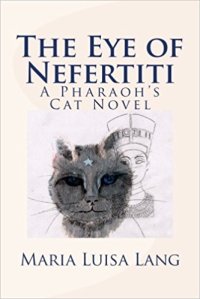 , which I reviewed in November of 2015. Written in the same light-hearted style, the sequel follows the adventures of Wrappa-Hamen, the walking, talking cat Egyptian cat and his family…who just happen to be a High Priest of Amun-Ra transported to modern-day New York City, his 21st century wife Elena the Egyptologist, and their child, who is the reincarnation of Wrappa-Hamen’s beloved Pharaoh.
 marianlthorpe.com
You must be logged in to post a comment.