Of Birding and Writing

May is the month when my two avocations – writing and birding – compete for my time and attention. For most of the year (or at least my Canadian year – our English months had a different rhythm), I write in the mornings, and do everything else in my life in the afternoons. But birds – especially songbirds, migrate primarily at night, dropping down into woodland, hedgerow and grassland to feed in the early mornings. So morning, during migration, is when to be out.

I’ve been birding at some level for over fifty years. I’ve been writing for at least as long. Birding keeps me in touch with the rhythms of the earth, and the non-human lives that we share it with: I may be primarily looking for birds, but I’m also seeing and paying attention to reptiles, amphibians, mammals, insect life – and plants. Honing skills of observation, layering experiences of sight and sound and smell – and even feel and taste – into my day and my memory, often to reappear in my writing.

I’m always birding. If there’s light in the sky, whether outside or near a window, if a bird moves, I look at it. Reflexively. (Not always the best reflex, when you’re having a serious conversation with your boss in the parking lot, but, there it is. They were all remarkably forgiving.) I’m always writing, too. Words move in and out of my conscious mind: description, conversation, mood. Sometimes I even write about birding.

Regardless of my respectable list of birds seen, garnered over seven continents, I’m not a world-class birder, and I never was nor will be. I have no ear for song, a requirement to be really good, and, at sixty-four, my eyesight isn’t what it once was. The details are harder to distinguish now. But I was at my best a solidly good birder. But I didn’t get there overnight. It took a lot of work, birding with people who knew far more than I, studying books, making mistakes, learning from them: hours and hours in the field and analyzing that field work afterwards. A lot of work for a ‘hobby’? But a discipline that overlaps with that of writing. I’m not a world-class writer, either. I’m probably a solidly good one. But I didn’t get there overnight. It took all the same steps, the same discipline, the same willingness and drive to learn, and keep learning.

As I walked the familiar paths of my birding patch this morning, I thought about how these two parts of my life complement each other. Birding taught, and continues to teach, lessons far beyond that of identification: patience, for one. But more subtle ones, too: yesterday I watched a bluebird hunting insects. Except I didn’t have my binoculars, and the position of the sun meant the bluebird was only a silhouette. How did I know it was a bluebird, then? From all the things it showed me: its size and shape, how it flew, how it returned to the same branch over and over – all these things said ‘bluebird’, without me having to be told, by an in-your-face, look-at-me view, that it was a bluebird.

Birding taught me, too, about glimpses, how to construct a whole from pieces. Tapaculos are small birds of the undergrowth of central America. They are, most of them, very hard to see, because they skulk under thickets. But if you see enough pieces of a tapaculo: an eye, a beak, the tail feathers – they add up to a whole bird in your mind. Just like worlds and characters are best built in the mind of the reader from pieces, hints, brief views.  

I could keep drawing parallels; I won’t. But this morning, as I left the coffee shop downtown where I’d had breakfast, still early, and stepped into St George’s Square, a raven flew low over the space, calling. Unexpected, delightful, (and perhaps portentous for some). I’m still thinking about it.  A plot twist, if you like.
The Landscape of a Dream

I love road trips, and over the years Brian and I have driven thousands upon thousands of kilometers across all North America and Great Britain, much of Australia and most of New Zealand, plus bits of more other countries than I can count. But I never stopped wanting to do one on my own.

I like my own company, and I like, perhaps need, space and silence to think. So when, in the summer of 2013, Brian went birding in Papua New Guinea – a place I had no interest in, having had enough of hills and humidity – I left the cats in the care of their usual sitter and drove west, out to the silence and space of the Great Plains and the Canadian prairies. A two week trip.

I’d originally planned to follow Highway 2, a non-interstate that runs not too far under the Canada/US border, but I soon learned it didn’t suit my needs: too many trucks, too few safe opportunities to pull of to look at birds. So I took myself up to the parallel county roads, where there was almost no traffic, and many opportunities to stop.

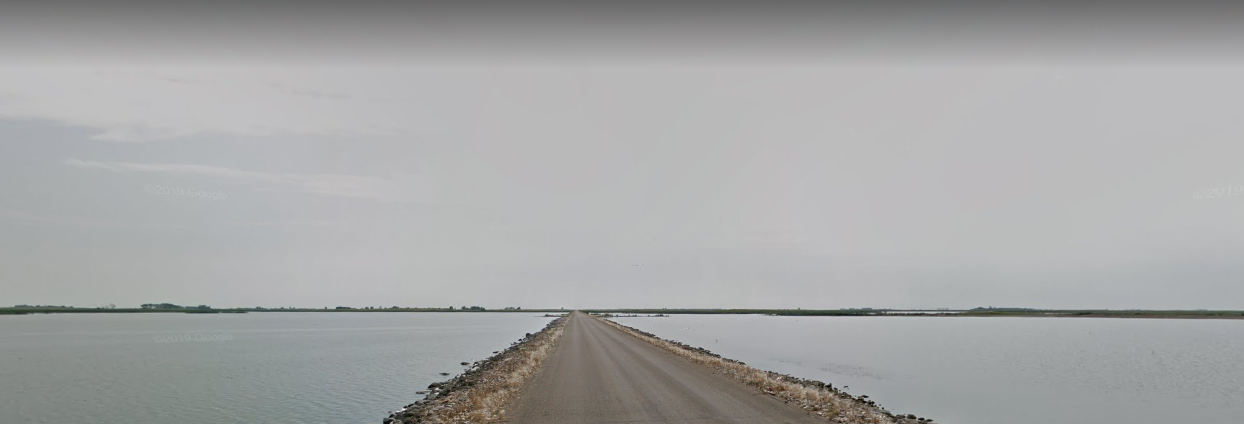
I’ve written before of the recurring dreams I’ve had since childhood: dreams of roads and paths, in cities but more often out of them. Some of these dreams involve water, paths crossing wetlands on causeways. They stay in my mind, holding their own authenticity overlaid on the real world. And on a county road in North Dakota, just west of the tiny hamlet of Whitman, I drove into one of those dreams. The road became a causeway, crossing a lake filled with birds. I pulled over, stopped, got out. Wonder coursed through me. I know I laughed aloud in recognition and delight.

Black terns hunted insects over the water; ducks of a half-dozen species swam and dabbled. I stayed maybe half an hour, the occasional pickup truck passing, but nothing else to interrupt, interfere. I got out the scope, looked at the birds, but it was almost an excuse to linger.

What has this got to do with my books? Just two lines. In Empire’s Exile, not too long after Lena and Cillian reach Casil, she asks:

“What did you think? It must be strange, to see these buildings you have read about.”
“Like finding the landscape of a dream is real,” he answered.

The Medium and The Message

Moby-Dick was the first assigned book I never finished. It was part of our American Literature focus in my last year of high school, back in the day when Canadian high schools were still ignoring Canadian literature. I was, and am, a voracious reader. But I just couldn’t read Moby-Dick. The prose was dense, meandering, sometimes unclear. And yet I kept thinking about it.

Fast-forward about thirty years, and a long-haul flight to New Zealand. Seventeen hours plus. I’d started listening to a lot of books: family circumstances meant I was driving eight hours every second or third weekend, and my job also entailed a lot of driving. Audiobooks helped pass the time. So, I decided to listen to Moby-Dick on that trip to New Zealand and Australia.

And fell in love with a magnificent book, a symphony of language and philosophy, of style and story. Whether it was my tendency to skim-read, or a symptom of my ADHD, or just maturity, I don’t know – but this book I couldn’t read is now one of my favourites: one I needed to hear to appreciate it.

Since then, I have learned that I appreciate almost all 18th and 19th century writers better when I listen rather than read. I wonder sometimes if it was that these books were expected to be read aloud, an on-going evening’s entertainment, or if a slower pace of life (for the privileged few, anyhow) meant reading was perhaps more leisurely. Regardless, when I want George Eliot or Tolstoy or Cervantes, I reach for my phone and earbuds, not a physical book.

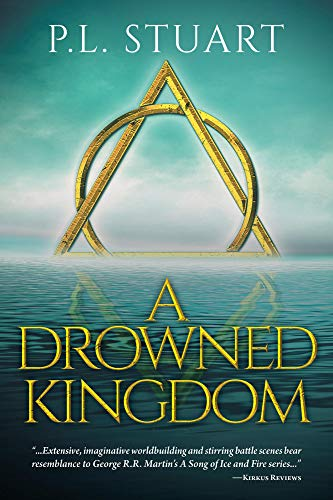
Which brings me to the actual subject of this ramble: a reconsideration of a recent review. A book I had difficulty reading: P.L. Stuart’s A Drowned Kingdom. It has, actually, a few things in common with Moby-Dick: a dislikable central character driven by hubris, and long expositions on the reasons for actions, to name a couple.  I read it, wrote a neutral and unstarred review (some of you reading this will know I rarely star reviews, for reasons given here), and moved on. And yet I kept thinking about it.

Then one day I was listening to Thomas Hardy’s Return of the Native, which is slow, and definitely not cheery (well, it’s Hardy, what do I expect?) and something clicked. I should listen to A Drowned Kingdom (which coincidentally had just come out in audiobook format.) So I did.

And, as with Moby-Dick, I liked it a whole lot more. Listening doesn’t change the arrogant hubris of the MC, Othrun, but that was never an issue for me. I still believe Stuart is brave, both for creating a dislikable main character and for writing in a style somewhat at odds with much modern fantasy writing. But the lack of enjoyment in my first reading of the book wasn’t due to a fault in the writing, but my own limitations in interacting with the prose.

Story is at the heart of what we as writers do, and stories can be told – and absorbed – in many ways: through poetry, through prose, through oral storytelling, through plays, through visual media. Sometimes, as the audience, we need to find the form that is right for us. I’m glad I could for A Drowned Kingdom.

And yes, I’ll be revising the review.

Hag of the Hills, by J.T.T. Ryder: A Review

Complex and detailed. Hag of the Hills is a hero’s journey with a difference. In the second century BCE, Brennus of Skye is a warrior’s son who isn’t allowed to be a warrior, until invasion changes that fate. But his journey to heroic status spirals around the geology and mythology of his island. His forward momentum is inexorable, driven by the words of a local deity and his own conviction that he must honour both his oaths and the visions granted to him – but with many mistakes, fears, denials and reversals.

Hag of the Hills is not a conventional Celtic-based fantasy book. I’d hesitate to call it fantasy, rather than a form of magic realism. The Sidhe are a real part of Brennus’s world, whether is it is the Cailleach or giants or the shape-shifter who speaks in words later attributed to the bard Taliesin. But they are not earthly beings, as often in fantasy, but remain other-worldly, real but inhabiting a different realm to which Brennus is given occasional access.  

Ethnobotanist Wade Davis has written:

 “The world can only appear monochromatic to those who persist in interpreting what they experience through the lens of a single cultural paradigm, their own. For those with the eyes to see and the heart to feel, it remains a rich and complex topography of the spirit.” 

The Wayfinders: Why Ancient Wisdom Matters in The Modern World

And this is what J.T.T. Ryder, an archaeologist specializing in Iron Age northern European cultures, has attempted to show us: that rich and complex topography experienced through a different cultural paradigm. Is it successful?  In my opinion, yes, for the most part.

Brennus’s world is one in which Cuchulainn walks in memory and stories are told of war-elephants crossing the Alps; where men leave Skye to fight in Thrace, where the stone tools found in caves are left by the Sidhe and the bronze sword in a barrow belongs to an ancestor: a world both intensely rooted in its geography and conscious of a wider world beyond, known through trade and commerce in soldiers and slaves. This duality is echoed in others: as well as the Sidhe and the everyday world, there are few shades of grey in Brennus’s world: he is either an oath-keeper or an oath-breaker, a free man or a slave, a warrior or a coward.

Whether purposely or not, this sense of duality is echoed in Ryder’s prose, which frequently changes tenses within a paragraph, creating for this reader a feeling of dislocation. Jarring at first, as the novel progressed I found it added to the veracity of Brennus’s experiences. Unconventional to 21st century prose, perhaps, but echoing the blending of past and present that Brennus’s cultural paradigms encompass. Time is a construct not experienced by all cultures in the same way.

(What was less effective for me was the use of modern words and terms, which took me out of the immersive and different world I was experiencing and returned me to ours. ‘Fetal position’ is one example.)

We are used to epic hero’s journeys, from Odysseus onward. Brennus’s is not epic; it is extremely local, both in geography and psychologically. Much of what he works towards may make readers uncomfortable: honour, revenge, a glorious death – and while there is near-constant action, the real journey is in Brennus’s mind – not a comfortable or familiar place to be, but one I found worth experiencing.

The First Casualty

Image by Darkmoon_Art from Pixabay 

“History is lies agreed upon.” A sentiment attributed to both Voltaire and Napoleon Bonaparte, but likely first used by Bernard Le Bovier de Fontenelle in 1724. As I wrote Empress & Soldier, the 7th book in my fictional early-medieval world, this idea is never far from my mind. But not for the big events of the world, but for my characters’ personal histories, and the small events that shape their lives.

History is a matter of interpretation and memory. Oh, we know Bonaparte lost the Battle of Waterloo, but if you asked a dozen people who fought in that battle, they’d all have different memories. Not only would those memories conflict, they’d change over time. Even what we remember immediately after an event isn’t necessarily what actually happened, and memory is malleable, easily reshaped.

Some of what happens in Empress & Soldier has been told before, in Empire’s Exile, although from different points of view, and some of character Druisius’s past history has been told in bits and pieces in all the books after Exile. There are discrepancies. They are, largely, purposeful on my, the author’s, part. Are the characters also purposely misleading? (Bear with me. I know I create these characters, and their thoughts. I will explain.)

Often, yes. My characters lie for all the reasons humans do: to protect another from hurt; to protect themselves from judgement, to hide their wrongdoing, or the actions of someone they care about, to avoid an argument. They lie for diplomatic purposes, for reasons of state security; they lie from love and fear and by the order of their superiors. Their lies are both of omission and commission, things left unsaid, things said.

In the latest-published book of my series, Empire’s Heir, my four main characters have been together for twenty years, give or take, as lovers, friends, parents. That’s a lot of shared history, and a lot of stories told. But in Empress & Soldier, which takes place in the decade before that foursome becomes a foursome, the history that unfolded for Druisius didn’t quite match his later stories.

I could, of course, have changed the unfolding story to match, or simply blamed it on faulty memories.  But that would have been far too neat, too fictional, really. Life’s not like that. And then I began to think about the other stories told, and how they reflected a truth, but perhaps not all the truth.

The challenge is to find plausible reasons for the discrepancies in the stories, true to my characters but perhaps also revealing (or at least hinting at) things about them we didn’t know. Why would they have lied, whether directly or by never mentioning something? What purpose did it serve at the time – and will it come back to haunt them?

In the next and last book, Empire’s Passing, when my foursome has had nearly thirty years together, events will lead to questions. What do we know about the people we love? How do we react when we learn they withheld things from us for all that time? Do we know them, or only the person they have let us see?  I’m setting up a lot of those withheld things now, in the current work.

It’s not a new theme for me: the idea of the mutability of history, both political and personal, is entwined in the stories, as well as the things left untold.

That the complex bonds among my parents and Druise and Sorley needed both deep trust and deeper love, I had understood. But I hadn’t thought then about the ways their lives were also delineated… Spaces in what they spoke of, too, even behind closed doors.

A price to be paid, for the love and the vision they shared.

Empire’s Heir

Truth is the first casualty of war, it is said. Is it also a casualty of love?