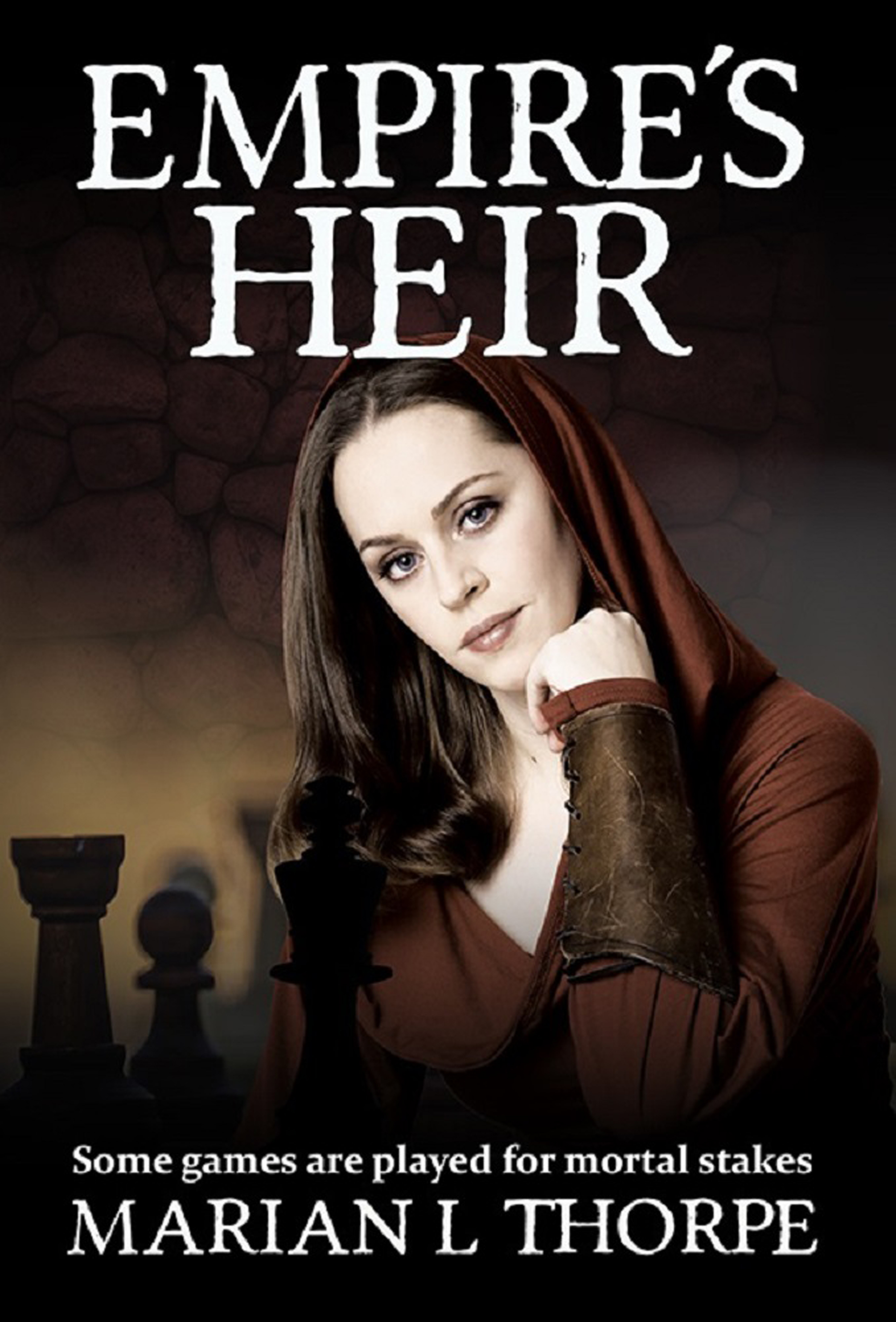
Not content with two careers as a research scientist and an educator, Marian L Thorpe decided to go back to what she’d always wanted to do and be a writer. Author of the alternative world medieval series Empire’s Legacy, Marian also has published short stories and poetry. Her life-long interest in Roman and post-Roman European history informs her novels, while her avocations of landscape archaeology and birding provide background to her settings. As well as writing and editing professionally, Marian oversees Arboretum Press, a small publishing imprint run as a collective. Marian is currently writing Empire's Heir, the sixth title in the Empire's Legacy series.
In The Place Below, Dan Fitzgerald brings his Maer Cycle to a satisfying conclusion. A generation after the first two books of the series, Sasha, daughter of human and Maer, is now an adult. Empathic, sensitive to touch, her natural skill with languages and communication enhanced as needed by magic, Sasha is searching out the tombs of the Ka-lar, the ‘forever kings’ laid to rest in a form of stasis hundreds of years earlier. Then one day, her empathetic connection to the minds of the dead encounters an awakened, living Ka-lar among a branch of the Maer who themselves are legendary: the underground-dwelling Skin Maer.
The book alternates between the viewpoints of Sasha and Kuun, the awakened Ka-lar, and they serve as counterbalances to each other: Kuun, who at first presents as confident and powerful, slowly reveals motives and doubts; Sasha, who presents as unsure and solitary by nature, grows into her own competence and agency. Familiar characters—Sinnie, Finn, Tcheen—are reintroduced, but as characters to support Sasha in her quest, not to direct and overshadow her.
Kuun, the scholar-scientist Forever King, choosing stasis in the face of unfinished research in a time of plague, is a nuanced and ambiguous character, his motives slowly revealed over the course of his narrative. Again, Fitzgerald’s themes of communication and understanding play into the development of his character and his actions.
Like Fitzgerald’s first two books, this is fantasy with few battles and heroics of a martial sort, but with questions asked and answered about the power of language; about acceptance of differences that are superficial; about what we might sacrifice for the good of the whole. Commonalities that connect, not contrasts that divide. Sasha, neither human nor Maer, embodies both the possibility and the questions that arise about differences between Maer and human, a question that will be, finally, answered through Kuun’s determination. Recommended (as is the whole series) for readers wanting character-centred fantasy that makes them think.
Find The Maer Cycle, including an omnibus edition with bonus features here.
Dan Fitzgerald is the fantasy author of the Maer Cycle trilogy (character-driven low-magic fantasy) and the upcoming Weirdwater Confluence duology (sword-free fantasy with unusual love stories). The Living Waters comes out October 15, 2021 and The Isle of a Thousand Worlds arrives January 15, 2022, both from Shadow Spark Publishing.
He lives in Washington, DC with his wife, twin boys, and two cats. When not writing he might be found doing yoga, gardening, cooking, or listening to French music.
He can be found on Twitter or Instagram as danfitzwrites, or on his website, www.danfitzwrites.com
If you don’t know this marvellous book, here’s my review from its release day in 2019.
Set against Iceland’s harsh but beautiful landscape in the late 19th and early 20th century, Bjørn Larssen’s debut novel Storytellers explores the multi-generational effect of the evasions, embellishments and outright lies told in a small village. The book begins slowly, almost lyrically, pulling the reader into what seems like situation borrowed from folktale: a reclusive blacksmith, Gunnar, rescues an injured stranger, Sigurd. In exchange for his care, Sigurd offers Gunnar a lot of money, and a story.
But as Sigurd’s story progresses, and the book moves between the past and the present, darker elements begin to appear. Gunnar’s reclusiveness hides his own secrets, and the unresolved stories of his past. As other characters are introduced and their lives interweave, it becomes clear that at the heart of this small village there are things untold, things left out of the stories, purposely re-imagined. Both individual and collective histories – and memories – cannot be trusted.
The book was reminiscent of Kazuo Ishiguro’s The Buried Giant, in both theme and mood. Both books deal with the unreliability of memory; both are largely melancholy books. And perhaps there is allegory in them both, too. Storytellers is a book to be read when there is time for contemplation, maybe of an evening with a glass of wine. It isn’t always the easiest read, but it’s not a book I’m going to forget easily, either.
“Lord Sorley,” he said, coming over to me. The puppy squirmed in his grasp.
“What is that?” I asked. Shugo was one of the shepherds, and his sheepdogs were the best around. We bought young dogs from him, rather than breed our own. But the puppy he was holding was no sheepdog, although its black and white colouring suggested one of its parents was.
He spat. “Hagen came through with his hound just when Meg was in heat,” he grumbled. “This is the result. I drowned the others at birth — what good would they be? Left her this one to raise so the bitch wouldn’t pine, but I need her back with the sheep. So it’s drowning for this one, too.”
“How old is he?” I could see from how he held the pup it was male.
“Six weeks.”
“Don’t drown it,” I said. “I’ll buy it from you.”
“Buy it? What do you want it for?”
“The Comiádh’s son is ten. Just the right age for a puppy. Will you send it? I’ll write a note, if you’ll wait a few minutes.”
“Aye,” he said. “It’ll make a boy’s dog, I warrant.”
One of the advantages of writing what I write – historical fiction of another world – is that I don’t have to stay true to historical fact. I do, a lot, but in the case of Colm’s puppy (and other dogs in the books), I may not have.
This isn’t to say that herding dogs and hunting dogs were unknown in the classical and early-medieval world. They were. Dogs have likely accompanied people and their herds since long before recorded history; once domesticated and relating to people as part of their pack, dogs’ protective instincts would easily extend to the animals associated with their people. Archeological excavation of sites dated to the middle of the 3rd millennium BCE has found the remains of sheep and dogs together. But the physical separation of hunting dogs and herding dogs by breed is thought by some researchers to have occurred much later – so Colm’s dog Peritas, which I envision as a cross between a border collie and a deerhound – appears anachronistic.
2nd century BC mosaic from Alexandria, Egypt of a dog and a pitcher. Public Domian, via Wikimedia Commons
Or does it? About 200 CE, Oppian of Apamea, a Greek poet, wrote a poem on hunting, in which he observes that, for the hunter, the black and white dogs of the farmer and shepherd (the mosaic above may show one of these) are not desirable. These may have been more guardian dogs than herding dogs – a couple of centuries earlier, Marcus Varro, in his De Re Rusticae, wrote:
As there are, then, two sorts of dogs — the hunting-dog suited to chase the beasts of the forest, and the other which is procured as a watch-dog and is of importance to the shepherd…
In the 2nd C Roman relief of a herdsman and his dog (above), there are no features that point to this dog as a ‘black and white herding dog’ as we know them in later centuries (and as I picture the herding dogs of Linrathe) – but no evidence it isn’t, either.
Mosaic of Dog Chasing a Rabbit, Roman, Homs, Syria, 450-462 AD, Chazen Museum of Art Daderot, CC0, via Wikimedia Commons
Hunting dogs – of the sort, perhaps, that has fathered Colm’s puppy, were praised and prized, and some of the best reputed to come from Britain. Oppian, again:
There is a strong breed of hunting dog…the wild tribes of Britons…call by the name of Agassian…. It is by virtue of its nose, however, that the Agassian is most exalted, and for tracking it is the best there is; for it is very adept at discovering the tracks of things that walk upon the ground, and skilled too at marking the airborne scent.
Later in Empire’s Reckoning, the protagonist Sorley, after a long journey south in the role of an itinerant sheep-shearer, sends the sheepdog that has accompanied him home, a long journey on its own. I took this idea from The Drove Roads of Scotland, the author commenting on this practice among the drovers of the 17th and 18th centuries. But it goes back much further than that: Varro, again:
Publius Aufidius Pontianus, of Amiternum, had bought some herds of sheep in furthest Umbria, the purchase including the dogs but not the shepherds, but providing that the shepherds should take them to the pastures of Metapontum and to market at Heraclea. When the men who had taken them there had returned home, the dogs, without direction… returned to the shepherds in Umbria a few days later, though it was a journey of many days.
This is a distance of some 300 miles, about the same distance that Haldane suggested the sheepdogs of Scotland, 1700 years later, travelled alone on their return home.
Maybe Colm’s Peritas isn’t completely anachronistic, nor is the black-and-white sheepdog Sorley sends home. In my fictional but familiar world, all that really matters is that the reader can believe in these dogs and their journeys.
Haldane, A.R. B. 1960. The Drove Roads of Scotland (2008 edition, Birlinn).
Featured Image: A child holding a dog, detail of the 6th century mosaic floor from the Palatium Magnum (Constantinople’s Great Palace), Palace Mosaic Museum, Istanbul . Carole Raddato from FRANKFURT, Germany, CC BY-SA 2.0 https://creativecommons.org/licenses/by-sa/2.0, via Wikimedia Commons
I’m pleased to be participating in theStorytellers on Tour blog tour (Aug 29th – Sept 4th) for Jonathan Nevair’s second novel in his Wind Tide series, Jati’s Wager.
A space opera heist brimming with action, twists, and turns that doubles as a story of personal growth, mentorship, and sacrifice.
Ailo is a streetwise teen surviving alone on the remote moonbase, Tarkassi 9. She wants nothing more than to flee into the wider world of the Arm. When her chance arrives, she makes it no farther than the first ship out of the system. That’s where Jati, the Patent War veteran and general fighting the Monopolies, gives her a second chance. It’s an unlikely partnership, but Ailo’s rogue status is just what Jati’s People’s Army needs to drive the final spike of victory into a weakening Garissian Council.
A team of experts assembles and hope rests on Ailo’s skill, stealth, and tenacity to pull off the impossible. It’s a wild gambit, and a moral code may need to be bent, or broken, to achieve success. When an internal shadow rises, casting doubt on their plans, Ailo and Jati are forced to weigh the cost of revenge against honor and justice.
My Review
Your own survival is paramount when you’re a street kid. You learn to be fast, to be silent, to move in and out of the shadows; to trust your instincts; to rely on your own judgement. You develop coping mechanisms, too; mental ones, to give you support, advice; a friend you can rely on. But all your experience and all your wiles aren’t foolproof.
When stowing away on a ship leaving the moonbase she’d grown up on doesn’t go the way Ailo had hoped, she becomes part of a crew under the legendary Jati, general, Legionary, idealist. Ailo has to learn to trust more than the part of her mind she calls Gerib, her ‘imaginary friend’ who guides and counsels her, and to see herself not only as an individual but as part of a team with a larger purpose. As the links between her hidden past and the cause Jati is fighting for are revealed, skills that have lain latent in Ailo’s mind: skills of tactics and strategy, of language, and the fusing of the two that make for skilled diplomacy, begin to emerge. But those are not the only reason Ailo is valuable to Jati. Is she the last piece in the puzzle that will bring them victory against the Garassian council?
Fast paced and complex, Jati’s Wager is a book that needs your full attention. Packed with action, the story moves forward rapidly, but the action invites deeper moral questions, not just for Ailo, but for the reader. There is a war to be won, but can it be done in a way that leaves the long history of violence, of conflict and retribution, behind? What is the moral path for a warrior? – not a soldier, someone who follows orders, but a warrior, making mindful, conscious choices, aware of the myriad consequences. Is vengeance – or sacrifice – ever appropriate? The questions of personal survival versus the collective good; the role and meaning and restrictions of history, and the power of language are woven throughout the story, reinforced in many ways, large and small, creating layers of meaning and contemplation in both the reader and Ailo.
Jati’s Wager is the second book in Jonathan Nevair’s Wind Tide series, but it can be read as a standalone. Links to his first book, Goodbye to the Sun, are present and important, but sufficiently explained that the reader does not need to have read it (although I strongly suggest you do!) In the background, not only do the myths of the Trojan War have a presence, but the author has quietly included references to classic science-fiction, ideas from Carl Sagan, and – in a sentence that made me bark with laughter – a nod to Apocalypse Now.
Highly recommended, both for lovers of space opera, and readers that like books that make them think.
Prize: A print copy of Jati’s Wager by Jonathan Nevair – US/UK Only
Starts: August 29th, 2021 at 12:00am EST
Ends: September 5st, 2021 at 11:59pm EST
Book Information
Jati’s Wager (Wind Tide (#2)) by Jonathan Nevair,
Published: August 18, 2021 by Shadow Spark Publishing
Genre:Science Fiction, Space Opera, LGBTQ+
Pages: 425
CW: death of parent (mentioned), death of mentor, verbal abuse, graphic violence and death, blood, homelessness, trauma, guilt, kidnapping (mentioned)
POSSIBLE ULTIMATE TOUR EXPERIENCE TICKETS: Let’s Get The Party Started, Represent, Lost In Space, Snark It Up, The More The Merrier, The Wings Of Change
Jonathan Nevair is a science fiction writer and, as Dr. Jonathan Wallis, an art historian and Professor of Art History at Moore College of Art & Design, Philadelphia. After two decades of academic teaching and publishing, he finally got up the nerve to write fiction. Jonathan grew up on Long Island, NY but now resides in southeast Pennsylvania with his wife and rambunctious mountain feist, Cricket.
The cat just loudly deposited a hairball on the rug. Her retching woke me.
The dishwasher needs emptying; the birdbath filling.
My day planner tells me I have a guest post due today, reading to do for a book review, and various tasks related to my volunteer job as editor of our community newsletter, as well as feedback notes to write for a first-time author I’m mentoring.
In other words, the world hasn’t stopped because I have a new book out, and, you know, that’s ok.
Brian and I will go out for ice cream at our favourite place by the river a little later today, to celebrate. (Normally, we go out for a meal, but as it’s also our 40th wedding anniversary this week, we’ll do that on Friday.) Friends are sending congratulations. I am suffused with the sense of accomplishment and pleased with the book’s reception so far. It’s the sixth book in a series; there will be a small spike in sales this week, and then it will trail off, to be purchased as people work their way through the first five. Six years and six books into the life of an indie author, I know it’s a long game.
Next week I’m taking a holiday, travelling a couple of hours north to Lake Huron and Georgian Bay, for a few days walking and birding, leisurely brunches on outdoor patios, some pleasure reading, and whatever else catches my fancy. After this short break. Heir will take up some of my time – guest blogs, interviews, a blog tour, perhaps some readings, but it’s out in the world, no longer mine alone but belonging too to its readers, to make what they will of it. Both the next two books – Empress & Soldier and Empire’s Passing – are nudging me: work needs to start in earnest there.
As it will. Alongside dishwashers to empty, and meals to cook, and community work…and hairballs.
Historical Fiction authors have all experienced it…blissfully writing away, unaware that we have just committed an anachronism. And chances are, we won’t even know until a reviewer calls it to the world’s attention—months, or even years later. Oh no!
I hate to admit it, but outside of my knowledge of historical events, I don’t know everything about everything historical. Trust me: it’s a tall order (according to the OED, earliest use of this phrase was 1893). Not every animal or plant was native to England (or America!). Sometimes they were introduced later than the period we are writing about. One time a reader penalized me for having Canute the Dane eat a rabbit because he said they were brought over with the Normans. D’oh! I looked it up and discovered a Roman recipe (in England) for rabbit, so they must have brought over the little buggers. That doesn’t excuse me, unfortunately. It never occurred to me to look up the origin of rabbits in England.
One little slip like giving King Alfred a tomato can wreak havoc with an author’s credibility. Potatoes are another bone of contention, as are turkeys, sugar, and chocolate, to name a few. Such foods may have existed but may not have made their way to England until late in the period. Not everyone agrees on the timing.
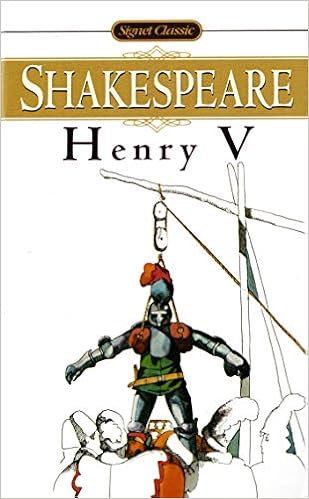
So where is the fine line between innocent errors and unforgiveable lapses? Laurence Olivier had Henry V in armor hoisted onto his horse with a crane-like contraption. He was warned against this inaccuracy by his historical advisor but preferred the dramatic effect. This gaffe is imprinted on our cultural memory!
Henry V (Signet Classics) (c) 1998
What about language? Idioms are another trap for the unwary. When I am writing, I run etymonline.com in the background, as well as phrases.org.uk. There are certain words and phrases that wouldn’t have been used in the early days. You can’t explode before the use of gunpowder. Can you really be nervous before the discovery of nerves? Of course, etymology is only a guide; the first known use of a word would be in writing. But I doubt if it would be in general use verbally for more than a century or two previously. So if a word was first discovered in 1650, for example, I would hesitate to use it in 1400. The trick is being cognizant of an anachronistic word in the first place.
Bottom line? The writer is going to make mistakes. We can’t forgive ourselves, but maybe our readers will cut us some slack (first use mid-1900s).
Mercedes Rochelle is a historical fiction author. Her latest release is The Usurper King; find all her books here.
The Unseen, as well as being a police procedural set in 10th century Baghdad, is also an investigation of the balance men and women must find between their existence in the physical world and their desire for human connection and love, and the call of the immanent god to a greater purpose, the subsumation of the life of the flesh in the life of the spirit. That Laury Silvers manages to balance the temporal story of her characters with their spiritual journeys in both a setting and faith unfamiliar to many readers (including me) speaks to her skill as a writer.
The title, as always with Laury Silvers’ books, has multiple meanings within the text, but one ‘unseen’ is the Twelfth Imam. Hidden from view; his very existence is a point of debate and division among the Shia of Baghdad. With tensions already high, when a man is killed in a way that parallels the death of a martyr two hundred years earlier, the city is ready to explode into violence. Grave Crimes investigators Ammar and Tein must find the man responsible before the caliph’s troops enforce peace. But Tein’s sister Zaytuna has a prophetic dream that points to the killer – or does it? And will Ammar and Tein listen?
As in her earlier books, The Lover and The Jealous, 10thcentury Baghdad is evoked through the senses of the characters. We see the world through their eyes, smell what they smell, taste what they taste. We know, their inner doubts and turmoil as the events of their lives, personal and public, conflict with their values.
Parallels with today’s politics abound. Difference of opinion over who should lead them causes rifts among the Shia, providing opportunity for other to infiltrate and to feed those fires. Senior police officers are all too ready to provide a scapegoat for the crime. But alongside these conflicts, Zaytuna and Tein, and Ammar too, all have a chance to find a path to a modicum of contentment in their lives, although none easily.
By this third book, readers know the main characters well, and I found myself strongly invested in their personal stories, but also intrigued by the solving of the crime. Highly recommended for readers who want a book that asks a lot, emotionally and morally, of its characters, and does not pretend there are easy solutions.
Laury Silvers is a North American Muslim, raised in the United States but finally at home in Canada. Her research and publications as a historian of religion focused on early Islam, early Sufism, and early pious and Sufi women. She taught at Skidmore College and the University of Toronto. Silvers also published work engaging Islam and Gender in North America in academic journals and popular venues, was actively involved in the woman-led prayer movement, and co-founded the Toronto Unity Mosque. She has since retired from academia and activism and hopes her novels continue her scholarship and activism in their own way. She lives in Toronto.
With Empire’s Heir coming out in just over a week, my mind has inevitably moved on to the next book. While still set in my fictional work, and with familiar characters, Empress & Soldier will be something a little different.
As the title suggests, it focuses on two characters: the Empress Eudekia, and the soldier Druisius. In my third book, Empire’s Exile, we are introduced to both characters in the last half of the story. Empress & Soldier will overlap with those chapters from Exile, although it will begin much earlier in the lives of both Eudekia and Druisius.
Empress & Soldier will – or can – serve as a second entry point into my world, so it creates some structural and conceptual challenges. In the overlapping part of the story, I will be writing scenes from either Eudekia or Druisius’s point of view. Sometimes these are scenes that are in Exile; sometimes they are scenes that happened ‘off page’ in that book, and are only referred to.
I can’t skimp on this by assuming the reader has read Exile. Nor should I just reverse the POV. What happens – what either Druisius or Eudekia think, want, act on – is what matters. And that may be the opposite of what the main or supporting characters in Exile think, want, or act on. In fact, I already know it is, in some cases. A friend who has read some of the early draft scenes said, “I thought I knew Druisius. I was wrong.”
I’ve created a planning document, with the entire section from Exile on half the page, and blank space on the other. Now I’ll start going through each scene, thinking about the purpose of a parallel or supporting scene from the viewpoints of my two new main characters – but still conveying the important parts of the arcs of the other characters, those whose actions and reactions we saw in Exile.
I expect to spend a good chunk of time on this. Planning now will save a lot of energy and words later. I also intend to write this last section of Empress & Soldier first, because what happens here tells me what I need to show in the character development as Eudekia and Druisius grow up in much different ways in Casil, my Rome-analogue city. The plot, which will include some antagonists familiar to readers of my other books, has a framework, with details to be worked out which also depend on these last chapters.
There’s also an enormous amount of research to be done, and another advantage of writing these last chapters first is that I can juggle writing and research, because this section will require the least – I did most of what’s needed when I was writing Exile.
My last challenge – or I should say the last challenge I know about now! – is how Druisius wants to tell his story. Unlike my previous protagonists, for whom the written word either is or becomes their preferred mode of expression in journals or histories, song or poetry, Druisius is an oral storyteller with a distinctive voice – and a desire to tell his story in present tense.
“Druisius!” My captain’s voice. What does he want? I am off duty. Friends are waiting to dice. I turn.
“I’m reassigning you. A ship arrived this afternoon from the west. One of the passengers might be a queen, or something. They’ve asked for an audience with the Empress. The harbourmaster says they look like barbarians to him, but,” he shrugs, “they’ve been assigned a house, and guards, and you’re one of them.”
“Why me? And who’s the other?”
He snorts. “As if we don’t all know how bored you are.” He drops his voice. “Anyhow, it was the Magistere Quintus who suggested you. You know what that means.”
Can I/he maintain this? I don’t know yet. (Nor do I know Eudekia’s voice at all, right now.) But this is a new adventure, in more ways than one!
OUT NOW Kidnapped in 7th century England and sold as a slave to a powerful mayor in France, Bathilde needs to adapt to survive. When the mayor’s beloved wife passes away, he looks to Bathilde for comfort. Fleeing his attentions, she is forced to live on the streets until she catches the king’s eye and everything changes.
How did a slave navigate the treacherous Merovingian courts and rise to rule an empire? And why have so few people heard of her? https://amzn.to/2VPPUIE
Paperback OUT NOW; e-book AUGUST 18: In the beginning there was confusion.
Ever woken up being a God, but not knowing how to God properly? Your brothers keep creating mosquitoes and celery and other, more threatening weapons. What can your ultimate answer be – the one that will make you THE All-Father and them, at best, the All-Those-Uncles-We-All-Have-But-Don’t-Talk-About? “FML! The answer’s why I drink!” – Odin
OUT NOW: GRACE ON THE HORIZON is the second full-length novel in The White Sails Series. Grace and Seamus, united by their past experiences, are adrift on a raft of shame in the sea of 1830s London society. After a personal tragedy, Grace’s desperation to leave London forces Seamus to accept a dubious commission on the private explorer, Clover. GRACE ON THE HORIZON promises another adventure on the high seas, bursting with action and suspense. https://amzn.to/2Ulhopg
AUGUST 18: A space opera heist brimming with action, twists, and turns that doubles as a story of personal growth, mentorship, and sacrifice.
Ailo is a streetwise teen surviving alone on the remote moonbase, Tarkassi 9. She wants nothing more than to flee into the wider world of the Arm. When her chance arrives, she makes it no farther than the first ship out of the system. That’s where Jati, the Patent War veteran and general fighting the Monopolies gives her a second chance. https://amzn.to/3iIftUW
AUGUST 25 When a young man is found dead, killed in the exact manner as a martyr slain on the fields of Karbala some two hundred years before, there is no mistaking it as anything other than an attack on the Shia community of Baghdad. The city is on edge as religious and political factions are exposed sending the caliph’s army into the streets. Ammar and Tein have to clear the case, one way or another, before violence erupts. But Zaytuna has had a visionary dream of the murder that holds the key to solving the case. Can she can read its signs? And will Tein and Ammar listen? https://www.llsilvers.com/purchase
Colm pointed to the gulls hanging in the sky. “Birds fly. Why can’t someone make wings so people can?”
“You know the tale of Vikar, whose father built wings of wax and feathers.”
“That’s a story,” Colm said, a little impatiently. “About setting our ambitions neither too high nor too low. I mean really fly.”
Empire’s Heir
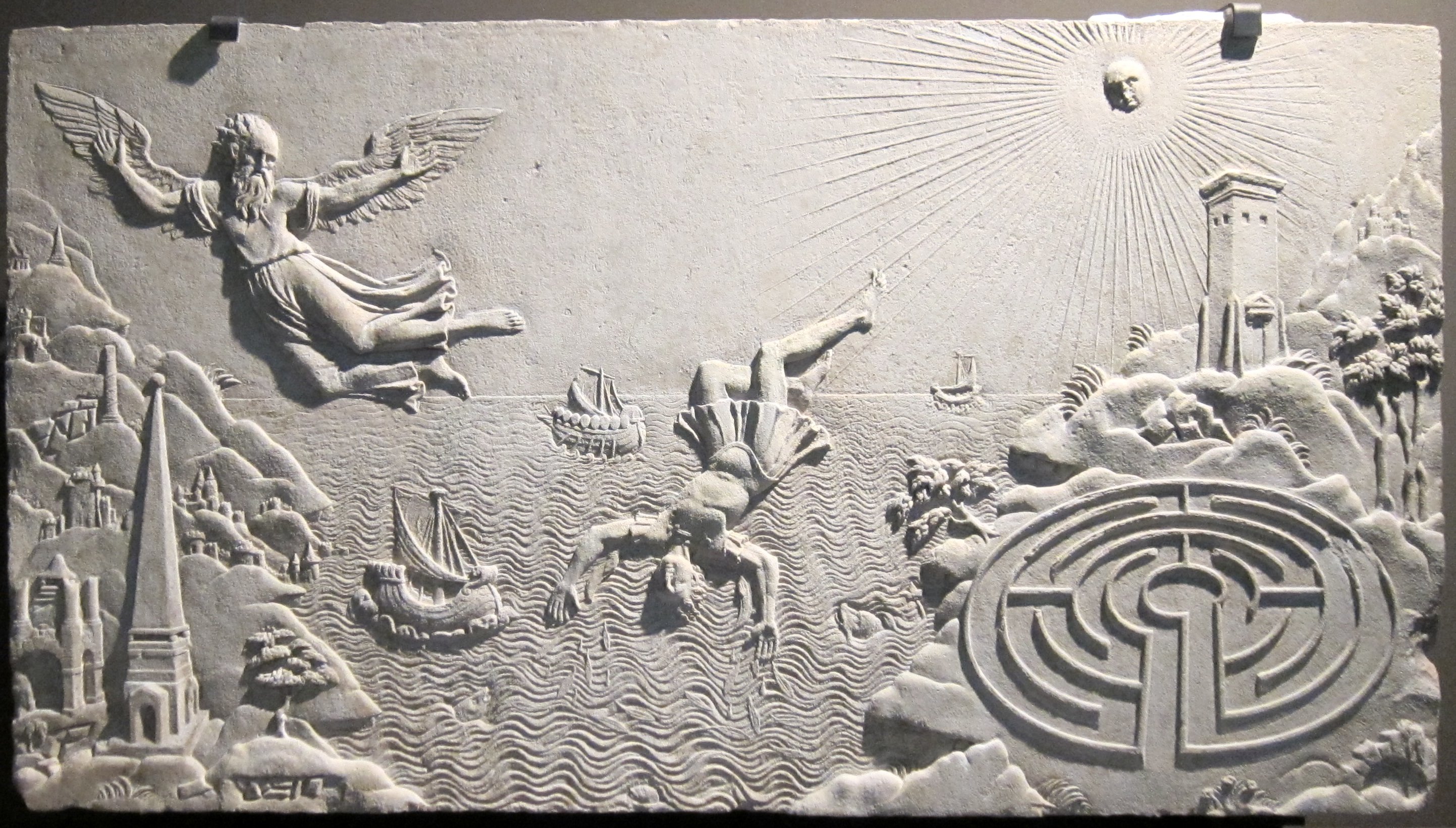
The legend of Icarus, which has come down to us from Greek mythology, is often interpreted as a warning not to set our goals too high. But Daedulus, Icarus’s father (Vikar, the name used in Empire’s Heir, is from the Etruscan name for Icarus, Vikare) warns his son against flying both too low, too close to the sea, where the waves might take him, and against flying too high, where the sun’s heat will melt the wax of the wings. A warning, as Colm says, not to set our ambitions too high or too low.
As I biked to and from the farmers’ market this morning, I contemplated what this meant for authors, or indeed, for any artist. At the market, I bought veggies from local farmers, and artisanal cheese, and looked at hand-made cards and jewellery; outside, I listened to buskers and took photos of the street art. So much art, so much talent…how do we as artists set our ambitions, so that neither the waves of despair nor the often-brief sun of recognition destroy us?
The Fall of Icarus, 17th century, Musée Antoine Vivenel. Public domain.
There is, of course, no one answer. Knowing why we create art, what purpose it serves in our lives, can help us understand where our flight path is. I write for the love of words, their cadence and rhythm and sound, for the look of them on the page, to explore ideas, and to tell my characters’ stories. Structure challenges me intellectually, a puzzle to solve. I love both the constraints and the freedom I grant myself in writing.
I have to remind myself of this, more often than I like. Our society tends to equate value with money, and more and more with celebrity. But the quiet satisfaction I find from the words of a reader who loves my books, or a review that appreciates my prose or worldbuilding, help keep me at the right height for my wings, although I will not pretend I don’t feel the desire for the sun, nor the darkness of the depths.
But these are my wings, my fragile construct not of wax and feather but of dreams and love. All my art has to do, in the end, is satisfy me, not pay my bills. This is only my flight path, not a judgement of other artists with different needs and different goals. But when I look up from my computer, from social media and sales charts and review stats, and take some time to consider and remember where writing has taken me – and, more importantly, what it has given me – I think I’ll keep flying for as long as I can.
Featured image: Jacob Peter Gowy’s The Flight of Icarus (1635–1637), public domain.





 marianlthorpe.com
You must be logged in to post a comment.