Not content with two careers as a research scientist and an educator, Marian L Thorpe decided to go back to what she’d always wanted to do and be a writer. Author of the alternative world medieval series Empire’s Legacy, Marian also has published short stories and poetry. Her life-long interest in Roman and post-Roman European history informs her novels, while her avocations of landscape archaeology and birding provide background to her settings. As well as writing and editing professionally, Marian oversees Arboretum Press, a small publishing imprint run as a collective. Marian is currently writing Empire's Heir, the sixth title in the Empire's Legacy series.
I used to work with a man who had all his best ideas in the shower. Others find running sparks creativity. For me, it’s driving. Not city driving, or bumper-to-bumper freeway driving, but long, mostly empty back roads (Blue highways, William Least-Heat Moon called them in his book about travel and place and belonging).
I was stuck, in my current work-in-progress, with a plot not complex enough for characters who are diplomats, subtle and devious. I needed a central conflict to have more layers to disguise a character’s behaviour. Pacing around the house didn’t help. So this morning, I went driving.
I’d gone perhaps 10 kilometers when something began to take shape, an idea rooted in a past book in the series and paralleling another subplot. Hmmm, I thought, this has potential. So what if…? By 30 km from the house, I had the outline. At about 50 km, I pulled over into a church parking lot in a tiny village, took my notebook out of my bag, and wrote notes for twenty minutes.
What is it about easy driving (or showering, or running)? I think it’s the repetitious, known activity that frees part of your mind to wander; the motor function taking its needed neurons, and leaving the rest to be creative. (And for me, at least, I can talk aloud to myself when driving, and that seems to help.)
This has, I think, roots in my childhood, when we’d drive to see an aunt a few hours away, or even into the city to shop, a shorter trip. I couldn’t read in the car; it made me carsick, so I’d look out the windows and make up things about what I saw: if this were my farm, I’d paint the fences white, and have ponies. Maybe that road leads to an abandoned village, the houses still standing. I’ll bet owls live in that old barn. Daydreams, but also stories.
I wish cleaning shook loose creativity in the same way; then I’d be doing something else useful at the same time. But sadly it doesn’t. I need a passing landscape: flying doesn’t have the same effect, nor does night driving. Trains are wonderful, but I haven’t much call to take trains in Canada. And the car does need to be taken out occasionally.
The results of today’s drive will keep my work-in-progress focused for some time. But sooner or later I’ll bump up against another problem that will need solving, and off I’ll go.
In Hollow Road (book 1), three companions discovered the monsters of legend were all too real…
Rumors among the Maer tell of an underground library called the Archive, which houses a wealth of knowledge and terrible magics that could be used to start the biggest war seen since the Great Betrayal. A mixed group of humans and Maer set off on an historic quest to find the Archive and protect it from those who would use it to destroy everything they hold dear. As the cold of winter bears down upon them, they trek through forbidding mountains beset by dangers they could have never imagined. They follow a set of ancient clues deep into the Silver Hills, forging surprising alliances and making new enemies.
The humans and Maer are linked by more than their quest to find the Archive and stop an insidious war. A mystical surrogacy may bridge the gap between two peoples, and many hearts entwine as their adventure hurtles toward its bloody conclusion.
In The Archive, Dan Fitzgerald returns to some of the same themes as in Hollow Road, Book I of The Maer Cycle: the building of alliances through communication and a defense against a mutual enemy; the importance of shared language and history; the understanding that arises from seeing past external differences to find common humanity.
The human protagonists from Hollow Road: Sinnie, Finn, and Carl, along with Maer companions, including Finn’s lover Fabaris, are seeking The Archive, a legendary repository of the written history of the Maer. Believed to lie deep in the mountains, finding it entails more than one danger. Among those dangers are the Wild, or Free, Maer: clans who have remained living outside of the settled Maer community. Enemies of both the Maer and humans, they will need to be convinced – by diplomacy or a show of force – that these strangers are not there to destroy or assimilate them, but for a greater cause, one that is as important to the Free Maer, too.
The world Fitzgerald has created is expanded in The Archive; the reader learns more about its history, its geography, and its cultures, while still leaving us with tantalizingly unanswered questions to draw us into the next book. It, like its predecessor, is a quiet book, primarily character-driven. There is plenty of conflict, but not often the sort that needs weapons to solve, although battle will play an important role.
Relationships develop further in this book, both friendships and sexual relationships (of many kinds, all seamlessly fitting into the story and the world), and with those relationships characters too are deepened and developed, increasing the stakes and the emotional impact of events. One of my small niggles with the story came here: in furthering Finn and Carl’s relationships, Sinnie seemed to be neglected – or perhaps my sense of her as a little on the sidelines is purposeful.
Once or twice specific word choices jarred me out of the pre-industrial world Fitzgerald’s characters inhabit, but overall the writing is smooth and effective; the plot and action well-paced, and the characters compelling. Oh, and did I say there are dragons? Feathered dragons! Strongly recommended for readers who want more from a fantasy world than battles, blood and beer.
Dan Fitzgerald is a fantasy writer living in the Capitol Hill neighborhood of Washington, DC with his wife, twin boys, and two cats. When he is not writing, he might be gardening, doing yoga, cooking, or listening to French music.
His debut fantasy novel Hollow Road, the first book in The Maer Cycle trilogy, was published in September by Shadow Spark Publishing. The Archive comes out on December 4, and the trilogy concludes with The Place Below in March 2021.
Find out more about Dan and his books at http://www.danfitzwrites.com, or find him on Twitter or Instagram, with the handle danfitzwrites in both places.
Dawn at Wood Buffalo National Park comes at about 4:30 am in mid-July, and with birdsong resounding through the trees, sleep is over. “Pure sweet Canada-Canada-Canada,” the white-throated sparrows sing, over and over.
It’s 1993, and we’re two weeks into the longest road trip we’ll ever do: 71 days across Canada in a Ford Escort, with a tent, a portable barbecue, and not much else. I love road trips: of all the things I couldn’t do because of the pandemic, this is probably the one I felt the most. We’ve done endless trips – all 50 states, many several times (we drove to California from Ontario three times); all Canadian provinces and two of the three territories (Nunavut didn’t exist when we did the big cross-Canada trip.) Most of Australia. All of New Zealand. England, Scotland, Wales. Costa Rica, Belize, Japan, Taiwan, too many Caribbean islands to count. Mostly the two of us together, but I’ve gone on my own, too.
The mosquitoes are horrendous, which is why we’re the only people in the campsite at Wood Buffalo, maybe the only people camping in a park the size of Switzerland. We run from the tent to the lake to swim (it’s COLD) and back to the tent to dry off. Later this day we’ll walk for hours, plagued by flies, following wolf tracks and buffalo hoofprints in the dried mud of the trail.
But this isn’t a travel memoir. I wasn’t writing my series yet: that would begin a few years later. But so much of this trip is in my books, even though I was traveling in North America in the last decade of the 20th century, and my characters are in a fictional 7th century analogue European world. The memory of that plunge, naked (there was no one around, after all) into the lake at Wood Buffalo became a lake in a plain in Empire’s Exile. The flies are in the same book. So, too, is the experience of standing on a ridge in the Richardson Mountains in Yukon, and looking east, and seeing nothing but endless peaks and valleys, snowcapped even in July, hearing the whistles of marmots and the cries of golden eagles. If we’d travelled east through that wilderness, were it possible, the first significant population centre we would have come to would be Trondheim, Norway.
Richardson Mountains from the Dempster Highway. Wikipedia, public domain.
That memory became the Durrains, the mountain range thought uncrossable that divides Lena’s land from whatever lies east, and that she and Cillian must attempt to cross, or die trying. But not just the physical geography, but the sense of a vast expanse of unknown territory, unknown people, unknown dangers…and somewhere, very far to the east, perhaps civilization.
The books are full of these landscape and place memories: someday perhaps I’ll go through and annotate them, just for fun. I have a strong suspicion that almost nothing in the landscape of my world is invented; I think they’re all just taken from one trip or another; in mountains or on coasts, the sounds of fishing villages, the crowds of a city, the ice on the wash water in the morning at a campsite.
Write what you know. So I write what I’ve experienced; weaving together memories from a thousand times and places; remembering the smells, the feel of the breeze, the flies and the birdsong – and how I felt: joy, exhaustion, irritation, fear. The blisters, the aching shoulders; thirst, hunger, desire. I give all those to my characters: my experiences become theirs.
But there is something I think is key to this: I was in those moments. I wasn’t photographing, or texting, or videoing; I wasn’t digitizing them or filtering them for someone’s consumption. I was there, fully. I was paying attention. Not because I knew I wanted them for a book, later – because that too is a filter. I was – on that trip and many others – simply experiencing the world I was in at that moment, creating memories that transfer themselves to words thirty years or more later almost effortlessly. So I guess that’s the answer – or one of them – to the question I’m asked most frequently: how do I build a world that feels so real? By remembering it.
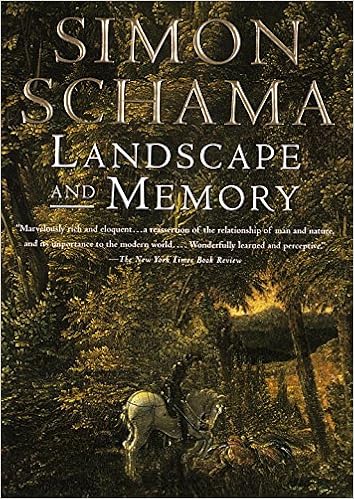
(With apologies to Simon Schama for borrowing the title of his marvellous 1996 book.)
Featured image: White Throated Sparrow by Becky Matsubara: Flickr. CC 2.0 licenses
This scene didn’t make it into the final version of Empire’s Reckoning, mostly because the book was already long, and while this added to character- and world-building, it didn’t feed the plot. But I awoke to snow today, and was reminded of it, so here it is. If you’re in the middle of the Empire’s Legacy trilogy, there are spoilers here.
“Teannasach, may I go?” I asked formally. He stepped forward, offering an arm and the kiss of farewell. Our lips brushed for the briefest of moments. I wondered if knowing what I was made him uncomfortable, but if it did, he did not show it.
“Go safely, Lord Sorley,” he said. I swung up onto my horse and turned its head south.
I’d woken with a scratchy throat, but we’d talked and sung into the small hours, so I thought little of it. But as I rode through the morning, I reluctantly admitted to a cold. My throat was painfully sore now, and my nose alternately running and blocked.
Ingoldstorp was some distance away yet, but they would give me soup and fuisce, and a warm bed, and perhaps a night’s sleep would chase the illness away. I found my hat in the saddlebags and wrapped my scarf a little tighter around my neck. The day was getting colder, I was sure.
An hour later the snow began. Big flakes, wet and heavy, at first: then, when the wind picked up, smaller and denser. The world around me turned white, and still the snow fell, thick and fast and rapidly shrinking the visible world to no more than a few arms’ lengths in front of me. I started to shiver. I couldn’t see the road now; all I could do was trust my horse to seek shelter.
I let the reins lie slack. The gelding plodded steadily forward, its head low against the wind. My fingers were numb, and my toes. The snow stung the exposed skin of my face. I closed my eyes.
Random thoughts: lambs would die in this. Had I wrapped my ladhar properly? Druise would be so angry with me. I drifted into a daze, time and the white world passing without sense or recognition.
My horse roused me, swinging his head and snorting. I looked around me, slowly realizing we stood in the lee of a building. I pushed myself up in the stirrups, my right leg dragging over the saddle as I dismounted, feet sinking into snow well over my ankles.
I fumbled along the wall of the building, looking for a door. I found one, but its latch resisted my stiff fingers. Swearing loudly, I pulled a glove off with my teeth and tried again. The horse pushed up against me, wanting cover.
On the fourth try I got the latch and the door open. I stumbled in, the horse following. A cattle byre, I could tell, from the smell and the heat, although almost no light found its way into the building. A cow lowed, and another. Probably the torp’s milk cows, I thought muzzily. I hoped so.
My hands were too cold to remove my horse’s bridle, or its saddle, even with both hands bare. He stood placidly enough, so I left him, moving towards the cattle. A warm, heavy body loomed in front of me. I put a hand on its side; it didn’t flinch. Slowly I moved around it until I was among the cows. I leaned up against one, almost hugging it. Apart from a flick of her tail, she didn’t object. Milk cows, as I had hoped, accustomed to being handled.
The heat radiating off the animals warmed me, even though the strong smell of urine in the byre made my eyes water. I would stink of cow, I thought, but I didn’t care. The cattle chewed and belched and shuffled, and one nosed me, its hot breath scented with hay. I’d never liked cattle much, before.
Warmed, I went back to my horse, removing his tack. He’d find hay and water, although the cows might kick him. By feel I found the bread and cheese in one saddlebag. Then I sat down to eat and wait.
The food tore at my sore throat, but I made myself swallow it, in small mouthfuls. I sat as close to the cattle as I safely could, and at some point, exhausted, I fell asleep.
A man’s voice woke me. Concerned, not angry: no torp or house would turn away a traveller in this weather. He knelt. “Are you well?”
I tried to speak, coughed instead. “Well enough,” I managed. “My horse brought me here. Where am I?”
“Ingoldstorp. Who are you?”
“Sorley.” A bout of coughing racked me. “Toscaire to the young Teannasach. I was riding south from Dun Ceànnar.”
“Well, sit quiet while I give hay to the kyne and your horse. I’ll take you up to the house, after.”
He was quick with the feeding. Then he piled the water trough high with snow, the byre door letting in blasts of cold as he went back and forth. It would melt soon enough from the animals’ body heat. Then he gave me a hand up, threw my saddlebags over his own shoulder, and took me to the house.
Winter Sheep Herd: Scott Payne, Pixabay
The snow and my cold ran their course together. Ingold—or rather his Konë—distractedly welcomed me, found me a bath and a bed, fed me, and sat me by the fire when I coughed. I had been lucky: I could well have died, had my horse not brought me to the cattle-byre. But my cold remained only a cold, preventing me from singing to repay my hosts’ hospitality, nothing more.
Not that the Eirën was often present. Ingold, a handful of years older than I, spent all the daylight hours out with his men and the sheepdogs, digging ewes and lambs out of drifts. I offered to help, but he refused. “I don’t doubt your skill with sheep, Sorley,” he said. “But you’ve work to do for the young Teannasach, and that can’t be risked.” So instead I fed the penned and stabled animals, and warmed half-dead lambs by the hearth of the house, with the Konë and the torpari women.
The weather changed on the fifth day, the wind shifting south, warm on the skin. Snow melted rapidly, turning the yard and the track to muck. “I’ll turn the sheep out in the morning,” Ingold told me, as we shared fuisce that night. I had played for them earlier; I couldn’t sing, but music of any sort was always welcomed. “You’ll be on your way, no doubt?”
“I will. If this weather reached south, the Casilani ships will have been delayed, but if not, they could be in harbour already. I have letters to go to Casil, from Ruar and the Raséair, and I must stop at the Ti’ach na Perras on the way.”
I had been gone well over two weeks. Ingold sipped his fuisce. “What are they like, these Casilani?” he asked.
“Wily. Sophisticated, and skilled with words and subtlety. At least the officials. The soldiers,” I shrugged, thinking of Druise, “are not so different from any men.”
“You’ll need all your wits about you, if you’re to ensure they treat us fairly,” he commented. “But the same was needed with the Marai. I suppose it’s no different. But we’ll be hard-pressed to pay tribute this year.” The talk drifted to the effect of this unseasonal snow, and how many lambs had been lost. “We’ll have been better off than most,” Ingold said. “I had enough men to rescue most of them. Some of the torps will have lost almost all, I’d think.”
“Why did the Marai leave you alone?” Had he supported them?
He snorted. “I’m a practical man, Sorley. I sent my wife and children to Dun Ceànnar, and then I went too, but later. I told the torpari I’d gone south to fight at the Wall, for the Marai, and I left them orders to cooperate. We lost a lot of animals to feed the raiders. There’s some pale-haired babies born this year, and they took a few girls, and a boy or two, as slaves, but they didn’t burn the byres, or the cottages. A small price to pay for our lives, I’d say.”
I couldn’t argue. I toasted him silently, and he grinned and drank his fuisce down. “Bedtime,” he said. “I’ll be out at dawn tomorrow, so I’ll say goodbye now. Safe travels, Sorley.”
(c) 2020 Marian L Thorpe
Featured Image: Beneath The Snow Encumbered Branches, Joseph Farquharson. Public Domain
Being interviewed as an author is one of those love/hate situations. We’d probably all be happy to talk about our books and characters – but not about ourselves! But we also know we shouldn’t turn down the chance to promote our work.
Here’s my latest author interview, from A Muse Bouche, an Ottawa-based writing site:
My current work-in-progress, Empire’s Heir, is probably the most planned book I’ve ever begun. I’m moved from complete pantser to at least acknowledging that an outline isn’t a bad idea. With Heir, I did a really detailed outline. I know my themes and my subplots, and where I was introducing a new twist to support the saggy middle – all before I began to write.
I got 50K words in, and I stopped writing. Not because I didn’t know what came next, but because I was both bored and frustrated by my own writing. Bored because I’d already done ‘young woman coming of age under challenging circumstances’ story with my protagonist’s mother – it’s what my whole first trilogy is about. Frustrated, because some of the themes and subplots meant I was stretching credulity to have my MC present for some of the conversations and action, but without them, the book would be too simplistic.
My last book, Empire’s Reckoning, also challenged me in different ways, and I found having a playlist for it helped keep me focused. Maybe that would help, I thought, and went looking for (and soliciting) ideas for songs. And I gave my playlist for Reckoning one more listen.
One of the songs on that playlist is Crosby, Stills, Nash & Young’s Teach Your Children, one of the anthems of my youth. I listened to it, and sang (ok, that too is stretching credulity – let’s say I vocalized) along with it, and then I went to bed.
To wake up early the next morning hearing, very clearly, the voice of my protagonist’s father, a voice I’ve never heard, although he’s been a central character in all books but one – and the solution to both my problems with the story. Switching its focus just a little, creating a two point-of-view story that contrasts Gwenna’s youth and naivete with Cillian’s wisdom and experience, adding a ‘passing of the torch’ theme – all those made the story so much more interesting. Situations central to overarching themes in the series can unfold without Gwenna directly observing them.
I should know by now that linear planning doesn’t work for me. I’m a mind-mapper on paper, a doodler, working with free-flowing thought and image, creating lateral connections – and I think that’s what ‘pantsing’ is about: letting the subconscious make those connections and drive the story. “Feed them on your dreams…” Graham Nash wrote, fifty years and more ago…and it seems it’s still the best advice for my writing.
A writer, releasing her work into the world, gives her characters over to the readers. We have our own idea of their personalities, their appearance, their voices, but what we see and hear will not be what the reader sees and hears.
But an audio version of your work – that’s an interpretation of your characters that extends out to others, a shared experience. I’ve had other work read before on podcasts, but Benjamin Kelman’s reading of the first chapter of my novella Oraiáphon surpassed them. He has given his own versions of personality to my characters, surprising me with some, but in the end completely pleasing me.
Here’s the link. You’ll need about half an hour, but please, listen to his other readings too on Stories to Drive By. You won’t be disappointed.
The Moon Hunters is an atypical post-apocalyptic story; instead of a devastated, destroyed world, much of the narrative occurs on a lush tropical island. Members of a group led by a charismatic man escape an early 21st century pandemic by travelling to a remote, privately owned island. Out of touch with the rest of the world, sub-societies within the group evolve in several different directions. But one man’s belief in his own divine enlightenment – and his power over others – challenges the lives of everyone, but most of all the protagonist Leilani.
The reaction of individuals or small groups to years of isolation is not an uncommon theme in books: Robinson Crusoe, The Swiss Family Robinson, Lord of the Flies – but the evolution of a isolated society is usually the realm of science fiction stories based on lost colony ships. That The Moon Hunters is set on our world was a refreshing change.
What does a group withdrawing from the 21st century world take with them? The eclectic choice (Leilani is a librarian/scribe, and so has access to the books and written documents brought) is, I think, key to Pavelle’s world-building. The society has developed cultural traditions that appear drawn from a wide range of cultures, as it would be if their libraries – and members of the group – reflected a varied cultural heritage. Add to that the materials and foods available on a island in the tropics, and the rituals and hierarchies that have emerged in one of the towns on the island are reasonable developments.
World-building is The Moon Hunters greatest strength: detailed, precise description of the environment, of clothes and buildings, of the sounds and sights of the island – and of the off-island settings. Immersive and imaginative, the reader is subsumed into the world. But for all the lushness and beauty of the physical world, the political one – in Leilani’s village, at least – is harsh and unforgiving. How she navigates and eventually breaks free of its restrictions and expectations is a large part – but not all – of the story – and there is a romance, too.
Recommended for readers looking for a post-apocalyptic story less dark and disturbing than many.
I haven’t been blogging much recently, and I’m not apologetic. It’s October, my favourite month. So instead of sitting at my desk, or even going out for an hour on my bike, I’ve been hiking – and hiking takes longer. Sometimes half a day, sometimes more, depending on how far I drive to get there.
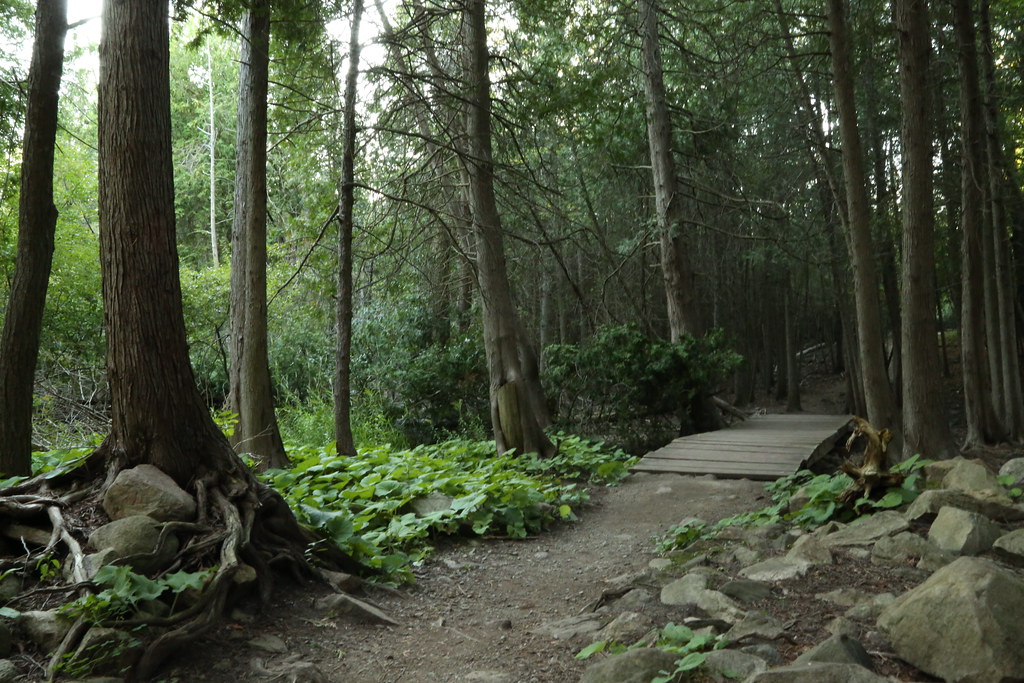
I often don’t drive far. My city is blessed with good hiking trails, both in it and close by. We’re a ground-water-dependent community, and the aquifers in the limestone bedrock are protected. So lots of naturalized parkland, and lots of trails. Two days ago I hiked for nearly three hours, through old cedar forest, regrowth deciduous, and open, regenerating pasture – and I didn’t leave the city.
Preservation Park
Some days, I don’t drive at all. I just walk 10 minutes to the university arboretum across the road, and from its own loops of trails I can connect onto the river trails, and go either west or east. One way takes me into the city (and the BEST ice cream shop); the other takes me away from houses and roads and alongside limestone cliffs. It depends on my mood (and my craving for ice cream.)
Guelph Radial Trail
Other days I have a wish for less familiar trails, and I drive to somewhere new, or less visited. My hiking boots and pole live in the car now.
Pinehurst Lake
I love this season. The colours are beautiful, there are no mosquitoes or deerfly, and the air is cool. Winter will be here far too soon. I’ll blog more then. In fact, I’m only writing this post because it’s raining!




![The Moon Hunters: A Post-Apocalyptic Science Fiction Adventure by [Anya Pavelle]](https://m.media-amazon.com/images/I/51RJi0BibSL.jpg)


You must be logged in to post a comment.