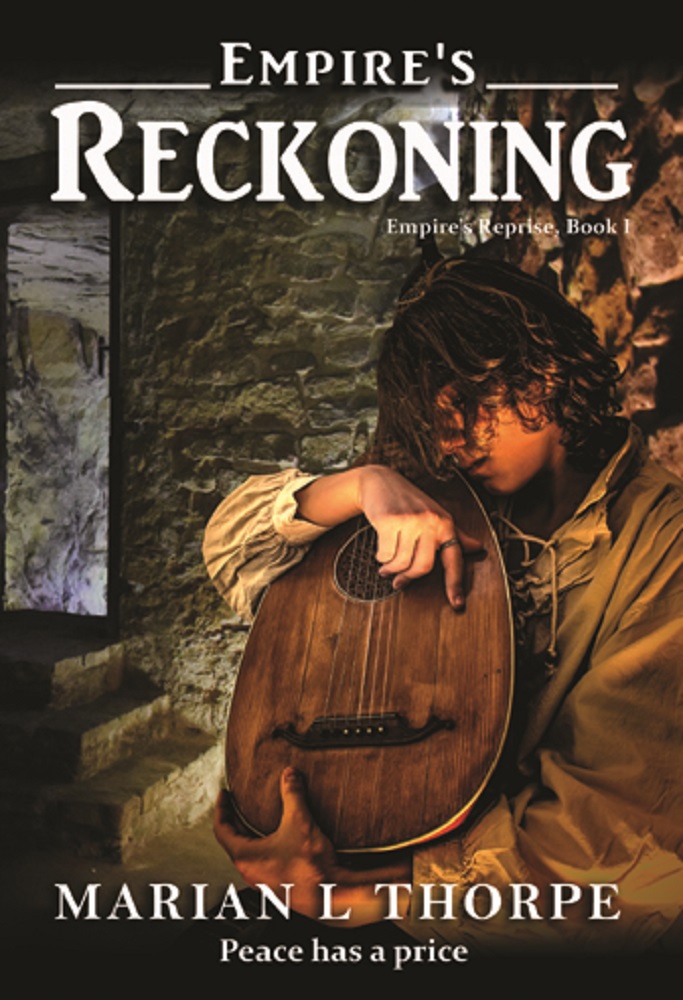
Empire’s Reckoning – Marian L Thorpe

A wonderful review of Empire’s Reckoning from Mai Taylor at Mai’s Musings.

Mai Taylor's avatarMai's Musings

When I heard that Marian L Thorpe was writing a follow up trilogy to Empire’s Legacy, I was over the moon, and I am delighted to be able to introduce it to you all today, as I join the blog tour for Empire’s Reckoning, the first book in the new series. Many thanks to Marian, and to Rachel at Rachel’s Random Resources, for inviting me to be a part of the tour, and for providing me with a copy of the book.

BLURB:

How many secrets does your family have?

For 13 years, Sorley has taught music alongside the man he loves, war and betrayal nearly forgotten. But behind their calm and ordered life, there are hidden truths. When a young girl’s question demands an answer, does he break the most important oath he has ever sworn by lying – or tell the truth, risking the destruction of both his…

View original post 614 more words

Warrior Women: Archaeological Evidence

“But the world changes. In all the women’s villages of the Empire, this week or next, a soldier like myself will arrive to ask to live in the village, to take up a trade.” Casyn paused, for a breath, a heartbeat. “And to teach you and your daughters to fight.”

Empire’s Daughter

So begins the major conflict of Empire’s Daughter, the first book in my Empire’s Legacy trilogy. My protagonist Lena’s journey from fisherwoman to soldier, and the life-changing effects on her and the women of her village and her land is its theme and story. Lena is already competent with a hunting bow; now she must learn to use other weapons.

“But how realistic is this?” one of my reviewers asked. Far more so than people of my age were educated to believe, based on archaeological evidence coupled with advanced DNA analysis techniques.  In recent years, analysis or re-analysis of skeletal remains of bodies buried with weapons and other grave goods associated with warriors have shown up to a third of these are women.

In 1941, a grave was excavated at Birka, a town in Eastern Central Sweden and a centre for trade during the 8th–late 10th century. This was an exceptional grave: on a raised area between the town and a hillfort, the goods buried with the warrior included “a sword, an axe, a spear, armour‐piercing arrows, a battle knife, two shields, and two horses, one mare and one stallion; thus, the complete equipment of a professional warrior. Furthermore, a full set of gaming pieces indicates knowledge of tactics and strategy, stressing the buried individual’s role as a high‐ranking officer.”[i]

So, of course, this was a man. Except she wasn’t, when the DNA work was done in 2017, confirming earlier analysis of the bones that had strongly suggested the skeleton was female. More than a ‘shield-maiden’ of the sagas, this was the grave of a high-ranking commander.

The Hårby Valkyrie, c 800 CE, Denmark. Gilwellian / CC BY-SA (https://creativecommons.org/licenses/by-sa/4.0)

Later in the Empire’s Legacy series, Lena learns to use a bow from horseback as a weapon of war, a bow she’s never seen before: triple-layered and powerful. In January of this year, results of excavations in the western Russian village of Devitsa revealed two, or maybe three, generations of warrior women buried in one mound: Scythians from about 2500 BCE. Ranging in age from  12 or 13  between 45 to 50 years old, these women were buried with daggers and arrowheads and spears, and in the position of a someone riding a horse.[ii] Over a third of Scythian graves containing women also contain weapons, with skeletal remains showing injuries consistent with war wounds – and with changes to bone structure indicating long hours spent on horseback and using a bow.[iii]

(Archaeoolog.ru, via https://www.smithsonianmag.com)

Key to the involvement of Scythian women in warfare was likely the Scythian bow, a composite bow. Lena first sees one when she visits the horse archers’ training ground:

Compact and deeply curved, it reminded me of the bows we had taken from the plains riders. But I had never seen one constructed like this. It had three layers, I realized as I examined it: a central layer of wood between horn on the inside and what looked to me like sinew along the outer curve. As I compressed it to fasten the bowstring, I felt its resilience.

Empire’s Exile

Composite bows combine a smaller size with higher power, making them especially useful on horseback or from a chariot.  

“If you think about it, a woman on a horse with a bow, trained since childhood, can be just as fast and as deadly as a boy or man.”

Adrienne Mayor

Lena and her fellow female warriors in my books may draw on traditions from across a wide range of dates, but I write the history of an alternate world based on ours, not a faithful interpretation of events. Could she have wielded these weapons in defence of her land?  Recent research says a resounding yes.

Like what you’ve read? Sign up for my monthly newsletter, News from the Empire.


[i]    https://doi.org/10.1002/ajpa.23308

[ii] https://www.smithsonianmag.com/smart-news/tomb-containing-three-generations-amazon-warrior-women-unearthed-russia-180973877/

[iii]   The Amazons: Lives and Legends of Warrior Women Across the Ancient World, Adrienne Mayor, Princeton University Press, 2016/

Featured image: Statue of Boudicca at Westminter: Paul Walter: licensed under the Creative Commons Attribution 2.0 Generic license.

A Landscape of the Heart: Building the World of my Books.

The English county of Norfolk, as those who have been following my blog for some time know, is my second home. When I will see it again, in the wake of COVID-19, is another question, but it has a firm hold on my heart, my imagination, and a solid place in the construction of my fictional world.

Anyone who knows Norfolk – and my books – may now be asking how?  A flat land, for the most part; arable, with little rivers and chalky soils and patches of reedy fen. Not the hilly, sheep-grazed moorland that so much of my world encompasses. No, the influences are more subtle.

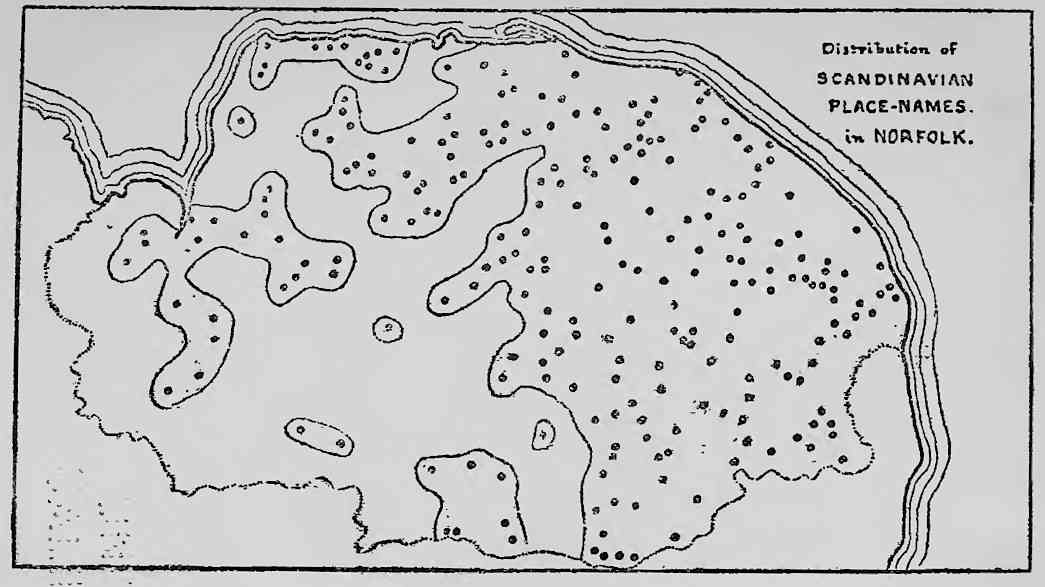
Firstly, Norfolk was part of the Danelaw, the part of England under Scandinavian rule. Twenty-nine existing places in Norfolk have ‘thorpe’ as a suffix or prefix, and while this happens to be my last name, its meaning ‘outlying hamlet, small village’ is from the Norse þorp, and from it I take my settlement names in Linrathe and Sorham.  In fact, Ingoldstorp, mentioned several times over the series, is the name of the village (Ingoldisthorpe, pronounced Inglesthorpe) just north of the one where I have spent my winters since retirement.

The next village north from that is Snettisham, and I borrowed Snetti’s name, too, for a minor character. There are more examples, but I won’t belabour this point. But in the last paragraph I wrote ‘twenty-nine existing places’.  There are also thirty-three ‘lost’ villages in Norfolk with ‘thorpe’ in their names, and it is these missing settlements that also inform my world.

Deserted medieval village is the correct term for these abandoned settlements.  In many cases there is nothing but a few lumps and bumps on the ground, and perhaps the ruins of a church. (Or sometimes, a church still in use, but standing in the middle of nowhere, apparently.) The reasons for abandonment are many, including land enclosure and parkland created for manor houses. Others suffered as rivers changed course or land flooded. But in Norfolk, one reason was simply depopulation.

Norfolk is now 40th of the 48 counties of England in population density, the number of people per unit of land. But in the middle ages, it was the most populous county, and its county town, Norwich, the second city of England. Until the plague: first the Black Death in 1349; then, two centuries later, a third of its population died in the  epidemic of 1579, and another third in 1665.  

The land Lena inhabits is like this, a depopulated land, villages scattered and distant, too few men to defend the land against threats from two directions. The reasons for the Empire’s depopulation and that of Norfolk are pretty much the same, although the Eastern Fever isn’t the Black Death.

But while Norfolk – and the Empire – are depopulated lands, they both have long histories. If Lena rides east from her coastal village, she will come to the military road, running north and south, wide and paved. If I walk or drive east from my Norfolk village, about, in my mind, the same distance, I come to a Roman road, running north and south. No longer paved; no longer very wide, but a reminder, every time I walk it, of a time there was a Roman fort on the coast, and villas along the ridge overlooking the Wash, and the coins in use bore the likenesses of emperors far away.

Peddar’s Way Roman Road, Norfolk

Danes and Romans; disease and depopulation; all these are important aspects of my books, influenced – sometimes consciously, sometimes not – by what I know. Not reproduced, but borrowed, moulded and transmuted into a different form, almost recognizable, almost history.

map of Scandinavian place names https://www.mygen.com/users/outlaw/Outlawe_Viking_Origins.htm

Like what you’ve read? Sign up for News from the Empire, my monthly newsletter with more of the history behind my books, short stories, and cat pictures.

Vikings and Buddhas

In Empire’s Reckoning (now also available in the duology box set Empire’s Bard) the protagonist Sorley has returned home after an absence of a couple of years. His brother’s family has come out to greet him, but one member is missing.

I looked around, not seeing my half-brother. “Where’s Nyle?”

“Gone trading,” Roghan said. “He’s nineteen now, and there’s little for him here. So he took a place on a ship heading east to trade furs and amber.”

“East?” I said. “Down the Ubë?”

Sorley’s home is in the very north of his land, an area which I envision as equivalent to the Norse areas of early-medieval Scotland. And, as the Netflix series Vikings – if nothing else – has brought to more common knowledge, the Scandinavian people did explore, and trade, eastward.

Scandinavians, in fact, are often credited with creating a trading network in Europe, but that may be because the archaeological record is more perceptible for the Viking era than any other. Much of that network, in truth, already existed in the Baltic and the coastal areas of the North Sea. The Frisians dominated this trade, using early forms of the cog (a flat-bottomed, rowed boat) to transport goods along the coastlines and into river systems.

Viking keeled boats, however, allowed for open ocean travel, and while initially the Vikings came to raid, increasingly, they stayed to trade. The trading city of Dublin arose in this manner, and all around Northern Europe, Scandinavians took over or replaced existing trading sites such as Hedeby in Jutland and Eoforwic (York) in England.

 Further east in Europe, commercial trade along water-based routes created new economic centres in Eastern Europe, which trace their beginnings to the appearance of the people we call Vikings (or Varangians). Sorley’s half-brother and the ship he’s on are playing an important role  in the creation of the early framework of my pseudo-Europe’s economy.

Scandinavian traders travelled the river systems as far as Byzantium and even into the Arab world to obtain goods. They brought those goods back, both to emporia along the route, and directly to Scandinavia. Viking-era trade created a network across and beyond Europe, bringing items as rare as an Indian Buddha figurine, a north African bronze ladle, and Arabic coins back to their homelands.

Can you blame Sorley’s half-brother for wanting to be part of this?

The circa 6th C bronze Helgo Buddha, found on the Swedish island of Helgo, an important trading centre from the 6th – 11th C. The Buddha probably arrived in Helgo via Swedish merchants who traded east, along Russian rivers such as the Volga. © Swedish History Museum

For more information on the Helgo treasure:

http://irisharchaeology.ie/2013/12/the-helgo-treasure-a-viking-age-buddha/

Like what you’ve read? Sign up for my newsletter, News from the Empire, for more of the history behind my books, plus subscriber-only short stories and other special features.

Featured image: https://about-history.com/knarr-the-oldest-norse-merchant-ship/

How many hours? Planning research for a historically-based novel: #authortoolboxbloghop

The books I write are quasi-historical: they are set in a world with strong similarities to northern Europe after the decline of Rome. There are significant differences, but many of the events that shape it are based on real history. For my first two books, I was lucky – years of immersing myself in the Roman and post-Roman history of Britannia meant I had little actual research to do, except fact-checking. But the third took me out of the Britannia analogue – and into the library.

As I prepare to write the fifth full novel in the series, I am expanding into both a geography and a political history I know less about. So it’s time for more research, and in this month’s #authortoolboxbloghop, I look at how I do that.

When I say research, I mean major research, not the quick Google search for ‘how many public bread ovens were there in Rome’. (One for every 350 people, roughly, if you care.) Without giving too much away, the plot of Empire’s Heir, the next book, takes place mostly in Casil, my Rome analogue, and involves the politics of power as they rest in a high ranking, and therefore highly marriageable, young woman.

So, what major topics did I need to research this time?

Setting: Rome in the 4th C, which is the time in Rome’s history I chose to base my physical city on;

Character background: the education of an heiress to a country’s leadership in early-medieval Europe;

Politics: the politics and practicalities of marriage alliances.

(In other books, it’s been battles, and ship construction, and travel times between Rome and Britannia, and Viking travel into continental Europe and Byzantium…whatever you’re writing about, you need to define what you’ll have to spend time researching.)

Let’s look at those topics one at a time.

Setting:  Part of one of my earlier books takes place in Casil, so I’ve already done a fair bit of research. Three sources have been particularly useful

  1. Video reconstructions
  2. Ancient maps
  3. A research trip to Rome, with a private guide. (I realize this is a luxury out of the reach of many, but good guidebooks to ancient Rome could have been substituted, especially used in conjunction with the video reconstructions.)

What I have now are sources to refer to, and a fair understanding of the geography of Rome. Between watching the videos, taking an on-line course on ancient Rome, studying the maps and actually going to Rome, I’ve spent about two weeks – call it 80 hours – on this prior to beginning to write the book. I need to spend another 10 or so, I think, working with a map and the structures of buildings in conjunction with the plot of my story.  Where are the stairs she’ll need to access? How long did it take to get from the Forum to the Pantheon on foot?  What’s the easiest route for a character who is physically disabled to travel?

Character background: the education of an heiress to a country’s leadership in early-medieval Europe. I’m using a number of sources here, some on-line, more not: several new books on early-medieval women wait to be read. I did both a literature search, and asked some friends whose research area this is, to find the books to read. 40 hours here, for a solid understanding.

Politics: the politics and practicalities of marriage alliances.  Again, more reading; some will be covered in the other books; some will be separate. I estimate 30 hours.

In total, I expect to spend 160 hours in major research prior to writing. Four forty-hour weeks. Some of it’s already done, so now perhaps I have 80 hours to do, or 2 full weeks. But I can’t devote 40 hours a week to research – while I work as a writer & editor full time, that includes all sorts of other writing (like this blog post), my editorial work, and promotion and marketing. Call it 6 weeks, then (providing I don’t find myself going down fascinating rabbit-holes of trivia.)

As fascinating as I find all this, I can’t focus on one subject for too long. So I will divide it up –  a couple of partial days spent on the mapping and logistics (which I love, and can easily hyperfocus on); a couple of partial days spent on reading. The advantage, too, of doing it this way will be the cross-pollination of ideas that will occur – because while I have an overall plot outline, it will be the research that fills it out and provides details and plot twists I won’t necessarily have thought of. But it also means I won’t start the actual novel until September.

Sometimes I envy writers who get to make it all up!

If my books interest you, please consider signing up for my monthly newsletter, News from the Empire. It includes information about my characters and the history behind my world, short stories or vignettes, and pictures of my cat.

One Small Thing

This is a very different blog post than I usually write, but it’s what I was thinking about for much of the day. I woke up yesterday mentally exhausted, from editing and book launches and promotion and marketing and my community newsletter responsibilities and reviewing and…..just too many words. My wrists ached from typing. My eyes were dry. My creativity was missing. So I went birding instead.

Alone. I needed space and silence. I drove up to a lake about an hour north of us, and walked around a pond and then along the lakeshore, and looked at trumpeter swans and blue herons and pied-billed grebes, and the osprey overhead and the swallows chattering over the water, and listened to yellow warblers singing. I took pictures of wildflowers. I startled a white-tailed doe, and a lot of turtles. And I thought about my two solo birding trips: one a week in the High Island area of Texas; one a road trip out across the Dakotas and up into Saskatchewan.  

Luther Lake, Ontario

I was in my 50s, for both trips. In Texas I stayed in one place, and did day trips to the local wildlife refuges. On the road trip, except for three nights at Grasslands National Park, I moved every day. I drove back roads; I stopped at ponds and potholes and rivers; I hiked into prairie. I had no phone reception, much of the time, and anyhow, my husband was in Peru when I was in Texas, and in Papua New Guinea when I was on the road trip.

Nighthawk roosting, Grasslands National Park, Saskatchewan

I was mildly conscious there was some danger in what I was doing. There always is, for a woman travelling alone. I was always alert; not on edge, but alert. Once or twice I returned to my car earlier than I’d planned, because something made me nervous: a pickup truck stopping, its driver watching me, that sort of thing. Once or twice I didn’t stop at a location I’d meant to, because who was already there concerned me.

Then this week I read stories from birders who are black, men and women, about their experiences in the field: about the suspicion they often are met with. How they are watched, and sometimes followed, and challenged. How having the police called can so easily outweigh the pleasure of birding. What are they doing, with those binoculars or spotting scope or camera?

I thought about the slight extra alertness I had on those trips, and the few times I listened to instinct and didn’t bird. What if every day was like that? How many challenges or scrutiny would it take to stop me birding entirely? How much fear?  I think of the joy and delight birding has brought me in the fifty years I’ve been consciously doing it, and what I would have lost if I’d been driven away from it.

Racism mars lives – destroys lives – in worse ways, without a doubt. But the scream of an osprey or the chatter of tree swallows – and the ability to stop and watch and listen– should belong to everyone. I am doing my best to simply listen to and learn from the voices calling (again) for change, because I know much of what is behind these valid and overdue demands is outside of my experience. But this one small thing isn’t.

I don’t know, yet, how – or if – I can help bring about change. But I can ask how. I can try. That’s what I thought about today, while the yellow warblers sang.

Romans in Africa, Africans in Rome

We first meet my character Druisius, one of the two MCs of Empress & Soldier, in the last third of Empire’s Exile, when he’s assigned to guard the party of travellers from the lost West who have unexpectedly arrived in Casil. (If you’re new to my series or this blog, Casil is an analogue of Rome, in most ways.) Druisius is a palace guard and a musician, and were my world real, he’d be of African origin.

“I am different.” He was, of course, his dark skin making him stand out in Linrathe and Sorham. In Ésparias, where men from the southern coast and Leste served on the Wall, his appearance wasn’t remarkable, a matter of degree rather than sharp contrast.

Empire’s Reckoning

The Phoenicians, Greece and then Rome had traded with north and northwest Africa from about 900 BCE (Carthage was founded about 800 BCE) and among the trade goods were grain and salt, olive oil, gold and pottery. Rome controlled north Africa for about 500 years.

But goods from further south were also brought to Carthage and other trading centres, and Rome, always looking for efficiencies, sent perhaps up to five expeditions into sub-Saharan Africa. (They also wanted, at one point, to circumnavigate the continent, but that appears to not have happened.)

In 21 BC, Lucius Cornelius Balbus, Proconsul of Africa, sent troops as far south as the Niger River (Manding: Jeliba or Joliba “great river”; Igbo: Orimiri or Orimili “great water”;  Tuareg: Egerew n-Igerewen “river of rivers“) in part to subdue the Garamantes people who had a nasty habit of disrupting trade caravans passing through their territories. Sixty or so years later, Suetonius Paulinus led an army across the Atlas range and possibly to the borders of modern-day Senegal. Two expeditions to Lake Chad occurred in the first century CE, and possibly one that travelled into modern-day Nigeria.

Roman military leaders kept detailed records (ok, Rome kept records of everything, pretty well) and much of what we know of these explorations comes from Pliny the Elder. But archaeological evidence also suggests that trade continued well after Rome declined as a world power. Analysis of copper-based objects in Burkina Faso shows the origin of the ore to be in the Eastern Mediterranean, and dating from the 3rd to 7th C of the common era.

So – back to Druisius. Rome was a cosmopolitan city; its colonies were, too, in part because one of its strategies was to send legions of young men far away from home, where they couldn’t lead rebellions against their land’s Roman rulers. Historian and archaeologist Anthony Birley, in his book Septimius Severus: The African Emperor notes that between 193 and 211 CE eight men of African origin commanded Roman legions in the north. Severus himself was of Libyan origin, and is portrayed in contemporary portraits as dark-skinned.  So there is nothing unusual about Druisius in my city of Casil – or among the troops who, like Druisius in Empress & Soldier, are sent to the Empire’s frontiers.

Septimus Severus and his family. Tempera on wood. Acquired from Egypt in 1932 CE. from Roman Egypt c. 200 CE. It is on display at the Altes Museum in Berlin, Germany. Photo by Osama Shukir Muhammed Amin

The featured image is a bust of the Emperor Caracalla, Septimus Severus’s son. His mother, Julia Domna, was Syrian.

Map of Roman Africa: Eric Gaba (Sting – fr:Sting), modified by Gigillo83, CC BY-SA 3.0 http://creativecommons.org/licenses/by-sa/3.0/, via Wikimedia Commons

Release Day for the book that almost wasn’t.

I had begun to write Empire’s Heir, the book I thought would be the next in my series, set about 18 years after the end of Empire’s Exile. The narrator was Gwenna, daughter to two of the main characters in the previous series. Early on, she was mentally describing another character, Sorley, and in that unfiltered flow that happens sometimes, from subconscious brain to keyboard, she told me something about him that made me stop and say “What? How? When?”

So then I had to tell his story, because it was important.

But because I hadn’t known I was going to, so I hadn’t thought about this story at all, it took a long time to take shape. I scrapped the first draft at 80,000 words and started again. At 130,000 words, I excised 40K to become the novella Oraiáphon. I wrote a bunch more, revised, cut, trimmed….and it still wasn’t right. Then one day I wrote one paragraph…and suddenly it WAS right.

It went out to beta readers and my developmental editor. Beta readers loved it, with some wise suggestions. The developmental editor did not, for both structural and story reasons. I listened, accepted some structural revisions, ignored the story reasons – because what he hated was the thing I hadn’t known, the thing the character Gwenna had told me way back when. (He still doesn’t like it, but we’re agreeing to disagree.)

So today the book that nearly wasn’t is out in the world, and some people will agree with my beta readers, and some with my developmental editor, and some will be in-between. That’s ok, because no book is right for everyone.

A deep breath, a few weeks to relax, and I’ll start (again) on Empire’s Heir.

You can read the first chapter of Empire’s Reckoning  here…and hear Paths Untrodden, Sorley’s song for Cillian.

Available from Amazon in both Kindle and paperback formats.

Also available in e-pub format for Kobo, Nook, and other e-readers

The Procurator & The Governor

Two new characters were introduced into my ‘Empire on the edge of history’ in the novella Oraiáphon and the novel Empire’s Reckoning (now published together under one title, Empire’s Bard):  Decanius, the Procurator from Casil, and Livius, the Governor. Who are these characters, and what exactly do they do?

A Procurator in the Roman Empire was the man in charge of the finances of a Roman province. He worked beside the Governor but was not subordinate to him, and his responsibilities included tax collection, rents on land belonging to imperial estates, pay to the military and other public servants, and the management of mines. You can see how this might be a position that allowed for enriching yourself, and your friends, and also could make the office-holder extremely unpopular among the residents of the province. Are tax-collectors ever admired?

Decanius arrives first, because the army must be paid, and tariffs and taxes are going to be collected as soon as possible. He’s an accountant through and through, counting and measuring everything, and he has no interest in the people of Lena’s land, or their laws and traditions. His name derives from Cato (or Catus) Decianus, the Procurator of Britannia at the time of Boudicca’s fight for freedom from Roman rule. Dio, writing a hundred years and more later, suggests that heavy taxation was behind the rebellion, and it would have been Decianus who was responsible for that. So with a little tweaking, the historic, hated Decianus becomes the fictional, hated Decanius.

File:Boudicca Statue.png
Statue of Boudicca at Westminster

Livius is the new Governor. (I just liked the name, in his case.) A Roman governor was responsible for the civil administration of the province; he was also the judge in capital crimes (smaller crimes often being left in the hands of the people he was governing) and was the commander-in-chief of all military units deployed in the province. Unlike the Procurator, who was a civilian, the Governor was a military officer. So almost the first thing Livius asks to do when he arrives from Casil is inspect the troops. An experienced official, Livius governs with affability, but he’s also adamant about what has to happen. “There’s iron behind his smile,” Sorley says of him.

Domitius Corbulo, the Roman governor of Germania Inferior

There were differences in how Imperial provinces (under the control of the Emperor) and Senatorial provinces (under the control of the Senate) were governed, but to say more about that might reveal too much of what happens in Oraiáphon. The roles and responsibilities changed over the years Rome had an Empire, and I chose the pieces that work. I’m not tied to a specific timeline: I borrow concepts, not exact history, in creating my alternate world. What I was interested in was how an Empire, sure of its institutions and its laws and traditions, integrates its practices with those of another country; not a conquered one, but one that has agreed to become a client province. Do they integrate, or do they impose? “We might have been a province of the Eastern Empire once before,” Lena says, “but we kept almost none of its laws and traditions, except in the army.” Peace has a price.

Oraiáphon

Empires’s Reckoning

Empire’s Bard: The Complete Duology

Would more posts like this interest you? Or short vignettes set in my world? How about cat pictures? Sign up for News from the Empire, my monthly newsletter: it comes out around the third weekend of each month.

Statue of Domitius Corbulo: photo by Carole Raddato, licensed under the Creative Commons Attribution-Share Alike 2.0 Generic license.

Statue of Boudicca:  https://commons.wikimedia.org/wiki/File:Boudicca.jpg Creative Commons Attribution-Share Alike 3.0 Unported license.

Statue of Julius Caesar (Featured Image): By Skitterphoto –  Creative Commons CC0 1.0 Universal Public Domain Dedication.