Kerala Hugged, by Ankur Mutreja: A Review

Kerala Hugged is a delightful and quirky travelogue, chronicling the author’s travels kerala-huggedthrough this southern-most part of India.  I travelled in Kerala a few years ago, so I agreed to review the book even though it’s well outside of what I usually review.
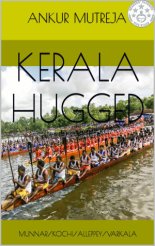
Ankur Mutreja has a very personal way of describing his relationships with landscapes, objects, and events. His description of muddy roads, busy towns, river trips, friendly people and home-stays brought back my own experiences there (I ate some of the best food I’ve ever eaten anywhere in the world in Kerala, the spice-growing area of India).  As he wrote about free-wheeling down through the tea-gardens on his hired motorbike, I thought of all the people we had met doing exactly that.

The writing is lyrical, and it’s clear the author fell in love with this area (just as I did). It’s far from the usual travel book: you’re not going to read detailed reviews or directions, or a list of the top attractions. It’s much more personal than that! It’s his impressions, emotions, reactions to the location and his experiences there, much written in almost poetical language.

When I first wrote this review, I commented that the biggest lack in the book was a map.  The author has since added one, much to the benefit of the reader who does not know southern India.

So…not a typical travelogue, but one I personally enjoyed. 4 stars.

I received a copy of this book in exchange for an honest review.
Shadow Magus, by Rob Steiner: A Review

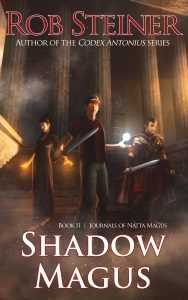
shadow_magusShadow Magus continues the adventures of Remington Blakes, aka Natto Magus, a 21st-century American magus transported to 1st century Rome.  (It’s not necessary to have read the first book to enjoy this one, but I’d recommend it.) Steiner continues to blend good writing, likeable characters, fast action and sense of humour in a well-paced and well-plotted story.

I reviewed the previous book in the series, Citizen Magus, about a year ago, giving the light-hearted and fast-paced fantasy five stars. The sequel continues the mood and quality of the first book.

Another magus, with a type of magic that Natto Magus can’t identify, appears in Rome…and apparently bent on destruction. Caesar Augustus needs Natto’s help to save Rome. From the Circus Maximus to the underworld of Egyptian mythology, Remington pursues the magus in a desperate quest, while not losing his own life to this new power.  Even Remington’s household god Lares gets involved in the crusade.

I don’t want to give away too much of the plot.  But as in the first book, Steiner captures Ancient Rome in all its crowded, smelly reality, without ponderous archaeology weighing the book down.  The magic remains internally consistent and very well described, even the new type of magic the intruder brings, and the historic backstory to the conflict is accurate.  And Natto Magus’s character continues to develop; the next in the series should prove quite interesting!

Five stars to the second installment of a fun series.

I received a copy of this book in exchange for an honest review.

Lands of Dust, by John Triptych: A Release-Day Review

Lands of Dust is the first book in a new series by prolific indie author John Triptych.  In a dying world of sand and dust, where humans cling to life by farming algae and fungi in the barren wastes, a child is found unconscious in the sands.  He has no memory of life beyond the torture he endured at the hands of the Magi, and all the mind-probing skills of the village Striga, the wisewoman with psi powers, cannot find out more.

Prophecies exist that foretell this child, and in the course of this first story in the series, the village is challenged to give up the child; the price will be their lives if they disobey.  Can Miri, the Striga, herself an orphan of the sands, the village ‘teller’ (the keeper of the village’s history), and a young brother and sister keep the boy safe, and fulfill the destiny outlined in the prophecy?

Triptych is a good story-teller.  As a fast-paced adventure s in the ‘magical child’ sub-genre of fantasy/sci-fi, this is a good story.  I wanted to know what happened to Rion, the child; I wanted to see how the prophecy played out.  For sheer enjoyment of a story, I’m giving it 4 stars.

But while Lands of Dust is a good story, it’s not particularly well-written.  The world building is good, lots of background; the pacing is good, but the flow of many sentences is middling and there are frequently places where less verbosity would have benefited the writing.   Action sequences often end weakly.  There are questionable uses of commas.  Does this matter?  Not if the adventure is your primary reason for reading.  But to me, it does.  I continue to hold self-published books to the same standards as traditionally published books.  So, for the competency of writing, I’m giving it 3 stars.  Overall, I’m rating it at 3.5, which will translate on Goodreads and Amazon as 4.

I received a copy of this book in exchange for an honest review.


Shaman Machine the Mentor, by Trenlin Hubbert: A Review

On one level a meditation on sentience and consciousness, on another a story of shaman-machineexploration and adventure on a water-world, Shaman Machine the Mentor contains some beautifully-written and insightful passages:  “A commotion of scraping chairs opened a slim gap of welcome.”; or, “I grew up in a house filled with chaos,” he replied. “I was crowded out by indifference.  There was no room for a child in there.”

Both these passages occur in the first third of the book, where the writing is noticeably stronger than the rest of the narrative.  After a promising beginning, introducing us to the robot Chance, the wandering free spirit Ziggy, and the contained city in which Ziggy tries to find some semblance of freedom, the story extends outward to encompass another group of characters, and then another, and a different world.  In this widening of the scope and themes, the story loses its centre. The core characters in the next two-thirds of the book, the troubled architect Alex and the bot Chance, are trying understand each other and their worlds. Alex uses shamanic drugs and alcohol to try to still his critical, sarcastic mind but refuses to accept a different reality when it’s presented to him.  Chance uses its programming and its capability to learn from conversation to expand and encompass the new experiences presented to it. The machine appears to be master to the man.

There’s a good novel in Shaman Machine the Mentor. The book would have benefited from a developmental editor who could have guided the author towards a tighter and more focused narrative. As it stands now, there are too many events that don’t seem to really add to the story and an almost scatter-gun approach to events which the reader then needs to tie together. Some of the technology as proposed was fascinating but not fully fleshed out: the use of sound-clips from a new world to create interwoven agglomerations of spheres as the building blocks for a new city on that world, for example, should have been more important than it was, given the world’s reaction to that city. I wanted to know why the sentient beings of this world reacted as they did to a city based on their own ambient sounds, and how (if) that technology was used as they moved forward.  And while the ending is ultimately beautiful and appropriate, it is reached as an epilogue.

But regardless of its flaws, both the structural ones I have discussed and its need for a copy-editor to weed out inappropriate commas and semi-colons, and the very occasional mis-used word, I find myself contemplating the themes of, and questions raised in, Shaman Machine the Mentor well after I finished the book.  They are not superficial questions, but ones that ask us to think about the meaning of ‘humanity’.  Overall, 3 stars.

I received a copy of this book in exchange for an honest review.

Lena’s World: The Social Structure of Empire’s Daughter

In Empire’s Daughter, men and women lead very separate lives, the women living together, primarily in farming and fishing villages, the men in mandatory military service.  Male children are taken at age 7 to begin military training; girls are educated in their own villages, and then apprentice to a trade.  Where did these ideas come from?

There isn’t one source, one society that I borrowed from.  The idea of male children being taken at seven into military training is from the social structure of the ancient city-state of Sparta, where exactly that happened.  Spartan boys were basically cadets until age 20, when they took on greater responsibility in the military; they could marry at 30, but did not live with their wives, but stayed with their military comrades in barracks….and that was the germ of the idea of the men and women living almost completely separate lives, except for a couple of weeks each year.

The Roman Empire’s military structure also influenced how I envisioned the lives of menroman_soldiers_at_rest2 in the Empire. Roman soldiers served 25 years in the military, and could not (officially) marry unless they were of officer class, although they often formed permanent relationships with local women.  But again, it was that sense of a primarily masculine life that influenced how the men live in Empire’s Daughter.
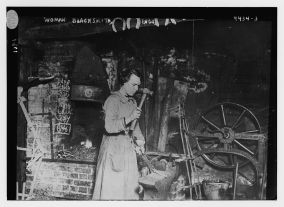
The lives of women were influenced by a number of sources: Icelandic and Viking women, for one, where women frequently were completely responsible for farming and fishing and all the other work woman_blacksmith_-_eng-_i-e-_england_loc_24225694456while the men were at sea, either fishing (Iceland) or raiding (Vikings).  The apprenticeship of girls at twelve to a trade is simply based on long practice throughout much of the world, for both boys and girls: even my own grandfather was apprenticed at age twelve to a coal merchant in England, in about 1896. (The photo is from England, c 1915-1920)
Now, as to why there is this tiny, isolated Empire at the edge of the world, underpopulated and ring-fenced by the Wall, the mountains and the sea….well, to say more would need a big SPOILERS alert.  You’ll have to read the books to find out!

Empire’s Daughter, book one of the Empire’s Legacy series, is currently available from Amazon in e-book format or paperback.  Look for book 2, Empire’s Hostage, around June of 2017!

Roman soldier picture: By Pablo Dodda (Flickr: Roman Soldiers) [CC BY 2.0 (http://creativecommons.org/licenses/by/2.0)%5D, via Wikimedia Commons

Woman blacksmith picture:  Bain News Service; taken in England c 1915-20; courtesy of Wikimedia Commons.  No known copyright restrictions.


Freebies and Giveaways!

Empire’s Daughter is the critically-acclaimed first book in my Empire’s Legacy series. Set in a world inspired by Britain after the fall of the Roman Empire, Empire’s Daughter asks hard questions about gender roles, the personal price of a stable society, and the demands of love and loyalty in a time of war.  For a few days (Dec 7 -11) you can download  Empire’s Daughter for free on Empires cover 3Amazon.

If you’d prefer a chance at a paperback, enter the giveaway on Goodreads (Canada, US, UK and Australia only for this one, sorry!)

Lena’s World: Empire’s Daughter Backgrounder part 1

This is the first in an occasional series about the historic and geographic background to my historic fantasy series, Empire’s Legacy.

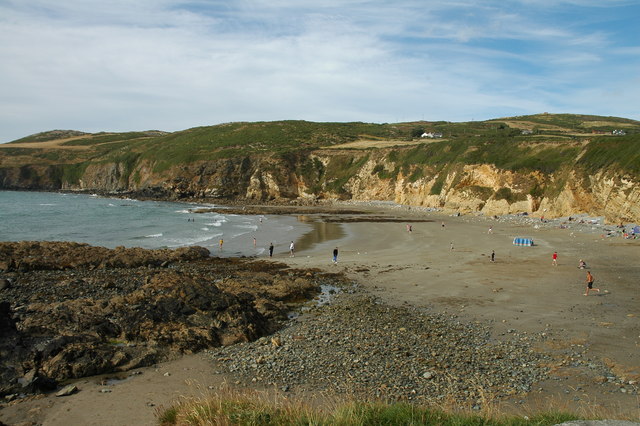
Lena’s world, in the Empire’s Legacy trilogy, is imaginary, but at the same time it isn’t: it is firmly rooted in the landscape and history of Britain and Northern Europe.  I started writing Empire’s Daughter with nothing more than an image in my mind, an image of a young fisherwoman, a fishing village, and the harbour and hills.  But the picture in my mind wasn’t imaginary: it was Anglesey, Ynys Môn, an island off the coast of Wales.

porth_swtan_or_church_bay_-_geograph-org-uk_-_414251

So, when I picture Tirvan, this is, more or less, what it looks like in my mind.(Remove the modern aspects!)  The fishing harbour would be where the beach is; the village houses close to the harbour (perhaps the cliffs aren’t quite so steep, at least in one area), and the meeting hall, the baths, the forge and the sheep-fields further up the hillsides.

This landscape isn’t unique to Wales; you’ll find similar coastal coves along much of the West Country of England, on both coasts, and throughout Scotland.  And I’ve only been to Anglesey once, but still, it was that landscape that began the book.

And likely influenced its development.  Anglesey was a holy island to the pre-Roman people of Britain, and associated with the resistance of these people to Roman rule, that resistance centred in their priests, the Druids.  In AD 60, the Roman general Paulinus attacked Anglesey, destroying sacred groves and shrines, and in folk memory driving the Druids into the sea. It took a few years (and a few more battles for supremacy within Britain) but by AD 78 Anglesey was firmly under Roman control, the Romans building forts, mines and roads on the island. (At least one road is still in use).

I knew all this, from various courses I’d taken and books I’d read. So, when Anglesey arose in my consciousness as the referent for Tirvan, it brought with it all these Roman associations…which in turn led to me modelling the Empire’s military on that of Rome, and indeed the basic infrastructure of the Empire on that of Britannia (Britain) during its time of Roman rule.

In further installments, I’ll talk about how other aspects of Roman military and non-military life influenced Empire’s Daughter, and where and why it deviates completely from any known history. (That is why I call it historic fantasy; there’s no magic, which the word ‘fantasy’ usually connotes, but it certainly isn’t history! Maybe I should call it ‘imaginary history’!)

Photo: Porth Swtan, by  Graeme Walker [CC BY-SA 2.0 (http://creativecommons.org/licenses/by-sa/2.0)%5D, via Wikimedia Commons

Coffee, anyone?

It’s the first of the month, the day my Amazon payments show up in my bank account.  T.S. Eliot wrote “I have measured out my life in coffee spoons,”….well, I measure my royalties by how many cups of coffee I can buy.  This month it’s two, as long as they’re from Tim Horton’s or McDonalds, and nowhere fancier.

I’m not complaining…. I knew I’d never make a lot of money at this, and if a few people are still buying one of the books each month, that’s good.  There are a few more dollars trickling in from paperback sales at different sources too.  This afternoon I’m heading downtown to a couple of other stores that I’ve heard are open to carrying indie author books, and to give a few copies away to the annual books-for-kids (up to 18 years, so Empire’s Daughter, as a young adult book, qualifies).  And I’ll probably stop at my favourite coffee shop….and blow my entire month’s Amazon royalties on one cup of coffee!