The Rowanwood Curse, by Elizabeth O’Connell: A Review

In a world where magic helped the industrial revolution begin, the sons of one of the greatest industrial magicians England has known are called upon to lift a curse laid on the daughter of mine owner Jasper Pryce. Bored with the routine probate magic they are practicing, they accept the offer, and travel north to find the girl near death, the local farmers besieged by a beast, and the mine itself beset by problems.

Reminiscent of Susanna Clarke’s Jonathan Strange and Mr Norrell, but less dense and less complex, The Rowanwood Curse nevertheless is an enjoyable read. Author Elizabeth O’Connell writes in a consistent period voice with almost no mis-steps, giving us tantalizing glimpses into a world where magic is part of everyday life, practiced by those trained in it and both revered and rejected by those who are not initiates. Because magic, as it exists in O’Connell’s world, behaves consistently with traditional faerie and elemental magic known to us from children’s books onward, there is little cognitive dissonance for the experienced fantasy reader: the tale is one of familiar elements, not surprises. Nonetheless, the story is well-crafted. The Rowanwood Curse is one of a proposed series, and therefore its lack of detail in world-building is more teasing than annoying: I want to know more about aether-engines, and probate magic, and all sorts of things hinted at but not fully explained, and that desire to know more will bring me back to the series, as the author intends.

The Rowanwood Curse is short, more novella length than full novel, and fairly predictable. The characters – magicians Hal and Jem Bishop, industrialist Sir Jasper Pryce – will feel familiar to readers of Victorian-era stories and/or those of us addicted to BBC period dramas. In short, I’d describe the book as a comfortable excursion into an almost-known magical world, a good book to curl up with on a rainy afternoon (or as I did, read on a flight, where escapism without significant challenge is an antidote to the discomfort of flying); bake some gingerbread, brew some tea, light the fire, (diet coke and pretzels really didn’t quite suit it) and enjoy the story. Four stars.
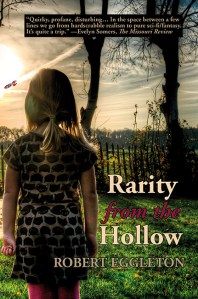
Rarity from the Hollow, by Robert Eggleton: A Review

Rarity from the Hollow is subtitled A Children’s Story. For Adults. The author, Robert Eggleton, 1 Rarity Front Cover WEB (2)writes with the accuracy of familiarity about the lives of children caught in a multi-generational cycle of abuse; of men scarred by war and poverty, of PTSD, of the coping mechanisms of wives and mothers trying to hold families together.

The opening scenes of this book are difficult to read and harrowing in their blunt depiction of the kinds of abuse that Lacy Dawn, the protagonist, and her friend Faith experience. As Lacy Dawn narrates the story, elements of fantasy begin to develop, fantasy that then changes to a coherent, but oddly detached story of extra-terrestrial (and human) intervention. The extra-terrestrial intervention addresses primarily the psychological and behavioural issues confronting Lacy Dawn’s family; the human intervention – of a type beyond (or above?) the law, in a renegade Gates Foundation way – provides employment and support.

The book could be read, I think, as pure fantasy, revealing Lacy Dawn’s imagined escape from the cruel realities of her life, or, as a satire on the hurdles faced by agencies or individuals attempting to intervene in the lives of families caught in the vicious cycle of abuse. Or, perhaps, a combination of the two. I lean toward the latter. In either case, it is not a particularly easy or enjoyable read, the reality of the described lives always in the back of the reader’s mind, emphasizing the unreality of the unfolding events. A strong element of sexuality, realistic but disturbing given the age of the protagonist, remains throughout the story. But it stands in good company: I can think of other disturbing satires that have been difficult to read, but carry a strong message: A Clockwork Orange, for one.

This is not a book for children, or even for teens, and it is not a book for those who are looking for escapist fantasy. Rarity from the Hollow pulls no punches: even though some passages are very funny, it is unlikely to be those the reader remembers. It’s also a book you’ll likely need to take breathing spaces from. But I remain glad I was offered it to review. I’m giving Rarity from the Hollow four stars.

All proceeds from the book have been donated to a child abuse prevention program.

Available on AmazonLulu, or from Doghorn Publishing.

After the Queens of the Sicarii, by William Wire: A Review

Social Agent Nancy Rose inhabits a dark and dangerous world, where she must navigate a complex, convoluted underworld where power resides in the few, lives are short and shadowed, and the lines between law enforcement and the underworld are blurred.

Several generations after a virus has destroyed all men, scientists have found a way to return men to the world, but there are those – the Queens of the Sicarii – who oppose this. Nancy Rose has her own complex relationships with men, and her own motives in the pursuit of her duties may be suspect. While Wire’s novel is science fiction, it owes much to classic crime noir.

Wire writes in a style that strongly evokes the dark mood and setting of this story. Characterization and character development reflect the noir genre, revealing just enough about the protagonist, her allies and her enemies to move the plot forward. The first book in an intended series, it could be argued that the world-building is a bit weak, but more is likely to be revealed in further stories. There were times I found myself slightly confused about the motivations of some characters, and I found the the pacing a bit uneven.  But overall, After the Queens of the Sicarii kept me intrigued and entertained. Wire’s world may be post-apocalyptic, and his protagonist is a young woman, but this is far from the various Hunger Games or Insurgent clones that are offered to me for review.  Four stars for this debut novel from a talented new author.


The War of the First Day, by Thomas Fleet: A Review

The War of the First Day, by Thomas Fleet, is a rollicking, fast-paced adult fantasy novel. Witch-aspirant Lilta kidnaps the Taxian royal heir on the instructions of her mistress, but rapidly discovers she is caught up in a complex web of betrayal within her own kind. In attempting to both survive and negotiate the civil war that erupts in the Witchlands, Lilta must embrace her own magical powers and make decisions to act independently, risking not only her own life but potentially much, much more. As the magical Day of All Centuries approaches, Lilta must decide to act before the traitors of the Witchlands use the power of the day for their own purposes.

I really enjoyed this book. It’s not easily classified: it certainly isn’t classic (or stereotypical) high fantasy: magic is at the heart of the story, but guards who shout “Shit, a witch!” and witches who refer to another witch as “You traitorous little bitch,” are not voicing the usual expressions to be found in high fantasy. But while the characters use language and expressions that sound like fairly typical 21st Century North American speech, it is not out of place in the complex world Fleet has imagined. This is a world of political rivalries, where characters jostle for power and will go to any length to obtain it: it just happens to be one where magic is the chief weapon in use.

There are a lot of twists and turns in this story, and I don’t want to spoil it for readers. At its heart I read it as a coming of age story, where the protagonist Lilta must learn for herself the extent and limitations of her magic and the price for using it. There are aspects of traditional concepts of women’s power, especially that of the tripartite goddess figure, woven into the story, as well as links between magic and mathematics which are familiar from a number of sources. Fleet interweaves these influences and concepts with skill, building a believable world both in terms of the magic and the politics.

The ending of the story, without giving it away, was conceptually reminiscent of the endings of stories by some of the science-fiction classics from Asimov, Clarke or LeGuin: a surprise, and one that leaves the reader thinking.

The writing is highly competent, active narration occasionally interspersed with descriptions of precise beauty: “Far above, a line of birds flew, their beating wings flashing in the sun’s rays. The pulse of brightness played up and down their line like the sun on water, a glittering, fluid flow of light.” The pacing is solid, Lilta’s internal dialogues and realizations occurring naturally within the flow of action. I found no production errors in the e-pub version I read.

Overall, while this will not be a story to everyone’s taste – in part because it isn’t easily classified into a genre – I’m giving it five stars. Please note this caveat: this is, due to sexuality and language, a book for adult readers, not a young-adult fantasy.

The author provided me with a copy of the book in exchange for an honest review.

Bleeding Snow, by Caroline Peckham: A Review

Bleeding Snow, the sequel to Creeping Shadow, is the second book in Caroline Peckham’s Rise of Isaac fantasy series for young adults. The story continues from where it left off. Oliver and his compatriots, including his grandfather Ely, have crossed into Glacio in an attempt to reach Brinatin and save May’s life by lifting the curse. They are rapidly captured and jailed for illegally using a Gateway. The ensuing consequences make up the bulk of the story in Bleeding Snow, along with the continuing back-story involving Oliver’s parents and Isaac.

I found this second book less compelling and more derivative than the first volume. The book continues the action and moves the story forward, although not very far in the terms of finding a cure for May. Faced with a huge obstacle standing between them and their goals, the group has to adapt and compromise. The plot, and the action resulting, take centre stage over character development, but there is enough growth (and romance) to continue to make the characters interesting. It’s always difficult to fairly judge the second book of a multi-book series: they are frequently bridges between the introduction of characters and their challenges and the climax of the action in a further book, and cannot be fully assessed as a stand-alone novel would be.

We do learn more about William, Alison and Isaac, and how this back-story intersects with the immediate action involving Oliver, May, and the others. I found this thread of Bleeding Snow and its development more satisfying than the main story, as it appears that, in the overall story arc, the developments here are of more consequence than the events that befall the protagonists in this book. But only time and the next book will confirm or contradict that supposition!

I did, however, have serious niggles with this book, falling into two categories: plot, and errors of grammar and spelling.

A large part of the book is taken up with a journey in the winter world of Glacio and the rescue of a kidnapped prince from the evil trolls that mine gems in the caves. Unfortunately, this read to me as being heavily influenced by a combination of the attempted journey over Caradhras and the Redhorn Pass in The Fellowship of the Ring, Thorin and Co.’s adventures in Smaug’s cave in The Hobbit, and the battles in Moria. The escape sequence that ends this adventure again appears to owe much to Indiana Jones and the Temple of Doom. This may not have been the author’s intent, nor even her influences, but that is how they came across to me.

As far as grammar and spelling, there were more errors than I like to see in the text, the most jarring being the mis-use of ‘effect’ or ‘effected’ when ‘affect’ or ‘affected’ is meant, and the mis-spelling of ‘mat’ as ‘matt’. The inclusion of the non-standard grammatical structure ‘was sat’, which is ubiquitous in the UK, should also, in my opinion, been caught by the editors. A few other minor errors occurred, but these were the ones that caught my eye. However, the author assures me these will be corrected.

Overall, then, I’m giving Bleeding Snow three-and-a-half stars at this point. That may change after the next book, when I can more fairly rate it as part of the overall series. Three-and-a-half stars means I like it, but found some significant flaws. I would still recommend the series to someone looking for an undemanding, entertaining young-adult fantasy story.
The author provided me with a copy of this book in exchange for an honest review.

Sailor to a Siren, by Zoë Sumra: A Review

In a complex universe of humans and aliens, sectors and rivalries, guns and magic, two mercenaries, brothers Connor and Logan Cardwain, become involved in what appears to be a drug sting so convoluted they are soon tumbling through a maze of betrayals and corruption, not sure what turn to take or whom to trust. As they are torn between relationships and survival, a deeper secret emerges, threatening not only their own plans and lives but the entire political structure and detente of the galaxy.

Sailor to a Siren is classic science fiction, belonging to the genre that gave us Dune and The Sardonyx Net, complex, multi-layered, multi-generational examinations of politics, ethics and personal choice, combined in this instance with rapid, bloody, action and strong prose. Author Zoë Sumra’s world-building is the best I have seen in a very very long time, conjuring with minimal explanation a developed, complex universe where family, sector, marriage, and magic all interconnect to create a hierarchical structure whose subtle nuances concerning power and influence unfold over the course of the novel. As Logan and Connor are drawn more deeply into the conflicts among the sectors, their own choices, forced on them at times at bewildering speed, are not simple, nor are they portrayed as such. Sumra shows us the difficulty and anguish of such choices in the context of this universe, making the brothers (and other characters) fully-realized people, without moralizing or over-describing.

The magic of Sailor to a Siren is integral to the novel, but this is no high-fantasy story. Magic is, and it is at the heart of the power structures and the conflicts into which Logan and Connor are drawn. Again, the structure, parameters and power of magic in this world are revealed as part of the story, glimpses and hints and demonstration showing again the skill of the author in subtle, effective world-building.

This is one of the rare books where I have no ‘niggle’ to report. Production quality in the ARC PDF copy I read was faultless. The pacing of the novel is rapid, with the writing matching the action, punctuated with descriptions of stunning precision and beauty: “Strobe lights and neon danced patterns in the carnival night, now and then kaleidoscoped by flurries of rain.” Passages like these are scattered throughout the book, allowing the reader a brief pause from the action, and an opportunity to appreciate the beauty inherent in this dark and violent world.

Five stars – five stars plus, if I could – for this outstanding debut novel.

The author provided me with a copy of this book in exchange for an honest review.

Finding Solace on Goodreads

Being both an author and a reviewer, I find writing not-so-rave reviews difficult, because I know first-hand how devastating they can be.  If I’m feeling particularly down over a bad review (and that can be either one I got or one I wrote  – regardless of how diplomatic I try to be, and how well I’ve managed to find some positive things to say, I still don’t like writing them) – I go to Goodreads, and the reviews posted on the sites of authors I believe write in a way I wish I could, those I read every chance I can, whose new works I actually buy (in hardback, even)….like Guy Gavriel Kay, or Neil Gaiman.  Why?  Because even these guys get poor reviews. I do it to remind myself that I as a writer will never be to everyone’s taste, and as a reviewer, I may dislike something others love, or love something others dislike.  It works.

How do you find solace after a poor review?  I’d love to know!


Spinnings garners more 5 star reviews!

Many thanks to reviewers Liz Scanlon at Cover to Cover and K.T. Munson at Creating Worlds With Words for their generous reviews of Spinnings: Brief Fantasies in Prose and Verse.  Read their reviews at the links below:

Cover to Cover

Creating Worlds With Words

Spinnings can be pre-ordered from Amazon; release date is March 25th.

Leaves of the World Tree, by Adam Misner: a Review

Leaves of the World Tree is a collection of short stories by first-time author Adam Misner. Taking place in a wide variety of worlds, the overall theme of the collection is that people are not what they seem: heroes are not entirely heroes, villians are not entirely villians. Misner is a young author with skill in evoking mood, especially dark moods, effectively. The stories have some interesting premises: of the collection, Olaff was my favourite story among them; the title character’s slow realization that the difference between being mediocre and being a hero is a matter of degree was handled competently and the story is defined in its purpose. The enigmatic 3 A.M. was a close second, though.

The stories are uneven in execution. The longest, Amorphous, is in my opinion the weakest; it has an ‘outline’ quality to it suggesting the author might wish to consider expansion into, perhaps, a novella. Shorter stories – Olaff, There are No White Knights – are tighter, the writing more focused.

The production quality of the paperback is less than stellar. There are changes in font size not related to the story and first-line indent issues. While these don’t detract from the stories, they are just a small annoyance that could have been avoided. The book cover by Jorge Jacinto, evoking Yggdrasil, the World Tree of Norse mythology, is attractive.

Overall, I’m giving Leaves of the World Tree three stars. Short stories are a difficult form, and Adam Misner has made a good start in some of the stories in this first publication. As he matures as a writer, I’ll be interested in reading what he produces.

The author provided me with a copy of this book in exchange for an honest review.

Halcyon Dreamworlds, by Lee Baldwin: a Review

Imagine a world not too distant from our own, where the current research into neurological bridging between human minds and computers has become a reality….a two-way reality. The entertainment-industrial complex, run by the rich elite of the world, sees the potential for complete mind control, bringing the mass of workers into line through implanting ideas and reactions into the brains of all participants in the virtual reality game Halcyon Dreamworlds, through the simulation’s neurological controller. As Halcyon Dreamworlds is already the escapist alternative to the drudgery of daily life for many, if not most, of the population, there seems little to stand in the way of this plan.

Logan Fischer, big-box-store drudge with a past marked by failures she’d like to forget, is one of those whose alternative life in Halcyon Dreamworlds is more appealing to her than her reality. She is nearly swept away entirely into the glittering, decadent sexuality of the simulations, until her one trusted friend and family member is found dead…and the cause may be the neurological bridge, the ‘spider’, that links his brain directly with the computer program. Devastated by this loss, Logan finds herself being drawn deeper and deeper into the converging worlds of the police investigation and the lives of the elite who control Halcyon Dreamworlds, and who count no cost too great in their bid for world domination.

Fast-paced and complex, Halcyon Dreamworlds is believable science fiction, raising questions about technology that are relevant and challenging. Author Lee Baldwin’s background as a human interface designer in Silicon Valley no doubt adds to the veracity of the technology and its potential. The political issues in the background of the novel are the political issues of today, if more extreme, also adding to the sense of possible reality. There are no huge dystopic events here, only the expansion of climate change, the decline of the middle class, and an increasing isolationism in the West.

Baldwin uses language effectively, with a flair for description and dialogue. Characters are complex, with the main characters presented as more than stock figures, and in the case of the protagonist Logan, with a back-story which shapes her actions.

If I have one niggle it was the novel’s pacing, which I found to be a bit uneven, not quite hitting the right balance for me between world-building and narrative action. Production quality was good; I noted one mis-placed comma in the Kindle version I read. Overall, 4 stars for a thoroughly entertaining and thought-provoking story.

The author provided me with a copy of the book in exchange for an honest review.