This past month, when I wake in the night, there’s almost always a tawny owl calling outside – which is a hint that I’m not in Canada. Several things brought us to England in September, largely research for An Unwise Prince, my work-in-slow-progress: a chance to tour a medieval merchant’s house that’s only open a few times a year; the Silk Roads exhibition at the British Museum (and its medieval exhibits); Peterborough Cathedral, built as an abbey in the 13th C, which will become the physical model (more or less) for the school in the new book.
Peterborough Cathedral Precinct. My photo.
But also, of course, the birds, and the long walks, and in the four weeks we’ve been here we’ve had four days of serious rain. Most have been sunny. We caught the last of the summer birds, chiff-chaffs still singing, and the first of the winter migrants, pink-footed geese and redwings, as well as two birds new for the UK for us, yellow-browed warbler and cattle egret. The saltmarshes are washed pink with sea lavender, the hedges are bright with rose hips and hawthorn fruit and blackberries, and filled with red admiral and fritillary and cabbage white butterflies. Deer – roe and muntjac, fallow and Chinese water – browse field edges and park, and on the mud of the marshes probe godwit and golden plover, redshank and curlew.
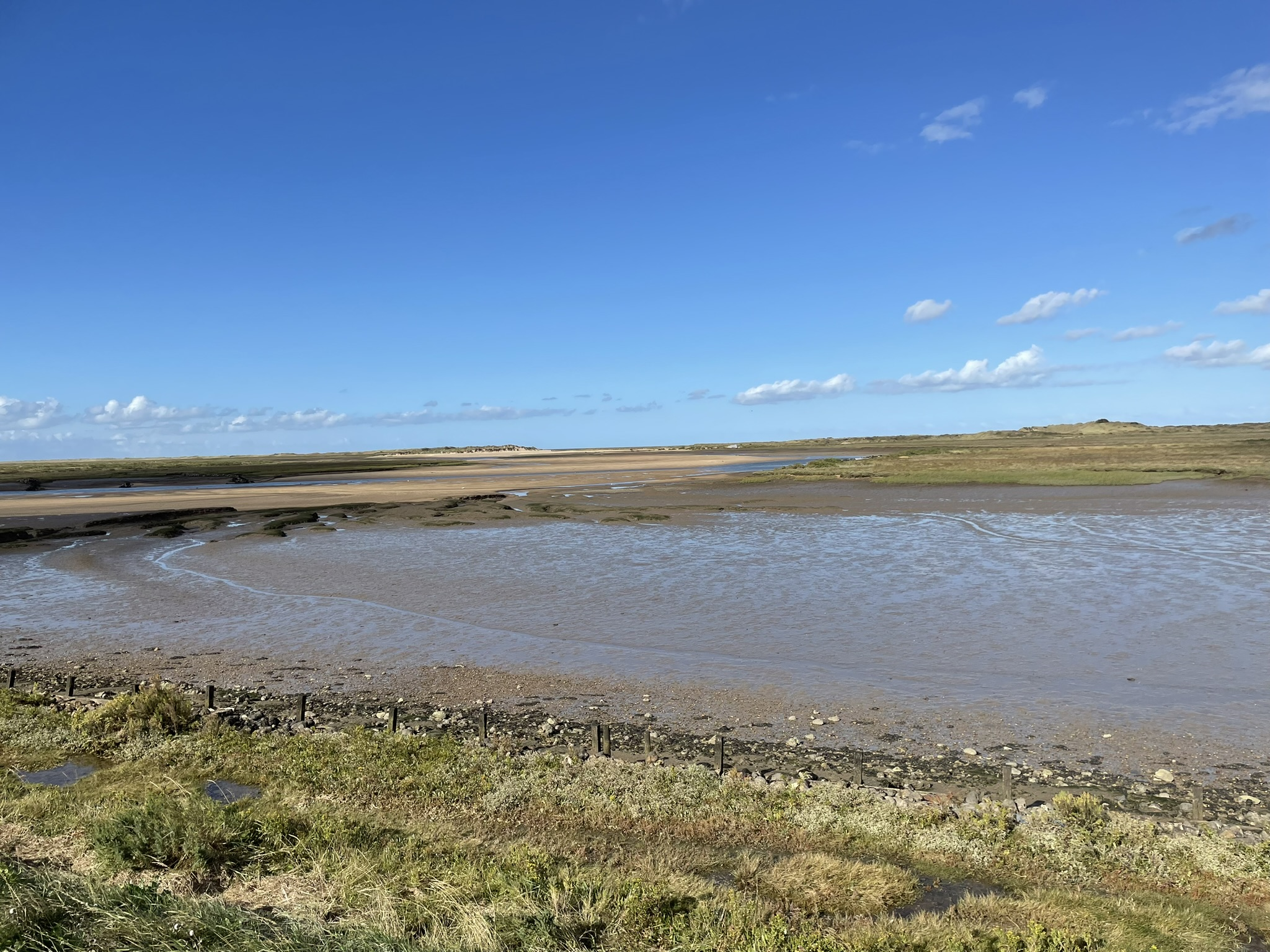
Burnham Overy Staithe harbour. My photo.
Yes, but how’s the book coming, you ask? I’m about 30,000 words into the first draft of what’s going to be the most complex book(s) I’ve ever tackled. It’s already clear it isn’t one book. I thought there were four point-of-view characters. Ha! I’ll be lucky to get through the story without adding at least another four. I’m borrowing from the Hanseatic League, medieval universities, Byzantium-North African-Arabic interaction, 12th C silk roads trade, intellectual exchange around the entire Mediterranean, the Mongol invasion of both the middle east and eastern Europe, Genoa’s near trade monopoly in the eastern Med, and the first crusade. All I can do is trust the process – do the research, let it marinate, and write down the words my characters dictate.
This are the tentative covers for the first two books. If it turns out to be more than a duology, the theme is easy to work with.
You may have noticed I’m not doing many updates here now. I will try to do monthly ones, but a much easier way to keep up with what I’m writing – short stories, poetry, non-fiction and a chance to read Empress & Soldier for free as a serialized novel – is to join me on Substack. My fiction site is History & Imagination; my non-fiction site is Landscapes of Memory.
Inspiration and understanding can come from the most unexpected sources. In my other blog, which focuses mostly on writing – mine and others’ – about the natural world, I mentioned, a week or two ago, that I was reading a collection of essays about landscape and place called Going to Ground. One of these essays is by Amina Khan, on the link between Islamic writing about nature and the Romantic movement in English poetry and prose.
My fictional world isn’t ours, but I can’t pretend it isn’t based on ours, and in the cultures I’m writing about, trade with my equivalent of North Africa and the Middle East is an important part of the story. In an earlier instalment of this series, I wrote about my youngest point-of-view character, Audun, and his love for the sea and sky and saltmarshes of Torrey, where he grew up. Audun is seventeen, academic, and of course he’s written some juvenile poetry.
Audun, being who he is, is expected to travel, to learn more of the world before he enters a life of teaching, his dream being to eventually be the head of my equivalent of a medieval university. His great-uncle, whom he hopes to emulate, spent a few years in his youth travelling east, gathering histories, settling down to a life of translation and comparison with the histories of the west. Luce, his aunt, is a doctor, much of her learning done in eastern lands as well.
But what Audun was going to learn in those travels (outside of life lessons, of course) I didn’t know. Until I was showering today (why do ideas so often arrive in the shower?) and my mind made the connection between Audun’s love for nature and the Islamic writing Amina Khan described in ‘A Wild Tree Toward the North’, her essay in Going to Ground.
Organized religions don’t exist in my books, replaced by philosophy and personal faiths in a wide range of deities. But religious writing can also be read for its poetry, and that’s how I’ll approach this. The bonus here is I’ll read some poetry that I probably wouldn’t have otherwise, and my world, like Audun’s, will expand.
Trade routes from central Africa to the Mediterranean, c 12-13th C. Illustration Cleveland Museum of Art. My photo.
Inspiration comes from many places, some random, serendipitous, some sought out. This week I drove the 1000+ km to and from Cleveland, to see an exhibition at the Cleveland Museum of Art called ‘Africa & Byzantium’, an exploration of mostly religious art produced in or resident in the lands of North and East Africa influenced by Byzantium.
But there’s no religion in your books, you might say. This is true – or rather, there are no large organized religions; personal faith is another matter – but it’s not religion per se that matters here. It was the communication, the translation of concepts and ideas I was interested in. The icon pictured below was possibly gifted to its Sinai monastery by Emperor Justinian himself, as he endowed the monastery in the mid-500s. It – and many other pieces of ancient art and writing – have been a part of the library of the Holy Monastery of St. Catherine since then.
In the new series set in my fictional world, the role of monasteries as repositories of knowledge and houses of learning is replaced by what the Ti’acha, the schools, of the Empire series have evolved into – the equivalent of the medieval universities not just of Europe but of the middle East and north Africa as well. So what writings – of philosophers from Casil and Heræcria and lands further east and south; of Heræcrian and Ikorani and Marai travellers, or even, at a more personal (for my new characters) level, of Cillian’s or Colm’s, Lena’s or Tarquin’s or Gnaius’s – might have found there way there, in original or copy, for Gerhart or Luce or Kirt to discover and learn from in their travels? Trade, medicine, history, mathematics, music, science: the knowledge held, exchanged, sometimes forgotten, the disciplines and interpretation of thought and ideas – all that still holds, even removing organized religion from the world.
I learned more practical, tangible things, too: the gifting of large brass trays, beautifully inscribed, as diplomatic gifts from the Mamluk sultanate; that a written language called Old Nubian existed; the trade routes from central Africa to the Mediterranean (invaluable); what block-printed linen of the period looked like; the three sources of treasured ivory. All useful things to be tucked away and possibly used, if and when they fit.
And, with pure serendipity, wandering the galleries before my entrance time to the exhibition, I walked into a room and saw – whatever the artist intended nearly 200 years ago – a portrait of my character Luce as a young student, studying medicine in an eastern school.
The Young Eastern Girl, Friedrich Amerling, 1838. Cleveland Museum of Art. My photo.
Driving home along Interstate 90, I could feel this information slotting into the background of my world, hear the characters taking it in, shaping it to their experiences (and being shaped by it), becoming part of the world and character building. Both the book(s) and I are richer for it.
I am deep into a book with the unprepossessing title of Trade and Institutions in the Medieval Mediterranean. It is, if I understand correctly, an adaptation of its author’s (Jessica Goldberg) Ph.D. thesis, and it is, for me, absolutely fascinating.
This is, in part, how the world – and sometimes the plots – of my books develop: I read a research book, and every few sentences I think, “Oh, I can use that!” There are four trade alliances in The Casillard Confederacy series (as I currently envision it): one based on the Hanseatic League, one on the Scandinavian Kalmar alliance , one (well, ok, this isn’t an alliance) based on a blend of the Italian city-states – think Genoa with some aspects of Venice – and one based in my equivalent of North Africa.
I had some varying degrees of knowledge about the Hanse and the city-states and the Scandinavian alliance. (They all still need research, though.) I had none at all about North African trade in the 11-13th centuries, except to know, barely, it existed. But in the Empire series, I’d made my character Druisius’s family traders and merchants operating both in my Rome analogue, Casil, and from the southern coast of the Nivéan Sea, which is, of course, basically the Mediterranean. The Casillard Confederacy is the same world, 500 years later, and the major characters are descendants of my original cast. Druisius’s family – some of them, anyhow – are still merchants and traders. Hence my need to learn about how trade worked in that period.
There are aspects of this book that don’t fit my fictional world – the focus is on the trade networks of Jewish merchants – the Maghribi traders – operating primarily in the eastern end of the Mediterranean (for an overview of the documents this detailed analysis is based on, see https://en.wikipedia.org/wiki/Cairo_Geniza) – but the organization of trade, the commodities, the methods of communication and transport, the difficulties to be overcome, how merchant apprenticeships worked – I can use all these. (And tidbits like the fact Jewish bankers in Old Cairo in the 11th C were using a double-entry bookkeeping system, predating any known usage in the Italian city-state banking systems. Maybe. If I can slip that in without it sounding like, look, I did my research!)
This is just one aspect of how I build both a world and a character. I immerse myself in the history – in this case the world of Mediterranean trade that Goldberg has so masterfully laid out, and it becomes part of one or more character’s story. If I’m lucky, that transfer will happen naturally, shaping who the character is, how they think, their loyalties, their presumptions of how the world works, the conflicts and dissonances that happen when confronted with another way of thinking and doing business.
But it’s not the only aspect. People are shaped by their cultural environment, but as I alluded to in the last entry in this occasional series, they’re shaped by their landscape, too. That will require a different sort of research. Meanwhile, back to bales of indigo and flax, and the tribulations of weather, markets, and unreasonable customs charges.
A novel – or its components: character, theme, plot, setting, language – has many sources, many experiences, real and imagined, that work together to create something whose whole is greater than its parts. I am a writer of place, of landscape, and of characters who are shaped by the places they call(ed) home. Many of those places are drawn from my own experiences.
In An Unwise Prince, one of my characters, Cenric, has stuck close to home, a medieval trading centre. Kirt, his partner, has travelled widely, an explorer, a risk taker. Luce has travelled too, but in pursuit of her education in medicine. Then there’s the fourth—young Audun, Cenric’s son, seventeen or eighteen, just finished what might be considered his secondary education, hoping to go home for a while before his next term of study.
I knew Audun was from Torrey, a coastal village (it has a few brief mentions in the Empire series) where his mother runs a workshop making baskets from the reeds and willows of the marshes. I’ve been reading pretty widely on the pre-drainage landscape and ways of life in the fen country of England—not so much for research but because it’s a landscape I love, a love that perhaps has its roots in my genes—or at least in family stories. I’d had a few thoughts about how to use this information to flesh out Audun’s character a little, but they hadn’t coalesced.
Then I started to read Nick Acheson’s The Meaning of Geese, a book about the flocks of geese that return each year to north and west Norfolk to escape the Icelandic and Scandinavian and Russian winters. Acheson—who is a friend of the friend who insisted I needed to read this book—writes in part about his own teenage experiences in the coastal marshes of north Norfolk; about places I know, have walked, can picture in detail. I can hear and feel and smell and see the birds, the wind, the salt in the air, the long views. And suddenly, I had my key to Audun.
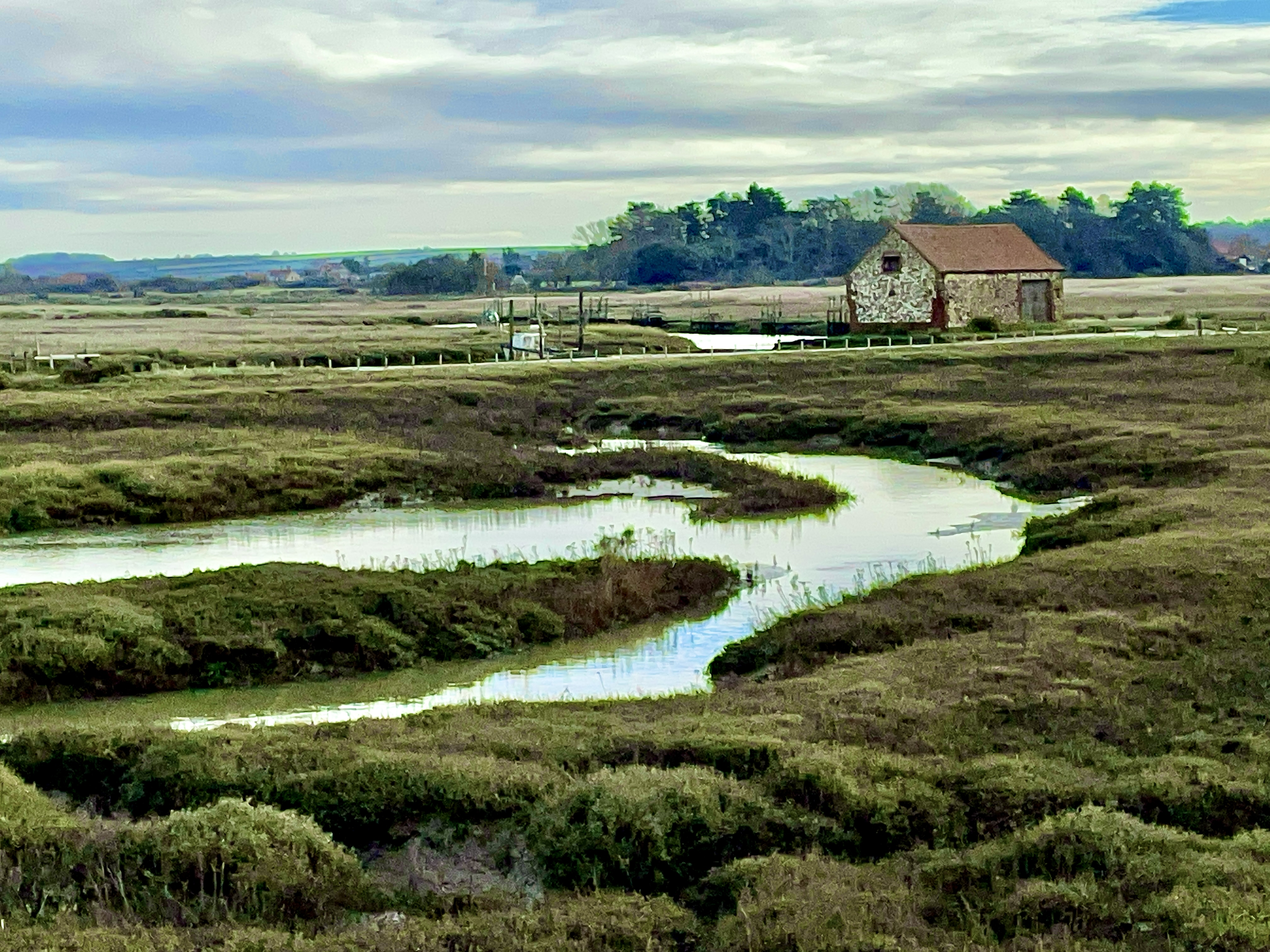
The Coal Barn, Thornham Staithe. My photo.
It’s not all there is to Audun, of course, but it lies at the heart of who he is. And gives him a knowledge that may prove useful, later in the story. Or so I think, at this moment in time!
Well, I didn’t expect it to be almost three months before I had anything more to say about the next novel! (The first part of this occasional series is here.) January, though, was mostly taken up with finishing other tasks, primarily getting Empire’s Passing ready for release and completing a contracted edit. February took us to Spain, a road trip for birds and Roman ruins and medieval city centres; one of the things I wanted to experience was how remnants of the Roman Empire (or the Eastern Empire, in my fictional world) appeared in a countryside that wasn’t Britain. Something beyond the familiar, to make me see.
Sadly, I don’t have a photo of the image that had the most impact: part of an aqueduct in a random field, and in that field, a man walking his dog. Living with this ancient piece of infrastructure as background to his everyday life. That was the sense I wanted; it will metamorphose, by whatever alchemy happens in a writer’s mind, into what it’s like, 500 years after we last saw my world, to live with the remnants — tangible and intangible –of a past empire.
One of the hardest things I had to find was some scholarly books with a good overview of European history of the later middle ages – roughly 1000 to 1400. Eventually, through discovering the online syllabus to a university course covering that period, and checking its reading list, I ordered two books:
I’ve also signed up for a six-week online course on medieval universities, as the Ti’acha of the first series have developed into something fairly similar (but without the religious context).
I’m still writing exploratory short stories, which can be found, one a month from January onward, on the A Muse Bouche Review. This is a way for me to get to know my characters, and some of the conflicts that the story will be based around.
As my research and character development continues, I’ve realized there are two big challenges ahead of me: which bits of European history to cherry-pick for the books (there’s a LOT going on in Europe and around the Mediterranean in these centuries), and, maybe even harder, to write a novel or novels with at least four POV characters. Two is the most I’ve done before.
But as the book gestates, moving from concept to reality, its lack of a working title was nagging at me. (Titles and book covers make an idea more solid, at least for me.) So here’s a cover mock-up: a place-holder image, and the working titles for both the book and the (presumed) series: All of which may change between now and publication!
‘A wise prince should establish himself on that which is in his own control and not in that of others; he must endeavour only to avoid hatred.’ The Prince, Chapter XVII Niccolò Machiavelli
Varril, the elected Princip of Ésparias when the story opens (at this point, at least!) is not a wise prince. Not at all. And on that, it seems, will hang the tale.
(As for the Casillard Confederacy – think of the Hanseatic League, often simply called the Hansard.)
Even before Empire’s Passing, the last book in the Empire’s Legacy series, was partially written, people were asking ‘what’s next?’ To be fair, I had a glimmer of an idea – the same world, about 500 years later, with some aspect of the story derived from the trade alliance of the Hanseatic League.
Passing is done now; I’m just awaiting the paperback proof. It’ll be out in February. I’m in no hurry to write this next book, for many reasons. Key among them is that I know little of 13-14th C history, so I have a lot of research to do. But books evolve not just from plot but from characters—after all, it is the characters’ responses to the problems and conflicts they are faced with that makes a book interesting. And for me as a writer, characters simply appear, with much of their personalities in place, immutable except through personal growth, their responses to the circumstances of their lives.
Over the next—how long?—year? more?—I plan to record the development of this next book, as much to see if I can elucidate my own process as for anyone else. But you’re welcome to come along on the journey as this yet-without-a-working-title book emerges from research and imagination and craft.
So: where am I now?
Five characters of some importance, so far; one minor ones. Who do we have?
Cenric bé Casille, who describes himself as ‘a man of mature years and a merchant of standing and not insignificant influence’. He’d be about forty.
Kirthan del Candre de Guerdián en Leste, more usually known as Kirthan de Guerdián, another merchant, described by Cenric as ‘made of autumn oak leaves, shades of gold and brown from the short curls of his hair to the tips of his polished boots.’ A few years older than Cenric, known to his intimates as Kirt.
Luce bé Casille, Cenric’s sister. Physician, musician, mid-thirties.
Of some importance is Cenric’s son, Audun, who is about seventeen, and currently attending the equivalent of a cathedral school (equivalent because organized religion continues to play no part in my world) at which his great-uncle (Cenric and Luce’s uncle) teaches. The so far unnamed great-uncle will be an important secondary character, I think.
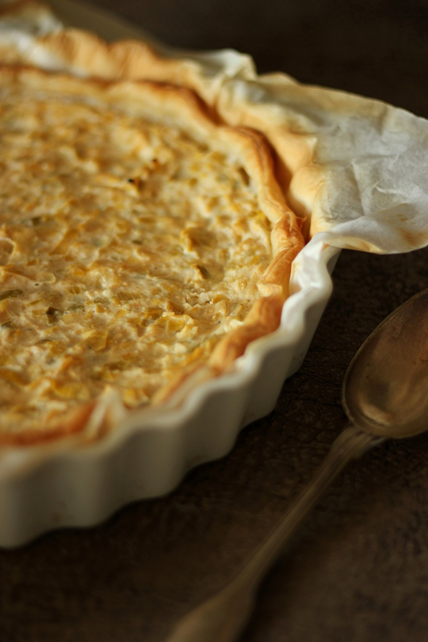
The first three characters (and the minor one of Cenric’s housekeeper) are introduced in an exploratory short story called The Onion Tart, published this month in A Muse Bouche Review. There will be more of these character-exploring stories: some may become part of the book, some won’t. I don’t think The Onion Tart will, but its description of the meeting of Cenric and Kirt will be background (and canon!).
Image by magdus from Pixabay
Meanwhile, while Cenric and Kirt and others tell me little bits about themselves, my first research book is Seb Falks’s The Light Ages: The Surprising Story of Medieval Science. Its focus is the 14th C, but the advantage of writing historically inspired speculative fiction is I can borrow from adjacent centuries, as long (my own rule) I’m not blatantly anachronistic with technology.
I was extremely pleased (to put it mildly) to have a chance to talk to David M. Perry, one of the authors of the brilliant new book The Bright Ages: A New History of Medieval Europe. I’m focusing on just a tiny part of what the book covers – it would be impossible to discuss all its themes.
David, my first stop at the British Museum is always the Sutton Hoo treasure. As an amateur historian of the period previously known as the dark ages, it has, to me, always represented the conundrum of the times for a researcher. It presents us with evidence of the interconnectedness of the world: the Sri Lankan garnets, the Byzantine silver, the lyre now suggested to share features with those of steppe cultures far to the east. The burial itself appears to follow traditions outside Christian practice: the ship itself, the grave goods—but some of those grave goods are specifically Christian. And at the same time, we don’t know for certain whose burial this is, because of the lack of written records.
In reading The Bright Ages, I was struck by something I hadn’t been able to articulate before, although it is important in my own fictional, alternative early-medieval world: the conception of places like Rome and Byzantium as cities of more than political importance, but occupying a space best described as sacred, or at least revered, in the mental geography of people who had (perhaps) never been there. The Byzantine silver in the 7th century Sutton Hoo burial would then be not just an offering to whatever gods there were to receive the dead king, but a direct and purposeful link to Byzantium as a concept. A connection to the holy. So, after that long-winded preamble, my first question is simply: is that a valid interpretation? Can you explain a bit further why or why not?
So in my formal academic career, I began as a historian not only of medieval Venice, but of narratives about the movement of objects (first relics, then other things) into and out of Venice, and the ways that people found and created meaning in things that came from elsewhere. People connect themselves in their current moment to places that are in fact far away, but are always present in their imaginary geography, through things (and through images, but often images of things!). I do think that the use of garnets, of Byzantine silver, of silks, of beautiful things from ELSEWHERE, and elsewheres associated with important positions in imaginary sacred geographies, is not an accident.
And in the places I know best, like high medieval Venice, or as in 6th-century Byzantium as we discuss in the book, or in the creation of Ste. Chapelle, again and again, we see that this re-ordering of the imaginary geography isn’t just something that happens, but something people do with great intention.
What interests me always is when people try to reorder the imagination but fail, because failures leave few records.
My first introduction to the intellectual exchange of ideas during early-medieval times came from reading about Alcuin of York. For readers who may not know much about him, to summarize, Alcuin, who lived about 100 years after the king buried at Sutton Hoo, was an 8th century scholar and teacher, educated at the cathedral of York. Sent to Rome on a diplomatic mission, on his way home he encountered Charlemagne, who persuaded Alcuin to join his group of scholars at Aachen, leading to the reformation of the palace school into a centre of learning, with methods and traditions derived from the schools of Greece and Rome.
Raban Maur (left), supported by Alcuin (middle), dedicates his work to Archbishop Otgar of Mainz Fulda, Public domain, via Wikimedia Commons
Charlemagne, of course, is a hugely important and powerful figure, crowned by the Pope as Roman Emperor in 800. He had betrothed a daughter to the Byzantine heir at one point. Rome and Byzantium were far more than concepts to him; they were real places, centres of power as well as holiness. Can you speculate – or more than speculate – on the effect Alcuin’s reformation of the palace school might have had on Charlemagne’s self-concept and ambition, and his efforts to create, at Aachen, a mirror of Byzantium’s sacred and secular power in both physical (the cathedral and palace) and intellectual/spiritual form?
For this question, I had to turn to my Carolingianist colleague and co-author, Matt. He said, “I think this is a bit backwards in that Alcuin didn’t really create the palace school, Charlemagne did. Alcuin didn’t transform it so much as accelerate the transformation, but it wasn’t to ape the East; instead it was to ape the late Roman West – Theodosius, Constantine, etc. In other words, Alcuin was not – by a longshot – the only exceptional intellectual in the late 8th-century palace school. people like Theodoulf of Orleans or Paul the Dean who floated around the court were movers and shakers as well.”
(John Julian Norwich said ‘Most British people know practically nothing at all about French history.’ and this is an excellent example of me relying on entirely British sources for my idea of Alcuin. I’m glad to have it corrected, and it’s a good reminder to me to broaden my reading.)
Jumping forward nearly 500 years, to France in the 13th century, Chapter 14 of The Bright Ages tells us about Louis IX of France, and the role the Sainte-Chapelle chapel played in his centralization of both secular and sacred power. But an earlier church – Saint-Denis – also intentionally reimagined Paris – or at least this part of it – into a sacred space in which light is used with purpose and thought to shape and guide what is experienced: a ritual landscape where light represents the true light of Christianity.
The windows of Sainte-Chapelle tell the story of the Crown of Thorns’ travel from Jesus’s head to Constantinople to the king of France – a ‘translatio imperii’ – transfer of imperial power, as you explain. But this isn’t just a transfer of secular power, but of the implied approval and blessing of the Christian god. The Crown of Thorns creates a direct link between Jesus and Louis IX, giving him immense power beyond simply political.
This creation of a sacred, ritual landscape is nothing new: from the first cave paintings that move in flickering light, to the solstice-aligned bronze age monuments and the oculus in the Pantheon, people have consciously set about to create wonder and mystery linked to religious belief—and light. But it appears that in 12th and 13th century France, this was being done quite purposefully, in a way that to 21st century eyes looks almost clinical, like Disney designing an attraction to maximize gasps and awe (and pilgrims exiting through the gift shop?) Can you expand a little on this – is there a dichotomy here? And secondly, although this might need an entire book to answer, how did Abbot Suger know/learn to design such a ritualized, psychologically-influential landscape?)
This question ties directly in to your first, with Ste. Chappelle crafted as a way to try and create a new center of gravity for world (from the point of view of Louis IX and his supporters) by not just relocating the relics of the Passion, but installing them in grandeur, giving them a site from which to re-order the world. But you’re right, the place to understand how we reach here in 13th century France is to drop back a century and look at Abbot Suger.
The great historian of the topic is Erwin Panofsky, whose works not only contain the key translations of Suger, but also analysis of the Abbot. What’s amazing about Suger is not only that he built such glorious spaces, but that he articulated a theory of light and beauty, a viewer-response theory, that in gazing about the most glorious sights of earth, the viewer would be transported to the true glory of heaven. I read it – and of course I’m not alone – as neoplatonic in nature, or similar to how St. Augustine told medieval Christians to read scripture (starting at the words themselves, but using them to find one’s way to caritas, to love of God, reading for symbols as needed). Was it cynical? Well, Suger certainly had a political agenda in mind, but I’d be hard pressed to think of anyone working at the scale who didn’t. He wasn’t personally interested in luxury, as far as we know, but rather performatively lived in a simple bare monk’s cell, even as he covered the church in gold.
I grew up a lover of simplicity in sacred spaces. The bare white New England Church. The ruined monasteries in northern England. The writing of St. Francis. So it’s been important for me to immerse myself in the words of Suger in order to find the fully expressed counter theory as to why beauty matters as a pathway to the sacred.
For readers of this interview, I’d like to say there is much more to The Bright Ages than what I’ve focused on here: this was my choice of one small thread within the book to follow, because it’s of personal interest. David, is there anything else you’d like to highlight, either in the book’s content, or why you chose to write The Bright Ages at this particular point in history?
Every professional medievalist that we know sees the intense disconnect between the broad narrative of “the dark ages” and the actual period we study. We all push back against it in our classes, and hopefully most students who leave a medieval history class leave with more complex ideas. But sadly not everyone takes a medieval history class! And so we took the leap to not write the standard 700 page big pop history book, many of which are lovely and I’ve read, but rather to try and write a different kind of book that simultaneously provided a narrative mostly chronological framework, but centered not a succession of facts, popes, kings, men with sticks, queens, etc., but instead centered ideas. Centered humanity, in all its messiness. If it generates even the most miniscule push back against the dark ages, and provides a tiny bit of momentum to the huge community of scholars doing the work, we’ll be content.
David, thank you for taking the time to answer my questions. The Bright Ages is a book that’s going to stay on my bookshelves, and I expect readers will see its influence in my own books before long.
Many long years ago, I took courses from a Scottish Studies professor who, hands down, was the most entertaining lecturer I ever had. He combined serious scholarship with stories – sometimes scurrilous – that made us howl with laughter. L J Trafford’s Sex and Sexuality in Ancient Rome fits that model: solid research told in an accessible manner, and it too had me howling with laughter in places.
Divided into sixteen chapters covering everything from ideals of beauty, the sex lives of Emperors, and what constitutes good sex (from the point of view of a Roman male), this is all presented in a fairly light-handed manner. While Trafford does acknowledge that Roman morals and behaviour cannot always be judged by 21st century standards, she also does not shy away from pointing out the inequalities and lack of choice for many Romans, especially those who were enslaved.
I was pleased to see that women’s sexuality was not ignored, as it often is in books on this subject. The information (opinion) still comes from men, who were doing most of the writing at the time, and much of it is as eyebrow-raising as men’s thoughts on women’s sexuality often are…but then we have Ovid, who wrote that mutual pleasure was the goal of sex, and that women’s orgasms were important and desirable. I learned more about women’s sexuality in ancient Rome than any other topic, and for that alone the book was worth reading.
Trafford also shows how some things never change. The sex lives of prominent people, including (maybe particularly) the emperors and their wives, were topics of discussion, and the reputation of many an emperor was dragged in the dirt by the poets, satirists and orators of the day. What we would now view as homophobic slurs were common insults, but this isn’t how the Romans saw it. The gender of your sexual partner was (almost) irrelevant; what position you took – the active or passive partner – was. The passive role was unmanly, and Roman men could not be unmanly. Some of the insults remain the same to this day.
I read Sex and Sexuality in Ancient Rome as a novelist, judging it for its usefulness in world-building. It is full of tidbits that, judiciously adapted, would certainly add to the verisimilitude of historical fiction set in ancient Rome. That along the way I was entertained, educated, but also made to think reflects Trafford’s grasp of her subject as well as her skill as a writer. Highly recommended.
Slingers portrayed on Trajan’s Column. Public Domain via Wikimedia Commons
Smooth stones shot with a sling…are more dangerous than any arrows, since while leaving the limb intact they inflict a wound that is still lethal, and the enemy dies from the blow of the stone without loss of blood…This weapon should be learned by all recruits with frequent exercise, because it is no effort to carry a sling. It often happens too that warfare is carried on in stony places, that some mountain or hill has to be defended…
Vegetius: De Re Militari
Druisius, one of the main characters in my newest book, Empress & Soldier, is a new recruit facing his first battle, defending a mountain pass. In the vanguard of the troops facing the enemy are the slingers. (No, this isn’t historically correct: what I write isn’t. It’s a created world that looks a lot like ours, but I’m not bound by absolute accuracy.)
Slings are an ancient weapon, most likely in use long before any written record. The first written record in the western world is the story of David and Goliath in the Old Testament of the Bible (1st Samuel), thought to have been written about the 6th century BCE. Used across the world, the oldest-known slings are from coastal Peru, radio-carbon dated to c. 2500 BCE.
Roman slingers, which I am using as my model, used lead sling-bullets: the density of lead means that the mass of a sling-bullet made from the metal is much greater than one of stone. Lead sling-bullets could therefore be small, able to travel further than a stone of the same mass due to less resistance in the air, and difficult to see in flight. A painful projectile, with larger ones capable of speeds up to 160 kph. As archaeologist John Reid of the Trimontium Trust told Scientific American, it could take the top of a head off. Romans (and Greeks) literally added insult to injury: bullets were sometimes inscribed with images of snakes or scorpions, or inscriptions such as ‘catch!’.
Peter van der Sluijs, CC BY-SA 3.0 via Wikimedia Commons
Perhaps the most interesting of all the sling bullets found from the Roman period are those from Burnswark, or Birrenswark, Hill in southwestern Scotland. In the second century CE, troops under the command of Quintus Lollius Urbicus, the Roman governor of Britannia (himself following orders from Antonius Pius, the Roman Emperor) attacked the hillfort of the Caledonian people here. Archaeological investigations at the site discovered about twenty percent of the sling bullets were smaller than average, and had holes drilled into them. These bullets whistle as they fly. Their assumed purpose is to terrify the enemy: small, stinging, whistling projectiles, almost like a swarm of biting insects.
Druisius isn’t a slinger; he’s infantry, a foot soldier using shield and sword. But he sees the value of the sling in his first battle. Will he ever use it? You may have to read Empress & Soldier to find out!
References:
Translated Texts for Historians Volume 16: Vegetius: Epitome of Military Science. N.P. Milner, Translator. Liverpool University Press, 1996. pp 16-17







 marianlthorpe.com
You must be logged in to post a comment.