You Scratch My Back, I’ll Scratch Yours.

“We ourselves have seen Manius Manilius walking across the forum; a signal that he who did so, gave all the citizens liberty to consult him upon any subject; and to such persons, when thus walking or sitting at home upon their seats of ceremony, all people had free access, not only to consult them upon points of civil law, but even upon the settlement of a daughter in marriage, the purchase of an estate, or the cultivation of a farm, and indeed upon any employment or business whatsoever.” Cicero, De Oratores, Book III:XXXIII 

https://pages.pomona.edu/~cmc24747/sources/cic_web/de_or_3.htm
aeneid
DEA / G. Dagli Orti / De Agostini / Getty

Manius Manilius, whoever he was*, is represented in this passage by Cicero as a patron: an important position and concept in the hierarchical structure of the Roman social contract.

In the Roman world, a patron-client relationship was a form of noblesse oblige, although with the loyalty and support of the client expected. Based on the Roman ideal of ‘fides’, loyalty, the patron – (the word derives from ‘father’) – the head of a high-status family, dispensed advice, loans, and influence to his clients – men of lower status, in exchange for political support, respect, and sometimes the physical presence of their clients for protection.

In Empress & Soldier, we see this in action when Salvius, Druisius’s father, goes to ask his patron for help in acquiring certain licenses he needs as a merchant. He takes his oldest son (Druisius) with him, as part of his education. They go early in the morning, are admitted to a waiting room, where they and the others waiting are seen in order of their social status. I based this on the salutatio, the morning greeting of clients to their patrons, and also the opportunity to ask the patron for a favour.

By the late Roman Empire, the patron-client relationship had changed quite a bit, to a more self-serving relationship between the two. But one of the advantages of writing a fictional world is I can pick and choose what aspects of history I want to use and adapt – and so I’ve kept patronage in my city of Casil to reflect patronage in the Roman Republic.

* an orator and jurist of the Roman Republic, c 150 BCE, actually.

Lucius Primus’s Unauthorized War

Look back over the past, at the empires that rose and fell, and predict the future.  Marcus Aurelius (or Catilius, in my fictional semi-parallel world.)

There are – as there are in almost all multigenerational sagas – two areas of focus in my books: the personal arcs of my characters, and the political/social background against which those character arcs unfold, and by which they are challenged and tested and developed. In Empress & Soldier, the political plot was a different challenge for me, the writer, because my knowledge of Roman political history outside the major events in Roman Britain and a few highlights elsewhere is fairly limited.

Map

Description automatically generated

The Odrysian Kingdom, which existed from the early 5th century BC at least until the mid-3rd century BC, was one of the most powerful of its time. Throughout much of its early history it remained an ally of Athens; eventually, Philip of Macedon, Alexander the Great’s father, would conquer it. But in the early part of the common era it was under Roman control, and in one jurisdiction, there was a proconsul governor named Lucius Primus.

According to Dio (54:3:2) Lucius Primus (or he might have been Marcus Primus) stood trial in 22 CE for starting a war against the Odrysae. The Odrysae were Thracian, and Thrace had been an important ally of Rome, especially in the Battle of Actium. Why Lucius Primus started this war I haven’t yet been able to find out, but apparently it was ‘unauthorized’ by Augustus. (Starting a war against allies doesn’t appear at first glance to be a good move on a governor’s part.)  He swore he had Augustus’s approval; Augustus said he didn’t…and Lucius Primus was eventually executed.

The event is mentioned by Dio because it’s important in Augustus’s gradual expansion of power: the jurisdiction Lucius Primus governed was a senatorial province, and it should have been the senate that decided the governor’s fate without Augustus’s interference. That’s not what caught my attention. In furthering the history of my fictional world, I needed a reason for my antagonists (a family) to have a grievance against the Emperors. So this little bit of history served as a template. A governor who starts a war he shouldn’t have, a trial and execution….and then imagination created a son who, exonerated because he was serving in another province nurses his grievance and plans a long, multi-generational game of revenge – a game he trains his nephew in as well.

Of Bere and Beer

I demand historical accuracy of my alternate-Europe: its geography, social constructs, and history may differ somewhat from the real world, but the background is as correct as my research allows. (And my interpretation of that research, of course.) But this conversation between two characters in my fifth book, Empire’s Reckoning, led me down a research path I hadn’t expected.

 “Should I put the meadows along the water to the plough, if I can find seed? They’ve been grazed, but we’ll not have sheep in numbers for a few years yet.”

“If those meadows are like the Ti’ach’s, they’re wet,” I said. “Better leave them to the sheep, and plough better drained land, if you can.”  He’d be late getting the barley in…

And then I stopped. This scene is taking place in early May, in a land that is an analogue of lowland Scotland, in more-or-less the 7th century.  Was this TOO late to plant barley?  Would it mature before winter came? (I have a graduate degree in crop science, and so I think about these sorts of things.)

I googled  ‘medieval Scotland planting date barley’…and discovered something I didn’t know. (Not terribly surprising, that, except that due to the aforementioned graduate degree in crop science, I actually do know a fair bit about the origins of cereal grains. And the professor who taught that bit was not only a Scot, but a whisky aficionado…which will become relevant.)

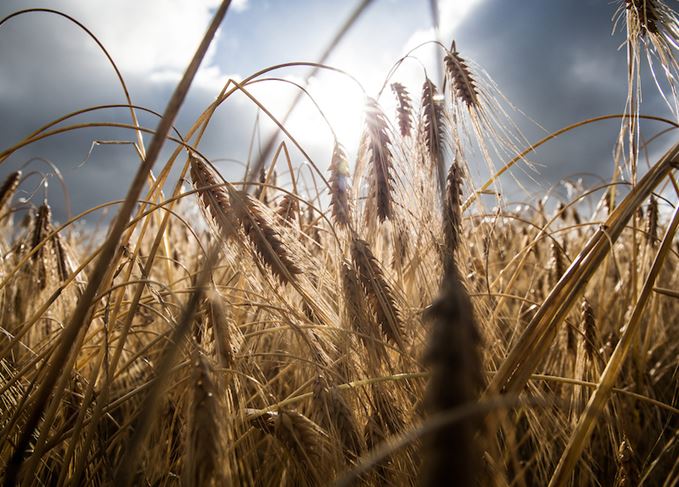
What I discovered was ‘bere’ (pronounced bear): a barley race introduced to northern Scotland by the Vikings in the 8th century or earlier (earlier was good). Peter Martin, director of the Agronomy Institute at Orkney College, part of the University of the Highlands and Islands (UHI), says, ‘Bere is probably the oldest cultivated barley, definitely in Britain and probably one of the oldest still in cultivation in Europe.’ Adapted to the climate and soils of the far north, it matures in 90 days. Plenty of time for my character to plant it in lowland Scotland in mid-May (or even June by the time he gets those fields under plough) and harvest it in late summer.

It’s also taller than modern varieties, which means it has an unfortunate tendency to lodge, or fall flat on the ground near to harvest in heavy rain or wind. I knew this about older barley varieties, so I’d already written this later scene, a different landholder and a different year than the earlier one.

In the long summer twilight, the clouds and rain now blown eastward, we walked up to the barley fields. Much of the grain lay flat. Roghan clicked his tongue. “Harder work for the men,” he said. At the greener field, he shook his head. “It will mould before it ripens. We’ll try to rake it, but likely I’ll turn the cattle out on it in the end.”

At the start of this century, there may have been less than 10 hectares of bere left in Scotland, grown only in small fields in the far northern and western islands. What has saved it is its unique flavour when used to brew beer or whisky. Small breweries and small distilleries produce short-run, expensive beverages with it, aimed at the increasing market for local-provenance food and drink. Barony Mill, a watermill on Orkney, produces flour (beremeal) from it as well. It’s a tough grain, difficult for modern machinery to handle — and would likely have ground down the teeth of people who ate it regularly (that and the flakes of stone from the grinding).

I’m visiting Orkney  in April, too early to see bere growing. I’ll look for the whisky, if it doesn’t break the bank. Well, maybe one glass, somewhere on that northern island, in honour of my constructed world and the real one it’s based on.

(Well, that visit didn’t happen, because COVID did. Still hoping to get there someday!)