Reverse Migration: A Discourse into the Spirit of Place: Excerpt 4

Movement

The great chalk arable uplands of Norfolk have very little of wild left, being intensively farmed to wheat and barley, rapeseed and sugarbeet.  But even here, hedgerows, lanes, and verges have life, and many farms are part of stewardship schemes, leaving ‘weedy’ margins, not cutting hedgerow and lane verges, putting up nestboxes.

The bird I notice most ‘up’ here (up being by Norfolk standards only) is the yellowhammer, singing its ‘little bit of bread and no cheese’ song. (To me, it sounds more like ‘see me see me see me please’.)  It’s a bunting (ammer means bunting in Germanic (Saxon?) dialect, so, yellow-ammer = yellow bunting) of dry, open country, and these wide fields suit it well.  I am walking, on a  warm and sunny day, a section of the Roman road known as the Peddar’s Way, running north from Thetford to Holme.  It’s a lane here, bordered on both sides by hedges, with occasional opening s to the fields.  A hare lopes toward me:  it hasn’t seen me yet.  In every spot of shade it stops.   Eventually it realizes I’m here, although I’ve stopped and am as still as I can be, and it disappears into the hedge.

round barrow
Bronze Age round barrow near Anmer

The land slopes slowly down, south and west, to the valley of the Babingley.  On the highest ground are several Bronze Age barrows, round, slightly conical hills.  On the lower slope would have been the fields, and below that, closest to the water, some industry.  The barrows were ancient when the Romans – or more likely, auxiliary troops from somewhere in the Empire – built this road nearly two thousand years ago. There is a good chance they were from Pannonia, a Roman province lying south and west of the Danube, based on a military diploma – a document granting citizenship after twenty-five years of service – found in Norfolk a few years ago. Walking away from Pannonia to service in Rome’s most northerly province, they would have heard yellowhammers singing along the road.

***

If I continue south, I will come to the B1145, the old Saxon road running across Norfolk west to east, from the port of King’s Lynn to Aylsham, north of Norwich, where it meets a north-south road. If I walk north, I will come to the road from Flitcham to Docking called the Norman Road. I can find no documentary evidence to tell me this is truly a Norman road, but the name is tantalizing. Roman, Saxon, Norman roads, intersections of time and history.

In the triangle of land bordered by the Peddar’s Way, the Norman Road, and the by-way from Anmer to West Rudham lies another Bronze Age burial mound. This one is reputed to have had a second use: that of the moot-hill for the hundred, the administrative unit of the area in Saxon times. Moot-hills were the location for the courts and administrative debate and rulings and were supposed to be as close to the centre of the hundred as practicable. I walk by it on on a sunny January day, the track beneath my feet muddy and rutted. Did my Saxon ancestors come this way, to hear judgment at this ancient hill, walking in the same mud up from what is now West Newton?

Roads are not static things: they come in to being and they disappear. Sometimes traces remain only as cropmarks seen from aerial photographs and as earthworks on the ground, or even only as excavated archaeology, as is the case with some of the oldest trackways across the fens. Changes in land ownership moved roads; villages were deserted in medieval times by plague or by planned changes by the landowners and roads fell into disuse; enclosure of common lands removed access. But many of the roads shown on old maps of this area are still in use, as bridleways and footpaths. East of Castle Rising the old road from the village to the watermill on the Babingley is now a footpath leading to the bus stop on the A149.

Partridge run from the side of the track; here, they are mostly grey partridge, the native bird, and growing rare in most of Britain. Management practices on the two huge estates bordering the Peddar’s Way here have allowed it to maintain reasonable populations; the same practices allow the yellowhammers to flourish. Harriers – marsh, hen and this winter a vagrant Pallid Harrier – are winter hunters over these upland fields, joined by barn owl and short-eared owl, common and rough-legged buzzard, and little owl. Once, a road, extant on the 1797 map, ran across the Peddar’s Way to the hamlet of Flitcham, where an abbey stood before the dissolutions. No trace of the road, even as footpath or cropmarks, remains west of the Roman road, although it continues in use as a footpath to the east. But were it there, and I could walk it to Flitcham, I would come to Abbey Farm, where the remnants of the fishponds and water management canals of the abbey are now overlooked by a bird hide, and a huge old oak is home to a pair of little owls. These tiny owls – they are about the size of a starling – might have been known to the Roman soldier, but not from here. Nor would my Saxon ancestor have known them (although their first Norman overlords, born in France, might have). Introduced to England in the latter half of the 19th century, they are a bird native to Europe and Asia. It is just possible that my father, as a boy, would have seen them hunting mice over the pastures.
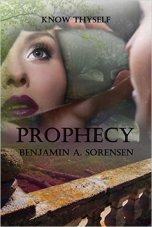
 

Prophecy, by Benjamin A. Sorensen: A Review

prophecyThe magical Dragoncrystal has been stolen, and eyewitnesses identify Arana as the thief. Aware of her innocence but terrified of what might happen to her at the hands of the Kaylarian Knights who are seeking her, she flees, with her brother Jard, first into a magical woodland, and then to the city of Marsa, and then onward, as many factions pursue the young farm girl and her brother.

What unfolds is a classic quest story, with the world’s fate in Arana’s untested and untaught hands. Prophecy is set in the world of high fantasy, and it’s a solid addition to that genre. Sorensen’s writing is competent and polished; narrative flow and structure fit the action of the story. Characters are familiar but not usually stereotypical, although I did find myself mentally ‘casting’ various characters from the television version of A Game of Thrones in some of the roles. The plot is complex enough to keep the reader’s interest without being unnecessarily intricate.

I particularly liked Sorensen’s ability to portray Jard’s over-protectiveness and Arana’s varied reactions to it as her abilities and her confidence in them increases. All important characters grow and develop throughout the book, Arana especially. In an unusual twist on one of the oldest themes not just of fantasy but of foundation myths throughout the world, Arana’s fate – and that of the world – will depend on her ability to fully accept herself.

I had very few niggles: an occasional awkward sentence, a few minor points that didn’t ring true to me. Not enough to detract from its overall score, which is five stars. If high fantasy is your genre of preference, then Prophecy will be well worth your time.

The author provided me with a copy of this book in exchange for an honest review.


Citizen Magus, by Rob Steiner: A Review

citizen magusWritten with a deft, sure, and light hand, this is the story of Remington Blakes, a.k.a. Natta Magus, a twenty-first century magus who has been transported against his will back to the Rome of 6 B.C. by his magical mentor. Steiner blends action, ethical dilemma, romance, humour and an accurate geographical and physical portrayal of ancient Rome to create a magical romp, that, while mostly light-hearted, also addresses some serious ethical questions.

The self-effacing hero of Citizen Magus has managed to set himself up as an artisan magus, providing finding services (his specialty) for the citizens of Rome. But he has not given up on searching for his mentor, William Pingree Ford, both to stop him meddling with history and to perhaps get home. When an evil, vampire-like creature murders a young woman and kidnaps another, Remington is swept up into a battle to defeat the creatures, which are part of Ford’s plot.

I particularly liked two things about Citizen Magus: the magic, and the setting. Remington’s magic is neither particularly arcane, nor is it matter-of-fact. Almost all people of this alternative Earth of the 21st century have magic. It’s a subject to be studied in university, which Remington has been doing back home in Detroit. There’s a believable explanation of how it works and what energies it uses, and of the laws and vows that govern it. The fact that Remington’s magical regalia includes a Detroit Wolverines baseball cap worn backwards reflects the overall light-hearted tone of the book.

As a writer whose own work is set in an analogue of the post-Roman world of northern Europe, I’ve spent a lot of time reading about, and taking courses on, the Roman Empire. Steiner’s portrayal of the geography, politics, and ways of life (and smells) of ancient Rome and its people added to my appreciation of the book: magic is more convincing when it’s inserted into a world that is otherwise realistic. But having set the book in a well-described Roman Empire, Steiner does not attempt to make the spoken language a direct translation of Latin, or archaic English. People speak fairly standard English, with a few Latin words that are easy to understand thrown in, effectively reminding the reader of the setting without adding difficulties to the dialogue that might detract from the flow of the narrative.

At this point in a review, I usually discuss my ‘niggles’: things that weren’t quite right. With the exception of one error missed in the copy-editing (an ‘it’s’ used when ‘its’ should have been) I found no errors of grammar, spelling or production in the e-pub version I read, for which the author and his editor should be commended.

I’m giving a solid 5 stars to Citizen Magus. I’m looking forward to the further adventures of Remington Blakes, as well as to reading Steiner’s earlier Codex Antonius series: if they are as good as this book, they’ll be well worth reading.

The author kindly provided me with a copy of this book in exchange for an honest review.

Firequeen (The First Covenant), by J.S Malpas: A Review

This is one of the hardest book reviews I’ve ever written. On the surface J.S. Malpas’s Firequeen is a fantasy novel with many of the familiar characters and elements of that genre: evil witches influencing young kings; a simple rural lad caught up in an adventure larger than himself, an old woman who is not what she seems; and a queen running from betrayal and gathering power and followers.

But I think the author may have been attempting something more. There is an odd feel to this book that I have encountered only once before. About a year ago, and for a different site, I wrote a review of Kazuo Ishiguro’s The Buried Giant. It was a book I really wanted to like, and couldn’t. I couldn’t get past the almost emotionless prose, the sometimes unnatural dialogue, and the sense that the whole thing was an allegory I couldn’t quite fathom. I found the prose in Firequeen almost equally emotionless, and the dialogue flat and frequently unrealistic, but in the way some translations of medieval works such as Gawain and the Green Knight or some of Lord Dunsany’s fantasies are – mannered, almost banal – although without the archaic language of Dunsany.

Many, if not most, of the characters are not fully-realized people, but are archetypes, and again it is my sense that the author expects us to recognize them as such and know how they fit into the world of the story. Even a monstrous animal that appears towards the end of the book appeared to be a version of the Questing Beast. Pulling themes and archetypes from a variety of mythologies and traditions, my feeling is that Malpas attempted to create a complex saga where much detail in world-building is unnecessary because it is already known to the audience and where the familiar characters’ roles and meanings are also known. Where Firequeen differs is in its multi-faceted nature: there are several stories here, all of which contain archetypal characters and set-piece situations, and which will, it is assumed, intersect at some point in the series.

I had one niggle that remains a niggle, regardless of the author’s intent in writing this book, and that is his unconventional use of punctuation in dialogue. Instead of the conventional ‘“I think the day will be rainy,” Bob said.’, Malpas consistently uses ‘“I think the day will be rainy.” Bob said.’ I found the replacement of the conventional comma with a period annoying and distracting.

As my regular readers know I use a rubric to evaluate and rate books. On the basis of this rubric, Firequeen rated poorly, coming out at 2 stars. But I have to say I’m not entirely sure that’s fair to this book, although I read it more with an analytical and sometimes puzzled eye than in enjoyment. If the author’s intent was simply to write a high-fantasy story, then I think the rating is fair. If the intent was to create something different, a retelling and amalgamation of tales of magic and mystery (in the sense of a mystery play, not a who-done-it) from a variety of traditions…well, it’s a valiant but (in my opinion) overall unsuccessful attempt.

The Best Present for a Writer

The best present for a published writer is simple:  buy their book. Either for yourself, or to give to someone else.

The best present for an unpublished writer?  Encouragement.  If you’re looking for something more tangible, consider any of the following: the gift of time – maybe you’ll do their grocery shopping or run their kids to soccer to give them an hour or two of writing time.  Or a financial contribution to any of the services of an editor or the cover art, or that creative writing course they’d love to take.  Almost anything that tells them you take their writing seriously and want to help make publication (if that’s their goal) possible.

What, fellow writers, would you add to this list at this time of gift-giving?

I wish you all Blessed Yule, Merry Christmas, Happy Kwaanza, and best wishes for any and all of our celebrations against the dark and for the burgeoning light.