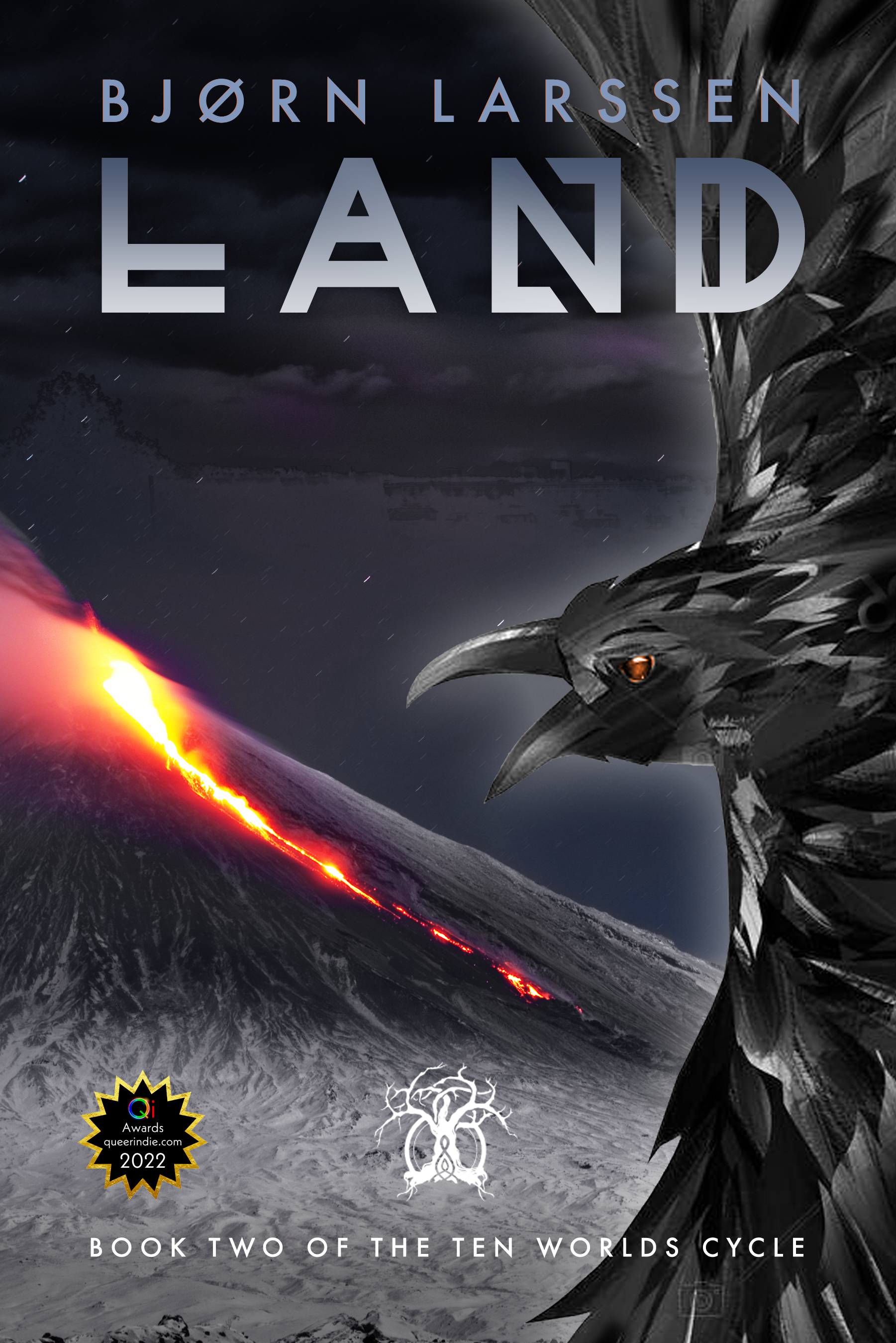
Cover Reveal!

The Ten Worlds #2: Land, by Bjørn Larssen

Loss. Love. Land. Happy Never After. (A grimdark retelling of the discovery of Iceland. )

The truth Maya fought for all her life turns out to be a lie a thousand years long. She neither understands nor knows how to wield her hidden power, simultaneously endless and limited, forcing her to face responsibility for the harm she causes and parry countless questions she has no answers to. Neither time nor space can stop her – but can she stop herself?

Bound with an unbreakable love spell, Magni and Thorolf, both raised in darkness and pain, only share one thing: the fear of revealing their truths. One was born to be a God; the other only knows a slave’s life. One craves peace and quiet; the other believes peace is a brief reprieve between wars. As they mourn those they have lost, the constant war of their own threatens to destroy all they have left – each other.

Haunted by Gods old and new, in the shadow of Odin’s raven, they head to conquer the new Ásgard. Apart from their demons, nothing and nobody is what it seems. Unwilling to give up love, freedom, or land they’re fated to live happily never after… unless destiny can be altered after all?

The book includes strong language, depictions of sexual, physical, and emotional violence. Full list of triggers, which may contain minor spoilers, will be provided.

Preorder link:
https://www.books2read.com/thetenworlds2

Website link:
https://www.bjornlarssen.com/land/

Goodreads link:
https://www.goodreads.com/book/show/217183142-land

Social media:
https://www.bjornlarssen.com/sm/

Bio:

Bjørn Larssen is an award-winning author of historical fiction and fantasy, dark and funny in varying proportions. His writing has been described as ‘dark,’ ‘literary,’ ‘cinematic,’ ‘hilarious,’ and ‘there were points where I was almost having to read through a small gap between my fingers.’

His debut novel, Storytellers, won a Readers’ Favorite Gold Medal (Best Historical Fiction Novel) and was shortlisted for Eric Hoffer Grand Prize Award. His fantasy works, Children and Why Odin Drinks have been shortlisted for eleven (11) Indie Ink Awards – so far; Children was also nominated for a Stabby Award (Best Indie Novel of 2020). Bjørn is a Queer Indie Award laureate (best speculative fiction author) and very proud of it.

Bjørn has a Master of Science degree in mathematics, and has previously worked as a graphic designer, a model, a bartender, and a blacksmith (not all at the same time). He currently lives with his husband in Almere, which is unfortunately located in The Netherlands, rather than Iceland.

He has only met an elf once. So far.

His upcoming release, the second book in The Ten Worlds cycle – Land – is coming out on November 5, 2024.

What if the world you create becomes real?

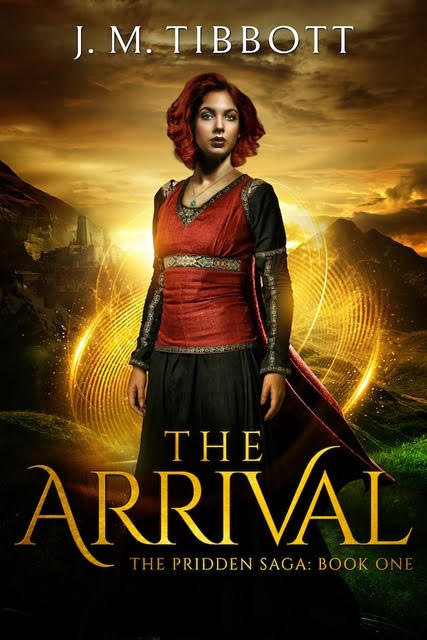
A spotlight on J.M. Tibbott’s fantasy series, The Pridden Saga.

A prickly young game designer finds herself in a medieval world reminiscent of the video games she creates. Magic, dangerous creatures, and political intrigue were fine as a fantasy, but navigating them all in real life is a different challenge. Will Kat find her way through the maze of this new existence?

An enchanting adult fantasy, The Arrival is Book I of The Pridden Saga. Six books are published; the seventh has a planned release of autumn 2024. Find out more at the author’s website:

https://jmtibbott.com/books/


 J. M. Tibbott is a prize-winning author, a writing instructor and editor. J.M. has been writing since grade school, and continues to study literature and the English Language. She believes there is always something new to learn. 

Her works include magazine and newspaper articles, newsletters, online blogs, and story collections. With the 6th book of The Pridden Saga published, J.M is deep into the final conclusion in Book 7. Another couple of series are tucked up her sleeve, the first with a decided Detective bent. After that, more are planned but only her muse is in on the secrets. 


A Book Develops, Part II

Well, I didn’t expect it to be almost three months before I had anything more to say about the next novel! (The first part of this occasional series is here.) January, though, was mostly taken up with finishing other tasks, primarily getting Empire’s Passing ready for release and completing a contracted edit. February took us to Spain, a road trip for birds and Roman ruins and medieval city centres; one of the things I wanted to experience was how remnants of the Roman Empire (or the Eastern Empire, in my fictional world) appeared in a countryside that wasn’t Britain. Something beyond the familiar, to make me see.

Sadly, I don’t have a photo of the image that had the most impact: part of an aqueduct in a random field, and in that field, a man walking his dog. Living with this ancient piece of infrastructure as background to his everyday life. That was the sense I wanted; it will metamorphose, by whatever alchemy happens in a writer’s mind, into what it’s like, 500 years after we last saw my world, to live with the remnants — tangible and intangible –of a past empire.

One of the hardest things I had to find was some scholarly books with a good overview of European history of the later middle ages – roughly 1000 to 1400. Eventually, through discovering the online syllabus to a university course covering that period, and checking its reading list, I ordered two books:

I’ve also signed up for a six-week online course on medieval universities, as the Ti’acha of the first series have developed into something fairly similar (but without the religious context).

I’m still writing exploratory short stories, which can be found, one a month from January onward, on the A Muse Bouche Review. This is a way for me to get to know my characters, and some of the conflicts that the story will be based around.

As my research and character development continues, I’ve realized there are two big challenges ahead of me: which bits of European history to cherry-pick for the books (there’s a LOT going on in Europe and around the Mediterranean in these centuries), and, maybe even harder, to write a novel or novels with at least four POV characters. Two is the most I’ve done before.

But as the book gestates, moving from concept to reality, its lack of a working title was nagging at me. (Titles and book covers make an idea more solid, at least for me.) So here’s a cover mock-up: a place-holder image, and the working titles for both the book and the (presumed) series: All of which may change between now and publication!

‘A wise prince should establish himself on that which is in his own control and not in that of others; he must endeavour only to avoid hatred.’
The Prince, Chapter XVII
Niccolò Machiavelli

Varril, the elected Princip of Ésparias when the story opens (at this point, at least!) is not a wise prince. Not at all. And on that, it seems, will hang the tale.

(As for the Casillard Confederacy – think of the Hanseatic League, often simply called the Hansard.)

More when there’s more to say!

A Book Develops: Part I

Even before Empire’s Passing, the last book in the Empire’s Legacy series, was partially written, people were asking ‘what’s next?’ To be fair, I had a glimmer of an idea – the same world, about 500 years later, with some aspect of the story derived from the trade alliance of the Hanseatic League.

Passing is done now; I’m just awaiting the paperback proof. It’ll be out in February. I’m in no hurry to write this next book, for many reasons. Key among them is that I know little of 13-14th C history, so I have a lot of research to do. But books evolve not just from plot but from characters—after all, it is the characters’ responses to the problems and conflicts they are faced with that makes a book interesting. And for me as a writer, characters simply appear, with much of their personalities in place, immutable except through personal growth, their responses to the circumstances of their lives.

Over the next—how long?—year? more?—I plan to record the development of this next book, as much to see if I can elucidate my own process as for anyone else. But you’re welcome to come along on the journey as this yet-without-a-working-title book emerges from research and imagination and craft.

So: where am I now?

Five characters of some importance, so far; one minor ones. Who do we have?

Cenric bé Casille, who describes himself as ‘a man of mature years and a merchant of standing and not insignificant influence’. He’d be about forty.

Kirthan del Candre de Guerdián en Leste, more usually known as Kirthan de Guerdián, another merchant, described by Cenric as ‘made of autumn oak leaves, shades of gold and brown from the short curls of his hair to the tips of his polished boots.’  A few years older than Cenric, known to his intimates as Kirt.

Luce bé Casille, Cenric’s sister. Physician, musician, mid-thirties.

Of some importance is Cenric’s son, Audun, who is about seventeen, and currently attending the equivalent of a cathedral school (equivalent because organized religion continues to play no part in my world) at which his great-uncle (Cenric and Luce’s uncle) teaches. The so far unnamed great-uncle will be an important secondary character, I think.

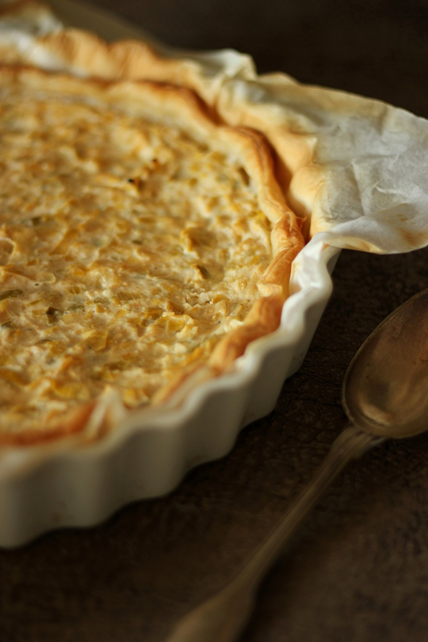
The first three characters (and the minor one of Cenric’s housekeeper) are introduced in an exploratory short story called The Onion Tart, published this month in A Muse Bouche Review. There will be more of these character-exploring stories: some may become part of the book, some won’t. I don’t think The Onion Tart will, but its description of the meeting of Cenric and Kirt will be background (and canon!).

Image by magdus from Pixabay

Meanwhile, while Cenric and Kirt and others tell me little bits about themselves, my first research book is Seb Falks’s The Light Ages: The Surprising Story of Medieval Science. Its focus is the 14th C, but the advantage of writing historically inspired speculative fiction is I can borrow from adjacent centuries, as long (my own rule) I’m not blatantly anachronistic with technology.

More to come, when there’s more to say!

Part II is here.

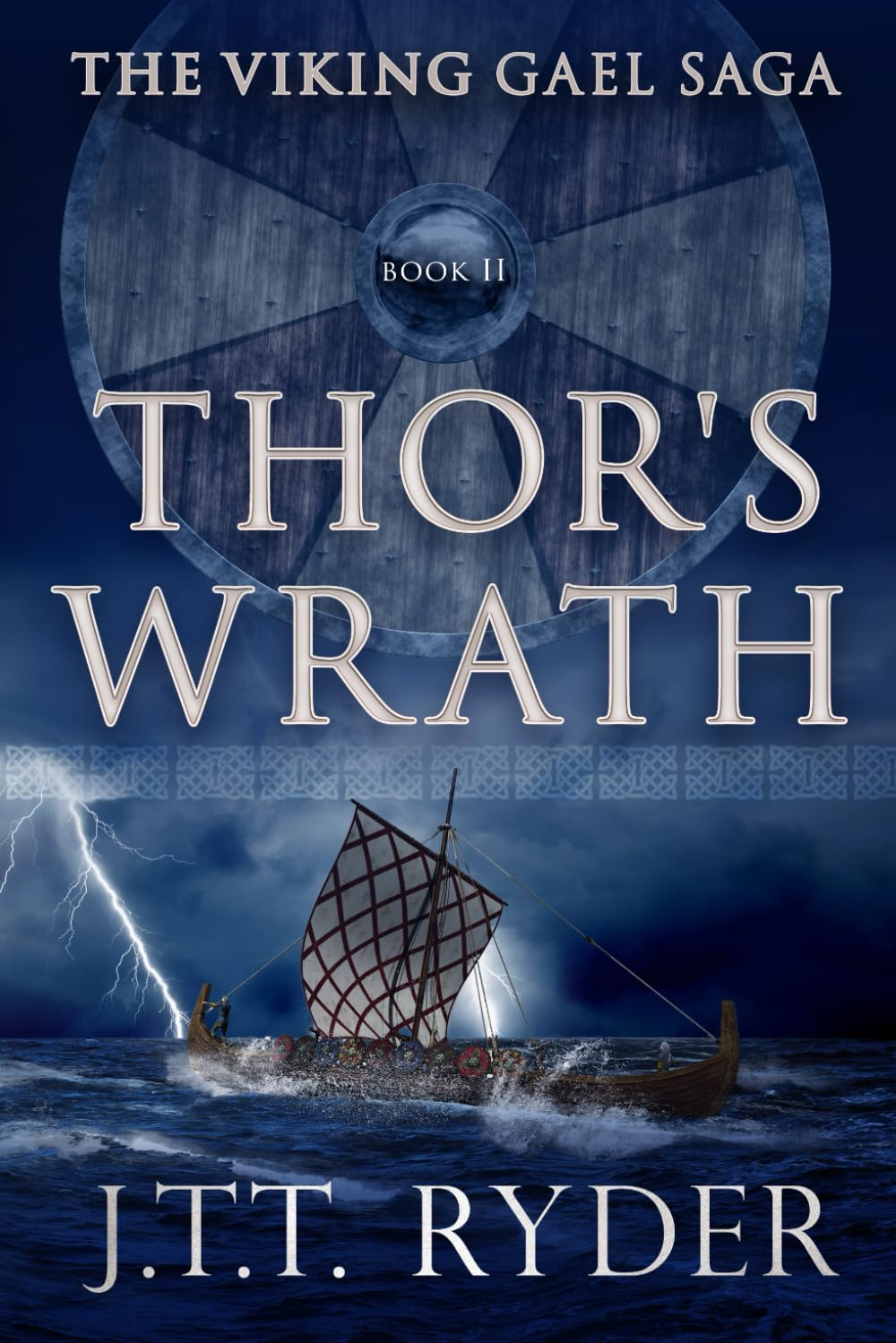
Thor’s Wrath: Book II of the Viking Gael Saga, by J. T. T. Ryder: A Review

When we left Asgeir in book 1, he had saved his life (and his cat) but lost his honour. Now, as Harold Finehair works to unite Norway, Asgeir lands in the Orkneys, into conflict and battle: a chance for Asgeir to overcome his shame and redeem himself in his eyes and his gods.

J.T.T. Ryder continues to draw on his extensive knowledge of the history and archaeology of the setting – both time and place – in recreating a 9th century north-western European world. While Asgeir (and his compatriots) worldview is not ours, it is convincing: enmity and friendship flipping back and forth; the importance of personal honour; the role of single combat over warfare. This is a world of foresight, of visits from gods, of visions and portents–all are real, all are to be taken seriously.

The story moves quickly; the reader and Asgeir together are given little respite as threats are overcome, peace is agreed, only for another threat or a betrayal to begin the action again. Ryder’s writing is sometimes lyrical, especially in his place-based descriptions: ‘A whirlwind of puffins blackened the sky over the rocky, chilly islet… Mist shrouded the horizon like unspun wool, and the wind bit as remorseless as a fox…” In other places it echoes the alliteration of the sagas: ‘shocked him with sleet sideways.’ Even the occasional unusual word choice adds to the story, creating a sense of a world different from ours, refracted through time and distance.

The story is perhaps Ryder’s best, the complexity of Asgeir’s choices and of his thinking deepening as the youth matures into manhood. The telling is excellent. The editing, I am sorry to say, is less so.

(I dislike on-screen reading, so whenever possible I buy the paperback, so these comments pertain to the first paperback edition published in 2023.) I am tolerant of a certain number of typographical errors: they appear in even the best edited books, traditionally published or independent. But repeated sentences, repeated scenes, should not. Nor should a leg of lamb in one paragraph become a leg of pork in another. These errors spoke of a rushed production, an incomplete editing process, and one, inevitably, that jolts the reader out of the story. A second, corrected edition* is strongly suggested.

But! Thor’s Wrath is still well worth reading, and I look forward to the next book in Asgeir’s saga. (And yes, the cat is still Asgeir’s companion at the end of this installment.)

*Update: correspondence with the author assures me these errors have been or are in the process of being corrected.

WRITING A SERIES by Helen Hollick

What could be easier? You have an idea for a new book, it doesn’t matter what genre – historical fiction, romance, fantasy, crime…The basic plot has popped into your mind and the characters come trooping into your life: the protagonists, the good guys, the bad guys. You start writing, the plot flows and the first draft is done. Then the editing, the cover design, the formatting. The excitement of publication day. Maybe an online launch and a book tour. And then you realise exactly what you have. The first part of a potentially cracking good series.

Now you wish you’d kept notes, details of what your characters were like – in looks and mannerisms. Eye colour, hair colour, tall, short, fat, thin? Their quirks and foibles. Maybe you should have delved into their backstories a bit more? Oh heck – I should have made a note of locations, of the little details. Believe me, unless you intentionally set out to write a series from the very beginning, all these possible continuity pitfalls suddenly appear like wasps at a summer picnic.

Readers notice, or at least, they will when your wonderful series takes off and the demand comes for ‘More!’

When I wrote Sea Witch, the first of my Captain Jesamiah Acorne nautical adventure voyages, I intended it to be a one-off tale, (not helped by my ex-agent who had no faith in it  – hence the ‘ex’!) But readers loved it (and Jesamiah,) so I had to write another adventure for him, then a third… I’m in the process of starting the seventh full length yarn. And I wish I’d made more notes along the way.

Lesson learned, I keep notes for my Jan Christopher Cosy Mystery series (that’s coZy in US spelling). The location for the episodes set in the north-east London suburb of Chingford are not a problem as it’s where I used to live and work in the public library back in the 1970s. Apart from the roads where murders happen, all the streets and places are the real thing. (I’ve made the murder locations up, though, in case of any residents’ sensitivity.) The library itself, South Chingford, was an actual place. The building still exists but the local council closed it as a library several years ago (shame on them!) and it is now used as offices. I’ve quite enjoyed bringing the old place back to life; remembering all the goings-on during the thirteen years I worked there. The characters, however, are entirely made up – although several of Jan’s anecdotes are partially biographical.

I decided to deliberately alternate location settings between each book, primarily because I was torn between writing about Chingford as it was, and my present life here in glorious North Devon … so episode 2 (A Mystery of Murder) saw Jan and boyfriend Detective Sergeant Lawrence Walker visiting his parents for Christmas 1971, who live in the fictional village of Chappletawton. Based on my village – but not quite the same.

All well and good, but by the time I got to episode 4 –which again sees a return to Devon, I had to ensure I had the right place names, the right village residents … was Bess, the dog, a black or golden labrador? What had I called the neighbouring farmer? And even more important, which characters leant themselves to becoming possible murder suspects and which ones were reliable witnesses?

I think I’ve managed to tie everything together in A Meadow Murder, introducing new characters, revisiting previous friends, and remembering to make notes for the next planned instalments…

ABOUT A MEADOW MURDER

A Meadow Murder is the fourth tale in the Jan Christopher cosy murder mystery series, the first three being A Mirror Murder, A Mystery of Murder and A Mistake of Murder… see what I’ve done there? Yes, I’ve created a proper puzzle for myself because now every tale in the series will have to follow the same title pattern of ‘A M-something- of Murder’ (Suggestions welcome!)

Based on working as a library assistant during the 1970s for almost thirteen years, the mysteries alternate between the location of Chingford, north-east London, where the real library I worked in used to be, (the building is still there, but is, alas, now offices) and my own North Devon village, but slightly fictionized. Chappletawton, for instance, is much larger than my rural community and has far more quirky characters, (and we haven’t had any real murders!)

The main characters, however, remain the same: Jan Christopher is the niece, and ward, of Detective Chief Inspector Toby Christopher and his wife, her Aunt Madge. In A Mirror Murder, Jan (short for January, a name she hates) meets her uncle’s new driver, Detective Constable Lawrence Walker. Naturally, it is love at first sight … but will an investigation into a murder affect their budding romance?

We find out as the series continues: Episode Two takes the young couple to spend Christmas at Laurie’s parents’ old farmhouse in Devon, while Episode Three sees us back at work at the library in the north-east London suburb of Chingford. We yet again travel to Devon for Episode Four – A Meadow Murder. And no spoilers, but the title is a little bit of a giveaway!

I had the idea for A Meadow Murder during the summer of 2022, while watching our top meadow being cut for hay. The cover photograph for A Meadow Murder is my field – a real Devonshire hay meadow, and the scenes in the story about cutting, turning and baling the hay are based on how we really do it. (Even down to the detail of the red Massey Ferguson tractor.)

In fact, I’m very glad that we cut and brought in our 480 bales of hay this year back in June when it really was a case of ‘make hay while the sun shone.’

I am relieved to say, however, that we didn’t find a body…

“As delicious as a Devon Cream Tea!author Elizabeth St John


“Every sentence pulls you back into the early 1970s… The Darling Buds of May, only not Kent, but Devon. The countryside itself is a character and Hollick imbues it with plenty of emotion” author Alison Morton


*
Make hay while the sun shines? But what happens when a murder is discovered, and country life is disrupted?


Summer 1972. Young library assistant Jan Christopher and her fiancé, DS Lawrence Walker, are on holiday in North Devon. There are country walks and a day at the races to enjoy, along with Sunday lunch at the village pub, and the hay to help bring in for the neighbouring farmer.

But when a body is found the holiday plans are to change into an investigation of murder, hampered by a resting actor, a woman convinced she’s met a leprechaun and a scarecrow on walkabout…

Buy Links – Paperback or e-book, including Kindle Unlimited

Amazon Universal Link: this link should take you direct to your own local Amazon online store https://mybook.to/AMeadowMurder

Also available worldwide, or order from any reliable bookstore

All Helen’s books are available on Amazon: https://viewauthor.at/HelenHollick

ABOUT THE AUTHOR: HELEN HOLLICK

First accepted for traditional publication in 1993, Helen became a USA Today Bestseller with her historical novel, The Forever Queen (titled A Hollow Crown in the UK) with the sequel, Harold the King (US: I Am The Chosen King) being novels that explore the events that led to the Battle of Hastings in 1066. Her Pendragon’s Banner Trilogy is a fifth-century version of the Arthurian legend, and she writes a nautical adventure/supernatural series, The Sea Witch Voyages. She has also branched out into the quick read novella, ‘Cosy Mystery’ genre with her Jan Christopher Murder Mysteries, set in the 1970s, with the first in the series, A Mirror Murder incorporating her, often hilarious, memories of working as a library assistant.

Her non-fiction books are Pirates: Truth and Tales and Life of A Smuggler.

She lives with her husband and daughter in an eighteenth-century farmhouse in North Devon, enjoys hosting author guests on her own blog ‘Let Us Talk Of Many Things’ and occasionally gets time to write…

Website: https://helenhollick.net

Subscribe to her Newsletter:  https://tinyletter.com/HelenHollick

Main Blog:  https://ofhistoryandkings.blogspot.com/

Facebook: https://www.facebook.com/helen.hollick

Twitter: @HelenHollick  https://twitter.com/HelenHollick
Creating King Arthur – in Post-Roman Britain

By Helen Hollick

Pendragon’s Banner Celebration Tour April 2023

Thirty years ago in April 1993, one week after my 40th birthday, I was accepted by William Heinemann (now a part of Random House UK) for the publication of my Arthurian The Pendragon’s Banner Trilogy. It had taken me more than ten years to reach that stage of my dream to become a real writer – more than that if you count that I had been scribbling stories since the age of thirteen.

So why King Arthur? I had never liked the Medieval tales of knights in armour, the Holy Grail and courtly chivalry – I couldn’t stand Lancelot (what on earth did Guinevere see in him?) Why did Arthur go off on a religious quest for so many years? For me, none of those tales had the believability that writers today create in their novels of historical fiction. Arthur and the people of his court, if they existed, (and it’s a very big IF!) had no place in factual history after the Norman conquest of England. Those Medieval tales are merely entertaining stories, with the Holy Grail quest perceived, perhaps, to encourage men to join the Holy Crusades, and maybe the Arthur story mirrors the fact that Richard I spent many years away on his own ‘quest’ and very little time in his kingdom of England.

I was intrigued, therefore, when I discovered that there were earlier tales of Arthur, not only pre-Norman but pre-Anglo-Saxon. These were the Welsh legends, stories and poems of a warlord who fought against the incoming Germanic tribes. To place an Arthur figure during the upheaval and chaos of fifth-century Britain made sense. The period is not known as The Dark Ages for nothing, for written evidence, the whys and wherefores, are few and far between – we are, very much, ‘in the dark’ for the years around 430-550 AD.

So this is when I set my Arthurian tale, it is fiction – let’s face the fact, ‘Arthur’ as a king did not exist. (Sorry!) But even if he didn’t exist the earlier stories about him are wonderfully exciting.

I researched, as well as I could, the detail of post-Roman Britain (no internet back in the 1970s/’80s!) using archaeological evidence to add into the many, many imagined fictional bits, which include the Welsh tales and writing of clerics such as Nennius, who mentioned twelve battles that Arthur (supposedly) fought.

My character of Arthur, therefore, is a fifth-century warlord, passionate about fighting for his rightful place as King, and fighting as hard to keep it. As passionate, is the love of his life, Gwenhwyfar, who in my tale remains loyal to her lord, Arthur, despite their many ups and downs, hopes, fears, achievements and disappointments. Despite their laughter and tears.

I wrote my Arthur as a real man – warts an’ all. He is not the Christian king of the Medieval tales, he is a soldier, leader of the cavalry, the Artoriani, a man trying to sort the chaos Rome left behind, a man living in a world of upheaval, where Christianity is still in a state of embryonic flux, where pagan beliefs are still very much to the fore, and a world where Britain is changing, through battle and peaceful settlement, from a Province of Rome’s authority into the emerging kingdoms of Englalond – Anglo-Saxon England.

But maybe, just maybe, my story as told in the Pendragon’s Banner Trilogy is the base for how the enduring legend of King Arthur really happened…

© Helen Hollick

Helen’s new, self-published, editions with beautiful covers designed by Cathy Helms of www.avalongraphics.org are, alas, only available outside of USA and Canada, where the same books are published by Sourcebooks Inc. (The new covers were offered – free – to Sourcebooks, but the offer was declined.)

ABOUT THE KINGMAKING (Book 1)

The Boy Who became a Man:

Who became a King:

Who became a Legend… KING ARTHUR

There is no Merlin, no sword in the stone, and no Lancelot.

Instead, the man who became our most enduring hero.

All knew the oath of allegiance:

‘To you, lord, I give my sword and shield, my heart and soul. To you, my Lord Pendragon, I give my life, to command as you will.’

This is the tale of Arthur made flesh and bone. Of the shaping of the man who became the legendary king; a man with dreams, ambitions and human flaws.

A man, a warlord, who united the collapsing province of post-Roman Britain,

who held the heart of the love of his life, Gwenhwyfar – and who emerged as the most enduring hero of all time.

A different telling of the later Medieval tales.

This is the story of King Arthur as it might have really happened…

“Helen Hollick has it all! She tells a great story and writes consistently readable books” Bernard Cornwell

“If only all historical fiction could be this good.” Historical Novels Review

“… Juggles a large cast of characters and a bloody, tangled plot with great skill. ” Publishers Weekly

“Hollick’s writing is one of the best I’ve come across – her descriptions are so vivid it seems as if there’s a movie screen in front of you, playing out the scenes.” Passages To The Past

“Hollick adds her own unique twists and turns to the familiar mythology” Booklist

“Uniquely compelling… bound to have a lasting and resounding impact on Arthurian literature.” Books Magazine

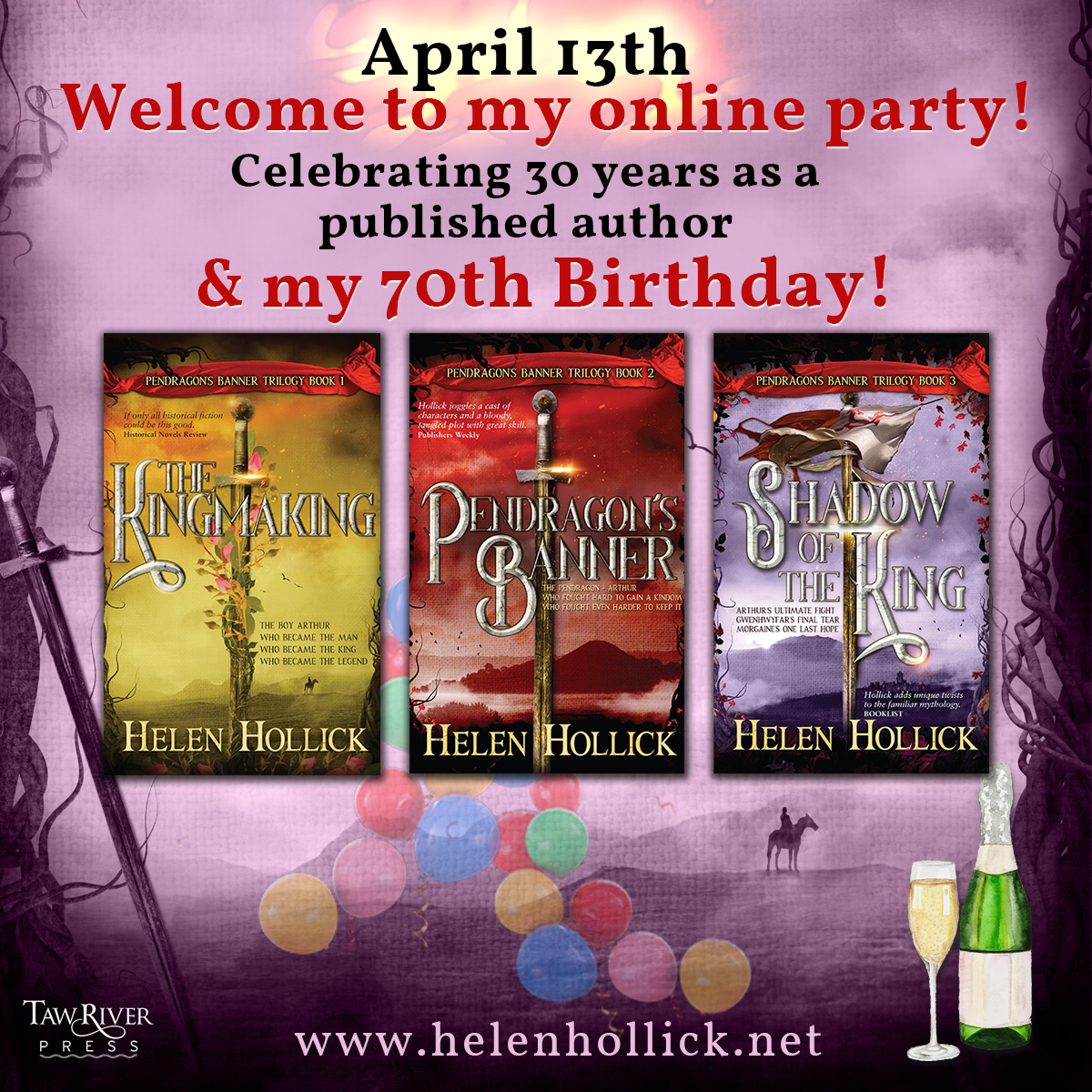
The Kingmaking: Book One

Pendragon’s Banner: Book Two

Shadow of the King: Book Three

(contains scenes of an adult nature)

BUY THE BOOKS:

THE PENDRAGON’s BANNER TRILOGY 

New Editions available worldwide except USA/Canada

https://mybook.to/KingArthurTrilogy

Available USA/Canada 

US TRILOGY: https://www.amazon.com/gp/product/B074C38TXN

CANADA TRILOGY: https://www.amazon.ca/gp/product/B074C38TXN

ABOUT HELEN:

First accepted for traditional publication in 1993, Helen became a USA Today Bestseller with her historical novel, The Forever Queen (titled A Hollow Crown in the UK) with the sequel, Harold the King (US: I Am The Chosen King) being novels that explore the events that led to the Battle of Hastings in 1066. Her Pendragon’s Banner Trilogy is a fifth-century version of the Arthurian legend, and she writes a nautical adventure/fantasy series, The Sea Witch Voyages. She has also branched out into the quick read novella, ‘Cosy Mystery’ genre with her Jan Christopher Murder Mysteries, set in the 1970s, with the first in the series, A Mirror Murder incorporating her, often hilarious, memories of working as a library assistant.

Her non-fiction books are Pirates: Truth and Tale sand Life of A Smuggler. She lives with her family in an eighteenth-century farmhouse in North Devon and occasionally gets time to write…

Website: https://helenhollick.net

All Helen’s books are available on Amazon: 

https://viewauthor.at/HelenHollick

Subscribe to Helen’s Newsletter:  https://tinyletter.com/HelenHollick

Her Blog: https://ofhistoryandkings.blogspot.com/

Facebook: https://www.facebook.com/helen.hollick

Twitter: @HelenHollickhttps://twitter.com/HelenHollick

Follow Helen’s Celebration Tour https://www.helenhollick.net/

The old order changeth…

Yesterday all the planters and garden statuary that my cousin and her partner had collected over their forty years in this house were removed, going to new homes. Nearly at the top of the long sloping garden, one remains, a Grecian figure carrying wine jugs. It draws the eye, now all the distractions are gone.

The house is free of boxes and much of the furniture, too, cleared two days past by the auctioneers. A door long blocked by a bookcase is now open, creating flow and light in the house. There isn’t a lot left to do, except some cosmetic improvements and the slow bureaucracy of probate.

And with the clutter, both mental and physical, gone, my mind is bubbling with ideas and dialogue and scenes for  the book I’ve had to put off for the last few months. There is flow and focus and illumination, thoughts pushing themselves out of my subconscious like the bulbs bursting into bloom in the garden.  

Empire’s Passing, I already know, is a complex, multi-layered book, not surprisingly. The last book of a long saga has a lot of threads to bring together, questions to answer, farewells to be made. The title is a deliberate nod to ‘This too will pass’, the adage that reminds us that all things, good or bad, are fleeting. “For one brief shining moment…” But there will be hope too, at the end.

It’s going to be a challenge. But one I can finally give the time and attention it needs.

Image by Greg Montani from Pixabay