Reading about Writing


I’ve just finished reading two diametrically opposed books on writing.  One is Robert McKee’s Story, which is really about screenwriting but almost all of it is applicable to any writing.  He’s an advocate of the ‘plan everything out in detail’ style of writing, with some very good insights on conflict and pacing. 

The other was Stephen King’s On Writing (King is up there in my favourite writer category, when he’s at his best), in which he says basically: think up a situation, and let the characters take the story wherever it goes. No planning.  Which is exactly how I wrote Empire’s Daughter, so I automatically favour his approach (confirmation bias, that’s called) – but I think McKee has some very good advice as well.

The key to any advice on writing is to pay attention to what lies underneath the overarching organizational structure of the advice. I’m not going to plan out every scene before I write it, as McKee suggests, but his discussion of how scenes need to move the protagonist and the story from one place to another (physically, emotionally, spirituallly); that each scene must involve meaningful change, now that’s useful for me. But I need to let my subconscious guide that meaningful change, let my characters speak and do and think and react for themselves. I can’t force them to do something that isn’t right for them, and my understanding of my characters’ temperaments and beliefs and emotions resides somewhere that I can’t reduce to lines on an index card or in a notes file on my laptop. On the other hand, when I have a fair idea of the overall story arc and the major conflicts inside that arc, then that place that knows who my characters are and what they’ll do has more time to develop a deeper response from them.

Both books agreed on a couple of things, the biggest one being: don’t write what isn’t necessary. Every word should be there for a reason. That doesn’t mean we all have to write like Ernest Hemingway, nor does it preclude description, but there should be more to describing a setting or a person or a facial expression than just filling space: the invocation of character, of mood, time, familiarity or alien-ness, joy or desolation. If we’re showing the reader something important, good. If we’re over-describing instead of showing character through dialogue or reaction, bad.

Related to this is the need for dispassionate editing. You may have written the best scene of your writing life, but if it doesn’t play a part in the story, why is it there? “Kill your darlings,” King quotes. (I never got to see the movie Genius, about the relationship between Thomas Wolfe (not Tom), author of Look Homeward, Angel, and his editor Max Perkins, but I gather this was part of the conflicted relationship between them.) King says if the writer’s reaction to the advice to cut a scene is ‘Yeah, but…”, then the scene most likely needs cutting.

McKee and King both discuss the difference between writing and story-telling; the first is a matter of having the skill to put words together in a way that is literate and has style, a way that evokes emotion and captures setting and mood. But you can do all that, and still not have a story to tell. Some of the world’s best story-tellers have no or limited written literacy skills, but they know all about character and pacing and tension and crises and climaxes, and that a story – any story – must contain some universal features – the struggle for identity, the conflict between life and death, a facing of horror: a personal journey of some sort. But of course, a good story is not necessarily well written.

A writer can learn the elements of style, and a story-teller can learn to structure her stories for maximum impact. When the two are skillfully put together, in a story told in a way that is truthful, honest to the characters, and concise, then the result should be a book (or a movie or a play) that is remembered by its audience.

What have been your most useful books on writing?
Oracle (Freya Snow Book 4) by L.C. Mawson: A Review

The fourth installment in L.C. Mawson’s Freya Snow series continues the story begun in oracleHunt. Freya, now more aware of her magical heritage and powers (although not completely) accepts a work experience placement in London, only to discover that her employer has chosen her for her magical abilities, and her assignment is to track down a missing Oracle. The problem is, does this Oracle want to be found?

Switching between the Shadow Realm and everyday life, the story provides more explanation of Freya’s background and foreshadows one possible future. It also acts as an exploration of some of Freya’s deepest fears and the choices she needs to make. But I also found parts of this book had, for me, a deeper resonance as a metaphor for the difficulties and choices people on the autism spectrum disorder face. I hesitate to write this, because I am allistic (non-autistic), but my husband is autistic (Asperger’s diagnosis), and after thirty-eight years of living with him, I may have a few valid insights. When Freya (or her Shadow Realm counterpart, to be precise) is told this about her possible bond with another magical creature: “The only way the two of you can bond is if you form a real and lasting attachment to the Human world. We always knew you were too closed off to others for that ever to be likely….” it struck me as the truth about relationships many autistic people live with. It can be easier to invest in other sorts of relationships – with computers, games, or, as Freya does, as a bounty-hunter of evil magical creatures – than it is with other humans…especially when the powers you hold – whether it is Freya’s magic or the ability to envision and analyse and discard dozens of answers to a word-game problem in a few milliseconds (don’t play Tribond® with my husband) – separate you from allistics.

Even with that possible interpretation aside, this is a fast-paced magical adventure. It should not be read without having read the previous books, and perhaps the related short stories too: I have read all the books, but not the stories, and there were occasionally times when I found myself confused about past events, which could be due either to my poor memory or to something happening or revealed in a story I haven’t read. But overall the four books have provided a coherent narrative and a developing story. I’m giving this installment four stars.

I received a copy of this book in exchange for an honest review.

A Dream Come True

For thirty-eight years–since I came here for university in 1978–I have frequented the aisles of an independent bookstore in my city, starting at its original location and moving with it to its purpose-built new home, which included a cafe, and after a few years, a cinema. I’m not exaggerating when I say it has been, and is, a cultural hub here, and is in part responsible for the fact that we have a small but healthy downtown, one filled with cafes and interesting stores, music venues and concerts, art shows, and summer markets. It’s been a labour of love from one family, into the second generation now.

I used to look at all eclectic books…and dream that one day a title of mine would join them. Delivered to them today, soon Empire’s Daughter will grace the Young Adult fiction shelves. I am excited, awed, honoured. Of all the places it can be bought, this is the one that matters to me. This is the one that validates me as a writer. This is the dream come true.  Can you imagine how that feels?

Arboretum Press presents….

Empire’s Daughter, by Marian L Thorpe  

Empires cover 3

In a world reminiscent of northern Europe after the fall of the Roman Empire, this historical fantasy, meant for young and new adults, explores the meaning of loyalty and love in a rapidly changing society. Seventeen-year-old Lena must decide between her love for her partner Maya or her loyalty to her village, her people and her land.

…a lovely novel….” 

Mezzalily’s Teen Book Reviews

…easily one of the most intriguing books I’ve read all year…(an) indie-published gem….”

Writerlea Book Reviews

…this book is just something special….It was absolutely fantastic!”

Cover to Cover

…expertly done world-building….”

Creating Worlds with Words

 $13.95 CA + s&h

ARBORETUM PRESS ACCEPTS PAYPAL, MONEY ORDERS, OR PERSONAL CHEQUES WRITTEN ON CANADIAN BANKS. ALL PRICING IS IN CANADIAN DOLLARS AND INCLUDES TAXES. PLEASE CONTACT US AT ARBORETUMPRESS@GMAIL.COM FOR DETAILS, CURRENT CURRENCY CONVERSIONS, AND SHIPPING COSTS.

Empire’s Daughter paperback now available from Amazon!

Empires_Daughter_Cover_for_Kindle

Since Amazon moves pretty quickly, if you live in the US or the UK, you can order the paperback of Empire’s Daughter from Amazon:

Amazon.com 

Amazon.co.uk

Canada?  Not so quickly.  I’ll let you know when it can be ordered from Amazon.ca….or when you can order it in Canada directly from me.

Finding Inspiration

Trying to maintain writing discipline while packing, arranging for (and checking on) tradespeople, and doing all the other things involved in moving house after twenty-two years, is, to put it mildly, difficult. I’ve done my best to keep up with my blogs (three of them now – one of which I started in the midst of all this, for some reason….) but work on Empire’s Hostage has been non-existent. That’s only in part due to the move, and in part due to, basically, writer’s block.

But this last week I’ve been reading – in small chunks, usually at lunch or when I really need a break from something – Malachy Tallach’s book 60 Degrees North: Around the World in Search of Home, a book I chose to read in part because, I thought, it might give me more insight into life ‘north of 60’, as we say here in Canada. I’ve been there, in Canada and the US, but not otherwise. As Empire’s Hostage takes place largely in what might be ‘north of 60’, in a land that more or less parallels northern Europe, it seemed a potentially useful book to read.

It was. Yes, I’ve learned some things that I may or may not use. But it was one passage – a descriptive one, not factual – that suddenly sparked a scene, a setting to begin the next section of Hostage, one accurate to the landscape and mood of the story. I can feel the relief, a lifting of the nagging tension that I wasn’t going to find a way forward. But now, of course, I have to find time to write….

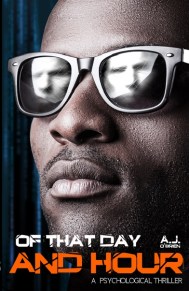
Of That Day and Hour, by Anthony O’Brien: A Promotion

“‘Of That Day and Hour’; a page-turning psychological thriller. Of that day and hour cover

Jefferson Davies is a lecturer at Harvard University. His life takes on an unexpected, dark and chilling twist after receiving a phone call from an ex-student and lover.

Eve works as a psychiatrist at a maximum security prison. Her patient is Casey Lee Jones. A convicted killer. His defense for the murder of two police officers is his ‘knowing’: his precognition. He knows the future, moments, hours, days, weeks or years before it happens. It was kill or be killed. He will only cooperate if Jeff’s involved, yet the men have never met.

Jeff flies out to Colorado, convinced he’s dealing with a psychopath. Scientifically he dismisses the phenomenon of precognition. Through a series of mysterious incidents, he begins to have serious doubts, even questioning his own sanity. Seeking the truth opens a Pandora’s Box, and what’s been started cannot be undone.

A fast moving, chilling, psychological thriller that will keep you guessing right to the end.”

This isn’t a review: it’s a promotion for a fellow indie writer. I was the editor of this edition of the book (previously titled Bad Man & Mad Men), so I can’t ethically review it.   Of That Day and Hour is available from Amazon in e-book or paperback format.

Amazon.com link

Amazon.co.uk link