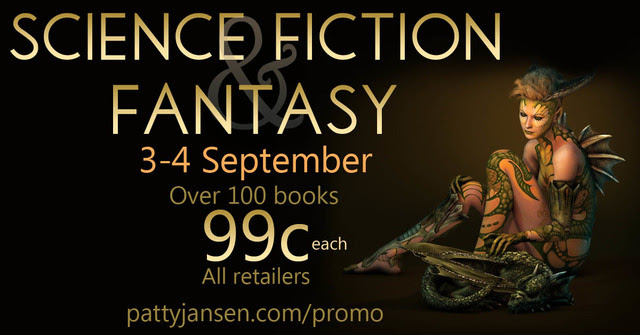
Including my book, Empire’s Daughter….and lots more. Check it out!
Including my book, Empire’s Daughter….and lots more. Check it out!
I’ve just learned that my local library has ordered Empire’s Daughter for its collection. That’s quite rewarding, really; it’s really nice to see the library supporting local authors. So now it’s in three libraries – two public (the other one is my university’s library, as part of its Campus Author program) and one private (the library of the rec centre in the over-55 community in which I live.)
And I’ve finally worked out a thorny problem in the sequel, so it’s coming on a-pace!
The fourth installment in L.C. Mawson’s Freya Snow series continues the story begun in  Hunt. Freya, now more aware of her magical heritage and powers (although not completely) accepts a work experience placement in London, only to discover that her employer has chosen her for her magical abilities, and her assignment is to track down a missing Oracle. The problem is, does this Oracle want to be found?
Switching between the Shadow Realm and everyday life, the story provides more explanation of Freya’s background and foreshadows one possible future. It also acts as an exploration of some of Freya’s deepest fears and the choices she needs to make. But I also found parts of this book had, for me, a deeper resonance as a metaphor for the difficulties and choices people on the autism spectrum disorder face. I hesitate to write this, because I am allistic (non-autistic), but my husband is autistic (Asperger’s diagnosis), and after thirty-eight years of living with him, I may have a few valid insights. When Freya (or her Shadow Realm counterpart, to be precise) is told this about her possible bond with another magical creature: “The only way the two of you can bond is if you form a real and lasting attachment to the Human world. We always knew you were too closed off to others for that ever to be likely….” it struck me as the truth about relationships many autistic people live with. It can be easier to invest in other sorts of relationships – with computers, games, or, as Freya does, as a bounty-hunter of evil magical creatures – than it is with other humans…especially when the powers you hold – whether it is Freya’s magic or the ability to envision and analyse and discard dozens of answers to a word-game problem in a few milliseconds (don’t play Tribond® with my husband) – separate you from allistics.
Even with that possible interpretation aside, this is a fast-paced magical adventure. It should not be read without having read the previous books, and perhaps the related short stories too: I have read all the books, but not the stories, and there were occasionally times when I found myself confused about past events, which could be due either to my poor memory or to something happening or revealed in a story I haven’t read. But overall the four books have provided a coherent narrative and a developing story. I’m giving this installment four stars.
I received a copy of this book in exchange for an honest review.
On the banks of the Eramosa River, in the tiny village of Eden Mills, Ontario, the Eden Mills Writers’ Festival is held every year, as it has been for over twenty-five years. One of Canada’s premier writer’s festivals, it attracts huge crowds and very well known Canadian writers, reading their works in a variety of picturesque outdoor settings (if the weather cooperates, that is; indoors if it doesn’t. Usually it does.).
I’ve gone, on and off, for the last twenty years. And, of course, I imagined reading my own work at this festival…but it was never going to happen. Except it is. This year, I entered work in two categories – prose and poetry – in their Fringe contest, open to ‘not-yet-yet-widely-published’ authors. I really didn’t think I had a chance…but on the weekend, I got the call, telling me I’d been selected in not one but both categories. I was (nearly) speechless. The official invitation – not only to read, but to attend the author’s party the night before, and the Festival dinner after the readings – is hanging on my bulletin board. I’ll probably frame it.
So I’ve got some reading practice to get in over the next month, to get the flow of the poems right, to figure out what part of the short story I can read in ten minutes, the time allowed. Good problems to have.
Regular readers know I don’t do inspirational pieces, or moralize…but maybe I will just a bit this time. As I said, I’ve been going to this festival for over twenty years, and wishing I could read there. In my earlier entry I talked about how seeing my book on the shelves of my local independent book store was a dream come true, a dream held for over thirty-five years. I’m fifty-eight, readers, and while I postponed my writing dreams for far too long, caught up in life and work and travel, I never forgot them completely. Two years ago I got a blunt and visceral reminder that life is short…and to stop dreaming and start working, or I was never going to be able to call myself a writer. Now I can. My dreams may seem modest to some of you, but I’ve never been one for the limelight. This is enough for me.
Whatever it is you’re dreaming of, don’t give up, but you’ve got to do more than dream.
For thirty-eight years–since I came here for university in 1978–I have frequented the aisles of an independent bookstore in my city, starting at its original location and moving with it to its purpose-built new home, which included a cafe, and after a few years, a cinema. I’m not exaggerating when I say it has been, and is, a cultural hub here, and is in part responsible for the fact that we have a small but healthy downtown, one filled with cafes and interesting stores, music venues and concerts, art shows, and summer markets. It’s been a labour of love from one family, into the second generation now.
I used to look at all eclectic books…and dream that one day a title of mine would join them. Delivered to them today, soon Empire’s Daughter will grace the Young Adult fiction shelves. I am excited, awed, honoured. Of all the places it can be bought, this is the one that matters to me. This is the one that validates me as a writer. This is the dream come true. Can you imagine how that feels?
Five weapons of power. Magic gone wrong, and instead of five trained warriors bonding to 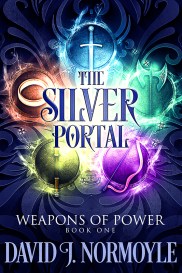 the weapons, five disparate young people from across the land become the weapons-bearers. Magically linked to the weapons, each must learn its powers and its responsibilities, evade those who want to use them for ill, and find each other across a wide and dangerous land. David J. Normoyle’s book The Silver Portal, the first book in a planned series, introduces us to the five protagonists: street urchin Twig; would-be-adventurer Lukin; noble Suma; Mortlebee, outcast from his religious community, and rebellious Simeon. Each character stands as individuals; each has their own difficulties with their unexpected weapons. Struggles with trust, ethics, personal convictions and the expectations of upbringing are central to each character’s growth and development through the story, but not in a heavy-handed or preachy way. Instead, these dilemmas are an integral part of the story, handled for the most part deftly and naturally.
The writing is competent and fluid, and at the right level of difficulty for the young-adult target audience. Readers are introduced to the history, politics and magic of the world in a gradual manner, often learning along with the characters. Although in a couple of places I found myself wishing for a deeper understanding of the history, enough is given to flesh out the story and the motivations of characters.
I found the plot a bit rushed towards the end, given the fairly slow development of during most of the book. But as part of a series, the pacing may be less uneven when the book is read as an introduction to the world and the characters rather than a stand-alone story. Overall, 4 stars, for a worthy addition to young-adult fantasy.


It’s common knowledge that humans have access to more digital media than ever before. Five hundred television channels, streaming movies, You Tube, ebooks, music in mp3 format or from streaming services… it’s everywhere. It’s wonderful that we have such a huge number of choices but I think something happened along the way. The huge volume of available digital media has caused it to lose its perceived value. Today, people fully expect this type of media to be free to the public.
Want to listen to the latest Lady GaGa album? Don’t worry, someone has tossed it onto You Tube for everyone to enjoy free of charge. At least until You Tube discovers it and takes it down, soon to be replaced by someone else in no time. If you don’t want to use You Tube, there are a number of sites to pass music and movies free of charge. I can’t tell you how many times I have seen people watching newly released movies on their laptops that they received for free. Love to read books but have a small budget? Sure, you can go to your local library, but why? Jump onto Amazon and grab a free copy of something interesting. I’ve seen people with tens if not hundreds of e-books on their Kindle that they downloaded for free. How did this happen? Where did this way of thinking start?
Here’s my guess.
Technology has allowed artists (musicians, writers) to make themselves visible to the public with as little as a click of a mouse button. In the old days, record companies ruled the music industry with an iron fist. They determined which bands made it and which ones didn’t. The few that did make it, sold millions of albums and filled huge arenas and those that didn’t were left to play at the local bar on Saturday night. But today, a band can set up a website and promote their music to the entire world without the help of a record company.
The publishing business has followed the exact same route. An independent author can write a book and easily toss it onto his/her own website, Amazon or Smashwords without the help of a publishing company. And this is great. As mentioned, this gives the public a huge variety to choose from and allows artists to be discovered. But as time has progressed a pattern has appeared. Four or five years ago, you would see indie e-books on Amazon for $4.99 or $3.99 [U.S. Dollars], with main stream published e-books coming in around $7.99 or $8.99. This makes sense to me since the quality of the indie books might not match that of the mainstream books. OK… I get it. But as time has passed, the price of the indie books has dropped and today most indie books are $0.99 or free. If an indie author sticks his e-book onto Amazon for $4.99, forget it… no one is going to look at it, because the public knows they can get another book that may be just as entertaining for free.
Don’t get me wrong. I’m an indie author. I run promotions where I give away ten or fifteen e-books over a weekend to try and increase readership and get reviews. But I believe that authors (and musicians) that provide their work to the public free of charge on a permanent basis, send the wrong message. I personally don’t write books with the sole purpose of generating income. I enjoy writing and I like to see people enjoy what I write. But I firmly believe that there should be a value attached to my work. Even a program like “Kindle Unlimited” that gives the perception of a free service, puts a value on a book through a subscription fee. (On a side note – I think KDP Select which gives an author access to Kindle Unlimited is a bit too restrictive over the long haul, but could be used for a period of time when a book is first released to draw attention and get reviews.)
My hope for the future is for artists to realize that the way to increase readership is not to lower the price of their goods but to make them better. Come up with a really good song or a really good book and people will notice. I don’t expect to become wealthy selling the few books I have written, but I feel they have a value and the public should provide me with the small amount I am asking for, to enjoy my book.
John A. Autero is an indie author of speculative and techno-thriller adventure novels. An
engineer by education, John employs a technical style of writing that combines existing technologies with those that are yet to be developed. John enjoys anything sci-fi, automotive, heavy metal and ballistic. Always a fan of government conspiracies and black-ops, stories like The Terminator and The X-Files are always on his list of favorites. John was born in the United States and has spent his entire life there, where he happily lives with his wife and pets. The Scorpion is his latest book.
“There was a pool of darkness in the midst of the light, where the wind had come in  accompanied by a shadow, a shadow with shoulders and a head that stretched into the lighted space on the floor at the bottom of the stairs.”
Reminiscent of Neil Gaiman, of the darkest episodes of Doctor Who, of some of the madness of Tim Burton, Devon Michael’s Hollo: The Gatecaster’s Apprentice is an artfully told, dark, and frightening coming-of-age tale with a twist. Hollo, the title character and protagonist, is a puppet made of wood, but one that can think and feel and move autonomously, created by her ‘father’ Fredric. (This might remind you of Pinocchio, but it shouldn’t.)
When Hollo reaches her twelfth birthday, Fredric takes her out into the world, a place far more complex and menacing than her sheltered world of Fredric’s house and the metal-casters workshop next door. Here she first hears the name Bander-Clou, and the words ‘Zygotic Pneuma’. Just what is she? And who is her father, really?
Clock-work soldiers of metal and wood pursue her. Hollo befriends a human girl; statues come to life; elemental forces protect her. Hollo’s world is under siege, and she is caught in a larger story, one older than she but one to which she belongs, and one in which she has an integral part to play. Michaels writes fluidly and effectively, his words invoking horror, happiness, fear and joy, the pacing moving the plot along quickly, but not so quickly the world-building is overlooked. This is a well-realized and developed world, one that the author leads the reader into by hints and clues: the reader learns the world along with Hollo.
Characters are well-developed, especially Hollo, whose innocence at the beginning is lightly but effectively shown, but also the supporting cast, from the malapropistic statue ‘The Countess’ to the marvellously conceived Lightening Man. And they all have a role to play; none of these characters, some of whom would not be out of place in Alice Through the Looking-Glass, are superfluous to the story.
Hollo: The Gatecaster’s Apprentice earns a rare five stars from me. I didn’t want to put it down, and yet conversely I rationed myself as to how much I read on any day, so as to savour the book and anticipate where it was going: it was far too good to read in one gulp. One caveat: in the e-book version I read, there were a few production errors, and a few errors that slipped through editing. In several places ‘won’t’ was written as ‘wont’; the common error of ‘broach’ for ‘brooch’ appeared a few times, along with the newly-frequent (in my experience of 55 years of reading) confusion of ‘piqued’ with ‘peaked’. One’s interest is piqued (excited); one’s interest in something can ‘peak’ (reach a height). Both can be correct, but are often, these days, confused. BUT: sometimes, as I wrote here, the overall quality of a book or a movie outweighs a few production errors, and this is one of those few cases. Regardless of the (easily-corrected) errors, Hollo deserves five stars.
I received a copy of the book in exchange for an honest review.

Arboretum Press is pleased to announce the release of

In a world reminiscent of northern Europe after the fall of the Roman Empire, this historical fantasy, meant for young and new adults, explores the meaning of loyalty and love in a rapidly changing society. Seventeen-year-old Lena must decide between her love for her partner Maya or her loyalty to her village, her people and her land.
“…a lovely novel….”
Mezzalily’s Teen Book Reviews
“…easily one of the most intriguing books I’ve read all year…(an) indie-published gem….”
Writerlea Book Reviews
“…this book is just something special….It was absolutely fantastic!”
Cover to Cover
“…expertly done world-building….”
Creating Worlds with Words

 marianlthorpe.com
You must be logged in to post a comment.