While I’ll keep this website somewhat updated, for short stories, poetry, non-fiction, as well as more frequent updates, find me at
Latest Posts
Ghost Encounters: The Lingering Spirits of North Devon
By Helen Hollick (With daughter Kathy Hollick)
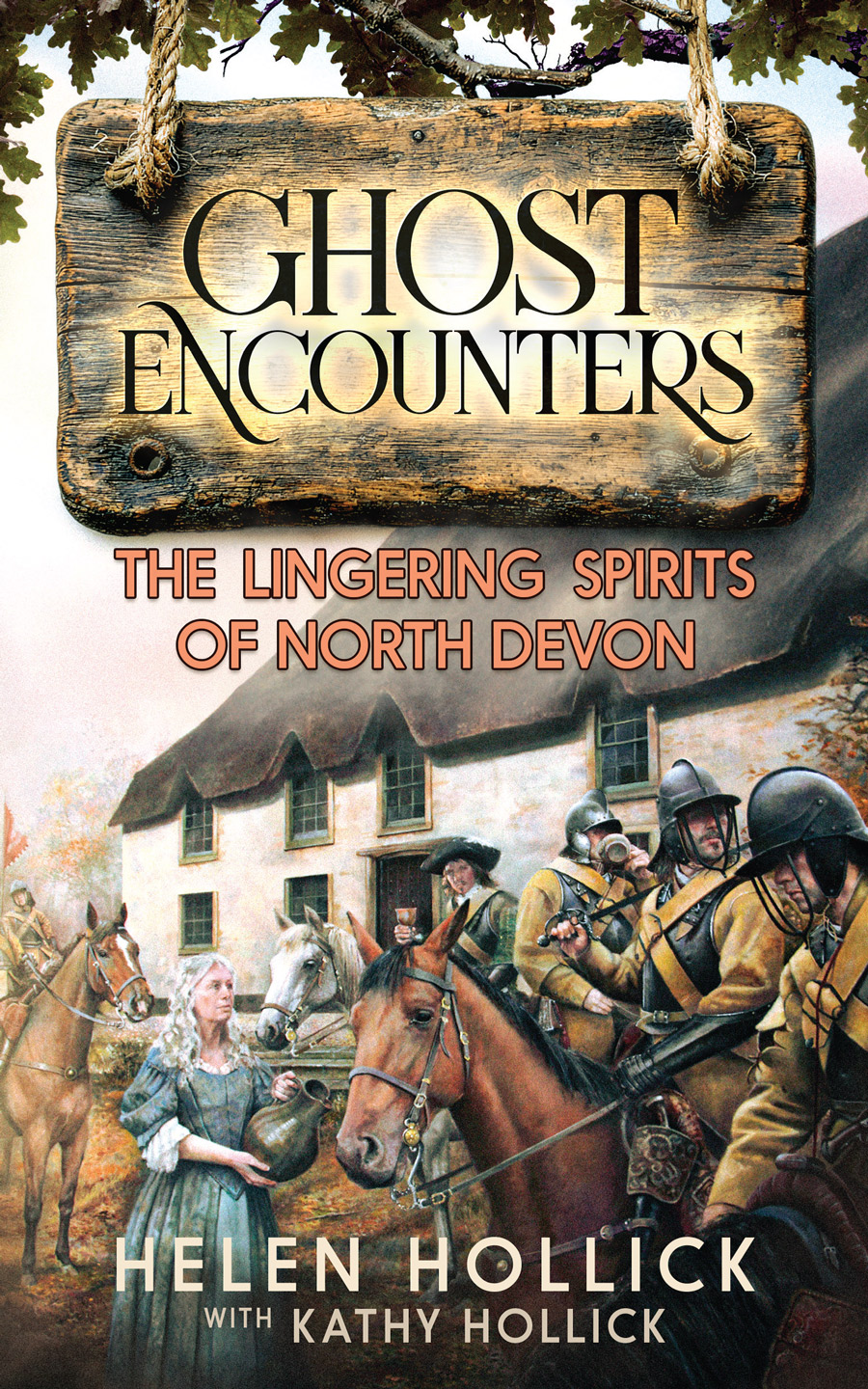
Everyone assumes that ghosts are hostile. Actually, most of them are not.
You either believe in ghosts or you don’t. It depends on whether you’ve encountered something supernatural or not. But when you share a home with several companionable spirits, or discover benign ghosts in public places who appear as real as any living person, scepticism is abandoned. In GHOST ENCOUNTERS: The Lingering Spirits Of North Devon, mother and daughter share their personal experiences, dispelling the belief that spirits are to be feared.
Ghost Encounters will fascinate all who enjoy the beautiful region of rural South-West England, as well as interest those who wish to discover more about its history… and a few of its ghosts.
(Includes a bonus of two short stories and photographs connected to North Devon)
Book Links:
Pre-order the e-book on Amazon
https://mybook.to/GhostEncounters
Paperback published February 28th – e-book will also be available on Kindle Unlimited
WHAT’S ALL THIS ABOUT GHOSTS?
I wrote Ghost Encounters with my dyslexic daughter because we wanted to show that not all ghosts are hostile, because there are animal ghosts as well as people – and because we wanted to share this beautiful part of England’s West Country – and some of its history – in a slightly different (maybe quirky!) way!
A ‘ghost’ is quite possibly only the remnant of some sort of past energy, something relayed as a hologram-like YouTube-type video that can only be viewed by those who can access the correct wavelength. If you don’t have the right frequency, all you get is nothing or static. What created this ‘energy’, no one knows, it’s inexplainable, which is why the subject is so controversial. What chance do poor old ghosts have when their is no fact, scientific or otherwise, to support their existence?
Many accounts claim that ghosts are deceased people bent on revenge against some misdeed committed against them during life, or they are souls imprisoned on earth for foul things they did to others. Or maybe a ghost haunts a certain location because that is where a violent or unnatural death occurred. My personal belief against this last: while there are ghosts lingering near battlefields (I’ve had personal experience) how come there are not hundreds – even thousands – of ghosts sitting around at known battle sites? Waterloo, Agincourt, the Somme… if this theory was right these places would be akin to a London or New York rush hour!
APPEARANCE
Misty shadows, a vague blur, maybe a hovering orb? Perhaps merely a feeling of a sudden ice coldness or a brief breeze across the cheek? A sound, a moan, a wheezed breath; or a sigh or something knocked over when no one was near to knock it. All must, of course, be ghosts.
Many female ghosts are described as being a ‘Lady in White’. White ladies seem to appear in rural areas, died tragically, experienced trauma, or tragically lost a child or husband.
Birds were often thought to be returning ghostly spirits, especially the Barn Owl, its white (though sometimes light brown) shape gliding soundlessly as dusk settles. Cats have spiritual connections, again, probably because they are often silent, can appear from nowhere and, apparently, have nine lives.
To many, though, a ghost appears in body form with clear features, including the clothing worn at the time of death. The Egyptian Book of the Dead, shows the deceased in the afterlife as they were before death.
My adult daughter, Kathy, sees ghosts as clear as living people, often not realising she’s seeing someone who is dead unless she knows they have died, or are dressed in period costume. Anyone walking along our farm lane would not be likely to wear Georgian or Tudor costume! Often, though, she will only see part of a person, which is a bit of a giveaway. Or more frequently, she gets a glimpse only. The moment they realise they have been seen, they disappear. These ghosts, I am convinced, vanish because they are startled to be seeing her. In their eyes, she is the ghost to be frightened of.
Our frequent ‘visitors’ to our house are, however, aware of us and are seen clearly. Occasionally even heard, passing comment or remarks. Our ‘Maid’ (we’re not certain if her name is Milly or Molly) has been known to announce her disapproval of building work within the house (because of the mess, I suspect,) or that I chatter a lot. Another visitor, seen from the waist up with three-corner hat, neat-tied cravat and a waistcoat, likes watching our horses. He is, we have discovered, the Georgian equivalent of the modern Amazon Delivery. In his case, bringing goods shipped to the nearby trade ports of Barnstaple or Bideford here in North Devon.
My daughter, Kathy, (and many other ‘ghost-seers’ also encounter animals. Dogs are the most common apparitions, perhaps because dogs have an especial affinity with us humans? For ourselves, we have lost horses in the past, both Saffie and Franc, mother and son, who died within two months of each other, (now very much missed by us) have been seen grazing in our fields.
Kathy has also seen a bear and another beast from the very distant past in our woods – she’s not too keen on ever seeing a dinosaur, though, so hopes they stay firmly on the ‘other side’.
Discover more in Ghost Encounters!
ABOUT HELEN

Known for her captivating storytelling and rich attention to historical detail, Helen might not see ghosts herself, but her nautical adventure series, and some of her short stories, skilfully blend the past with the supernatural, inviting readers to step into worlds where the boundaries between the living and the dead blur.
Her historical fiction spans a variety of periods and her gift lies in her ability to bring historical figures and settings to life, creating an immersive experience that transports readers into the past. Her stories are as compelling as they are convincing.
Helen started writing as a teenager, but after discovering a passion for history, was published in the UK with her Arthurian Trilogy and two Anglo-Saxon novels about the events that led to the 1066 Battle of Hastings, one of which became a USA Today best-seller. She also writes the Jan Christopher cosy mystery series set during the 1970s, and based around her, sometimes hilarious, years of working as a North London library assistant.
Helen, husband Ron and daughter Kathy moved from London to Devon in January 2013 after a Lottery win on the opening night of the London Olympics, 2012. She spends her time glowering at the overgrown garden and orchard, fending off the geese, helping with the horses and, when she gets a moment, writing the next book…
ABOUT KATHY

When not encountering friendly ghosts, Kathy’s passion is horses and mental well-being. She started riding at the age of three, had a pony at thirteen, and discovered showjumping soon after. Kathy now runs her own Taw River Equine Events, and coaches riders of any age or experience, specialising in positive mindset and overcoming confidence issues via her Centre10 accreditation and Emotional Freedom Technique training to aid calm relaxation and promote gentle healing.
Kathy lives with her farmer partner, Andrew, in their flat adjoining the main farmhouse. She regularly competes at affiliated British Showjumping, and rides side-saddle (‘aside’) when she has the opportunity. She produces her own horses, several from home-bred foals.
She also has a fun diploma in Dragons and Dragon Energy, which was something amusing to study during the Covid lockdown.
SOCIAL MEDIA LINKS
Website: https://helenhollick.net/
Amazon Author Page: https://viewauthor.at/HelenHollick
Bluesky: @helenhollick.bsky.social
Blog: supporting authors & their books https://ofhistoryandkings.blogspot.com/
Monthly newsletter : Thoughts from a Devonshire Farmhouse
https://ofhistoryandkings.blogspot.com/2024/01/thoughts-from-devonshire-farmhouse.html
Kathy’s Official Website:
https://www.white-owl.co.uk/
Cover design: Avalon Graphics https://avalongraphics.org/
Cover image: Chris Collingwood Historical Artist
http://www.collingwoodhistoricart.com/

October Updates
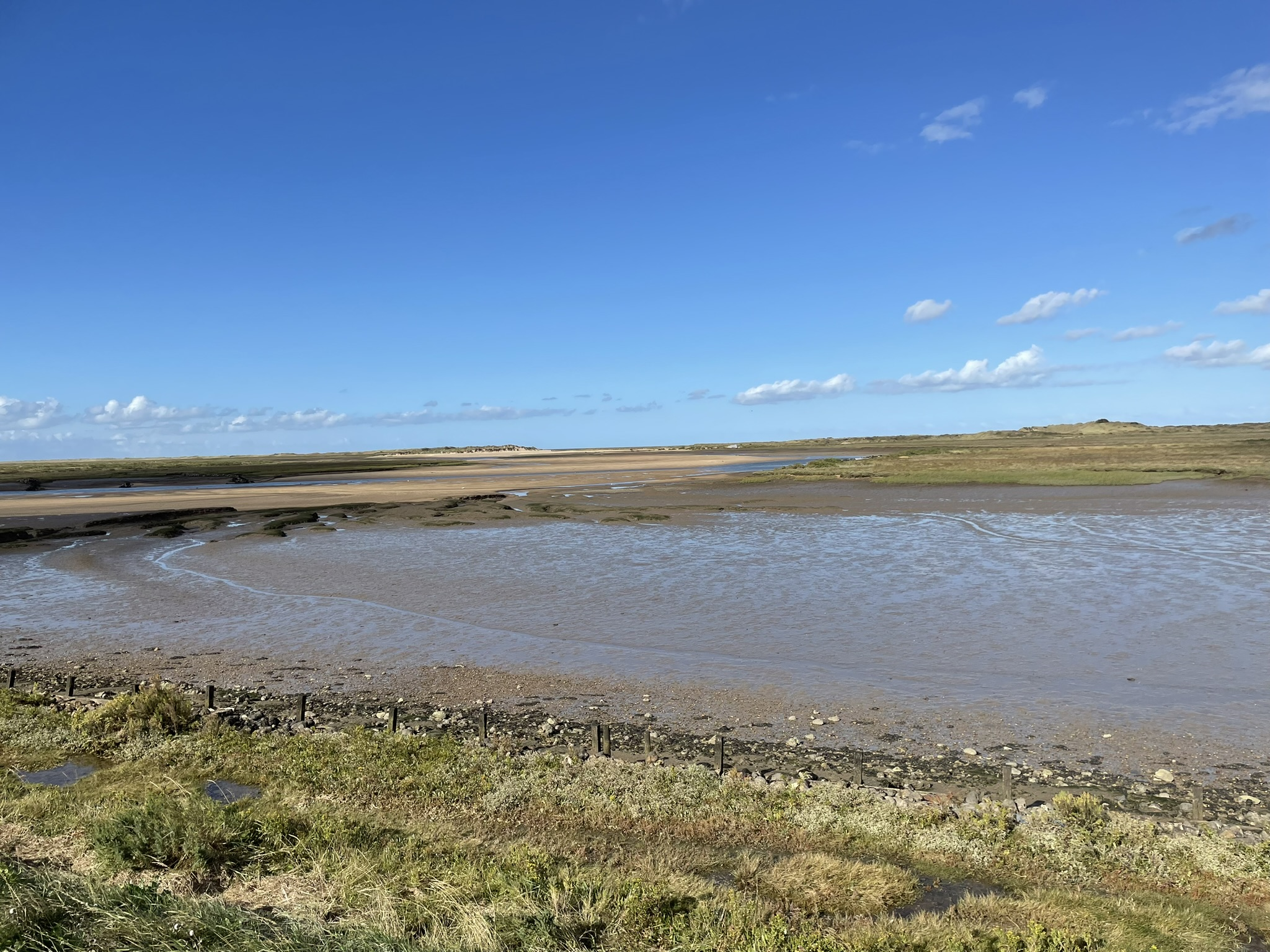
This past month, when I wake in the night, there’s almost always a tawny owl calling outside – which is a hint that I’m not in Canada. Several things brought us to England in September, largely research for An Unwise Prince, my work-in-slow-progress: a chance to tour a medieval merchant’s house that’s only open a few times a year; the Silk Roads exhibition at the British Museum (and its medieval exhibits); Peterborough Cathedral, built as an abbey in the 13th C, which will become the physical model (more or less) for the school in the new book.

But also, of course, the birds, and the long walks, and in the four weeks we’ve been here we’ve had four days of serious rain. Most have been sunny. We caught the last of the summer birds, chiff-chaffs still singing, and the first of the winter migrants, pink-footed geese and redwings, as well as two birds new for the UK for us, yellow-browed warbler and cattle egret. The saltmarshes are washed pink with sea lavender, the hedges are bright with rose hips and hawthorn fruit and blackberries, and filled with red admiral and fritillary and cabbage white butterflies. Deer – roe and muntjac, fallow and Chinese water – browse field edges and park, and on the mud of the marshes probe godwit and golden plover, redshank and curlew.
Yes, but how’s the book coming, you ask? I’m about 30,000 words into the first draft of what’s going to be the most complex book(s) I’ve ever tackled. It’s already clear it isn’t one book. I thought there were four point-of-view characters. Ha! I’ll be lucky to get through the story without adding at least another four. I’m borrowing from the Hanseatic League, medieval universities, Byzantium-North African-Arabic interaction, 12th C silk roads trade, intellectual exchange around the entire Mediterranean, the Mongol invasion of both the middle east and eastern Europe, Genoa’s near trade monopoly in the eastern Med, and the first crusade. All I can do is trust the process – do the research, let it marinate, and write down the words my characters dictate.


This are the tentative covers for the first two books. If it turns out to be more than a duology, the theme is easy to work with.
You may have noticed I’m not doing many updates here now. I will try to do monthly ones, but a much easier way to keep up with what I’m writing – short stories, poetry, non-fiction and a chance to read Empress & Soldier for free as a serialized novel – is to join me on Substack. My fiction site is History & Imagination; my non-fiction site is Landscapes of Memory.
Until November (I hope).
Marian
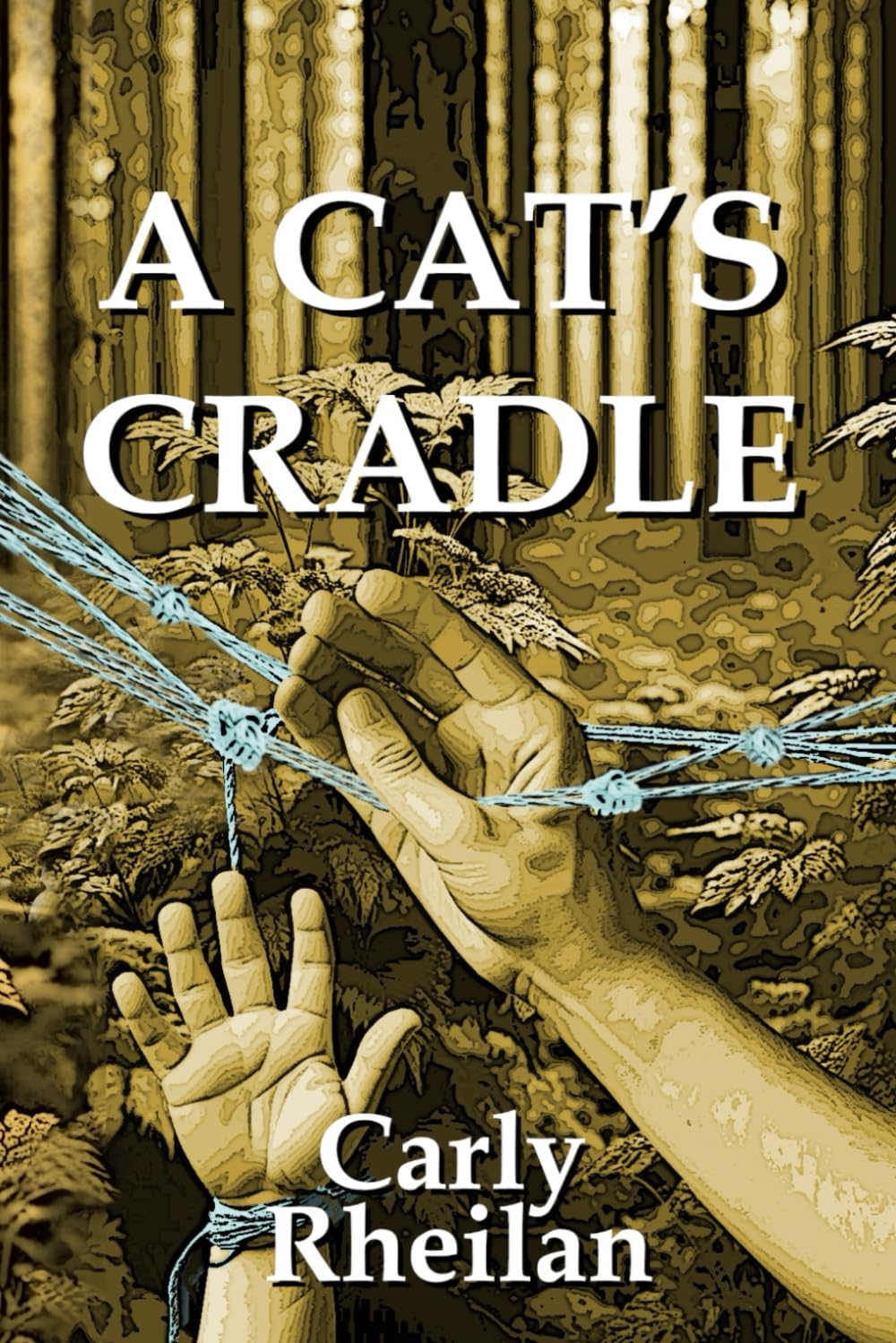
A Cat’s Cradle, by Carly Rheilan: A Review
A Cat’s Cradle is not a book for everyone. It is certainly not a book for those who rush to judgement, either of the author or her characters, nor is it a book for those who see the world in black and white, or who turn away from the realities of sexual abuse. (And yet, those things are exactly what the book is about.) It must have been a difficult book to write; it is a difficult book to read.
Mary, seven, lives in a small village where she is viewed suspiciously as an incomer, warned against being ‘forward’ by her new teacher, and discouraged from making friends by her mother, who considers herself superior to the local people. Mary has no one to play with but her older brothers, who, in the way of older brothers, both torment and ignore her, using any excuse to leave her on her own. Her father has left the family, something her mother is trying to hide while also desperately attempting to keep up appearances.
Fourteen years earlier, Ralph Snedden abused and murdered a girl he was babysitting. He has served his time and been released. On a rare visit to his ailing mother, he encounters Mary. They are drawn to each other: Mary thinks she has found a special, secret playmate; Ralph convinces himself he can control his urges and be the friend Mary craves.
All villages have their secrets, their dark sides which are never spoken of, whether they are rural villages or urban ones. This one is no different. Families have them too, and when everyone is related to almost everyone else, much that is known is never spoken of, never explained. What happened fourteen years earlier is never discussed, but Ralph’s mother is a pariah, abandoned in her failing health by all but the district nurse and an exploitative carer. So many silences, so much shunning, so many layers of judgement and pride – and pain hidden under those layers. Would anything have changed, if honesty and openness had prevailed?
Author Carly Rheilan allows the characters’ words and thoughts and action to tell the story without judgement. Both Mary and Ralph’s decisions and motives are dispassionately shown in the context of their troubled lives, the elements that draw the two together. We are observers of Mary’s loneliness, of the inklings of danger she suppresses in the name of good behavior and politeness, but also of Ralph’s rationalization and self-deception, and his ultimate and inevitable lack of self-control.
Even after the climax of the novel – an ending I won’t spoil – secrets and self-deception remain, and it is up to the reader to interpret the actions of characters, their compulsion to hurt and exploit or ignore the pain of others, the loss of many sorts of innocence, the desire to not admit to wrongs done or wrongs imposed; the desire not to see. A powerful, searing book for a mature, thoughtful reader.
Purchase link: https://mybook.to/CatsCradle
About the Author
Carly Rheilan was born in Malta and lives in the UK. She was educated in Oxford University (which she hated and left) and then at Brunel (a small-town technological university where she stayed for a PhD). As an academic and a psychiatric nurse she has done research into criminal justice, taught in universities and worked for many years in the NHS. She has children of her own and has also fostered two children with mental health problems.
Her novels address issues at the edges of psychiatry, crime and personal trauma.
Cover Reveal!
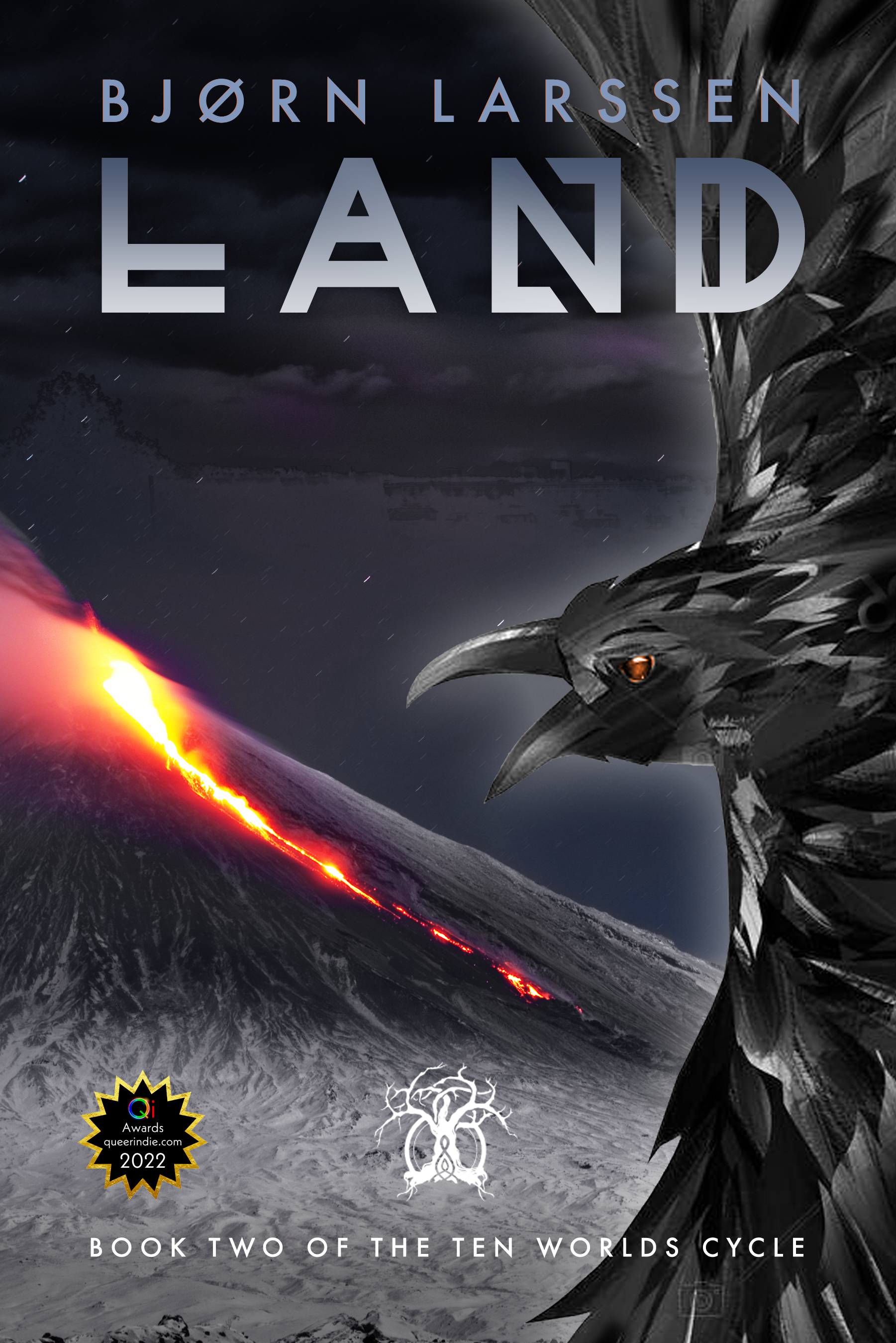
The Ten Worlds #2: Land, by Bjørn Larssen
Loss. Love. Land. Happy Never After. (A grimdark retelling of the discovery of Iceland. )
The truth Maya fought for all her life turns out to be a lie a thousand years long. She neither understands nor knows how to wield her hidden power, simultaneously endless and limited, forcing her to face responsibility for the harm she causes and parry countless questions she has no answers to. Neither time nor space can stop her – but can she stop herself?
Bound with an unbreakable love spell, Magni and Thorolf, both raised in darkness and pain, only share one thing: the fear of revealing their truths. One was born to be a God; the other only knows a slave’s life. One craves peace and quiet; the other believes peace is a brief reprieve between wars. As they mourn those they have lost, the constant war of their own threatens to destroy all they have left – each other.
Haunted by Gods old and new, in the shadow of Odin’s raven, they head to conquer the new Ásgard. Apart from their demons, nothing and nobody is what it seems. Unwilling to give up love, freedom, or land they’re fated to live happily never after… unless destiny can be altered after all?
The book includes strong language, depictions of sexual, physical, and emotional violence. Full list of triggers, which may contain minor spoilers, will be provided.
Preorder link:
https://www.books2read.com/thetenworlds2
Website link:
https://www.bjornlarssen.com/land/
Goodreads link:
https://www.goodreads.com/book/show/217183142-land
Social media:
https://www.bjornlarssen.com/sm/
Bio:

Bjørn Larssen is an award-winning author of historical fiction and fantasy, dark and funny in varying proportions. His writing has been described as ‘dark,’ ‘literary,’ ‘cinematic,’ ‘hilarious,’ and ‘there were points where I was almost having to read through a small gap between my fingers.’
His debut novel, Storytellers, won a Readers’ Favorite Gold Medal (Best Historical Fiction Novel) and was shortlisted for Eric Hoffer Grand Prize Award. His fantasy works, Children and Why Odin Drinks have been shortlisted for eleven (11) Indie Ink Awards – so far; Children was also nominated for a Stabby Award (Best Indie Novel of 2020). Bjørn is a Queer Indie Award laureate (best speculative fiction author) and very proud of it.
Bjørn has a Master of Science degree in mathematics, and has previously worked as a graphic designer, a model, a bartender, and a blacksmith (not all at the same time). He currently lives with his husband in Almere, which is unfortunately located in The Netherlands, rather than Iceland.
He has only met an elf once. So far.
His upcoming release, the second book in The Ten Worlds cycle – Land – is coming out on November 5, 2024.
What if the world you create becomes real?
A spotlight on J.M. Tibbott’s fantasy series, The Pridden Saga.
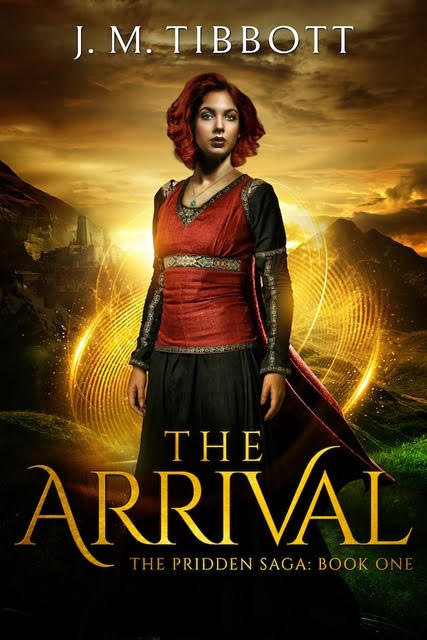
A prickly young game designer finds herself in a medieval world reminiscent of the video games she creates. Magic, dangerous creatures, and political intrigue were fine as a fantasy, but navigating them all in real life is a different challenge. Will Kat find her way through the maze of this new existence?
An enchanting adult fantasy, The Arrival is Book I of The Pridden Saga. Six books are published; the seventh has a planned release of autumn 2024. Find out more at the author’s website:
J. M. Tibbott is a prize-winning author, a writing instructor and editor. J.M. has been writing since grade school, and continues to study literature and the English Language. She believes there is always something new to learn.
Her works include magazine and newspaper articles, newsletters, online blogs, and story collections. With the 6th book of The Pridden Saga published, J.M is deep into the final conclusion in Book 7. Another couple of series are tucked up her sleeve, the first with a decided Detective bent. After that, more are planned but only her muse is in on the secrets.
A Book Develops, Part VI

Khalili Collections / CC-BY-SA 3.0 IGO, CC BY-SA 3.0 IGO https://creativecommons.org/licenses/by-sa/3.0/igo/deed.en, via Wikimedia Commons
Inspiration and understanding can come from the most unexpected sources. In my other blog, which focuses mostly on writing – mine and others’ – about the natural world, I mentioned, a week or two ago, that I was reading a collection of essays about landscape and place called Going to Ground. One of these essays is by Amina Khan, on the link between Islamic writing about nature and the Romantic movement in English poetry and prose.

My fictional world isn’t ours, but I can’t pretend it isn’t based on ours, and in the cultures I’m writing about, trade with my equivalent of North Africa and the Middle East is an important part of the story. In an earlier instalment of this series, I wrote about my youngest point-of-view character, Audun, and his love for the sea and sky and saltmarshes of Torrey, where he grew up. Audun is seventeen, academic, and of course he’s written some juvenile poetry.
Audun, being who he is, is expected to travel, to learn more of the world before he enters a life of teaching, his dream being to eventually be the head of my equivalent of a medieval university. His great-uncle, whom he hopes to emulate, spent a few years in his youth travelling east, gathering histories, settling down to a life of translation and comparison with the histories of the west. Luce, his aunt, is a doctor, much of her learning done in eastern lands as well.
But what Audun was going to learn in those travels (outside of life lessons, of course) I didn’t know. Until I was showering today (why do ideas so often arrive in the shower?) and my mind made the connection between Audun’s love for nature and the Islamic writing Amina Khan described in ‘A Wild Tree Toward the North’, her essay in Going to Ground.
Organized religions don’t exist in my books, replaced by philosophy and personal faiths in a wide range of deities. But religious writing can also be read for its poetry, and that’s how I’ll approach this. The bonus here is I’ll read some poetry that I probably wouldn’t have otherwise, and my world, like Audun’s, will expand.
Necessary Busyness
Watching the penultimate episode of Doctor Who last night, I realized (afterwards) that it was a rare hour in which my brain was totally engaged with story as it was unfolding. I wasn’t analyzing structure, looking for breaks in continuity or… well, I was going to say things that didn’t make sense, but then again, it was Doctor Who. Nonetheless, this is a rare occurrence now, my writer-and-editor’s brain always weighing if the narrative works, if it could be improved.
My brain is rarely still. It never was, but as a child my (undiagnosed) ADHD, of the day-dreaming, messy, begin-something-and-not-finish-it sort found what it needed by discovering new worlds in books. I once read six library books in a day (and they weren’t children’s books.) The Lord of the Rings was swallowed in three. Either that, or I was inventing my own elaborate worlds based on Star Trek or The Man from Uncle, or out in the fields and woods learning trees and birds and wildflowers. And like most people with ADHD, I could focus on a preferred subject for hours.
Somewhere in my sixty-six years, I learned to control my unquiet brain to some extent. But it can’t stand to be idle: I’m less obviously day-dreamy now, because that’s been channeled into the imaginary world of my books. But even though it’s a ‘preferred subject’ I can only write or plan for a few hours a day. And if I don’t have something else to focus on, I get bored. Moody. Unproductive. ‘Give me work!’ brain demands. (It doesn’t mean cleaning the cupboards, of course.)
Busy-ness is necessary for me. (And deadlines.) So, brain, looking at the year ahead – researching and writing the next book, a few short stories to write, a couple of editing jobs, chairing the community newsletter, said, ‘nope, this isn’t enough. Remember that creative writing group you were asked to lead?’
I live in a 55+ community of active, retired adults. How many want to try creative writing? Thirty. An impossible number for one group. Or even two. It’ll be four, occupying my Tuesday afternoons for the foreseeable future. Mostly beginners – but some novelists and poets already-published or agented-and-querying as well, people who have more formal education in writing than I do. I’ll get to learn, as well as teach, which is a bonus. But – the moment I agreed to do this, brain, which had been futzing around with character vignettes and some plot outlines for the next book, but no serious writing, said, ‘All right! Now it’s time to write! Fingers on keyboard, please!’ and began to unroll the story.
As perhaps I had secretly hoped it would. Maybe I do understand my brain a bit after sixty-six years. I will no doubt swear and whine and growl at it over the next months – but I will be writing and teaching, and researching and learning – all the things I love to do – and I won’t be bored.
But the cupboards probably won’t get cleaned, either.
Featured : Image by Megan Rexazin Conde from Pixabay
A Book Develops, Part V

Inspiration comes from many places, some random, serendipitous, some sought out. This week I drove the 1000+ km to and from Cleveland, to see an exhibition at the Cleveland Museum of Art called ‘Africa & Byzantium’, an exploration of mostly religious art produced in or resident in the lands of North and East Africa influenced by Byzantium.
But there’s no religion in your books, you might say. This is true – or rather, there are no large organized religions; personal faith is another matter – but it’s not religion per se that matters here. It was the communication, the translation of concepts and ideas I was interested in. The icon pictured below was possibly gifted to its Sinai monastery by Emperor Justinian himself, as he endowed the monastery in the mid-500s. It – and many other pieces of ancient art and writing – have been a part of the library of the Holy Monastery of St. Catherine since then.

In the new series set in my fictional world, the role of monasteries as repositories of knowledge and houses of learning is replaced by what the Ti’acha, the schools, of the Empire series have evolved into – the equivalent of the medieval universities not just of Europe but of the middle East and north Africa as well. So what writings – of philosophers from Casil and Heræcria and lands further east and south; of Heræcrian and Ikorani and Marai travellers, or even, at a more personal (for my new characters) level, of Cillian’s or Colm’s, Lena’s or Tarquin’s or Gnaius’s – might have found there way there, in original or copy, for Gerhart or Luce or Kirt to discover and learn from in their travels? Trade, medicine, history, mathematics, music, science: the knowledge held, exchanged, sometimes forgotten, the disciplines and interpretation of thought and ideas – all that still holds, even removing organized religion from the world.
I learned more practical, tangible things, too: the gifting of large brass trays, beautifully inscribed, as diplomatic gifts from the Mamluk sultanate; that a written language called Old Nubian existed; the trade routes from central Africa to the Mediterranean (invaluable); what block-printed linen of the period looked like; the three sources of treasured ivory. All useful things to be tucked away and possibly used, if and when they fit.
And, with pure serendipity, wandering the galleries before my entrance time to the exhibition, I walked into a room and saw – whatever the artist intended nearly 200 years ago – a portrait of my character Luce as a young student, studying medicine in an eastern school.

My photo.
Driving home along Interstate 90, I could feel this information slotting into the background of my world, hear the characters taking it in, shaping it to their experiences (and being shaped by it), becoming part of the world and character building. Both the book(s) and I are richer for it.
A Memory of Murder
Book 5 in the Jan Christopher Series by Helen Hollick
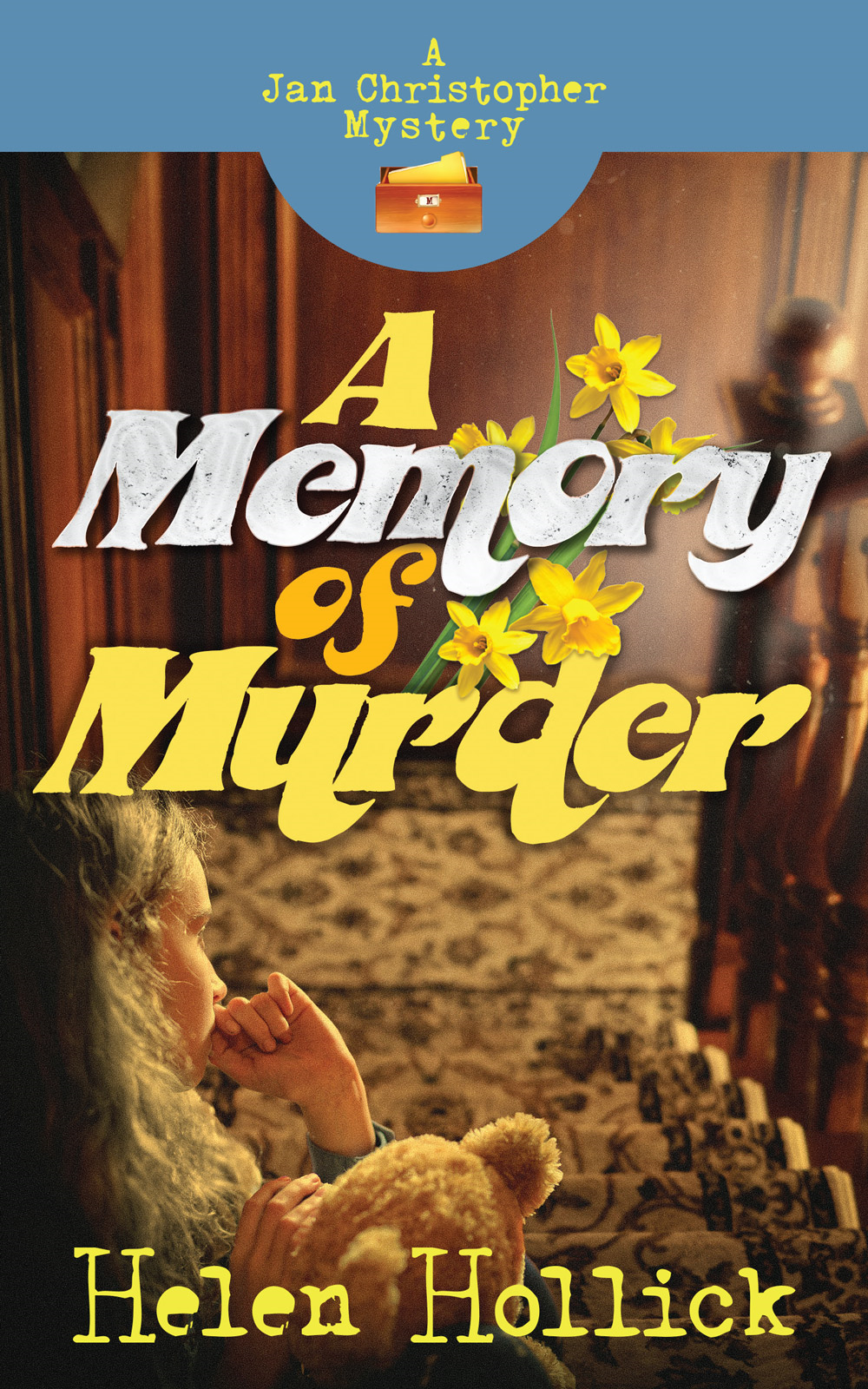
A Memory of Murder is the fifth in Helen Hollick’s Jan Christopher series, set in a less complicated time (at least as far as electronic communication is concerned!). It’s 1973, and Jan (January) Christopher’s work as a library assistant is disrupted by the decorating of the library, and by one particularly annoying workman who won’t take Jan’s engaged status as a deterrent to his attentions. Her Easter holiday plans with her fiancé, DS Laurie Walker, are disrupted too: a young girl has gone missing, and odd-but-significant objects are appearing at Jan’s family home. At least the circus arrives on its annual circuit to provide some distraction!
The details of life in a London suburb in the 1970s (Hollick draws on aspects of her own life in recreating this world) bring a comfortable sense of nostalgia to A Memory of Murder. The pace is in keeping with the time and place, and while the book fits into the ‘cosy’ subgenre, with a limited number of suspects, an amateur sleuth, and minimal on-page violence, the story does have a darker edge. Hollick writes with both humour and a keen sense of human nature; she is a talented writer whose books in any genre don’t disappoint. I look forward to what comes next!
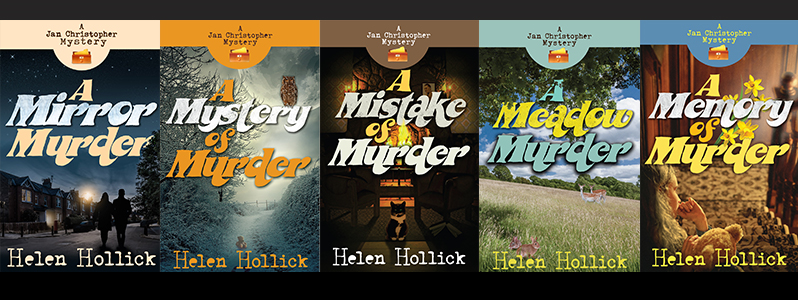
THE JAN CHRISTOPHER MYSTERIES by Helen Hollick
A Memory of Murder – a new cosy murder mystery to solve – along with library assistant Jan Christopher, her fiancé, Detective Sergeant Laurie Walker and her uncle, Detective Chief Inspector Toby Christopher.
Set in the 1970s this easy-read cosy mystery series is based around the years when Helen was a north-east London library assistant, using many of her remembered anecdotes, some hilarious – like the boy who wanted a book on Copper Knickers. (You’ll have to read the first book, A Mirror Murder to find our more!)
The mysteries alternate between Jan’s home town, and where Laurie’s parents live – North Devon, (where Helen now lives.)
In this fifth episode, there’s a missing girl, annoying decorators, circus performers, and a wanna-be rock star to deal with. But who remembers the brutal, cold case murder of a policeman?
Buy Link:
Amazon universal: https://mybook.to/AMemoryOfMurder
(e-book available for pre-order: published on 18th May – paperback release to follow)
Or order from any bookstore(cheaper on Amazon)
Reader’s comments:
“Can I say this is the best one (of the series) yet? YES! For the depth of the writing, the maturity of the main character, and the complexity of the premise. It’s cosy…with a few chills for good measure!” Elizabeth St John, author
“I sank into this gentle cosy mystery story with the same enthusiasm and relish as I approach a hot bubble bath, (in fact this would be a great book to relax in the bath with!), and really enjoyed getting to know the central character…” Debbie Young bestselling cosy mystery author
“Jan is a charming heroine. You feel you get to know her and her love of books and her interest in the people in the library where she works. She’s also funny, and her Aunt Madge bursts with character – the sort of aunt I would love to have had. I remember the 70s very well and Ms Hollick certainly gives a good flavour of the period.” Denise Barnes (bestselling romance author Molly Green)
“A delightful read about an unexpected murder in North East London. Told from the viewpoint of a young library assistant, the author draws on her own experience to weave an intriguing tale” Richard Ashen (South Chingford Community Library)
“Every sentence pulls you back into the early 1970s… The Darling Buds of May, but Devon not Kent. The countryside itself is a character and Hollick imbues it with plenty of emotion” Alison Morton, author
“An enjoyable novella with a twist in who done it. I spent the entire read trying to decide what was a clue and what wasn’t … Kept me thinking the entire time. I call that a success.” Reader’s Review
ABOUT HELEN

First accepted for traditional publication in 1993, Helen became a USA Today Bestseller with her historical novel, The Forever Queen (titled A Hollow Crown in the UK) with the sequel, Harold the King (US: I Am The Chosen King) being novels that explore the events that led to the Battle of Hastings in 1066. Her Pendragon’s Banner Trilogy is a fifth-century version of the Arthurian legend, and she writes a nautical adventure/supernatural series, The Sea Witch Voyages. She has also branched out into the quick read novella, ‘Cosy Mystery’ genre with her Jan Christopher Mysteries, set in the 1970s.
Her non-fiction books are Pirates: Truth and Tales and Life of A Smuggler. She is currently writing about the ghosts of North Devon for Amberley Press, and another, Jamaica Gold for her Sea Witch Voyages.
She lives with her family in an eighteenth-century farmhouse in North Devon with their dogs and cats, while on the farm there are showjumper horses, fat Exmoor ponies, an elderly Welsh pony, geese, ducks and hens. And several resident ghosts.
Website: https://helenhollick.net/
Facebook: https://www.facebook.com/helen.hollick
Blog: promoting good authors & good reads: https://ofhistoryandkings.blogspot.com/
 marianlthorpe.com
You must be logged in to post a comment.