Empire’s Reckoning – just a taste!

Here’s just a smidgen of Empire’s Reckoning, the current work-in-progress, to whet appetites!


Lost. I wrapped my cloak around me a little tighter, shivering in the night and fog. Lost, and cold, and in true mortal danger, from both the elements and men, and within a day’s travel from Gundarstorp. My father’s lands, which would have been mine now, before Fritjof, before Casil, and a treaty signed.

Not my lands, now; my brother’s, and if I died here or made it back to Ésparias – as Casil had renamed its newly-reclaimed western lands – it would make no difference. I had written a letter, renouncing my rights, signed and dated it in the presence of witnesses. Witnesses sworn to secrecy about my presence at Gundarstorp, but oaths could be forsworn. Even by the best of men, if the reasons were compelling enough.

No difference to my brother – oh, he would mourn me, if my body were ever found, if the foxes and eagles of these hills did not strip it bare – but I had a greater reason to live. I loved my brother, and I felt some attachment to his child, and to my little half-brother, but my greater love – my greater loves – were in Ésparias. Two men, one whose life had been inextricably bound to mine since I was sixteen, in ways I still struggled to fully comprehend, and one whose cheerful good humour and love of music had enriched my days since Casil. The grace note and the harmony for the melody of my life, I had called them once. Druisius truly had been the harmony; was still, I hoped. Cillian was far, far more than the grace note. I couldn’t think of an appropriate analogy. I couldn’t think properly at all. The cold fog enveloping the hill was filling my mind, too.

Move, I told myself. But move where? Wouldn’t it be preferable just to curl up in my cloak and let the cold and damp take me, rather than fall into a chasm groping my way in the fog? One would be painless. I closed my eyes. Nothing but silence surrounded me, a complete absence of sound; no owl hooted nor vixen yelped this night. Suddenly, as clearly as if she had been at my side, I heard again Lena’s words to me, from months before. If you turn away from him, you will hurt him more than you can comprehend.

I had not turned away, not in the end. But if I died here, Cillian would never know that. If I let exposure take me, I would be yet again running away. Come home, mo duíne gràhadh, if you can. His last words to me, before I fled a revelation I could not accept. Oh, I had couched my departure as the demands of my work, but he knew the truth. As did I.

I forced myself forward. It is ironic, I thought, to be physically lost in this landscape of my boyhood, when I am finally sure of my path as a man. I cocked my head. Had I heard something? I listened, intently. A faint ringing. A bell? Where would there be a bell?

Around the neck of a sheep, you fool, I thought. Think. Whose note is that? In Sorham’s highlands, each torp’s bellwethers carried a bell with a different tone, to help the shepherds locate a missing flock. I waited. At night, the sheep wouldn’t usually move much. Several minutes passed until I heard the distant ringing again. Pietarstorp’s bell, I thought. And that makes sense…

I closed my eyes again, to help me concentrate, trying to picture the hills and glens of Pietarstorp and where the sheepfolds were, against the landscape I had traversed to reach this spot. I had both walked and ridden these moors, stalking deer, flying the fuádain for hare or cailzie. Cailzie. If I was where I thought I was, there should be a wood to my left, at most half a mile away. Fog or not, at dawn, in early spring, the cailzie’s booming call would sound. What else should I hear? A stream, at the foot of the valley. Work down the hill, slowly, bearing left, I told myself. Hope, and a plan, cleared my mind.

I picked up my bag and shrugged it over my shoulders, and began the careful walk downhill. I could picture the spot now, the wood to my left, the stream, the sheepfold on the upward slope south of the stream. If there were a shepherd with the sheep – and likely there would be, with new lambs in the flock – his dog would raise the alarm if I was not careful, or maybe even if I were. But the fog muffled sound, and scent, so I might be lucky.

I slipped once, on some small stones, but I didn’t fall, and the noise did not travel. I thought I could just sense the darkness of the wood on my left when the deep boom of a cailzie on its strutting ground sounded. The bird thought it was dawn, and perhaps it was; looking up, I thought the fog brighter. I kept going to my left, and now I could make out the shapes of trees.

Inside the wood the fog seemed less dense. I found, as much by feel as anything, a tight group of pines, and as I crawled amongst the trunks I felt the ground. Its carpet of needles was dry. I gave a sigh of relief. I was safe. I would eat a little, and then I could sleep.

The barking of a dog woke me. An insistent, sharp bark meant to bring attention to a lost lamb, or a fallen ewe. I swore, but there was no sense in trying to run. I heard a voice silence the dog, and then the sound of a man beginning to crawl into the space under the trees.

“Don’t bother,” I said. “I will come out.”

“You startled me,” the shepherd said, in the soft accents of Sorham. “I thought maybe a lamb had strayed, with the dog so persistent. You are not Marai, from your voice.”

“No,” I said, standing. It was still dark in the wood, but I took a chance. “Daidh, is it not?”

“Aye,” he said doubtfully. “And who might you be, to know my name?”

“Sorley,” I told him. “Harr Gundar’s son.”

Lord Sorley? But you are…”

“Dead? As you can see, I am not. A traitor? Perhaps. That depends on your politics, Daidh.”

“Politics? What politics can a shepherd have? My lord would call you traitor, though.”

“Private beliefs, then. I had reasons to come home, and reasons to leave again. Will you let me do that, without telling Harr Pietar that you have seen me?”

He considered. “It was a drear night,” he said eventually. “Hot tea and porridge would warm you, Lord Sorley. Come with me. You can tell me your reasons, so I can decide.”

I followed him out of the wood. He would not press me to talk until after I had eaten, the hospitality of these highlands too ingrained. Even an outlaw could be offered shelter and food in poor weather. I had time to shape my story to my audience, for some of the truth would turn him against me immediately. And, I thought, it was far too long and complex a tale to be told in part of a morning. A tale that had begun ten years before, in the hall of my childhood home, the night my father had decided to entertain the visiting young toscaire with dancing, and asked me to play.



First Review of Empire’s Exile!

Empire’s Exile is a goldmine of anticipation, apprehension, joys and hardships, survival and all-consuming, accepting love.”


You can read the rest of Liis Scanlon’s detailed and comprehensive review here:

https://liisthinks.blog/2018/08/17/empires-exile-empires-legacy-3-by-marian-l-thorpe/

Exile ebook cover

amazon.com/author/marianthorpe

The Completed Trilogy

Unbelievably, the Empire’s Legacy trilogy is done. Here are the covers, the links, and an excerpt from trio2the third and final book.

Fifteen years of my life, these have taken: twelve for Empire’s Daughter, because I was still working and busy with other commitments as well; two for Empire’s Hostage, and a shocking less-than-one for Empire’s Exile, considering it is the longest (420 pages, more or less).

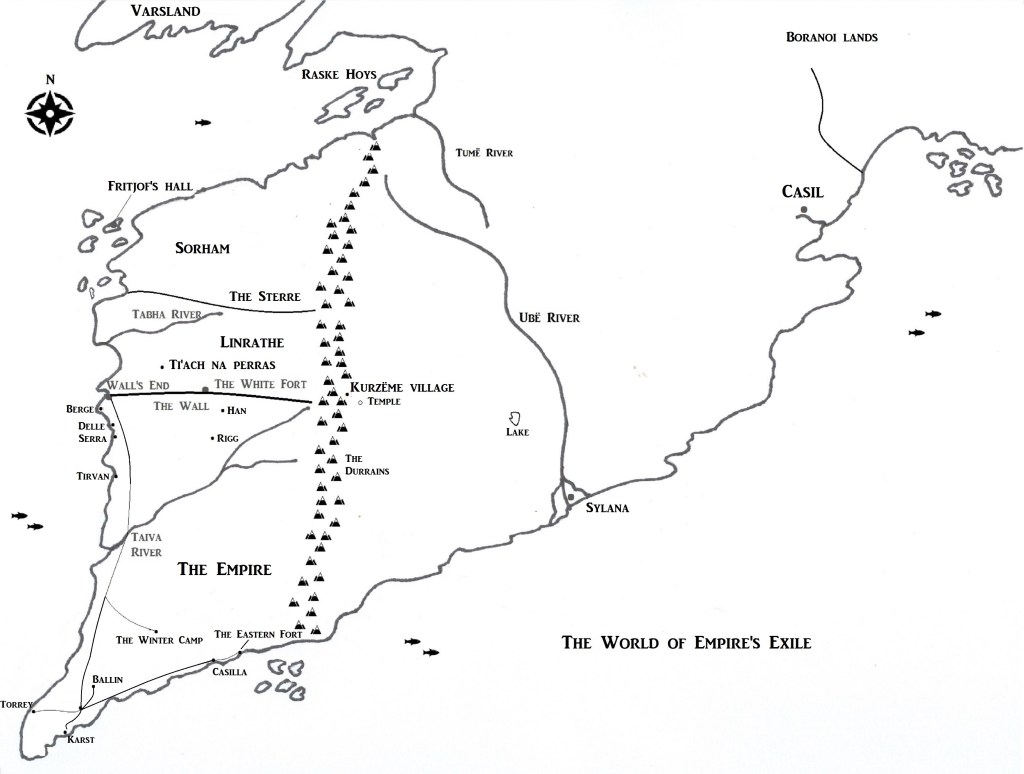
Am I done with my Empire? No! But the next book(s) will have different narrators and different points of view. empire exile map horizontal


Here’s the link: amazon.com/author/marianthorpe

And here’s the excerpt.

Chapter One

You shall leave everything you love most dearly: this is the arrow that the bow of exile first lets fly.                                                                                    Dante

I did not turn back to look at the land I was leaving, after Galen brought us to the path into the Durrains. I began to climb, always looking forward, and up. Anger fueled that climb, at first, cold fury at the sentence of exile. Perhaps I should have been grateful; I hadn’t been executed, as I’d expected to be. My Emperor had given me a chance, small as it was.

“Take it slowly,” Galen had said. He’d been further into the Durrains than anyone, but even he had no idea how high they were, or how wide. After a couple of hours of climbing, I needed to stop. I’d recovered from serious illness, including an infection in my lungs, not many weeks earlier. I hated showing weakness in front of Cillian, but if I were to have any chance of surviving in these mountains, I could not let pride override pragmatism.

We reached a small grassy meadow, scattered with boulders patched yellow and orange with lichen. I made my way to one of them, sitting down thankfully. I eased my pack off. Cillian had chosen a boulder a few paces away.

“Sorry,” I said. “But I need a rest. I’m not as strong as I should be, after the illness.”

“No matter,” he answered. “Galen told us to take it slowly.” He drank from his waterskin, sparingly. “Perhaps we should talk.”

“About?”

“What we can expect from each other, as travelling companions,” he said evenly. “I can build a fire, and pitch a tent, and use the stars to find my way, fairly well. I cannot use a bow, or butcher an animal. Or cook food, beyond a simple porridge and tea.” His words were precise, with just enough difference in pronunciation to remind me our common tongue was not his native language.

“I can hunt,” I replied, “and butcher what I kill. I can’t cook much, either, but I can roast a rabbit over a fire. And I can navigate by the stars, too.”

“I will be more dependent on you than you will be on me,” he observed.

“That’s not a good situation,” I said. “You can’t hunt at all?”

“No. Except to fly a falcon.”

“I should teach you to use a bow, then,” I decided. “If I am injured, or worse, dead, you need to be able to feed yourself.” We had two small bows meant for birds and small animals, and a dozen arrows each. I hadn’t realized that Cillian had no idea how to use his.

“That might be best,” he agreed. He glanced up the mountain.

“Another few minutes,” I said. He nodded.

“You should decide,” he said, “as you are the one recovering.” He drank another small mouthful of water. “One more thing, Lena. I would like this to be understood from the beginning. I am used to travelling on my own, rarely with a companion and never with a woman. I will respect your privacy, and you are in no danger from me.”

“Nor are you from me,” I said drily. I’d meant it to be amusing, but what flashed across his face looked like relief, to me. What had he thought I expected? “Seriously, Cillian, thank you,” I said. “It is good to be clear, from the beginning. I have travelled alone with men, and even in the Empire there can be moments of awkwardness. Shall we go? When we stop at mid-day, I’ll give you a lesson with the bow.”

The climb grew steeper. At one particularly difficult spot, Cillian went ahead, reaching down to offer me a hand several times. I cursed my frailty silently: I should be good at this. The game trail levelled out, but he stayed ahead of me. He moved with grace, balancing easily on the rocks. Watching him, a memory tugged, but stayed hidden.

Only when we stopped to eat did I realize what that memory was. He’d crouched to open his pack, straightening after finding what he wanted in one fluid move.

“Cillian,” I asked, “Do you dance?”

“An unusual question to be asked on a mountainside,” he observed. “But yes, I do. Why do you ask?”

I had flushed at his tone. “Our potter, Tice, was from Karst, where they dance from earliest childhood. You move like her, a bit.”

“Do I? I did not learn from earliest childhood, but from about twelve. Dancing is a necessary ability for what I was ordained to become, by Perras’s and the Teannasach’s decree.” Food in hand, he sat on the grass. I did the same, a comfortable distance away.

“What did you do, in Linrathe? Jordis said you were a student, but that can’t be right, can it?”

“Why would you concern yourself with what I did? It is in the past.”

“It may be,” I answered, ignoring the rebuff, “but we’re going to be travelling companions for the gods know how long. We probably should get to know each other, don’t you think?”

“If you wish, although I do not see why it matters.” He ran a hand through his hair, already unkempt. “Jordis was not incorrect. All ti’achan, even Perras and Dagney, are students for all our lives. But primarily I have been, or rather I was, for a dozen years now, a travelling teacher, to the estates of any Harr or Eirën who wished their nearly-grown sons, or sometimes daughters, to have a winter spent in learning. But that duty was almost an excuse for the second, which was to be a toscaire. An emissary, you would say. I brought news and ideas to the Harr or Eirën, and gathered their thoughts, and the news and rumours they had heard, and took them back to the Ti’acha, and our leaders.”

“What sort of ideas?”

“Whether they supported Donnalch for Teannasach, for one, and then after he had been chosen, what their support for his plans were.”

“Why didn’t you fight?” I asked abruptly.

“Fighting is not required of all men in Linrathe,” he said. “Those of us attached to a Ti’ach are exempt, and as a toscaire I had to be seen as impartial, or I would not be trusted with honest thoughts.” There is something evasive in his answer, I thought, even though it sounds plausible.

“So, like our young officers, as a…an emissary…you were trained in protocols, in how to behave and act around all ranks of people?”

“Yes. Even to the halls of King Herlief, in Varsland.”

“That training wasn’t evident the first week or so I knew you.” I hadn’t planned to say that. “I’m sorry, Cillian,” I said. “That was rude.”

“As to that, an apology is due you, for the way I treated you when you first came to the Ti’ach, if not for later as well.”

“Apology accepted,” I said lightly. “But why? Will you tell me that?”

He shook his head. “Not at this moment. It is not something I would have spoken of, except to Perras or Dagney, and I lost that opportunity.”

That had sounded honest. We might be together in exile, but that didn’t mean we needed to be privy to each other’s secrets, or innermost thoughts and feelings. I finished my cheese and oatcakes. “Shall we begin with the bow?”


A Valentine’s Day Excerpt

Here’s a little taste of Empire’s Exile (due out late 2018) just for today:

Empire's Exile beta cover

My doubts….were meaningless; they were as unfounded as if he had doubted me because I could shoot a bow, or navigate a sunless sea. I had touched on the truth, the first night at the lake:  the darkness within us both was more than one night, or many, would assuage. The man struggling to control himself last night, his fear expressed in cold, cutting anger, was still the reviled and terrified seven-year old, sent away from all he loved for safety. Too proud, or perhaps, in his child’s mind, too culpable, to beg not to be abandoned; too hurt to allow himself to love again.

And I? Violence done, by me and to me, and my own deep doubts about my ability not to betray. The last was gone, I thought, that decision made. I could not change the choice I had made at Tirvan, but I had not repeated it. But the scars of violence, the revulsion and the fear, would be with me always, and more savagery lay ahead.

In each other we had found healing, but neither of us were whole. If time, and the gods I did not believe in allowed, perhaps, but that grace was unlikely to be given in a time of war. I did not know where need ended and love began, for either of us, and I did not think it mattered.

I turned toward him. The moon was a week past full, but the night was clear, so enough light shone through the shutters that I could just see his face, untroubled in sleep. I touched his cheek with one fingertip. “Käresta,” he murmured, not waking, and reached out, pulling me closer. I settled against his chest, and closed my eyes.

LGBT history and the Empire’s Legacy Series

This is a reblog of a post I wrote some time ago, but in honour of LGBT History month here in the UK, which is where I am living until the end of March, I’m reposting it.

Lena’s World: Sexuality in the Empire: Empire’s Legacy Backgrounder IV

In Lena’s world, the world of the Empire, sexuality is varied and fluid.  This is, I hope, presented simply as part of the background and the culture of this world, but to some extent it is also based on history.

Sexuality is both innate, sexual preferences and gender identity something we are born with (and that do not necessarily conform to the gender identity we are assigned at birth) but the strength of sexuality as a basic human need can also mean that sexuality can be situational.  Men or women deprived of the company of their preferred sexual partners for long periods will seek and find sexual release and comfort where they can.  In the Empire, the structure of the society, where men and women live separately for all but a couple of weeks per year makes situational sexuality a normal and accepted practice in the lives of both men and women.

But of course, there is a wide range of sexual preference within this society, as there is in any, so the partnerships range from the men and women who prefer their own sex: Finn, the young officer; Siane and Dessa, at Tirvan; those who prefer the opposite sex: Tali, whose love for Mar keeps her living alone throughout her life; and those who are more fluid: Lena, the protagonist;  many of the women of the villages, many of the men of the army.  One or two characters may be construed as transgendered: Halle would be one.  My intent was not to define the characters by their sexuality, but let them be whatever they are, incidental, for the most part, to the story.

Where did this come from?  Greek and Roman societies were well known for accepting sexual love among athletes and soldiers of the same sex.  The Oxford Classical Dictionary, paraphrased on Wikipedia, states:

The ancient Greeks did not conceive of sexual orientation as a social identifier as modern Western societies have done. Greek society did not distinguish sexual desire or behavior by the gender of the participants, but rather by the role that each participant played in the sex act. (Oxford Classical Dictionary entry by David M. Halperin, pp.720–723)

The Sacred Band of Thebes was a 4th Century BCE troop of elite soldiers, comprised of 150 pairs of male lovers from the city of Thebes in Greece.  The troop, whose historical existence is accepted by most scholars, given its mention by classical writers such as Plutarch, was destroyed by Philip of Macedon (Alexander the Great’s father) in 338 BCE. Indeed, some military commanders of the classical era believed troops of lovers fought the hardest, because they were defending those whom they loved, not just the state.

Less is known about female same-sex relationships.  The Greek poet Sappho was head of a thiasos, an educational community for girls and young women, where same-sex relationships were part of life. The same may have occurred in Sparta.

Moving forward to the Roman era, many of the same attitudes regarding male to male sex continue, with the exception being within the military. In the Republican period (4th to 1stcenturies BCE) soldiers were forbidden, by penalty of death, to have sex with each other, although sex with male slaves appears to have been acceptable. In the Imperial period, this prohibition may have been lifted, as marriage was forbidden to soldiers.

Hadrian, the Roman Emperor from 117 – 138 CE, whose British wall is the model for the

Wall in Empire’s Daughter and Empire’s Hostage (and the upcoming final book in the trilogy, Empire’s Exile) had a lover named Antinous, one, likely, of Hadrian’s ‘harem’ of both male and female lovers.  But when Antinous drowned, Hadrian mourned him publicly, founding the Egyptian city of Antinopolis in the boy’s memory and having him deified, suggesting (strongly) that his attachment to him was deep and serious. In the British Museum’s exhibition marking fifty years since the decriminalization of homosexuality in England and Wales, the heads of Hadrian and Antinous stand side by side, honoring their relationship. (Hadrian’s the one with the beard.)

So, like most of the cultural structures in the Empire’s Legacy series, the sexuality is rooted in historical fact, although I do not pretend it is historically accurate. I write alternative history, or historical fantasy, (choose your category), not historical fiction!  But I also chose to honor the existence of these relationships in history, because so many books of this type seem to gloss over or totally ignore love that is not heterosexual, and that’s just not the way it was, or is.

Guest Post: Expressions of an Artist: The Whole Shebang – Frances Wassermann-Bildner

“I wonder the wonder, freedom of freedoms,
play for you nightly and sing in the rain.
I pray for your ghosts to let you off lightly,
lessen and get rid of your terrible pain.”

Welcome to today’s guest post, from Frances Wasserman-Bildner, promoting her new book, Expressions of an Artist: The Whole Shebang


Frances_Bildner_at_work-225x300

“I have  been painting a lot of my life, since I was 13 and had won an art competition where Sir Charles Wheeler the past president of the royal academy wanted to buy my painting.
I started writing in an automatic prose poetry way after the death of my aunt and five days after my younger son was born. I couldn’t get to my studio in downtown Manhattan and so one day I just picked up my pen and started writing. When I read what I had written I had to look up some of the words, yet it all made sense. I don’t edit my writing , it comes from my unconscious, as does my painting where I may start with a doodle and the painting paints itself and tells its own story.
I am influenced by life, my work is about the human condition, love, living, loss,
belonging, fear, political, outsider, Mother /Daughter. The kind of themes I write and paint about affect us all. I think the writing may speak to all as well.”


Front_cover_Expressions-199x300

The publisher describes the book this way:

“This book is not a novel, nor a book of short stories.

It is a collection of writings and paintings.

It encompasses the human condition by covering topics such as love, loss, living, fear, political, outsider and belonging.

Each piece of writing is written automatically and quickly. The writing actually writes itself and the author is a vehicle for her work. The paintings are done in the same way. There are no preconceived ideas in either paintings or writings.

Although the work is produced this way, it does touch the subjects that we are all concerned with. This is because the artist/author is a product of the human condition and will therefore hold these subjects in her subconscious.

Some of the work is quite dark, all of it is filled with energy and emotion and an appreciation of life in all its facets.

The book has been collated into these topics by a reader. One can easily dip in and out or read it cover to cover.”

Empire’s Exile milestone 1

Here’s one of those ‘milestones’ a writer reaches; I’ve got the first draft of the first third of Empire’s Exile written. That’s about 40,000 words. Writing this one is an interesting experience.

There are the logistics to consider: making sure I tie up all the loose ends and unanswered questions from Books 1 & 2.  There is making sure I stay true to the theme of exile:  in Book 1, Empire’s Daughter, Lena was barely adult, still a ‘dutiful daughter’ in many ways, just beginning over the course of the book to realize that truth comes in many forms.  In Empire’s Hostage, Book 2, Lena is a hostage both actually and figuratively, her fate in the hands of rules and traditions. In this third and last volume, I’m exploring the theme of exile, again both actual and figurative.  It doesn’t always make for easy writing.

Then there are my characters.  I thought I knew the basic story arc, but they had different ideas. Listening to what they told me (or what my subconscious told me, if you prefer), had led to Exile being a different story than what I thought it was going to be, introducing other forms of displacement into the narrative. It also left me with an enormous dilemma about the ending…which I have resolved in a way that is both true to the story and satisfying for me. (If you’re wondering why I’m talking about the ending when I’m only 1/3 into the book, it’s because I need to know what the ending is, so I can work towards it.)

So I’m going to take a breather for a few days, work on two unrelated editorial projects, get organized and packed for our escape from winter, and once we’re settled in there, start the middle third.  Quite a bit of research is associated with this third, and I need to plot out the major conflicts and crises, but I’m hoping to have this section done by March.  I’ll need to work flat out if I’m going to get this book out for the Christmas 2018 market…which is my current goal….but, just maybe, I will make it.

Updates, excerpts, backgrounders as I have time and they are appropriate!

The Best Fantasy Novels You’ve Never Heard Of

I am honoured to be included in Andrea Lundgren’s list of The Best Fantasy Novels You’ve Never Heard Of! There are some really good reads here, and others that are new to me (but won’t be for much longer!)

Andrea Lundgren's avatarAndrea Lundgren

I frequently get questions from fellow readers for fantasy book recommendations. I have well-known favorites (The Lord of the Rings, The Chronicles of Narnia, The Hobbit) but then my list goes off to books that are less known, so I wanted to share the best with all of you. These have been picked based on the quality of writing, world-building, characterization, and the fact that…well, I love them all! 🙂

  • Wind Rider Chronicles by Allison D. Reid. The first book, Journey to Aviad, is available to read for free and tells the story of Elowyn and her older sister, Morganne.

Their mother pushes them to work hard and work quickly, but Elowyn loves to explore the woods…until she encounters the strangest creatures, wolf-like hounds that prowl along her city, their presence an omen of evil things to come. Slowly, she and her sister are drawn into the changes in…

View original post 737 more words