How I Review a Book

With twenty-five years in education behind me, it will come as no surprise to readers who are also teachers, or who know teachers, to read that my book reviews are based on something called a rubric.  A rubric has several meanings, but in education, it means:

a guide listing specific criteria for grading or scoring academic papers, projects, or tests

So what are my criteria?

I consider the following major categories in reviewing a book:

  • Writing style:  does it scan?  Is the mix of active and passive voice appropriate to the story? Is there too much description, or  too little? Does the tone fit the story? Is the pacing of the story balanced?
  • Dialogue:  is it realistic? Is it complex – are emotions, nuances, subtleties conveyed?  If meant to, does it convey regional accents or cadences?
  • Plot:  is it either original, or a new telling of a genre-standard story? Is it internally consistent?  Does it rely on coincidences or happenings that strain the reader’s belief?
  • Character Depth and Development:  are these real characters, or stereotypes? Do they have dimension?  Do they develop over the story?
  • World-building:  does the author make us believe in this world?  Is it fully explained over the course of the story, or are we left guessing? Does the author appear to understand her/his world thoroughly? Are phrases/terms used correct for the setting? (e.g., not using Australian terms when the book is set in Canada)
  • Spelling and grammar:  Are conventions followed?   Are spelling errors the result of spell-check limitations? (e.g., overseas/oversees).  If non-conventional use is purposeful, is it used consistently?  Do spelling/grammar errors detract from the story?

I also look at production issues (the way the book is formatted) and reading level if it’s not an adult book.

Each of the 6 main categories is rated out of 4, and then the overall rating made. (Educational rubrics, at least here in Ontario, are always out of 4…so that’s why I rate out of 4 –  habit.) I then mathematically convert that to a rating out of 5, to be consistent with Amazon and Goodreads. (Unlike those sites, though, I will report 2.5 or 3.5 or 4.5, but I will use the next full ‘star’ when posting the review on either of those sites.)

I read with a clipboard and the rubric beside me, and I take notes.  Using a rubric means I’ll be more consistent, and, it allows me to rate a book in a genre I don’t usually read.  But I’ll be honest – there’s a bit of gut reaction still in there.  I’ll give you an example from film.  Years and years ago my husband and I saw a film called Blood Simple.  It had internal plot inconsistencies.  It had production issues, especially with continuity.  It was clearly low budget – and both of us loved it.  It was the first Joel and Ethan Coen film to be released (I think) and it had all the hallmarks of their quirky, eccentric film-making, and those qualities over-rode the problems, in our opinion.

And the last thing to remember about any review?  The friends we were with hated Blood Simple.  In the end, it’s only my opinion.  I’ve been known to be wrong.


Reverse Migration: A Discourse into the Spirit of Place, Excerpt 2

If you missed excerpt 1, read it here.

Deeper

The frothy umbels of cow parsley along the lanes are beginning to fade, to be replaced by the brilliant white of ox-eye daisies . There is less birdsong; instead, fledglings shout from the hedges and trees, demanding food. Pheasant chicks burst from cover as I walk through Bypass Wood on my way to the village fen.

What shapes a landscape begins in its depths: the soils that lie beneath the heath and woodland and arable fields, influencing drainage, fertility, and acidity, affecting plant and animal life, human use, and even ownership. I am just beginning to see this on my walks, both around the village and further afield.

The Drift, which I walked along to reach Bypass Wood, was once access to the western sections of a much-larger Dersingham Common. The western reaches of the common were flatter than the current commons, and drier than the Bog Common. The edges of the old Dersingham Common and the edges of the sand-belt in the base soil map below follow a common line. Walking the Drift, the subtle land contours can be seen, especially at the western end, where the islands of high land rise above what once once marsh. Now only undulations in the wheat show the difference.

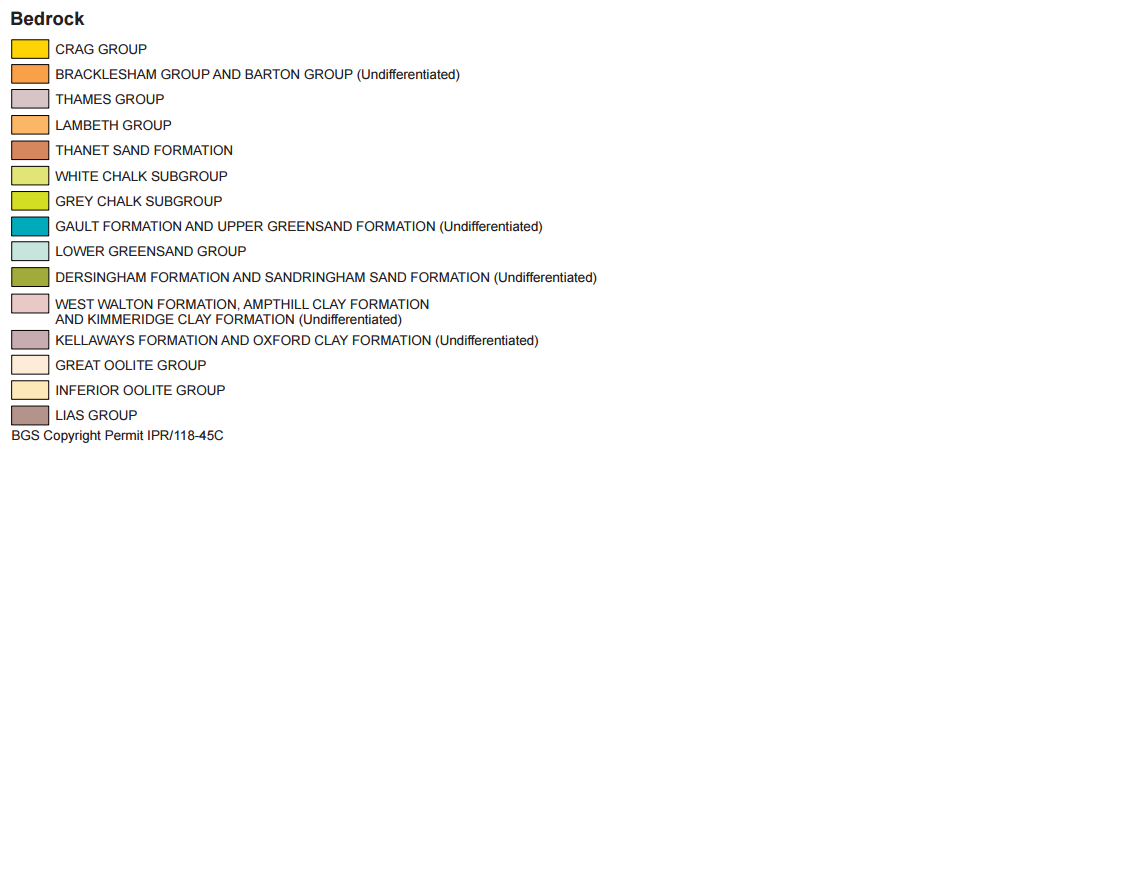
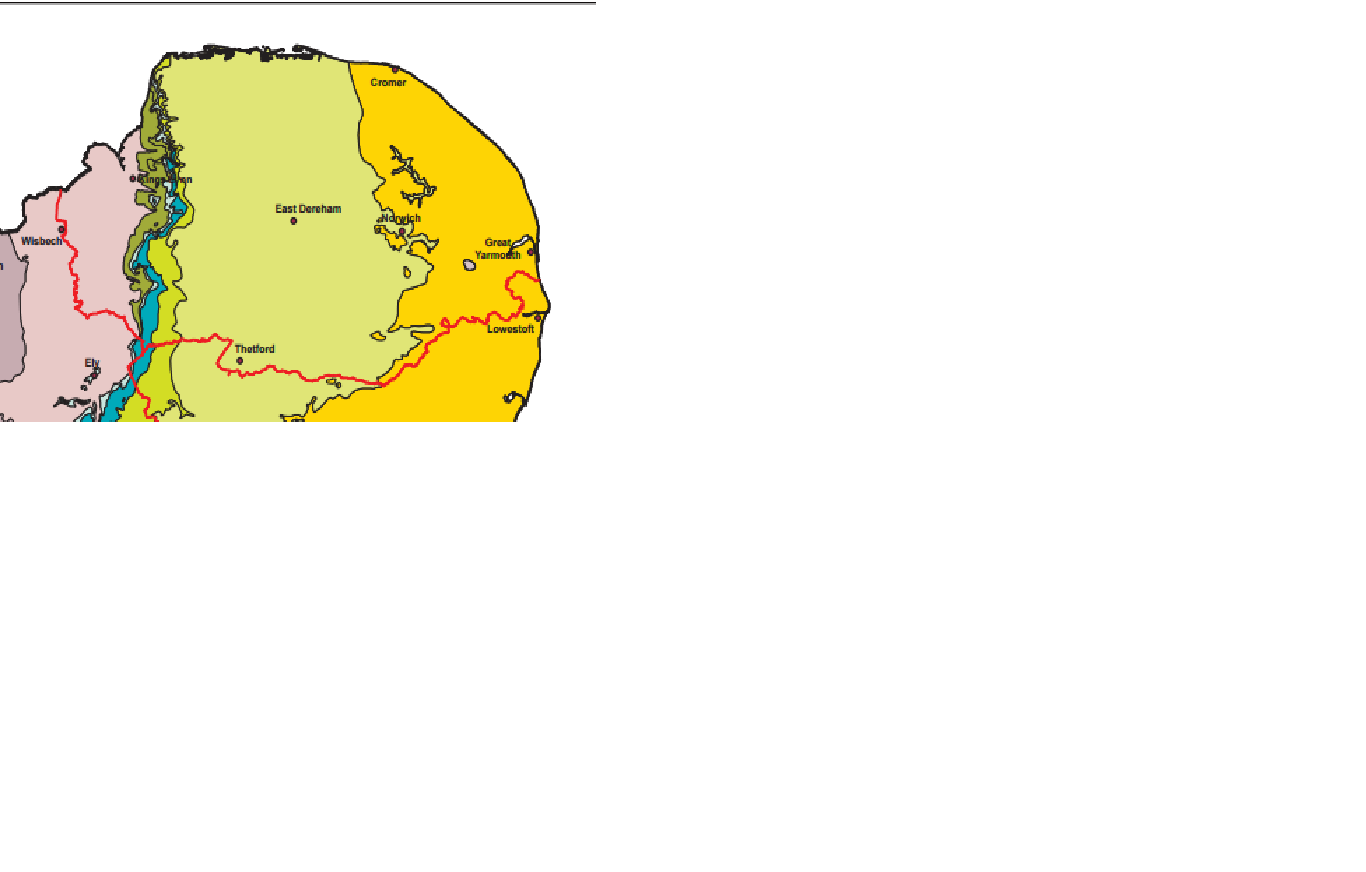
The base soil-map is below. Light mauve indicates coastal clays; the sand belt, running north through Sandringham and Dersingham, is avacado green. Blue is greensand, a mineral rich, coarser sand, and, moving west, the bright-and-dull greens are chalk.

bedrock mapBedrock legend

Walking east along the Drift, back into the village, the land rises infinitesimally, obvious only as the dyke on the southern edge gradually blends into the fields. Woodland and pasture lie on both sides now. These were part of the common land, but these were lands that could be put to the plough, and so, it appears, they were taken as part of the Dersingham Inclosure Act of 1797, when land-owners fenced common land for their own purposes. What was left as commons, for grazing, bracken, and wood for the villagers of Dersingham, was the common land lying on the less fertile, steep, greensand ridges that now make up Open and Shut-up Commons, and, the wet fenland of the Bog Common. This was the pattern repeated over Norfolk: the land left for the villagers was the poorest heath and fenland. (Although, deeper digging shows that some of the uses of Dersingham’s common land includes arable, grazing, and shooting rights…but the land used in this way is effectively not common land, although the revenues fund the management of what is left.)

My father’s memories of the common were of land utilized by the villagers. Pea-sticks were cut from the birches, and bracken gathered for fodder. There was a common-keeper, who slept in a shack on the common on a bed of bracken. Ponies grazed. Rabbits were taken for food. Heathland is a man-made landscape, but one so ancient it it is a valid and valuable ecosystem, habitat to flora and fauna found nowhere else. But changing ways of life changed the use of common land, and heathland was left to revert to birch and nettles, or else became pine plantations. Dersingham’s three public commons now are used primarily for dog-walking.

Heathlands may have sand, greensand, or chalk as the bedrock, but each type of heathland is slightly different. Sand heathlands tend to be acidic; that on chalk may have a thin layer of acidic soils overlying the alkaline chalk. Acidic heathlands, dominated by Erica species, were often planted to pines, especially where rabbits, warrened on the heath as a source of food, reduced the landscape to blowing sand. On the old map Sandringham Warren adjoins and perhaps includes part of Dersingham Common. Walking up the sand ridge that rises into Sandringham Park, the demarcation is a boundary ditch, crossed frequently now by unoffical paths; ‘official’ ones have bridges. This is all plantation, with an understorey of rhododendrons and other shrubs, and home to several species of tits. In early June they are all feeding young, and begging and contact calls fill the woods. Jays flit among the pines. There are no rabbits to be seen.

I feel no affinity for plantation (or most woodland, to be honest) and walk here only occasionally. But just west of here, and below the sand ridge, lies a large expanse of open heath: Dersingham Bog National Nature Reserve.

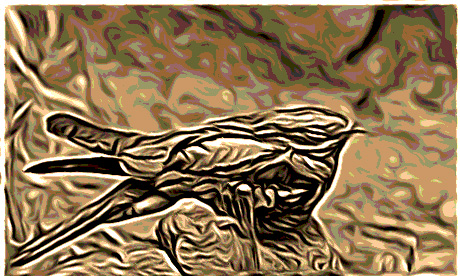
At dusk, (which is at ten p.m.) we drive to the Bog and walk out and down onto the reserve. We stand on the track, listening. From the pines edging the heath comes the churring of nightjar, a bird related to North America’s whipporwills and chuck-wills-widows. A night bird, becoming active at dusk to hunt moths and beetles over the heathland; sleeping motionless by day on horizontal branches.

Nightjar

Several birds churr, from both left and right of us. Brief glimpses are all we get as the birds swoop over the heath in the increasing dark. Dersingham Bog is low, a triangular scoop of land surrounded on two sides by the sand ridge and on the third by pine plantation: the birds do not show easily against the dark trees. Higher heaths give better views. As we walk back to the car glow-worms shine from the bracken.

In daylight, stonechat, woodlark, and tree pipit can be found here, and in the acidic bog that lies in the lowest elevation of the heath, a number of specialist acid plants – sundews, bog myrtle – grow. Butterflies and moths flit, and bumblebees (three species, told apart by the colours of their rumps and/or legs) gather nectar and pollen. In August, the heath flowers, brilliantly purple, and it can be very hot in this sheltered, sandy bowl. Like most heaths, it became significantly overgrown in the years following World War I, cleared in part and occasionally by fires generated by the railway that once ran beside it. Significant work was needed to return it to open heathland, maintained now by grazing cattle.


I AM SLEEPLESS: Sim 299, by Johan Twiss: A Review

i am sleeplessAidan is a prime. Primes have special powers, but each of those powers comes with a price, a defect that limits the prime in some significant way. Except for Aidan: his multiple prime gifts have not come with any defects, except that he doesn’t sleep.

Aidan, in his sleepless hours, meets secretly with General Estrago, who provides him with forbidden books for reflection and discussion, but additionally, Aidan spends his time working through the levels of the simulations designed to prepare each coterie of primes for battle against the Splicers, the creatures that sent this race from their home planet in search of safety. Aidan has reached Sim 299, the top level and a level higher than any other prime.

In attempting to conquer the challenges of Sim 299, Aidan must seek the assistance of both his friends and his enemies among the prime coteries, endangering them not only in the simulation but in real life. As the battles become all too real, Aidan uncovers a web of secrecy, betrayal and rebellion at the highest levels.

I AM SLEEPLESS: Sim 299 is science fiction for the young adult/new adult reader. It is fast-paced, and the world-building unfolds competently through both the narrative and through ‘quotes’ from a character’s book at the beginning of each chapter. The concept of cohorts of young people being trained for battle is familiar from books such as Ender’s Game, but that very familiarity helps the reader in accepting and believing in the story, which is at its heart a quest story.

A couple of things niggled at me. I would have preferred the information about each type of prime, their gifts and defects, to have been presented at the beginning of the book, not at the end: I found that trying to sort out what each prime was capable of distracted me a bit from the flow of the narrative. As well, Aidan’s world contains beasts which are apparently hybrids between (for the most part) familiar animals: the cobramoth for one. These animals are charmingly illustrated in the book (by the author’s wife), but I wanted an explanation for them. Are they genetic modifications? I would also hope for some stronger female characters in the sequel; in this first volume they seemed to me a bit more like adjuncts than full participants in the story.

I AM SLEEPLESS: Sim 299 is the first book in a series. It ends with the story not complete: Aidan and his friends have overcome one challenge, but many more lie ahead. The characters and the conflicts presented were compelling; I look forward to the next installment. My overall rating is 3 1/2 stars for this debut novel.

The author provided me with a copy of the book in exchange for an honest review.  The opinions expressed here are mine alone.

Reviewers wanted!

This may be an odd request from someone who reviews indie books, but I’m having a very hard time finding people to review my young adult/new adult e-book, Empire’s Daughter. In part, this may be because it doesn’t fit into any major genre and is difficult to classify. It takes place in a world inspired by Britain after the fall of Rome, but is not historically, geographically, or socially a direct copy. There is no magic. Human relationships cover all pairings, but there is no explicit sex.

You can check it out here:

http://www.amazon.com/Empires-Daughter-Legacy-Book-ebook/dp/B00TXFTZ3G/ref=asap_bc?ie=UTF8

https://www.goodreads.com/book/show/24979052-empire-s-daughter?from_search=true

If you’d like to give it a try in exchange for an honest review on Amazon and/or Goodreads, let me know and I’ll send you the electronic file of your choice for Kindle, iBooks, or Kobo (basically, any of .mobi, e-pub, or PDF).

Thanks, and keep sending me review requests for your indie work (review policy here).

Marian

Name a Character Contest

I need a name for a fairly major character in my in-progress young adult adventure novel, Empire’s Hostage, the second in the Empire’s Legacy series. Empire’s Legacy is set in a world not quite our own, but that is based on Britain/Northern Europe in the years after the fall of Rome. The character I need to name is the “Viking” heir-apparent to the king of the islands of the north coast, more or less equivalent to the Hebrides.

He’s not a terribly nice character, so might not want to suggest your best friend’s name!  The name also needs to sound vaguely Scandanavian/Icelandic/Gaelic to fit in with the rest of the names in the story.

What do you win?  A mention in the acknowledgments in the book, when it sees the light of electronic day sometime next year; a free copy of it and its predecessor, Empire’s Daughter, and, if you wish, either a review of a book of your own on this website, or a beta-read of work-in-progress.

The contest remains open until I have twenty names to choose from, or to December 31. Respond in the comments section or to marianlthorpe at gmail.com

Feel free to send this out to others!

thanks,

Marian

Hunt (Freya Snow: Book One) by L.C. Mawson: A Review

Hunt (Freya Snow: Book One) by L.C. Mawson

Freya Snow, the unknowing child of magical beings, has grown up in foster homes her whole life. Moving once again in her teens, her discomfort at a new situation grows as her powers begin to emerge and she discovers that the social worker who has organized her new home is actually her magical guardian and mentor.

Freya has only one friend, an older girl at her last foster home, Alice,who is high-functioning autistic and whose disinterest in most social norms and trends Freya shares. Unsurprisingly for a child who has moved multiple times and perhaps borders on the ASD spectrum herself, Freya finds it difficult to make other friends. But at her new school she is approached by the somewhat odd Damon, who is not English and is unfamiliar with many of the cultural references of the school and society. The two become allies and then friends as Freya’s world becomes much more complex, confusing, and dangerous.

The basic premises of Hunt will be familiar to readers of young adult fantasy: the magical child from another world whose powers begin to develop in their teens, bringing them to the attention of the powers of evil and good from their own realm. But for this premise to be convincing, the magical world must be internally coherent, fully understood by the writer, and that internal coherence conveyed to the reader. In the case of Hunt, this coherence is missing. While introducing such a magical world in small hints and explanations, to build interest and plot, is a valid device, in this case it leads more to confusion than epiphany. Whether or not this stems from a lack of understanding of her own magical world by the author, or a lack of telling the story in a way that explains that magical world, is not clear.

Hunt would have benefited, in my opinion, from being a longer book, told from two points of view, the second being from the magical realm, which would have given the author an opportunity to more fully flesh out the structure and conflicts of that world. As part of a planned series, these may be revealed in later books, creating from a promising but flawed first volume a substantial and fully realized universe.

My personal rating is two-and-a-half stars for this story from a young writer who is learning her trade. I’ll be interested to see how Lucy Mawson develops as a writer over the next few years; I think she’s worth watching.

The author provided me with a free copy in exchange for an honest review. The opinions here are completely my own.

How Stories Come to Be

If you’ve read my profile on this or other sites, (or if you read the post called Landscape and Story I posted a few days ago) you will know that I describe myself as (among other things) a part-time student of archaeology.  Currently I’m in the middle of an on-line course from the University of Exeter called “Landscape Archeology I”.  This week’s assignment was to look at what types of environmental archaeological evidence – things like animal bones, soil and water micro-organisms, wood – can be used to interpret either a castle or monastery site.

My response to the assignment was to write a brief story about a fictional monastery and point out all the things we knew about this monastery because of the archaeological evidence, which was fun and more interesting for me than just making a chart or list.  However…now this fictional monastery has a life of its own in my writer’s brain, and doesn’t want to go away.  It wants to tell its story more fully.

It doesn’t fit into the series I’m writing right now, but it may just fit into another planned novel/novel series. Or maybe it will be something completely new.  I don’t know yet.  I’m hoping I can use it for further assignments for the course, but regardless, it is now a real, dynamic place inside my mind, and another dimension of my created landscape(s) has made itself evident.  Now I have to see where it takes me.

Magic of the Gargoyles, by Rebecca Chastain: A Review

Magic of the Gargoyles (1)

Mika Stillwater is a mid-level earth elemental adept, specializing in quartz working. Moonlighting from her unfulfulling quarry job, she is desperately working late into the night to finish a commission that will finally fund her own shop, when a frantic, terrified baby gargoyle arrives on her balcony. Seeking help in rescuing its kidnapped siblings, new hatchlings that have been taken for black-market sales, the gargoyle has been attracted by the strength of Mika’s magic.

The opening scenes of Magic of the Gargoyles grabbed my interest and attention immediately. Nor did either wane throughout the novella. Well-paced action, interesting and strong female characters, and a fresh and imaginative take on a magical world all contribute to the strength of this story. Chastain’s writing is crisp, with enough description to flesh out her world and the people and creatures that inhabit it, and her descriptions of Mika’s magic are tactile and convincing.

I had only one tiny niggle, and that was the description of a captured hatchling as “a gross mimicry of a Thanksgiving dinner plate”. To me, the inclusion of Thanksgiving into this magical world, clearly not our own, jarred, and it took me a few minutes to return to the state of disbelief (or belief) needed to thoroughly enjoy this urban fantasy.

I would recommend this book to good readers over the age of twelve (there is some violence, no love or sex scenes). Girls especially will enjoy it, but it shouldn’t be limited to a female readership. It is also completely appropriate for adults who enjoy urban fantasy…I’m well into my sixth decade but read it in one day with great enjoyment. Magic of the Gargoyles is available from Amazon. Five stars.

The author provided me with a free copy in exchange for an honest review. The opinions here are completely my own.

The Quantum Door by Jonathan Ballagh: A Review

The door into another world is as old as Alice in Wonderland and as new as Neil Gaiman’s Coraline, with many many interpretations and reiterations in between (and since). In The Quantum Door, Jonathan Ballagh’s debut novel, it is given a familiar yet fresh treatment in this middle-grades science fiction story set a very few years in the future.

Brothers Brady and Felix are attracted by a faint light in the forest behind their Vermont home, a forest that has recently been purchased and fenced with No Trespassing signs. Felix, the younger and more technologically-oriented brother, attempts to investigate with a drone, leading to the discovery of the quantum door, a door into a parallel universe fraught with menace and danger.

The door has been constructed by Nova, a strong, resourceful female character who appears to be roughly the same age as the boys. With her robotic, AI dog – a canidroid? – Achilles, she is attempting to find a safe place away from the Elder Minds, the artificial, evolving intelligences that now rule her world.

The Quantum Door is imaginative and fast-paced, introducing young readers to many of the classic science fiction themes. The science and the technology is realistic and feasible, building on current knowledge, devices and systems. The scenes of the underworld where the Neurogeists, constructed creatures that house the reprogrammed minds of transgressors of the Elder Minds’ rules, are resonant of many dystopias portrayed in text and film, and yet manage to be fresh horror.

A mention must be given to the outstanding illustrations by Ben J. Adams. Dark and fractured, they convey the dystopian side of this novel perfectly.

The reading level and story complexity are also worthy of mention: they are appropriate to the age group to which this book is aimed, without talking down in any way. This is a book that in my previous career in education I would have been recommending to middle-grade teachers without hesitation. Five stars to this outstanding debut novel, and here’s hoping for a sequel.

This is an independent review of copy of the book provided by the author. The opinions stated here are mine alone.