Writing for Effect

A Dialogue with Eva Seyler
Eva Seyler is the author of four historical novels or novellas. Here, we discuss how she weaves emotion and reaction into her books, while maintaining a simple style.


Eva:

“Writing for effect”, in my books, is all about the characters.

Snogging 

I’m notorious for writing gratuitous snogfests that (often) don’t make it into the finished projects (for example, there’s an extremely un-kid-friendly RageSex scene that did not make it into The Summer I Found Home because it’s designed to be appropriate for kids). 

The scenes that do make the cut have to meet a few criteria: they need to signify something about the characters’ development, and they need to be focused on emotions rather than mere physicality. The goal is for what I don’t say, what is left to be read between the lines, to be as punchy as what I do say.

His voice caught as he wove his fingers into my hair and searched my eyes. “I am abominably drunk but I will show you things…” 

He bent close, his mouth exploring my throat and shoulders and breasts. His restless, certain fingertips called forth blissful whimpers from deep within me. Clothing shed, skin on skin, fingers of one of his hands interlacing with mine while the other hand like a magician’s called forth sense and life I hadn’t known existed. His mouth on mine, tasting of brandy and cigarettes and heaven, layer upon layer of feeling, sinking—drowning, but never dying, curiously alive, singing strings within. He was intense and he was focused and he knew what he was doing. 

Marian’s reaction:

My sense here is that the narrator is inexperienced, if not virginal: ‘sense and life I hadn’t known existed’. Perhaps she’s taking a risky step here?  And that the man is experienced, and both cultured and perhaps a little disreputable: – ‘abominably drunk’ – not the language of an uneducated man; the brandy also suggests this.  How far off am I?

Eva:

Right on every count. She’s been married before, but the husband was, shall we say, unimaginative at best—and it is a risk because this man is her best friend’s husband. (This snippet is from Ripples, the companion novella to The War in Our Hearts.)

Snappy dialogue 

Louise and George’s banter in The Summer I Found Home and its sequels has segued into an experiment: trying a brand-new (for me) style of dialogue that is intended to evoke the frenetic energy of 1930s-40s screwball comedy. I’m trying to perfect this for a WIP that’s third down the release pipeline: basically, using as few dialogue tags as possible, but still making it clear who’s speaking. 

Just one example of many from the WIP in question:

“I mean, friendship is wonderful. Everything is more fun with a friend. But imagine having, say, me for a friend, Miss Shipton.”

“I wasn’t aware we were friends. Anyway, I’m home now, you needn’t linger—”

“We could be. Friends, that is. Not home. We could be that too. I mean. Together.”

“Are you this eloquent and seductive with all your lady friends?”

“Oh no. Much more with them.” 

“You flatter me.”

“You hoover all the panache right out of me.”

“How romantic.”

“As I said.”

“Will you stop leaning in that impertinent way?”

He was too close, his forehead nearly touching hers. “What kind of person do you want to marry, Miss Shipton?” 

Marian’s reaction:

The short and sometimes interrupted sentences are very effective here, and it’s easy to follow who’s speaking by the inclusion of ‘Miss Shipton’ and/or ‘lady friends’. And then at the end the tone changes to more serious, simply by the dialogue becoming slower and a full sentence, and, the inclusion of an action tag prior to the dialogue. Was that your intent?

Eva:

I’m not sure I thought it out that thoroughly, but it’s true!

Simplicity 

Another strong aspect of my style is staying sharply on point. I don’t write flowery descriptions of scenery or events. I’m not against such things, by any means—it’s just not something that comes naturally. This Great Wilderness, at over 90,000 words, is incredibly long for me. Usually my books (including my two earliest, experimental novels) run considerably shorter. The Summer I Found Home is only around 62,000 words. 

I attribute this to focusing on character development and the specific events that drive that development. 

As with my snogfests and sex scenes, setting descriptions must enhance character development. Here’s an example from This Great Wilderness that encapsulates the scenery in a few short paragraphs, and the description is directly related to the state of Leni’s mind. 
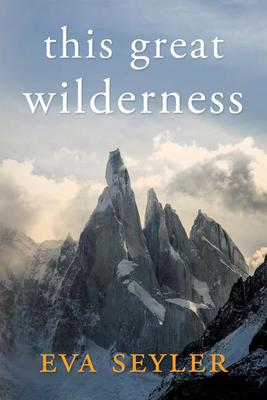
The scenery is stark and incredible. There is the brown, desert-like landscape going one direction, like what the American West always looked like in the cowboy pictures we sometimes sneaked out to see when I was little. 

But face the other direction, and it is saw-toothed mountains, and snow, and ice, and vast lake. 

Two worlds. The desert is my life with Mauritz. The mountains are my life now. Both of them are terrifying to me, and the solitude is immense.

Marian’s reaction:

I’m sure this has a formal definition in writing (it’s not quite pathetic fallacy), but I couldn’t find one – the landscape reflecting the emotions of the narrator. It’s one I use a lot myself. I particularly like the starkness and simplicity of the contrast here between the desert and the mountains, and the threatening aspect of the mountains: ‘saw-toothed’ and cold. But the lake – water is usually a symbol of life and renewal – modifies that. Was that your intent, to suggest to the reader that there is hope for Leni In this new environment?

Eva:

I had not thought of the water aspect! At least not consciously, but that’s an absolutely legit interpretation, and it’s true that the wilderness does bring her back to life.


Eva’s contact information is at https://linktr.ee/theevaseyler  Find out more about her and her books at https://www.evaseyler.com/
How Has Writing Changed Me?

A guest post by Raina Nightingale

I hardly remembered when I first started to write. I was eight years old, having just learned to read. And what I wrote first was something that was at least half fanfiction: sometimes simply out of love and enjoyment, I would write stories very much like those I read, but other times, when it seemed to me there was something lacking in a book, or something that was wrong and not the way I wanted it to be, I would try to write a story that was like it, but different.

I think in stories. Both reading them and writing them is a big part of my thinking. In some ways, the exploration that comes from both is similar, but in some ways it is different, and different books are very different to read and very different journeys, though I do love some good escapism now and then (especially if it has nice world-building that speaks to me, more on that later)! In reading, I explore other people’s thoughts and am sometimes prompted to consider things about myself and what I like from angles I might not have considered on my own, and it does not take the same energy that writing does.

But writing, making up stories and exploring them as I will, is how I really think, how I discover, challenge my thinking, and consider new thoughts that I find in other places or other people suggest. Or sometimes thoughts that seem to come out of nowhere. Character, plot, and world-building can all be a part of thinking to me. A lot of my world-building, even – especially – the more magical parts of it, is inseparable from my appreciation for and understanding of this world, and helps me to articulate things I see better.

My characters are more wild. Sometimes I don’t understand them very well, and sometimes what I think I ought to have learned from them, whether their relationships with each other or their responses to their environments, I’m not at all sure that I do.

Probably most of my characters share some likeness with me, even if it’s as trivial as an aesthetic appreciation or a taste in cuisine. Some of them are very unlike me, while others can be largely deep explorations of aspects of my personality, dreams, or desires, or questions about these might be, but in general I don’t think too much about whether a character is like or unlike me, or how. Yet I always find it fascinating when I’m writing a character like none that I have ever written before, and I keep having moments of, “Oh, this is how someone who is like this thinks!” It’s really quite surprising. Yet, in real life, I sometimes feel like my empathy, my ability to understand and feel for people, is far behind my characters. Yet what would it be if I didn’t try? Or what would my stories be if I didn’t try in real life?

It’s hard to enumerate, or even really define, how writing and stories have been a part of my life and thinking, since it is so interwoven altogether. I don’t think there’s anything where it can be fully separated: sometimes I learn, through writing a character who enjoys something, to have more appreciation for it myself. Some recent examples are that I see the beauty in the ocean so much more after having written Corostomir, a man who is in love with the ocean, and writing a dry plains-loving people sharpens my appreciate for desert climates, something that used to not exist at all: the greener and the wetter the better, I thought.


Raina Nightingale has been writing fantasy since she could read well enough to write her stories with the words she knew (the same time that she started devouring any fiction she could touch). She enjoys rich characters and worlds where magic and the mundane are inseparable. She calls her fiction ‘Dawndark’.

Author/Review Website: https://www.enthralledbylove.com

Universal Book Link for all my books: https://books2read.com/raina_books

Twitter: https://twitter.com/Areaer_Novels

Goodreads: https://www.goodreads.com/author/show/20243136.Raina_Nightingale


Are you a writer who’d like to contribute to this series? Leave a comment below and I’ll get back to you!

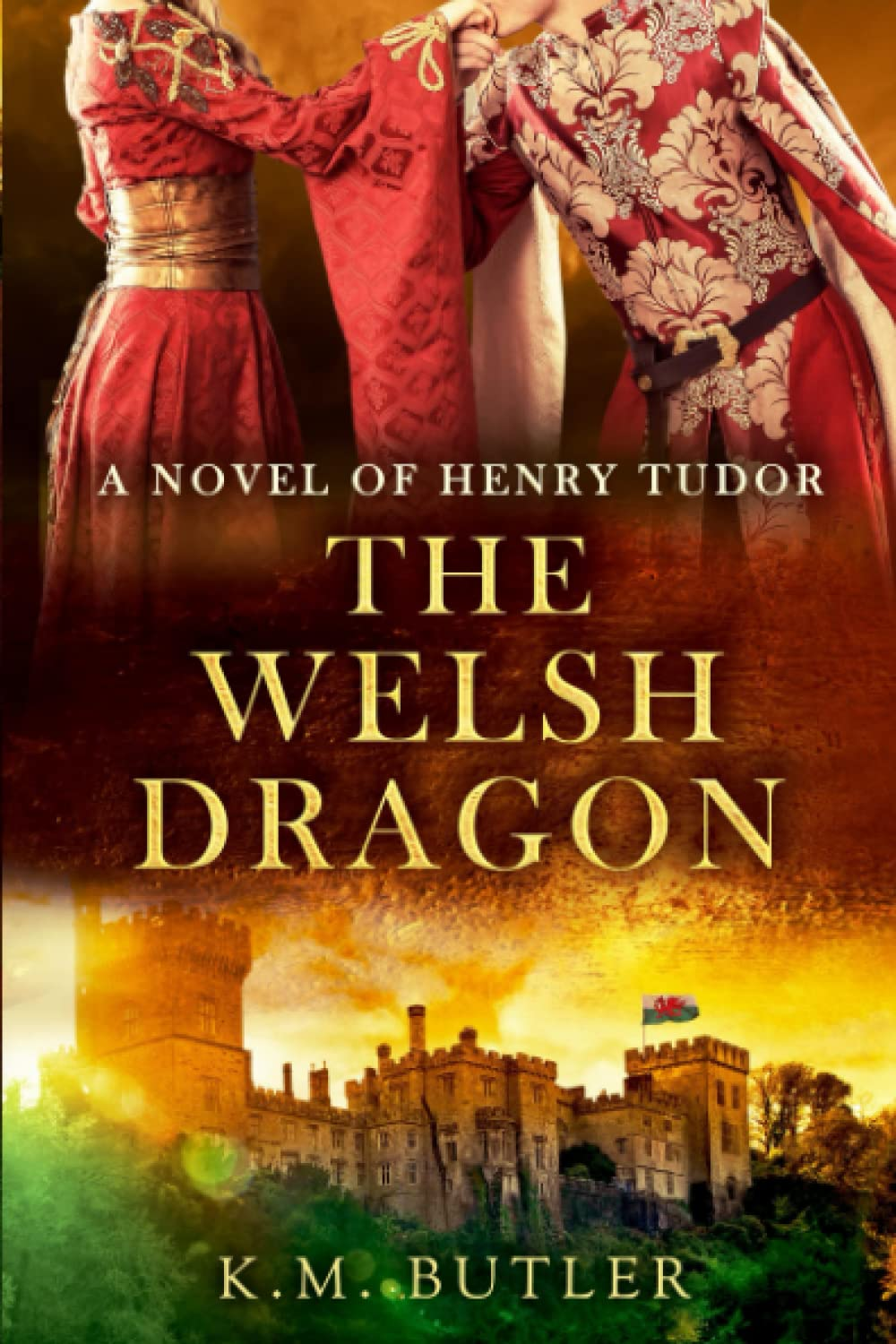
The Welsh Dragon, by K.M.Butler

A Review

Henry Tudor—the victor of Bosworth who defeated Richard III to claim the crown and become Henry VII of England, beginning the Tudor dynasty – had a weak claim to the throne. Descended on his mother’s side from the royal prince John of Gaunt and his mistress Katherine Swynford, Henry was barred from the line of succession by this illegitimacy. But Henry’s father Edmund Tudor was half-brother to the king, through his mother’s second marriage to Owen Tudor, and this too brought a potential claim.

When Edward IV took the throne from Henry VI in 1461, amidst the complex politics and battles of The Wars of the Roses, Henry Tudor and his uncle Jasper fled to Brittany. It is the fourteen years that Henry spent in exile that is the focus of nearly the first half of The Welsh Dragon – a period of which little historical fact is known. Author K.M Butler therefore had a fairly free hand to imagine this time in Henry’s life.

Butler shows us a young man attempting to live a life free of the politics of court and crown, in love with a commoner, the competent merchant Jehane, and learning to be useful and skilled in trade. A small life, perhaps, but a free one. But his mother’s (and others’) letters from England, the emissaries who come, and his own sense of duty can’t let him forget who he is. Nor can his enemies: Henry’s life is frequently in danger.

History takes its course, and Henry accepts his role. Butler handles the complexities of factions, allegiances and intrigue well (a small caveat here: I am familiar with this period and the historical people portrayed here – for someone new to it, it might still be a touch confusing) and does not, thankfully, underrepresent the role of the powerful and politically astute women on both sides.

One of the enduring mysteries of this time is the fate of the Princes in the Tower, Edward IV’s last two legitimate sons, imprisoned by Richard in the Tower of London. While generally considered to have been murdered by Richard’s orders, there are other theories. The one proposed by Butler was new to me – but plausible.

Henry may have been reluctant, but his acceptance of the expectations of his birth and upbringing rings true; Butler portrays him as a sympathetic character who grows into maturity and what he sees as his duty, accepting his role in the larger tapestry of politics and history, rather than his personal desires. The book ends with the victory at Bosworth: it is the making of a king, rather than his reign, that is brought to vivid life in The Welsh Dragon.

Writing for Effect: A Dialogue with Jamie Tremain

Jamie Tremain: aka Liz Lindsay and Pam Blance

Currently, Jamie Tremain has two series. The Dorothy Dennehy Mystery series is in the mystery/crime genre revolving around a female private investigator, Dorothy Dennehy.  The story is set in Portland, Oregon. Her office is aboard a houseboat, ‘The Private, Aye?’, moored in the Willamette River. She has a solid circle of family and friends who assist in her cases.  By the time we’d written the second book, we realized what we seemed to enjoy from writing this series, and Grant’s Crossing, is the building of character dynamics and relationships with one another.

Grant’s Crossing is our second series and is a mystery/amateur sleuth series. It might have cozy ‘overtones’ but doesn’t classify as a cozy.

It’s set in rural Ontario. We have two main characters, Alysha – owner of the home, and Dianne – a resident, and the story is told from each of their POV in first person. The setting is an old farmhouse converted to house 8 retired seniors in a guest-home type environment. 

As mentioned above, we feel our strength, and passion, in these stories has evolved to focus on character relationships, to show what life can do to all of us and how we cope or carry on. We’ve been successful based on comments and feedback received from readers.


Emotion of Characters, Witty Dialogue, and Diversity are the three topics we’ve chosen. They dovetail into each other as we build stories that portray life experiences on different levels a reader can relate to, while still providing a crime or mystery to solve.


Emotions of Characters – The Goal to build relationships built on human experiences common to readers.

These are two scenes from Lightning Strike, the second book in our Dorothy Dennehy Mystery series. Our protagonist, P.I. Dorothy Dennehy has learned her fiancé, Paul, has been murdered.  The first scene is her father, Max, trying to comfort her, and the second scene is Dorothy waking up from a dream the day of Paul’s funeral.

“Why did you change your clothes? she asked, wondering why his casual jeans and sneakers had disappeared. Now he wore his best corporate attire. Perfect tie and polished shoes.

“I had to change, Dee. You know what today is. Have to look my best.”

She awoke with a cry on her lips and a breaking heart. As the dream’s images fluttered away, she sighed. “You always looked your best, my love. I miss you so much and today will be the hardest day I’ve lived through.”

Marian’s thoughts:

Dreaming of lost loved ones is a common human experience. Dreams, too, often have hidden meanings. If I read into the scene that Paul’s message to Dee is that she must put on her ‘best’ today: best clothes, best front, best control – to change her real feelings to get her through this hardest day – would I be reading something into it you didn’t mean?

Jamie Tremain:

We think you’ve reacted as we intended. And without “knowing” our character Dorothy, this is even more true because she is a strong and independent woman, but the death of Paul has knocked her off her feet, and in addition to his funeral she knows that she, as a private investigator, is going to do her best to solve his murder. So, control of her emotions is paramount to her staying level-headed. Her grief will be put on hold. And Paul would have known that, as well.


Dialogue – The Goal to bring humour at times, but to always show that our characters are “human”, subject, for example, to petty backbiting, or one-upping.

We have fun with some characters’ dialogue scenes. This is from Resort to Murder, the second book in our Grant’s Crossing series. Our characters, most retired, live together in a small retirement “guest” home – Leven Lodge. Mealtimes can be lively due to their various personalities.

Rose changed the subject. “Anyway, I hope the investigation wraps up soon so the spa can reopen. I’m anxious to try out some of the services they offer.”

“Maybe they can do something about those wrinkles,” sniped Minnie.

“At least I know what a spa is for,” retorted Rose.

I settled back to watch the show, but Nina broke things up. “Now ladies. Let’s not bicker. Life’s too short. I’d hoped to make use of the spa while I’m here as well, but if it doesn’t work out, c’est la vie. That’s French you know.” The barb hit its mark with Minnie.

“Well kiss my derriere. That’s French too.” Minnie smirked. Then she exited the room. I noticed Lily’s small grin as she watched our wicked witch’s departure.

I had a feeling breakfast congeniality was done.

Marian’s response: 

Writing ‘gurus’ often say that no dialogue tags other than ‘said’ and ‘asked’ should be used. (Not that I agree with it!) Here you’ve used a variety of other tags and descriptors. Can you expand on why you chose them?

Jamie Tremain:

When we were traditionally published with our first 2 books, we had an amazing editor. Her opinion favoured avoiding the overuse of ‘said’ and it stuck with us. Not that there is anything wrong with ‘said’, but I (Liz) recently read a book, where about ten consecutive pieces of dialogue were tagged with ‘said’, and I found it boring, as if the writer couldn’t find something more descriptive to use. Balance is key, because to overuse any tag runs the risk of reader turn-off.

The narrator and Lily both seem a little detached from the bickering. You convey this both through the use of ‘watch’ and the fact that neither speaks. Were those conscious choices?

Jamie Tremain:

Definitely on Lily’s part, yes. She is an introvert, overshadowed by her extroverted twin sister. As for the narrator, yes as well. She enjoys being a bystander during these exchanges, although she has been known to stir the pot when it suits her.


Diversity – The Goal to have diversity in various forms, woven into a story so that it’s done in a way to make it seem natural and not because we have to tick boxes.

Without really intending to, we find our Grant’s Crossing series has touched on several areas of diversity, most done in subtle ways, to hopefully show diversity is taken for granted, and not a big deal to be fussed about. We’ve touched on Aboriginal issues, mental health, have had a gay character, and, aging is a general theme throughout. We, as writers, hope it’s a reflection of ourselves, that diversity is, and should be, a natural part of life’s fabric.

The example concerns a new couple, Sasitha and Bachan Patel, who have taken up residence in Leven Lodge – from the third book in the series, Acting Off-Script. It’s a small town in rural Ontario, with little familiarity of East Indian customs.

I decided to ask about a question I had. “I noticed you’ve placed some beautiful small candles in the front room. Are they for a special occasion?”

Sasitha beamed. “Oh yes, my friend. These are for celebrating Diwali. So important for us.”

“Festival of Lights,” interjected Bashan. “Lighting these candles, for us, means we are getting rid of the darkness. The darkness can be meaning bad vices, such as greed.”

From what I knew of the Patels, greed was a foreign concept to this generous and kind-hearted couple.

Marian’s thoughts:

You have subtly captured the rhythmic speech patterns of West Asian immigrants speaking English. Did you worry about being accused of stereotyping in the name of diversity?

Jamie Tremain:

The Patels are my (Liz) characters and have been modelled after a former co-worker, whom I am very fond of.  The speech patterns were part of everyday work life. Honestly, if a reader feels this is stereotyping, then, with respect, that would be an inaccurate assumption.  Earlier in the book, the Patels give an account of how they came from India, lived in Scarborough, and ended up in Grant’s Crossing. We thought having a retired married couple, who happened to be East Indian, would be an interesting dynamic to add to the mix of characters living at Leven Lodge.

Was the use of ‘foreign’ in the last line purposeful? To me it creates an effective dissonance between the idea of ‘foreigner’ and how we all share universal human attributes and concepts.

Jamie Tremain:

That’s an interesting observation, Marian. It wasn’t intentional, but we agree with your assessment of its use.


One final question from Marian:

You strive to show character relationships, ‘to show what life can do to all of us and how we cope or carry on’. Author intent and reader interpretation can be very close, or it can be very far apart. Art is a tension between the creator(s) and the ‘consumer’, the person experiencing it. Have you had feedback from people whose interpretation was far from what you intended?  If so, how did you handle it? (And if not, how would you handle it?)

Jamie Tremain:

We’ve been told our character relationships are a focal point of both series, and so we now make a conscious effort to create life situations for our characters that most people could relate to at various times in their lives – aside from finding murdered bodies, of course!

The most feedback we received was when we “killed” Paul in the second book of our Dorothy Dennehy Mystery series. Readers who had enjoyed the first book were dismayed, and even a little angry, that we’d dispatched him. We didn’t expect the level of disappointment but were gratified in a way because it showed readers connected with the character. And it made us realize that a mystery is not just about the crime to be solved, but it’s about the characters. So having the strong feedback about killing Paul was valuable.

Every reader has their own viewpoint and interpretation on what they read. We’ll continue to create scenarios we hope are relatable and always welcome feedback, be it positive or not, on how we’ve tried to portray relationship dynamics. We may be the author, but we can always learn from our readers, as well.


Links:

Web: http://www.jamietremain.ca/   

Blog : https://jamietremain.blogspot.com/

Amazon Author Page: https://www.amazon.ca/Jamie-Tremain/e/B06X1FFCCF/ref=dp_byline_cont_pop_ebooks_1

Books2Read :  https://books2read.com/ap/nObabJ/Jamie-Tremain

Facebook:   https://www.facebook.com/jamietremainwrites

Email: jamietremainjt@yahoo.com


Would you like to be part of this series? Authors published or unpublished are welcome – leave a comment and I’ll get back to you.

September’s Books

OK, it’s a little late…but here’s a roundup of books I read/listened to in September, along with some I’ll be starting soon, with some brief thoughts on each.

The Lion of Skye, by J.T.T. Ryder.  The sequel to his debut Hag of the Hills, set in iron-age Skye in a world where myth and legend walk with humans, for those with eyes to see. Fast paced, sometimes bloody, and definitely not a 21st C worldview. Full review here.


Gallows Wake, by Helen Hollick. The sixth book in the Captain Jesamiah Acorne series: piracy with a touch of the paranormal. Expert writing, engaging characters, a solid plot, and no need to have read the first five. Full review here.


Something to Hide: A Lynley Novel by Elizabeth George. The 21st Lynley novel; competent, twisty, the plot focused on FGM among Nigerian and Somali communities in London. Readable, but overall it felt tired, as if the author is putting her characters through their paces reluctantly.


The Wind in His Heart by Charles de Lint. I’ve been a huge de Lint fan for many many years; this one, set well away from his usual fictional city of Newford, had some interesting elements, but overall was too similar in theme and some aspects of plot with others he’s written, even if the mythology was primarily Native American and not Celtic. Enjoyable, but not his best.


A Prayer for the Crown-Shy: Monk & Robot Book II, by Becky Chambers (audiobook). Along with the first book in the series, A Psalm for the Wild-Built, hands down the most delightful, hopeful, and subtly thought-provoking novellas I’ve read in a very long time. Highly recommended for those tired of dystopias (and perhaps real life).


Begun but not yet finished (NOT DNFs)

The Welsh Dragon, by K.M Butler. A historical novel about Henry Tudor, focusing on the years before he defeated the Lancastrian forces at Bosworth, ending the Cousins’ War (The Wars of the Roses) and taking the throne as Henry VII. So far, I’m thoroughly enjoying it; review to come.


Fairy Tale, by Stephen King. (audiobook).  I have a long way to go in this…like most of King’s books, it’s not short. Reserving my opinion for now, because this is a book with two distinct parts, and I’ve only just begun the second story. 


Embrace Fearlessly the Burning World, a collection of essays by the late Barry Lopez. Like authors Annie Dillard and Robert MacFarlane, Lopez’s nature writing goes far beyond a set of empirical observations. I’m only not finished because I’m pacing myself, giving myself time to think about what he’s saying about human societies, the importance of place and belonging, and our relationship with the rest of the planet.

Although there are one or two statements among all the gems that don’t ring true, overall, a thought-provoking and sometimes lyrical book.


In the Queue:

Singing for Our Supper: Walking an English Songline from Kent to Cornwall, by W.R. Parsons. I’ve been following Will Parsons on his modern pilgrimages around the UK for some years, via Facebook, Twitter and his website. Walking in Britain has been both a place of peace and a source – the source, probably – for my novels, and my own walk across England, from the Irish Sea to the North Sea, a highlight of my life.  I, however, can’t sing a note. I am very much looking forward to this book.


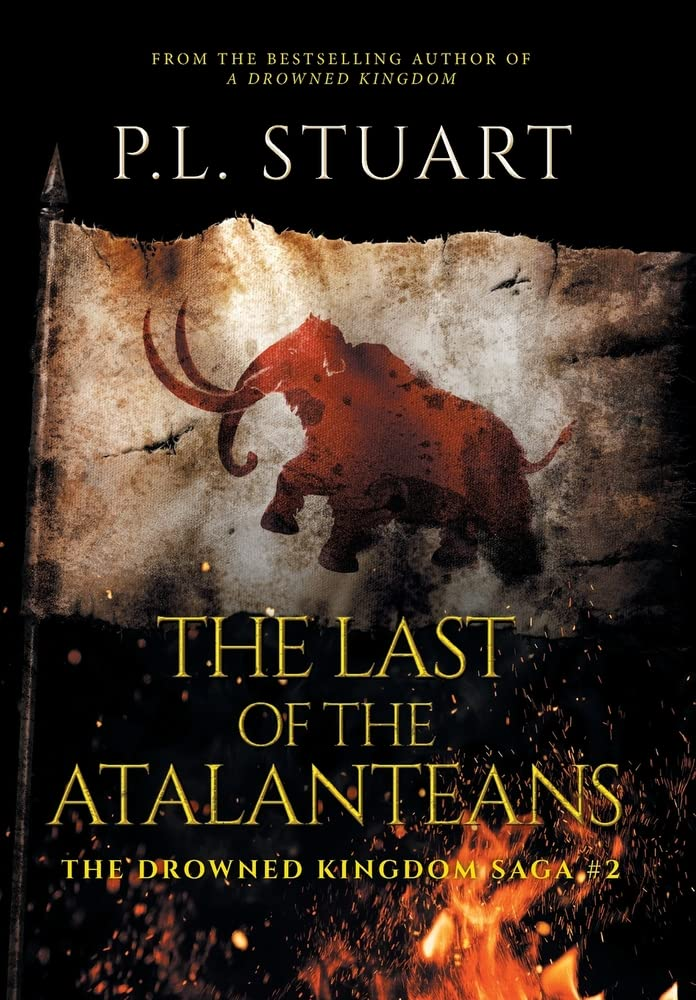
The Last of the Atalanteans (The Drowned Kingdom Saga, Book II) by P.L. Stuart. The second book in Stuart’s magnificently imagined world, with that hardest of protagonists to do well (and Stuart does) – an unlikeable one. Will Othrun’s hubris and ambition lead him to glory or to the ashes of his dreams? I’ll find out soon.

I Began with a Landscape

Thoughts on Worldbuilding, Part I

“Observing the interplay of minute details…within the larger, overall picture, sensing the tension between the revelatory particular and the general condition…the written stories we most trust about life begin to take shape.” 

Barry Lopez

Worldbuilding. There are a thousand blogs and articles and books on how to worldbuild in fiction. I wouldn’t be adding to them, except I was asked to. For years, my response to the readers and authors who ask me how I created the (apparently) immersive, believable, world of my books has simply (and honestly) been, “I don’t know. I just write.” 

But being asked to share my ‘wisdom’ on this subject made me analyse it – or try to. With the serendipity or synchronicity that often, I find, happens, I had started to read Barry Lopez’s last book, Embrace Fearlessly the Burning World, a collection of essays. Lopez is a writer I have returned to over and over; like Annie Dillard and Robert MacFarlane, his relationship with the natural world goes far beyond empiricism. And from the quote above, I began to see a way to explain how my fictional world came into being. At the heart of that creation is the often-given advice: write what you know.

Earlier in the summer I’d begun a stop/start/continue exercise to combat a growing sense of irritation and dissatisfaction with my life. Part of the exercise is to define what is important to you; what you truly care about. I knew that during the pandemic years, I’d lost sight of some of it.             

Here’s what that analysis showed me:

As I studied this result, I realized that these are not just the things I care about deeply. These are the things I know and have spent my days on. And as Annie Dillard wrote: “How we spend our days is, of course, how we spend our lives.”

Write what you know. What do we know better than how we spend our days and our lives?

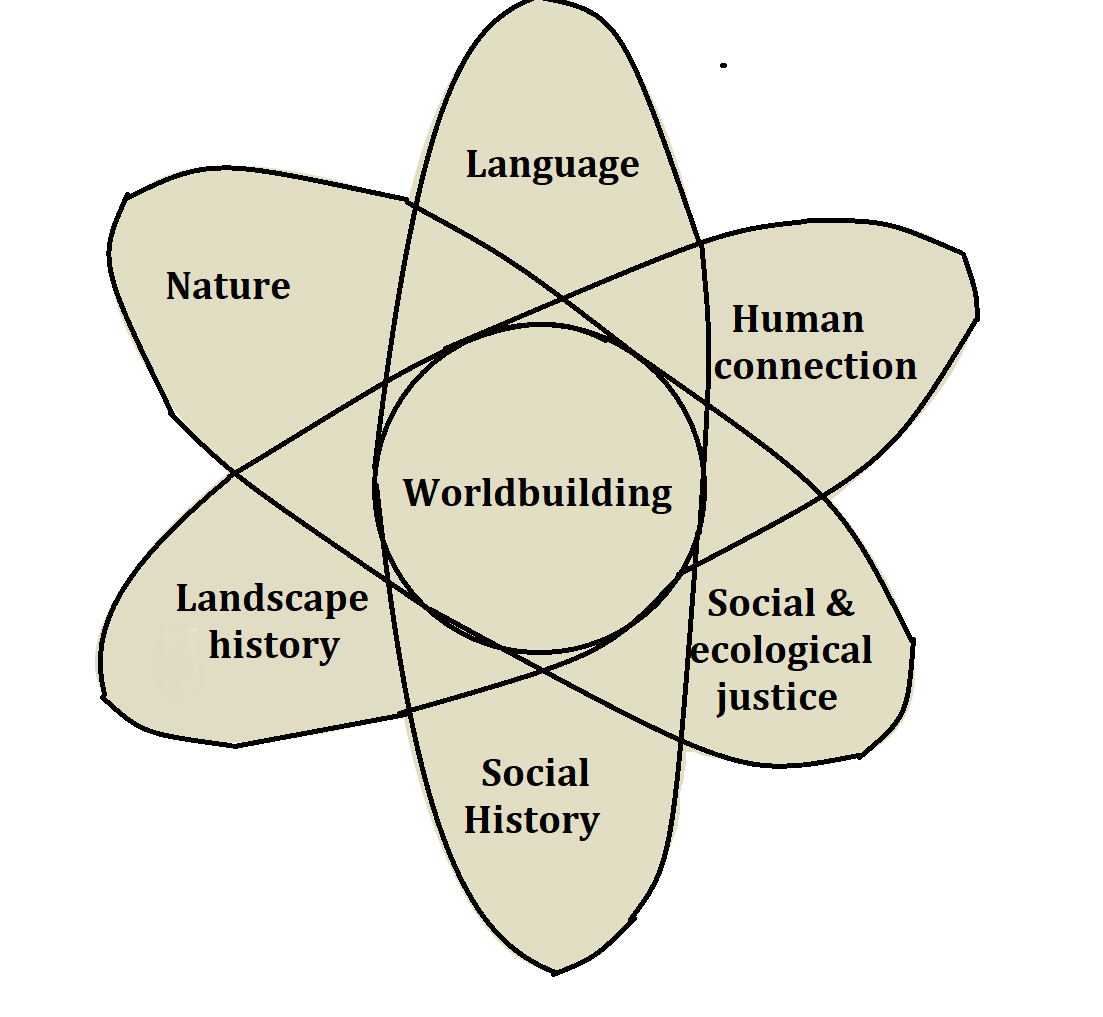
I took those eight identified foundations of my life, simplified it a bit, and created this slightly wonky Venn diagram:

At the intersection of these six passions, where their interplay of both detail and general weave together, is where, for me, worldbuilding occurs.  The world of my books – its ecology, geography, history; even its languages, arose from what I have spent a large part of my time on for over fifty years. Tolkien, the philologist, began with languages and built a world around them. I began with a landscape.

And I always did. Right from my first ‘apprentice novel’, begun when I was seventeen, the major theme of all my work has remained the same: the interrelationship between place and identity: what keeps us there, what drives us—or calls us—from it, how it shapes who we are both in its presence and its absence. In Empire’s Reckoning, the young Gwenna, visiting her mentor Sorley’s boyhood home with him, asks him about what it means to him. (The first-person speaker here is Sorley.)

“This all should have been yours.”
“I gave it to my brother,” I said.
“But you still love it here.” She shook her head in frustration. “That’s not right. More than love, but I don’t know how to say it.”
“Dùthcas.” She looked up at me quizzically. “I can’t translate it,” I said. “Belonging is close. It’s as if I carry this place deep inside me, and I hear it calling to me, always.”

This is the basis, the core of creation of a world for me. The bedrock. Place and culture are—or were—inextricably linked. The knowledge held and expressed in the tundra and taiga of northern Canada and the vast expanse of Australia are not the same, nor is the knowledge needed to navigate life in a big city the same as that needed to live on a ranch fifty miles from the next one. The next step in worldbuilding is showing that knowledge and its attendant skills in context, whether the world in question is real, quasi-real, or entirely fictional.

To be continued….

Gallows Wake, by Helen Hollick

Gallows Wake is the first of Helen Hollick’s Captain Jesamiah Acorne books I’ve read, but it won’t be the last. Nor was it necessary to have read the previous books to thoroughly enjoy this one; Hollick expertly weaves enough backstory into the narrative to explain what’s happening without taking away from the focus and momentum of the story.

Forced to put into a shipyard in Gibraltar for necessary repairs to his ship, Acorne finds himself in danger from several sides. Both his distant and immediate past are catching up to him—and his wife Tiola, pregnant with their first child. With a brood of children saved from capture to take care of, both Jesamiah and Tiola have their hands full. But Tiola has her own past to reckon with, and she too is in danger, especially after her return to England without Jesamiah.

Hollick’s writing is crisp and clear, and her ear for dialogue and ability to reveal character in a few brief sentences is enviable. While several of the characters in Gallows Wake have returned from previous books, again, I felt no need to have read those books to understand them. The paranormal side of the story—Tiola is a white witch, with powers of precognition and more, and one of the characters is not quite human—blends with the story beautifully, handled so matter-of-factly. This is simply Jesamiah’s reality, and he accepts it, as does the reader.

I’m not a student of sailing ships, but the scenes on board ship felt authentic. The author’s nod to a classic story of the West Country amused me, but also helped set the mood and landscape. I look forward to reading the rest of the series, and I hope there are more to come!

Pre-order Gallows Wake on Amazon.

Reflection

It’s cool the first morning of fall; 11 C, and cloudy. Yesterday at this time the temperature was rising into the 20s, and my shirt was sticking to me, the humidity was so high. But autumn blew in last night, right on schedule, and today is completely different.

On the banks of one of the ponds, where yesterday frogs made regular plops in the water as I walked, nothing moves. Too cold for frog activity; soon they’ll be burrowing into the mud on the pond’s bottom to hibernate. The woods are strangely silent, except for the calls of chickadees foraging overhead, whereas yesterday the screech of blue jays was about all I could hear.

Image by Brigitte Werner from Pixabay 

It wasn’t just me scaring frogs yesterday. A lone jay was feeding on the far bank of the pond, gleaning insects from fallen branches and the webs of caterpillars, sometimes dropping into the scatter of leaves to push them aside for whatever lived underneath them. When it got close to the water, a frog leapt, kaleidoscoping the reflection of sky and leaves for a minute before the ripples settled and the mirror returned.

The jay called, constantly. I wondered what it was saying: food here? Or, where is everyone? It’s rare for me to see a lone jay at this time of year; usually they’re in family groups, or even larger flocks, flying along fencerows from woodlot to woodlot, zig-zagging across a landscape, staying close to shelter. And not quietly.  The jay’s harsh call is a backdrop to most fall walks.

The foraging lone jay finished feeding and flew, its feathers refracting the sunshine as a brilliant blue. I watched its reflection in the dark water of the pond, then followed the real bird to where it landed: a maple branch overhanging the bank. It stopped calling then. I moved on.

Image by Brigitte Werner from Pixabay 

Years ago, I was at Point Pelee about this time of year, or perhaps a little earlier. The point is a sandspit jutting out into Lake Erie; it, and the presence of islands about halfway between Ontario and Ohio, make it a migration route for birds and butterflies. It must have been a weekday, because the park was nearly deserted. Along the beaches on either side of the point, the sand was littered with the wings of monarchs, torn off by jays as they fed. Among those red-gold wings were dozens of pairs of jay wings, torn off by Cooper’s hawks as they fed on the migrating jays.

“Cruelty is a mystery…” Annie Dillard wrote; then: “But if we describe a world to compass these things, a world that is a long, brute game, then we bump against another mystery: …beauty, a grace wholly gratuitous…”[1]

Jays as blue as the sky; dying leaves vividly reflected on still water. A red-tailed hawk gyring in the sky, its tail the exact rufous of the autumn oak below it. Scruffy juvenile cedar waxwings, swooping and calling like a gang of adolescent skateboarders as I walk along a gravel path. Grace, wholly gratuitous.


[1] Pilgrim at Tinker Creek

How Has Writing Changed Me?

A guest post by J.C. Paulson

On following your muse: it might just save your life, and other benefits.

When I awakened at three one morning a few years ago, as I had for months after a traumatic career ending moment, I was, for a change, not in tears.

I saw a (beautiful) reporter, a (stunningly handsome) cop, a (stupid homophobic) decision made by a church and a (dead) bishop. Where did that come from? Would I remember it all at a more reasonable hour of the morning?

Didn’t think so. But I did.

It became Adam’s Witness, a novel I never thought I’d write. Nor any novel, really.

I’m not much of a believer in intervention, divine or otherwise. Neither do I believe in astrology, but I am a perfect Virgo: analytical, critical, loyal to a fault . . . and very much with my feet planted on the hard unforgiving ground. Lightning bolts from heaven or any other mystical place do not, in my view, occur. At least, not to me.

But something happened. Somehow, my brain was trying to save my sanity, or perhaps myself. The mood did not actually improve much for a long time, in the overall; my father became desperately ill and eventually died, among other rather traumatic life events.

Even so, the creative muse eventually took hold and if nothing else served as a distraction. There’s nothing like diving into someone else’s life.

Even someone fictional.

And now, I am powerfully inclined to pitch my method of mind-bending to others. Simply, it is this: If a creative or athletic or other positive new thing is calling you, I advise answering the mental phone. Even if it’s hard.

Obvious by now is that my own escape from hell came via my creative cells, and I believe that most of us have those. Sometimes we have to go looking for them, but they are there; and in my view, they represent the best of ourselves.

Learning that I could actually sit down for longer than a few minutes, focus, type, research and write a book was an epiphany.

I am also here to tell you that publishing a book online and in print by yourself is not the easiest thing you’ll ever try, creatively or technically. Nor is trying to disseminate your new invention.

(I’m sure similar difficulties apply to all other pursuits.)

But I did it.

It boosted my self-confidence that I could learn something new — actually, several somethings. It cleared my mind of everything but my plot, characters, and message. Then it forced me to think, as they say, outside the box: how do you format a book on Amazon?

It also allowed me to blurt many of my strongly held beliefs (for example, why in the name of all that’s sane would some discriminate against or loathe LGBTQ people? Or any people?) when I had no other outlet.

To this day, I haven’t entirely sorted out why or how walking a new creative path changed my mind. Altered my brain, really. But it absolutely did. I’m quite sure it forged new synaptic pathways, and no kidding.

As to other benefits, there’s always a chance someone else might like, or even love, what you have made. Your book. Your painting. Your photograph. Your song.

You might make someone’s day. You might change their outlook for the better. You might entertain, or elevate, or excite.

But this is for certain. You have created something new and unique that did not exist before. And for that, my heartfelt congratulations.


Joanne (J.C.) Paulson, a long-time Saskatoon journalist, has been published in newspapers including The StarPhoenix, The Western Producer, the Saskatoon Express, allSaskatchewan and a variety of magazines.

She is the author of a mystery series including the novels Adam’s Witness, Broken Through, Fire Lake, Griffin’s Cure, and Two Hundred Bones, a novella. Her most recent works are a historical fiction/western novel entitled Blood and Dust, published by Black Rose Writing, and a wee children’s book, Magic Mack and The Mischief-Makers. Find her books via her website or on Amazon.


Are you a writer who’d like to contribute to this series? Leave a comment below and I’ll get back to you!

Empress & Soldier

A boy of the night-time streets; a girl of libraries and learning.

Druisius, the son of a merchant, is sixteen when an order from his father that he can neither forgive nor forget drives him from home and into the danger and intrigue of the military.

Eudekia, a scholar’s daughter, educated and dutiful, is not meant to be a prince’s bride. In a empire at war, and in a city beset by famine and unrest, she must prove herself worthy of its throne.

A decade after a first, brief meeting, their lives intersect again. When a delegation arrives from the lost West, asking Eudekia for sanctuary for a princess and support for a desperate war, Druisius is assigned to guard them. In the span of a few weeks, a young captain will capture the hearts of both Empress and soldier in very different ways, offering a future neither could have foreseen.

A stand-alone novel that can also serve as a second entry point into the Empire series. No previous knowledge of my fictional world is needed.

Electronic ARCs available after November 15, 2022. Email request to arboretumpress (at) gmail.com