Many thanks to Susan Leigh Noble at Into Another World for hosting this interview. https://susanleighnoble.wordpress.com/2016/02/19/todays-featured-author-marian-thorpe/
Category: Uncategorized
Frost Burn, by K.T.Munson and Nichelle Rae: A Review
Frost Burn, a fantasy-adventure novel by co-authors K.T Munson and Nichelle Rae, tackles the devastation of sudden climate change in a world where two nations, one of fire, one of ice, co-exist in mutual dislike and misunderstanding. The people of each nation are incapable of withstanding the environment of the other. But somehow the queens of the two nations must find a way to work together against both the forces of nature and internal rebellion, or face complete destruction.
The contrasting cultures of Fire and Frost create the opportunity for an exploration of how two differing cultures can learn to cooperate. While this is addressed to some extent, it takes second place to the action of the plot, which moves rapidly but allows for reasonable character building. The writing is competent, and I give the co-authors credit for their ability to meld their writing into one consistent voice.
Frost Burn adds a world unique in several aspects to new adult fantasy. I had a few niggles: the use of modern terms such as ‘tarpaulin’ and ‘mega-volcano’ didn’t sit well, nor did the use of ‘what the hell’ as an expletive. Two other examples that bothered me were the use of Fahrenheit temperatues – actually I had two reactions to this: one was the dispassionate ‘how will this read in all the countries of the world that don’t use Fahrenheit?’ (only 5 do, by the way) and then ‘hmmm, maybe it makes this seem more alien…’. So, maybe good, maybe not so good. I had a similar reaction to the use of ‘clicks’ to mean miles; generally ‘klicks’ means ‘kilometers’: so again – confusing to the reader, or just enough dissonance to remind us this is not our world?
There were a few awkward phrasings, and a few errors of word usage, and a few obvious borrowings from other books in the genre. Walls play a role in many books, so while the huge ice wall is reminiscent of the one from A Song of Ice and Fire, it plays quite a different role here. I had a bit more trouble with the messenger owls, though.
But don’t get me wrong! Frost Burn was an entertaining book. My personal rating is three stars. I’d recommend it to anyone looking for a quick, fast-paced read in the new adult fantasy-adventure genre.
If I Had 100 Dollars
I’ve written a fair bit on my other blog, Two Simple Lives, about how books and stories shaped my view of the world. As with most children, I was drawn to those books that mirrored my own family, solidifying my sense of cultural heritage, helping me understand and relate to my grandparents and parents who would always be a little out of place in the land to which they’d emigrated…and finally allowing me, as an adult, the cultural fluidity to move easily between two countries.
I did not grow up in a wealthy family. There was no extra money at all when I was a child. I wore hand-me-downs from my sister and from family friends, my bike had been second-hand about twenty owners before…but there were always books. Books passed on from friends whose children had outgrown them. Books as birthday and Christmas presents. Books from the library. Children’s magazines sent from England by aunts I’d never seen. Books at school. Books borrowed from friends.
But what if I hadn’t had those books? What if I hadn’t been taught, not just to read, but to understand and love language by my Montessori-trained teacher grandmother, who had come to live with us just when I was born? What would my world be like, without stories?
Stories shape us all, and what stories we have access to inform our thinking, about ourselves, about the world, and about our place in it. Stories are written, spoken, seen and heard. Stories are what the printed word, social media, film and television, the nightly news, the conversation on a bus tell us about ourselves and our society. Stories show us the world through other eyes, through the lens of other cultures, and help us see the humanity in us all. Literacy encompasses all these things: how to decode not just the written word, with all its nuances and inferences, but all the other forms of story as well.
I think about what my world could have been, not without stories, but without either the right stories, the ones that helped me see and understand who I was (who I am) or without the tools to decode and deconstruct the stories, the messages and opinions and advertising, that bombard us every day. I find that putative world a frightening place.
And so, for all those reasons, and more, I nominate Indspire as my charity for consideration in DM Wiltshire’s blog challenge If I Had 100 Dollars. Briefly, this young Canadian writer has challenged others – bloggers or not – to nominate a literacy charity to receive a donation, and to explain why. Indspire is “an Indigenous-led registered charity that invests in the education of Indigenous people for the long term benefit of these individuals, their families and communities, and Canada.” It’s also the largest funder of indigenous education in Canada after the federal government. Receiving a B+ rating from the Financial Post’s ratings of Canadian charities in 2014, it’s run in a fiscally responsible manner. But mostly I’m nominating it because I want all children, from the tiniest village on Baffin Island to downtown Toronto, to have what I have: the tools of literacy, and the opportunity to use them.
White, by L.C. Mawson: A Review
In my review of Hunt, the first book of the Freya Snow series, I wrote “I’ll be interested to see how Lucy Mawson develops as a writer over the next few years; I think she’s worth watching.” In Snow, the second volume of Freya Snow’s adventures, I am pleased to see that both the author’s writing and the world-building have developed considerably.
In White, which I would describe as Buffy: Vampire Slayer meets Into the Woods, much more of the backstory of Freya’s magical heritage is revealed. Previous characters are more fully realized and new ones introduced, and there is even an undercurrent of romance. There is a stronger element of urban fantasy – at one point Freya visits a magical marketplace hidden in an old building in her town – which reminded me of scenes from early work by Charles de Lint.
There were still a few twists and turns in the plot I either found difficult to follow or thought needed a more thorough explanation. But overall I read White with enjoyment and appreciation, especially liking the way Mawson brought characters and themes from both classic and more modern fairy-tales into Freya’s world. A mermaid with ‘Christian-Anderson syndrome’ had me laughing out loud.
The production quality of the ARC I read was excellent: I noticed neither typos nor formatting errors.
Four stars for White, and I hope the next book in the series is as good.
The author provided me with a pre-publication copy in exchange for an honest review.
Short Fiction: In an Absent Dream
Some of you may remember this post from December….it’s been edited since then.
In an Absent Dream
Where I go in my dreams is real.
I wrote that ten minutes ago. I’ve been staring at it ever since: twice I’ve reached for the delete key. Acknowledgement is the first step in solving a problem, it’s said, and until I actually wrote it down, I was in denial. Who wouldn’t be? But please, keep reading…this is important.
Let me correct what I just said – no, I’m not back-pedalling, just being more precise in what I say. Most of my dreams are just dreams like everyone else’s, my brain processing bits and pieces of what I’ve seen and done and turning them into a film, sometimes straightforward, sometimes incomprehensible. Sometimes an image or even a whole series of scenes remains in my consciousness when I wake, for a little while, before they fade; I think that’s normal.
And then there are the other dreams.
Please bear with me, Wills. You’re the only person I could think of who might believe me, and I think even you will find it hard. I promise you, though, this is real: I’m not on drugs, or mentally ill – at least, I don’t think I am. You’ll have to decide that for yourself, I suppose.
I couldn’t have been more than five or six the first time my dreams took me to this other place. I don’t have a name for it – it’s just a different reality, overlaying the everyday. Maybe it’s faerie, for lack of another label, but it’s not the faerie from the children’s stories. It’s just this world, these streets, these fields…but it’s overlain with roads and paths and occasionally buildings that don’t exist in the world under the sun. It’s like they hover over (or under) the solidity of the everyday world, taking shape and substance only when someone – me – enters them.
So for much of my life I’ve held two realities in my mind: the world we all walk in, and the world I walk in my dreams. In my waking life, I’d walk or cycle or drive, on footpath and bridleways, lanes and roads, and see the dream-paths overlaying the everyday world. I could tell you – can tell you – exactly where an unseen path branched off from the one I’m on, and what’s down it, and how it connects with other paths, seen and unseen. I dreamt the same dreams, the same paths, over and over again, and I remembered all the details, every time. Sometimes the paths took me underground; sometimes up through staircases and connecting aerial pathways between buildings that cannot be seen in the light of day. Sometimes I walked rock-strewn tracks through fields and woodland, and sometimes I waded through shallow water. Paths took me north and east and south and west, and the direction I moved in was always clear. And every time I moved away, to university, to a new city to work, there were new paths to learn.
No, that’s not true. There weren’t always new paths. In all the years I worked in a small, new city, and drove its suburban streets, there was no hint of a faerie world beneath or above it. It was a city I felt no connection to; a place to work, no more. But this city – when I came here for uni, I felt connected to it almost immediately –in my dreams, it’s full of faerie paths, at least in the oldest parts. When I moved away from it, I felt bereft. I had to find reasons to return, to walk the old city, to keep the faerie paths clear, like a rambler who walks a footpath every few months to keep it open. I’d moved to my village, and I was learning its footpaths and lanes – in daylight and in dreams – but the city called me back every few weeks. When I was offered this job at the college, I jumped at it.
I know what you’re thinking. Recurring dreams aren’t uncommon, and this is just how my brain, which loves maps and paths, interprets new experiences. I told myself this for years. I’m a scientist, remember? Of course this wasn’t real. I’d been brought up on Alice, and Narnia, and Alan Garner and Lucy Boston and Puck of Pook’s Hill, and all those other children’s books where another reality can be reached through a rabbit-hole or a wardrobe or a door.
So what changed my mind?
It started with a photograph. I was walking in the old city, down some cobbled passage, looking up, at the gargoyles, at window-boxes planted with pansies gracing tiny windows on the top floors of ancient buildings, at the pigeons on the tiled roofs. I came out into a courtyard I knew, a place I hadn’t been for a while, in either world. Across the courtyard from where I stood, the passage continued, heading northeast towards the river; to its left a three storey building abutted a taller one, leaning into it in the way of old structures. On the flat roof of the shorter house, someone had built a garden, iron railings enclosing a couple of potted trees, planters bright with flowers, and two blue chairs.
I remember wondering, somewhat mocking myself, what this new garden had done to the faerie bridge that had run from this roof across the passage to the next building. I found my phone and took a picture of the roof garden: I liked the look of it, the blue of the chairs against the grey stone. And then I kept walking, down to the river and along the embankment, looping back the car-park.
That night I dreamt of the faerie path that parallels where I’d walked that morning. I followed the passage to the courtyard, and then slipped onto paths that existed only in the dreamworld, through an arched gate and up an external stair onto the roof where the garden had been built. The bridge still rose from the roof to a door in the building across the passage, just as I remembered it. The garden had been arranged, it seemed, to accommodate it. I walked across the bridge – in the dream I looked back at the roof garden, which remained unchanged – and then through the door that let me into the house, and down a hidden staircase and out to the river.
When I woke, the dream was still vivid. I lay contemplating it, thinking about how my question of yesterday morning had been answered so directly. I couldn’t remember that happening before. I got up and made coffee, wondering if the faerie bridge could indeed have risen still from the roof, now the garden was there. Ignoring the cat, who was demanding to be fed, I found my phone, and opened the photos.
The garden was a tiny part of the picture, as is the way with phone photos. I zoomed in on it: the angle wasn’t good, but I thought I could see that potted trees were standing on what would be either side of the faerie staircase, leaving a space between them. I smiled. No doubt I’d registered that yesterday, on some subconscious level, and the dream had just been confirmation. Just before I put my phone down, I glanced at the screen again. I was holding the phone slightly tilted. From between the potted trees, a shadow, a shimmer of what looked like a bridge caught and held my eyes.
I brought the phone closer, the screen flat. Nothing. I tilted it again, and the same shimmer appeared, the faint hint of a shape, a structure. A reflection, I told myself. I put the phone away, fed the cat, drank some more coffee, made toast. I even took a bite or two, before I retrieved the phone and uploaded the picture to my laptop.
I worked on the picture all morning, adjusting lighting and contrast, playing with equalization and sharpness and every other filter and enhancement Photoshop offered me. By noon, my shoulders aching and the coffee and toast stone cold beside me, I had a picture in which something that could have been a set of steps and the deck of a bridge – or at least the outline of them – rising from the pavers of the roof garden.
I saved the file again and walked away from the table. I took a hot shower, letting the spray of water ease the tension in my neck and shoulders. I made fresh coffee, found eggs and cheese and cooked an omelette, ate an orange. I did all this methodically, focusing on the tasks and the food. Then I sat down and thought.
What had I done this morning? I had a picture that apparently showed the impossible, a bridge from my dreams visible in the light of day. But had I simply manipulated, pixel by pixel, an artefact on the screen into what I expected to see – what I wanted to see? I couldn’t rule out the possibility.
I needed someone else to enhance the picture, someone who had no preconceived idea of what the artefact was. In the spring, I’d taken a couple of sessions of an art class for a friend, teaching her evening group how to do what I do as a hobby: use Photoshop to manipulate their original works, watercolours and pencil drawings, into images more abstract and interpretive. One of the students had taken to the technique like the proverbial duck to water, sending me an e-mail later to say I’d changed her whole approach to art. I’d seen her at the Tuesday Market a time or two, selling greeting cards and prints of her work; she’d insisted on giving me a print, a slightly abstract view of the Minster. I thought she would do it, if I asked.
Hello, Abby, I wrote in the e-mail. I hope you’re well. I wonder if you’d do me a favour? I took this photo (attached) earlier in the week, and it’s got a reflection or some other artefact that you can barely see. I had an idea that I use that to make a more abstract image…but I’m not happy with my results. Would you play around with it for me? I think your abilities have outstripped mine long ago and I’d like to see what’s possible! Thanks, and let’s have coffee or lunch some day after the market, my treat. Claire.
I sent the e-mail. I closed the laptop, pulled on a coat and laced up my boots, and went out into the day. I walked a long loop west and south of the village, the wind off the North Sea brisk, ice still on puddles in shade. I had a biology class to teach Monday – the next day – and I’d barely thought about how to present it so my students would pay attention. I focused on my lecture, and on the play of sun and shade on the fields, as I walked through the March afternoon.
I heated soup and ate it with cheese and baguette and a glass of wine while I typed up my lecture notes, resolutely ignoring my e-mail. Only when my notes were complete and the summary posted to my website did I open Gmail, a new glass of wine in my hand. I scanned the new mail: a reply from Abby.
Hi, Claire, it read. Of course I will! I can’t do it today but I’ll see what I come up with as soon as I can. Lunch sounds great! Let me get the picture done and then we’ll set a date. Looking forward to seeing you! Abby.
Over the next few days I taught my classes, went to a film with friends – you were there – and enjoyed the spring sunshine whenever possible. It wasn’t till Thursday evening that the email from Abby arrived, with the little paperclip symbol that indicated an attachment. I opened the email.
Here it is! I had a lot of fun with it! It’s a really interesting picture – don’t know what was reflected there – maybe a builder’s ladder? Or some scaffolding? but it’s come out well. Let me know what you think! How’s this coming Tuesday for lunch, one o’clock, Florrie’s? Abby xo
I opened the attachment. Abby’s skill with Photoshop made my attempts look pathetic. Rising from the roof garden, shining in a sun I hadn’t remembered, was a bridge of finely-wrought metal, looking barely able to take a person’s weight, spanning the passage and ending at a arched doorway cut into the wall of the next house.
I typed a reply to Abby, words of thanks and a confirmation of lunch. Then I sat, staring at my computer screen, until my eyes itched with dryness. It couldn’t be. Eventually the persistent mewing of the cat brought me to myself. I got up, let her out, tidied away the remnants of supper and put the dishes in the dishwasher. By the time I’d done that, and used the loo, the cat was asking to come back in. I scooped her up, and went to bed.
Sleep was slow in coming. Part of my mind told me that Abby’s image just confirmed that there had been a reflection, somehow, of some builder’s gear; she had just artistically enhanced it to create that exquisite bridge. I’d buy her lunch to repay the time she’d spent on it, ask her if she wanted the picture for her cards. But another part of my mind told me a different story. As I drifted, finally, into sleep, I thought, at the edge of consciousness, bring something back, the next time you walk the faerie paths.
I’ve never been able to compel these dreams: they come as they want. But late that night – or more accurately, in the early hours of the next morning – I found myself again walking the cobbled passage and taking the stair to the roof garden. In the dream, I stood on the roof, looking at the plants, and at the bridge before me. I crouched, and from the planter box in front of me, I picked three pansies – two yellow, one deep purple – tucking them deep into the pocket of my jacket. Then I crossed the bridge, feeling its structure vibrate underfoot, and followed the faerie path away.
And woke, disoriented. I lay still. The familiar weight of the cat at the foot of my bed, and the soft hum of the boiler reheating grounded me, brought me back to the real world. I rolled over, and returned to sleep, deep and dreamless.
I had an early class the next morning. The bright smiling chatter of the morning weather girl told me the day would be warm and sunny; it was already ten degrees at seven a.m. I left the house without my jacket, simply throwing my favourite scarf, bright with poppies, around my throat against any chill.
The day passed as every last Friday of the month does: my morning classes, the staff meeting after lunch. Budget and curriculum, new regulations from the government, enrolment figures. Late in the afternoon we moved to the pub, but the conversation didn’t change much, as you know. It was dark by the time I left, and the temperature had dropped considerably. I wound my scarf more snugly around my throat, and walked quickly to the car-park. The car barely warmed in the ten-minute drive home, and I was shivering slightly as I unlocked my front door.
A jumper and a cup of tea helped warm me. After a short while I unwound the scarf and hung it on the coat stand in the hall, beside the jacket I should have taken that morning, regardless of what the weather girl had promised. And then I stopped. Slowly, I reached into the left-hand jacket pocket. Nothing but a pound coin. I put my hand in the other pocket. Again, nothing. I felt my shoulders relax…and then my fingers found something dry and crumbly. I caught a piece between my finger and thumb.
In the poor light of the hall it looked like a bit of dry leaf, something that could have been there since the autumn, picked up and forgotten. I walked slowly to the kitchen and its brighter light, laying the shred of dry material on the white counter. I stared at the counter. The scrap was brown and dry, but along its crumbling veins a hint of purple ran, rich and deep.
“It’s just a piece of copper beech.” I said to the empty room. The cat mewed inquisitively. “It probably stuck to my glove the day I was picking up conkers along the river.” I told her. She wound around my ankles, wanting her dinner. I fed her, and me, and poured myself wine, flipping through channels to find something half worth watching. I settled on a film, a sci-fi thriller set on a space station, good enough to keep my attention to bedtime. I took the last glass of wine to bed with me, and while I dreamt that night, confused, alcohol-induced images flashing across my eyes, I did not visit the faerie paths.
I didn’t make it to the Saturday Market until nearly noon, my pounding headache eased by then by water, strong coffee, and paracetamol. The day was dull, low clouds hanging over the town, for which I was glad. I bought bread and oranges, cheese and a bunch of daffodils, and a book I’d been wanting at Waterstone’s. The first chapter occupied me through lunch: another cup of coffee and a sandwich I couldn’t finish. But regardless of how good the writing was, I kept looking up, east, to where the cobbled passage ran out of the market square and towards the river. When I finished my lunch I closed my book, gathered my bags and very firmly walked west to the car-park.
I’m telling you this so you know how reluctant I was to go any further with these wild imaginings, and yet how drawn I was to the thought of that faerie bridge. I kept myself occupied all day Saturday – yesterday – cleaning, laundry, a trip to Tesco’s. In the evening I drank water and tea with my supper, and marked papers until past eleven, and then took my book to bed.
My bedroom was cool, so I got up again to get my poppy scarf, draping it around my shoulders like a shawl while I sat up to read. At some point, half-way through a chapter, I fell asleep. The dream started as it always does: I’m on foot, and walking east on the familiar path. I reach the courtyard and climb the stairs that aren’t there in daylight. On the roof, I stop, and very carefully loosen my scarf from around my neck, my poppy scarf, bright with blood-red blossom, and I tie it, tightly, to the railings. And then – I’ve never done this before – I retrace my steps, instead of going on.
It is barely light when I wake. I’m cold: the covers are pushed down, and my shoulders are bare except for the thin straps of my nightdress. I sit up, switch on the light. The cat blinks at me, disturbed. I close the book which has fallen, spine up, beside me, and hunt around for my scarf. It’s not on the bed. Of course not, I think, I tied it to the railings.
I spend the next hour looking for my scarf. I pull out the bed, to see if it’s slipped between the mattress and the headboard. I go through my closet, the drawers; I even look on the washing line in my tiny garden. It’s nowhere to be found.
The Minster bells are ringing for early service as I drive into town. I park in its car-park, take my ticket from the pay-and-display machine, drop it in the car. I turn, the wind from the North Sea blowing my hair, and walk away from the church, up one passage, across the deserted marketplace, and east along the passage that will bring me to the roof garden.
Even before I leave the cold shadow of the passage I can see my scarf on the railings. It’s moving in the breeze, fluttering, the red poppies blowing bright in the early light. I stand. I stare. I walk slowly into the courtyard, and carefully, quietly – it is still very early on a Sunday morning – I walk along the row of houses, looking for a way up, a way I could have put the scarf there, sleepwalking, entranced.
There is none. The roof garden has no staircase, no access except the door from the house beside it. Not under the sun of this world. A dog barks. The town is waking; I need to leave.
I think I walked much of the day; my feet are sore, and I’m hungry, but it doesn’t matter. It’s very late now; I’ll finish this e-mail and go to bed soon. I know you check your messages every morning, before you teach your first class, so you’ll see this one: I’ve scheduled it to be sent at eight. If you get it, cancel my class – I don’t teach until one on Monday, you’ll recall – and you’ll probably want to make arrangements for all my other classes this week. I’m going – I hope – to get my scarf back tonight, if the dreams allow. If faerie allows. I think it will. What I don’t know, Wills, is if it will let me come back.
Try to find me, Wills. If you can’t, please take care of my cat.
Claire.
Image courtesy of Greenpenwriter (Own work) [CC BY-SA 3.0 (http://creativecommons.org/licenses/by-sa/3.0)%5D, via Wikimedia Commons
Title from Goblin Market by Christina Rosetti.
Broken: Book III of the Cage of Lies series by Susanne Valenti: A Review
Broken is the third book in Susanne Valenti’s dystopian Cage of Lies series. Packed with action, the book continues the story of Maya and Taylor in the world beyond The Wall as the battle for independence and freedom intensifies.
Over the series Valenti has found a better balance for the intersecting stories of Maya and Taylor and their new compatriots. The characters have developed and their motivations, strengths and weaknesses are clearer than in the first book. The writing is competent and the action nearly non-stop; there is little time for contemplation or explanation in Maya’s world. As a dystopian action-adventure story, it delivers all the right goods. I found the plot a little predictable – no spoilers, but I’d worked out the end by about half way through.
In my review of Chained I commented that I felt the world-building was insufficient. While more background has been given over the series, I still find myself unclear as to where some of the items these people have access to – coffee, especially– actually come from. But that is a feature common to more than one dystopian novel or series I have read, and actually doesn’t diminish the action unless the reader allows it to.
Overall, 4 stars for Broken. Cage of Lies is an action-rich series that will appeal to many readers of young-adult dystopias looking for entertainment and the challenge of wondering what they would do in the same situations.
The author provided me with a copy of the book in exchange for an honest review.
Stone & Iris by Jonathan Ballagh: a mini-review
Do not pass up this short story by the author of The Quantum Door. Moving into adult fiction from his outstanding middle-school debut novel, Stone & Iris is a haunting look at choice, second chances and consequence in a future world, but one that could well be awaiting us. Ballagh’s writing rarely falters and some of his phrases are simply beautiful. Stone & Iris can be read in less than an hour and will cost you less than a cup of coffee, and its imagery will remain in your thoughts for a long time. Pour yourself a glass of wine, settle down into your armchair, turn off the phone, and give it the attention it deserves: you won’t regret it. 5 stars.
Stone & Iris is available from Amazon. I was provided with an ARC of the short story by the author in return for honest feedback.
The Realmsic Conquest by Demethius Jackson: A Review
The Realmsic Conquest series consists of two books: The Hero of Legend and The Icon of Earth.
The Realm is the world’s only magical kingdom and at the heart of its magic lies the Realmsic Crystal. The Wizard Kelm and the new, young King Maebus must protect the Crystal and the Realm against a potent threat from the Warlord Damian, who will not scruple to use any power to overcome the Realm’s defenses. To do so, they must make the right decisions, choose their allies wisely, and utilize the power of The Hero of Legend….if they can find him.
Author Demethius Jackson describes this series a ‘self-help fantasy’, designed to provide a model for young readers in making choices and developing self-reliance and resilience. Given that, I was a bit apprehensive in beginning this pair of books, concerned that the story might be a bit ‘preachy’. That concern, I am happy to say, was completely unfounded.
What Jackson gives us is a well-plotted, very well written fantasy adventure story in which the values of consultation and cooperation underlie the story but are not blatantly obvious. In that way (and that way only, because the genres are so different) they reminded me of the British children’s classic Swallows and Amazons by Arthur Ransome (and other books in the series) which I once heard described as “a lesson in good manners”. While there is nothing strikingly new about The Realmsic Conquest, as a solid fantasy-adventure for readers at the younger end of the young-adult readership it more than passes muster. Had I a twelve-to-fourteen year old to recommend books for (or either a younger readers with above-average reading skills or an older reader for whom reading was more difficult) I would be buying them this pair of books. Strong male and female characters, solid plotting, good dialogue and well-paced action all added to my positive impression. Jackson’s writing flows well; action and description are well balanced. There were almost no errors of typography or production in the e-pub copies I read. I really couldn’t find much to fault the books on at all.
So, five stars to both books for the late middle-school/early high school age reader. More from Demethius Jackson should be hoped for!
The author provided me with copies of both books in return for an honest review.
Book Challenge Progress
I’m participating in the 2016 book challenge from Johnny Reads. Here’s what I’ve read so far, and the categories I’ve assigned them to:
Paper Crowns, by Mike Cyr: A book that starts a new series
Sapphire Hunting, by J. SenGupta: A self-published book
Prophecy, by Benjamin A. Sorensen: A young-adult book
The World, by Robin Wildt Hansen: A book by an author I hadn’t read before
Undone, by Karen Slaughter: A crime novel
Not bad for the 20th of January, eh?
Sapphire Hunting, by J SenGupta: A Review
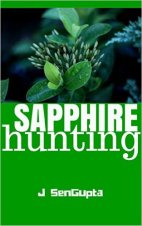 James is a math/physics student at an unnamed university somewhere in England. He’s likely a genius, or at least a savant; concepts, equations and theories of energy flow come easily to him; he likes the challenge but knows he can find the solutions. Other facets of university life are less attractive, but he’s coping.
But it’s not just the theoretical concepts of energy flow that James understands almost intuitively and without effort. There are other sorts of energy flow, a flux of darkness, destruction, focusing in on his world, something James can sense, something perhaps attracted to him. Others know only the frightening results of this dark power; James is caught up in its forces. Trying to escape, yet strangely attracted to this force, James steps through a doorway into another world, to find he is not alone in his fight against this dark vortex.
Sapphire Hunting is not a typical young adult fantasy novel. Written in a detached, dream-like style, bordering on prose poetry, Sapphire Hunting demands a lot of its readers. Action is fairly minimal; descriptions are long and lyrical, focusing on feelings, emotions, impressions, mood: “…a spark discharged from his forefingers, like winter, into the mantis-shaped thing, the fog, the flying rags looming over.” The words flow and pattern like the energy that fascinates and focuses James.
I read Sapphire Hunting in small chunks, both because it demanded close attention and because I wanted to draw out the experience. The closest other reading experience I can remember was that of reading Joyce’s Ulysses. So, for a reader who is looking for a book where the focus is on the action and the plot, one that reflects others in its genre, this may not be the book for you. But it is one whose imagery and language will stay with me for a very long time.
Did I have any niggles? One or two….there were sentences, that, despite their overall beauty, I would have restructured, changed the punctuation. There were one or two small typos. Neither issue detracted from my overall impression. Is it a young adult book? I wonder: probably for a few – I would have swallowed it whole at fourteen or fifteen – but it might be better directed to the New Adult readership. Five stars for a unusual and memorable book.
The author provided me with a copy of the book in exchange for an honest review.
 marianlthorpe.com
You must be logged in to post a comment.