A random interaction on Twitter earlier this year began me thinking about how the  elements and principles of design can be linked to writing. I’m trained in design, both for graphic art and landscape design, so the concepts were known to me. But I’d never thought about applying them to writing.
In this first analysis, I’m going to be considering them in the context of world-building, in preparation for a talk I’m giving in May, I’ll be doing a series of blog posts on this concept…and this is the first one. I won’t be talking about all the things that should be included in world-building – there are dozens (hundreds?) of resources for that, but rather how the design concepts can be used to integrate world building into the narrative.
Today, I’ll look at how the element of line can be used. In visual art, line refers to linear marks, or edges where shapes or positive and negative space meet. There are two ways to consider this in world-building.
The equivalent of visual art’s linear marks in writing is movement: journey, regardless of the method. Journeys are prime places for showing us the world: what is the traveller experiencing? What are their senses telling them, and how are they reacting? (I wonder sometimes if this is why fantasy worlds and hero’s journey story arcs go together – there is so much scope for world-building!) If these reactions or impressions add to the character’s growth or reveals things about them – either directly to the reader or to another character – then the world-building slides seamlessly into the story.
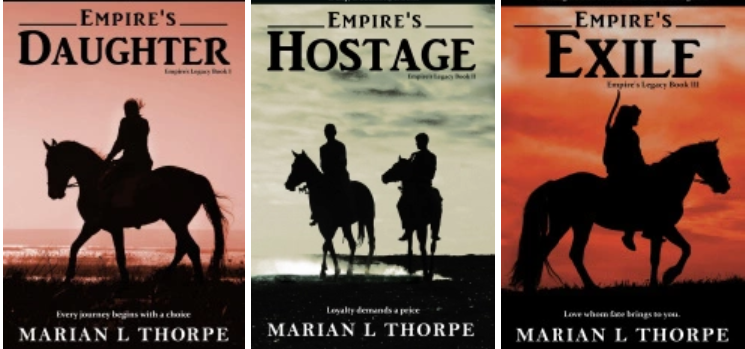
In this snippet from Book 1 of my Empire’s Legacy trilogy, Empire’s Daughter, here is the protagonist Lena at the beginning of a physical journey:
The track widened, allowing Garth and me to ride abreast, behind Casyn. Looking back, I could no longer see even the smoke from Tirvan’s chimneys. Stop that, I told myself. Look around you. This is new. The plateau we rode on was rocky, heathland and bog, without trees. A raven croaked from a boulder.
We came to the road. I had expected a cobbled track, but the builders had made it wide enough for two wagons to pass. Paved with squared stone, it spoke of permanence and age. Casyn signalled a stop. We rode up beside him.
“North,” he said, pointing, “the road goes to Serra and Delle, and beyond it to Berge where it turns east again to run below the Emperor’s Wall on the northern border. South, it meets the sea near Karst, and then again turns east to Casilla. The closest inns are an easy day’s ride in either direction.”
A map nestled in my saddlebag, drawn by Casyn, showed the villages and inns on the road. If no one at the first southward inn had news of Maya, I would accompany Garth to Karst, riding northward again as spring approached. The northern road, Casyn had counselled, would be treacherous for a lone traveller in a matter of weeks.
“Is there an eastern road?” I asked. When Casyn had brought me the map, I had focused on the inns, knowing that I was most likely to find Maya—or at least hear word of her—at one of them.
We learn a number of facts about Lena’s land in this passage: a bit about its ecology and its comparative eco-region: ‘…heathland and bog, without trees. A raven croaked…’ Most readers will be able to picture this and relate it to a northern setting. But we also learn that it is new for Lena: a short ride from her village, and she’s never been there. It tells us about the insularity of her upbringing and the expectations of her village.
“I had expected a cobbled track, but the builders had made it wide enough for two wagons to pass. Paved with squared stone, it spoke of permanence and age.” Here we learn that this country has a history, a past that is still to be revealed – but one that the character Casyn takes for granted, while Lena does not.
“North,” he said, pointing, “the road goes to Serra and Delle…. So we have map of Lena’s country laid out in words, grounding both her and the reader. Lena has this map, she’s seen it, but we also learn the geography isn’t her focus: she wants to find Maya, and she’s looked at the map only in relation to that goal.
World-building, using the linearity of the journey as the vehicle, has given the reader insight into the northern setting of this world, hinted at the age and technology of the culture, revealed a bit about the limits of Lena’s village’s worldview, and provided an brief overview of the settlement structure of the country – and shown us there is another country to its north. But because it is in the context of Lena’s experience, it blends into the narrative.
The second way to consider the concept of line is the intersection of shape or space: edges. In writing, the equivalent is meetings: the edges of culture, personality, gender, religions, politics, language…. Again, showing how protagonists react to these edges combines the world-building with character development.
In this excerpt from much later in Empire’s Daughter, Lena has reached a crowded southern inn, another new experience for her:
Only women occupied the tables and benches. The men had a separate room. Here in the south, where villages and farms crowded closer together, and with regular traffic on the road between Casilla and the Emperor’s camp, custom kept men and women apart. Voices and bodies filled the room. I went to the serving bar to order ale and food. When it came, I paid, then made my way to an empty place at the far end of a table. My room-mates sat at the opposite end. They each raised a hand in greeting but made no effort to include me in the conversation. I ate my stew, listening.
I heard talk of crops and herds, of a good year for wine, of births and deaths. Women bet on a dice game at a table behind me, and someone played a stringed instrument of some kind in the far corner, quietly and without accompaniment. I thought of the map Casyn had drawn for me, trying to picture this inn. As far as I could remember, it sat at the hub of several roads, leading out to a semi-circle of villages—Ballin, Karst, two or three others. When I finished my food, I turned slightly to watch the dice game behind me. It seemed friendly, with much laughter and joking. One of the women looked up. “D’you want to join us?”
I shook my head. “I’ve never played. May I just watch?”
“Sure,” she answered. “But where are you from, that you’ve never thrown the dice?”
In this scene of meetings – a new space, with different rules, new people, a new game – there are lots of opportunities for world-building. What do we learn?
Only women occupied the tables and benches. The men had a separate room. Here in the south, where villages and farms crowded closer together, and with regular traffic on the road between Casilla and the Emperor’s camp, custom kept men and women apart.
Fairly self-explanatory, and in all honesty if I were writing this book again, I might leave out that last sentence and just let the first two show us the difference in cultural practices between the south of Lena’s country and the north. (Or reframe the last sentence as Lena’s direct thought).
I heard talk of crops and herds, of a good year for wine…While the reader is picturing Lena sitting alone, listening (which gives more insight into her character), they are also learning that this is an agricultural area; coupling that with villages and farms crowded closer together tells the reader that the south is a more fertile area, with better conditions for crops, and warmer, if wine can be produced.
As far as I could remember, it sat at the hub of several roads, leading out to a semi-circle of villages—Ballin, Karst, two or three others. Here, as Lena remembers, the reader is reminded of the geography and infrastructure of roads and villages; the sentence also reinforces the higher population of the south.
The dice game gives the reader insight into recreational pastimes (as does the instrument being played quietly in the background); the fact Lena does not know how to play again emphasizes the cultural differences between north and south. It’s also a jumping-off point for a conversation that will lead the narrative (and the journey) forward.
Lena’s experiences here are mostly that of hearing and sight. I could have included other sensory information – the taste of the food, the smells in the air, the temperature of the room – but I’d done that in other inn scenes, so while repetition (a principle of design, rather than an element) is important, so is variation within that repetition. More on that in another post!
Elements of Design graphic By Mtpanchal – Own work, CC BY-SA 4.0, https://commons.wikimedia.org/w/index.php?curid=74316457


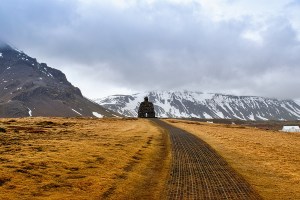 At the same time, and in the previous few years, I’ve been obsessed with the singer Ásgeir, whose debut album Dýrð í dauðaþögn (Glory in the silence) was my album of the year… for two years in a row, since nothing better came out. The English version, In The Silence, featured lyrics so beautiful they almost hurt, translated by John Grant. As I was listening to In The Silence for the 150th time, it dawned on me that there was a country called Iceland, which was cold and produced both Björk and Ásgeir. So I decided to investigate it a bit.
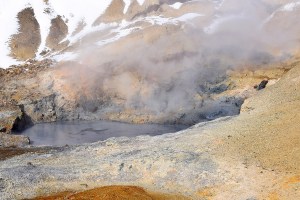 Wasteland With Words. Everything came into place. Iceland was not only a perfect setting for my novel, it felt as if the country was created especially so that I could write about it. It would take a while until I realised that the Old Gods worked the other way round, but at that point I started doing serious research. “A village in Iceland” still wasn’t enough of worldbuilding. I needed to know more. Whilst most Icelanders wrote diaries and memoirs, most of them were never translated to any language other than Icelandic. I realised I needed to go there – and talk to someone who would know much more than me.
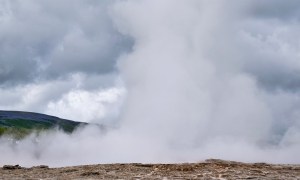 We went for four days. I needed to spend a day in Árbærsjafn, the open air museum the name of which I couldn’t even spell at the time, much less pronounce. Other than that, we intended to see the touristic parts – Thingvellir (which my husband still calls “the Game of Thrones place”), Geysir, and other attractions by the Golden Circle. I met up with a wonderful historian, Helga Maureen, got answers to most of my questions, then we drove around until all of a sudden a wave of heavy depression fell upon me. My husband and my friend went to see the Öxararfoss waterfall, I stayed in the car. And then something unexpected happened. Twenty minutes later, when they returned, my depression was gone and I was in the perfect mood to continue driving around.
 know them today, came up with two possible origins for the elves. One of them was that they were the “unclean” children of Eve, hidden from God when he came to visit (those are not my words). God, who was not pleased with this turn of events, decreed that what is hidden from Him will be hidden from everyone else as well. This is where the phrase “hidden folk” came from. The other story was even better, as it suggested that Eve was such an – ahem – lively lady that neither Adam nor God could control her. After some deliberation, God created a second man for her, naming him Elf. Therefore humans are descendants of Adam and Eve, and elves – of Elf and Eve.
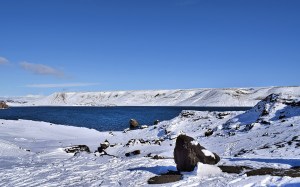 Snorri had to come up with something to avoid danger. The thirteenth century was not a good time to announce the existence of mythical beings that had nothing to do with the Christian God. Yet the belief in elves was widespread in Nordic countries even before Iceland became inhabited in the 9th century. The heathen faith lists Nine Worlds, one of which is Álfheim (the home of the elves), and another – Svartálfheim (the home of the dark/black elves). Back when the Old Gods ruled the worlds, their subjects did not use the phrase “hidden people”, but regarded them as natural spirits, same as the many species of wights guarding homes, land, trees. They had no need to come up with explanations why the elves existed. They simply did, same as Odin, Freya, Thor, and everyone knew that.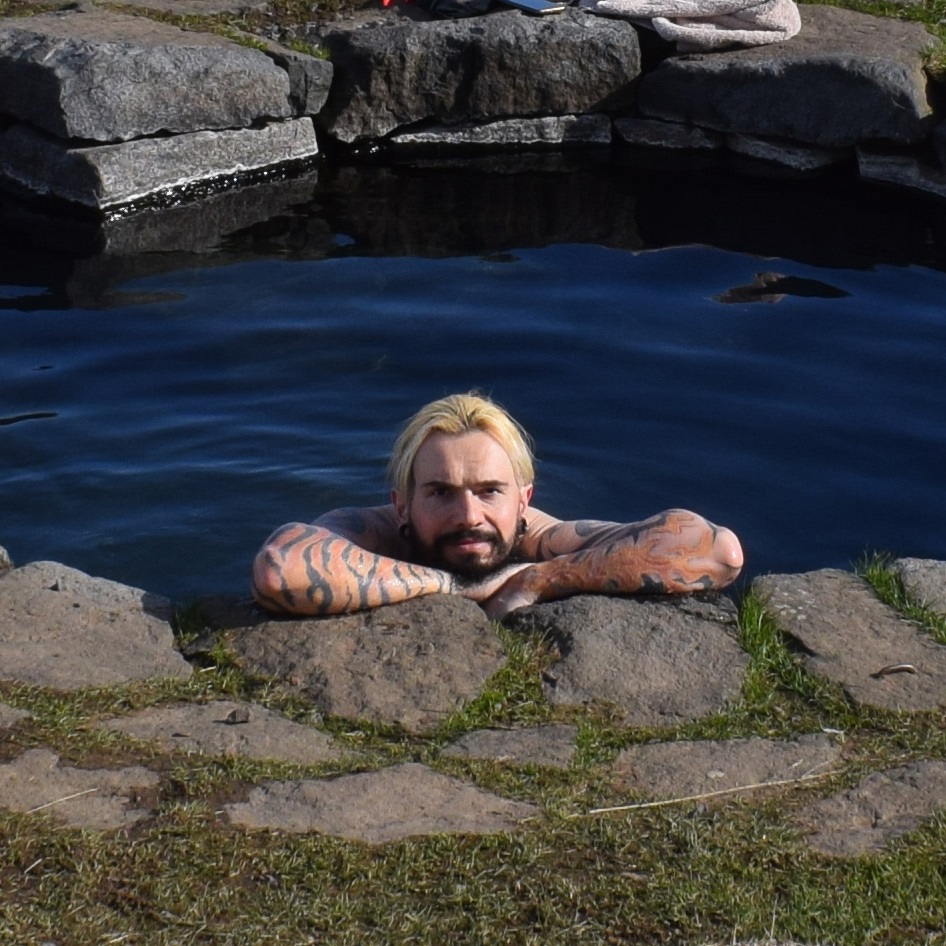
 Legion of Mono captures the resolve of a people’s last military leader in the hours before what he knows will be a final battle. His grief at leaving his partner and their child; his pride in his family’s honour; his strong bonds with his fellow soldiers: all are skillfully expressed. The author has created, in twenty-five pages, a glimpse into a world that feels solid and complete, a remarkable achievement. The ending left me wanting more, of both the world and the story. Highly recommended.

 In the third book of my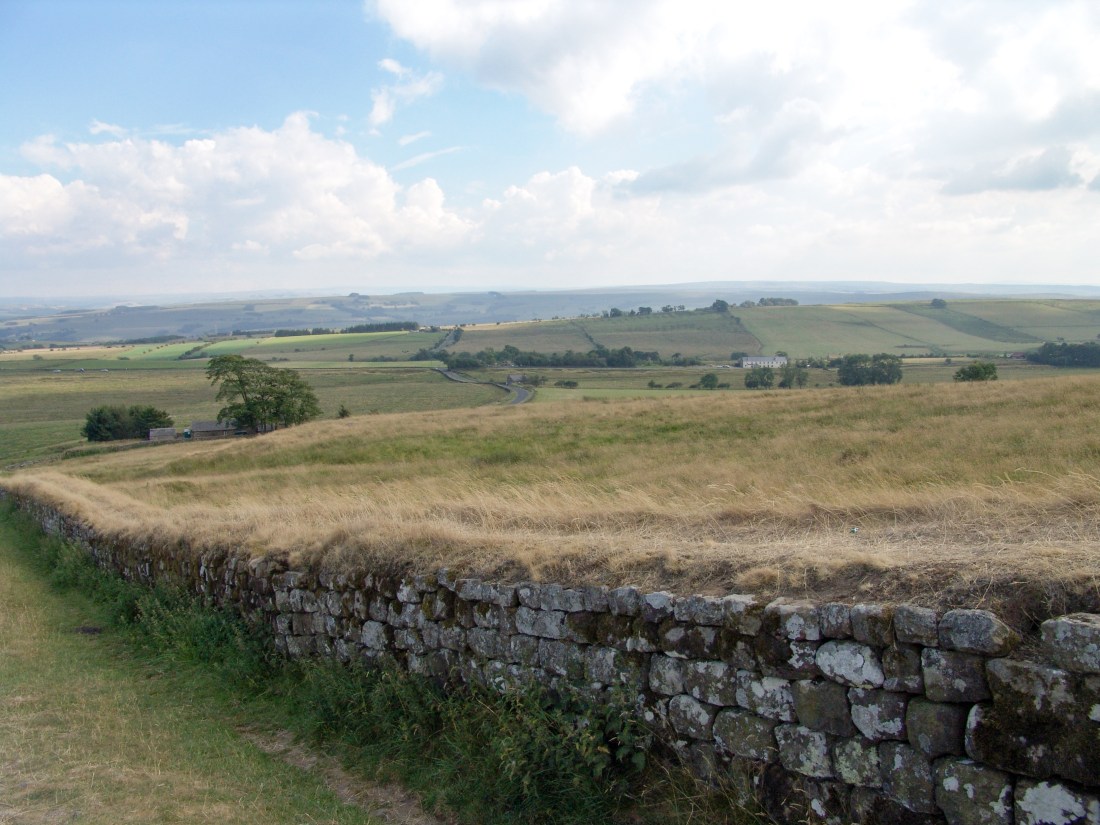
 marianlthorpe.com
You must be logged in to post a comment.