Category: writing
The Arrow of Exile

Whether in Rome or a dystopian future, from Norwegian falconers to princes, exile can be a choice for survival, or a forced exodus from everything that is loved. Thirteen stories by thirteen historically-inspired writers (including me), newly out in paperback and Amazon e-book.
‘a delightful collection….I highly recommend’ – Amazon reviewer
I Read Canadian

I Read Canadian Day is a day conceived as ‘a national celebration of Canadian books for young people, with the goal of elevating the genre and celebrating the breadth and diversity of these books.’ But in 2023, its own website acknowledges that it’s also a day that celebrates the ‘richness, diversity and breadth of Canadian literature.’
As I walked this morning I thought about my own experience with Canadian writing, both as a child and an adult. I’m 65, so back in the early ‘60s, only a few authors easily spring to mind: Lucy Maud Montgomery, Morley Callaghan, and Farley Mowat. (Callaghan wasn’t primarily a children’s writer, but his young adult novel Luke Baldwin’s Vow was excerpted in one of our school readers.) A few years later, I read Who Has Seen the Wind by W.O. Mitchell.
All these books touch on what Margaret Atwood argued was the central theme of Canadian literature in the first half to 2/3 of the 20th century—survival. Sometime physical survival, as in Mowat’s Lost in the Barrens; sometimes psychological survival, finding one’s place, a theme in Montgomery and Callaghan and Mitchell. Survival isn’t a theme specific to Canadian literature, of course, and not every literary scholar agreed with Atwood, but it may be telling that when I was being interviewed by another Canadian about my own books last week, and I answered the question about deeper themes by saying that they were in part about the love of place, of a geography and landscape, his comment was, “That is SO Canadian.”
When Jack McClelland (and others) began to actively promote and publish Canadian authors telling Canadian stories in the 1970s, my earlier enjoyment of Mitchell and Callaghan and Mowat and Montgomery (a lot of ‘M’ s! – even Callaghan is ‘Morley” and prominent among Canadian writes of the time were Margaret Atwood and Margaret Lawrence….but I digress) made me predisposed to read what was being published. While those children’s books had been primarily rural stories, resonating with me and my own small farming town upbringing, I began to read of worlds I didn’t yet know: the Toronto-set books of Robertson Davies; the Montreal-set books of Mordecai Richler (another M!). And then into worlds, too, that didn’t exist – Ottawa writer Charles deLint’s urban fantasies set in not-quite-Ottawa; Guy Gavriel Kay’s Fionavar Tapestry, that starts in Toronto but moves into another world altogether. At about the same time, British Columbia writer Wiiliam Gibson’s Neuromancer created language now part of our everyday speech (Gibson invented the term cyberspace in an earlier short story, but it was Neuromancer, his debut novel, that brought it into common usage). Neuromancer is the only book to have ever won the Nebula Award, the Philip K. Dick Award, and the Hugo Award.
Perhaps a major turning point for Canadian children’s books came in 1979, Roch Carrier published Le chandail de hockey (The Hockey Sweater), a short story about a boy in rural Quebec who is sent the wrong hockey sweater – a Toronto Maple Leafs jersey instead of a Montreal Canadiens sweater. Adapted by the National Film Board into a short film, then published as a picture book by Tundra in the early 80s, it is my impression that The Hockey Sweater helped change the demand for Canadian children’s stories, although the timing must also have helped! The Canadian Children’s Book Centre had been created a few years earlier, and The Canadian Children’s Book News began publication in 1977. Since then, organizations across Canada have sprung up to promote Canadian writers of works for children and youth: the Forest of Reading program run by the Ontario Library Association gives out 10 awards for Canadian children’s books yearly – and of course the I Read Canadian organization’s mandate is to promote Canadian children’s books and reading.
Canadian children who read become Canadian adults who read (we hope!) and the breadth and depth of Canadian literature has never been wider. Indigenous voices, new-immigrant voices, voices of people marginalized for many and multiple reasons; memoir, poetry, fiction, non-fiction, graphic novels; short stories, novels, novellas, whether published traditionally (by big presses and small) or independently produced; verse on broadsheets, hand-sewn chapbooks and hand-bound books; limited editions and trade paperbacks, ebooks and internet serials – so much to explore, to enjoy, to learn from. And to contribute to, by so many talented, passionate Canadians.
WRITING A SERIES by Helen Hollick

What could be easier? You have an idea for a new book, it doesn’t matter what genre – historical fiction, romance, fantasy, crime…The basic plot has popped into your mind and the characters come trooping into your life: the protagonists, the good guys, the bad guys. You start writing, the plot flows and the first draft is done. Then the editing, the cover design, the formatting. The excitement of publication day. Maybe an online launch and a book tour. And then you realise exactly what you have. The first part of a potentially cracking good series.
Now you wish you’d kept notes, details of what your characters were like – in looks and mannerisms. Eye colour, hair colour, tall, short, fat, thin? Their quirks and foibles. Maybe you should have delved into their backstories a bit more? Oh heck – I should have made a note of locations, of the little details. Believe me, unless you intentionally set out to write a series from the very beginning, all these possible continuity pitfalls suddenly appear like wasps at a summer picnic.
Readers notice, or at least, they will when your wonderful series takes off and the demand comes for ‘More!’
When I wrote Sea Witch, the first of my Captain Jesamiah Acorne nautical adventure voyages, I intended it to be a one-off tale, (not helped by my ex-agent who had no faith in it – hence the ‘ex’!) But readers loved it (and Jesamiah,) so I had to write another adventure for him, then a third… I’m in the process of starting the seventh full length yarn. And I wish I’d made more notes along the way.
Lesson learned, I keep notes for my Jan Christopher Cosy Mystery series (that’s coZy in US spelling). The location for the episodes set in the north-east London suburb of Chingford are not a problem as it’s where I used to live and work in the public library back in the 1970s. Apart from the roads where murders happen, all the streets and places are the real thing. (I’ve made the murder locations up, though, in case of any residents’ sensitivity.) The library itself, South Chingford, was an actual place. The building still exists but the local council closed it as a library several years ago (shame on them!) and it is now used as offices. I’ve quite enjoyed bringing the old place back to life; remembering all the goings-on during the thirteen years I worked there. The characters, however, are entirely made up – although several of Jan’s anecdotes are partially biographical.
I decided to deliberately alternate location settings between each book, primarily because I was torn between writing about Chingford as it was, and my present life here in glorious North Devon … so episode 2 (A Mystery of Murder) saw Jan and boyfriend Detective Sergeant Lawrence Walker visiting his parents for Christmas 1971, who live in the fictional village of Chappletawton. Based on my village – but not quite the same.
All well and good, but by the time I got to episode 4 –which again sees a return to Devon, I had to ensure I had the right place names, the right village residents … was Bess, the dog, a black or golden labrador? What had I called the neighbouring farmer? And even more important, which characters leant themselves to becoming possible murder suspects and which ones were reliable witnesses?
I think I’ve managed to tie everything together in A Meadow Murder, introducing new characters, revisiting previous friends, and remembering to make notes for the next planned instalments…

ABOUT A MEADOW MURDER
A Meadow Murder is the fourth tale in the Jan Christopher cosy murder mystery series, the first three being A Mirror Murder, A Mystery of Murder and A Mistake of Murder… see what I’ve done there? Yes, I’ve created a proper puzzle for myself because now every tale in the series will have to follow the same title pattern of ‘A M-something- of Murder’ (Suggestions welcome!)
Based on working as a library assistant during the 1970s for almost thirteen years, the mysteries alternate between the location of Chingford, north-east London, where the real library I worked in used to be, (the building is still there, but is, alas, now offices) and my own North Devon village, but slightly fictionized. Chappletawton, for instance, is much larger than my rural community and has far more quirky characters, (and we haven’t had any real murders!)
The main characters, however, remain the same: Jan Christopher is the niece, and ward, of Detective Chief Inspector Toby Christopher and his wife, her Aunt Madge. In A Mirror Murder, Jan (short for January, a name she hates) meets her uncle’s new driver, Detective Constable Lawrence Walker. Naturally, it is love at first sight … but will an investigation into a murder affect their budding romance?
We find out as the series continues: Episode Two takes the young couple to spend Christmas at Laurie’s parents’ old farmhouse in Devon, while Episode Three sees us back at work at the library in the north-east London suburb of Chingford. We yet again travel to Devon for Episode Four – A Meadow Murder. And no spoilers, but the title is a little bit of a giveaway!
I had the idea for A Meadow Murder during the summer of 2022, while watching our top meadow being cut for hay. The cover photograph for A Meadow Murder is my field – a real Devonshire hay meadow, and the scenes in the story about cutting, turning and baling the hay are based on how we really do it. (Even down to the detail of the red Massey Ferguson tractor.)
In fact, I’m very glad that we cut and brought in our 480 bales of hay this year back in June when it really was a case of ‘make hay while the sun shone.’
I am relieved to say, however, that we didn’t find a body…
“As delicious as a Devon Cream Tea!” author Elizabeth St John
“Every sentence pulls you back into the early 1970s… The Darling Buds of May, only not Kent, but Devon. The countryside itself is a character and Hollick imbues it with plenty of emotion” author Alison Morton
*
Make hay while the sun shines? But what happens when a murder is discovered, and country life is disrupted?

Summer 1972. Young library assistant Jan Christopher and her fiancé, DS Lawrence Walker, are on holiday in North Devon. There are country walks and a day at the races to enjoy, along with Sunday lunch at the village pub, and the hay to help bring in for the neighbouring farmer.
But when a body is found the holiday plans are to change into an investigation of murder, hampered by a resting actor, a woman convinced she’s met a leprechaun and a scarecrow on walkabout…

Buy Links – Paperback or e-book, including Kindle Unlimited
Amazon Universal Link: this link should take you direct to your own local Amazon online store https://mybook.to/AMeadowMurder
Also available worldwide, or order from any reliable bookstore
All Helen’s books are available on Amazon: https://viewauthor.at/HelenHollick
ABOUT THE AUTHOR: HELEN HOLLICK
First accepted for traditional publication in 1993, Helen became a USA Today Bestseller with her historical novel, The Forever Queen (titled A Hollow Crown in the UK) with the sequel, Harold the King (US: I Am The Chosen King) being novels that explore the events that led to the Battle of Hastings in 1066. Her Pendragon’s Banner Trilogy is a fifth-century version of the Arthurian legend, and she writes a nautical adventure/supernatural series, The Sea Witch Voyages. She has also branched out into the quick read novella, ‘Cosy Mystery’ genre with her Jan Christopher Murder Mysteries, set in the 1970s, with the first in the series, A Mirror Murder incorporating her, often hilarious, memories of working as a library assistant.
Her non-fiction books are Pirates: Truth and Tales and Life of A Smuggler.
She lives with her husband and daughter in an eighteenth-century farmhouse in North Devon, enjoys hosting author guests on her own blog ‘Let Us Talk Of Many Things’ and occasionally gets time to write…
Website: https://helenhollick.net
Subscribe to her Newsletter: https://tinyletter.com/HelenHollick
Main Blog: https://ofhistoryandkings.blogspot.com/
Facebook: https://www.facebook.com/helen.hollick
Twitter: @HelenHollick https://twitter.com/HelenHollick
Water and Blood, by Rik Lonsdale
A Review

When disaster strikes, you want your family around you—don’t you?
When the collapse of an Antarctic ice sheet causes catastrophic, world-wide flooding and the disintegration of society, Lucy Marchand thinks she’s safe on her family’s smallholding in the west of England. But family tensions that could be ignored when they were buffered by a larger society begin to become evident when her older brother Ben flexes his way to a position of power within the family.
Set against a dystopic world all too easy to imagine—and already real in parts of the globe—Water and Blood is a psychological study of narcissism, manipulation, and the responses of a family trying to survive, and trying too to believe that one of their own has their best interests in heart.
The choices made by each individual in on the smallholding are distinct, and the reasons behind their decisions believable and layered. Each person has a point at which they either say ‘no more’ or embrace the philosophy of the leader. Many things influence that choice, especially when it becomes a question of your own life or death. As winter deepens and starvation threatens, does morality matter at all?
I read Water and Blood in two days, and found it hard to put down. Well-paced, it asks some probing questions about how societies, even in microcosm, work. A solid debut novel, Water and Blood is out March 22. My thanks to the author for an advance review copy.
All purchase links at https://linktr.ee/riklonsdale
The Call of Home
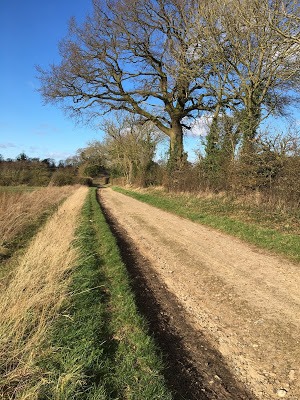
I walk steadily up the slight incline, my boots thumping rhythmically on the hard soil. Nearly two millennia past, Roman troops were doing the same: the track follows the line of a Roman road. It’s likely older than that; bronze age barrows lie to either side, on the high ground above the river valley below, and it ends very close to the place the wooden circle of uprights known as Seahenge was uncovered.
Within a few miles of my temporary, inherited house are three ringed enclosures (hillforts, as they’re generally known, whether or not they’re on a hill) that date to Iceni times. One corresponds with Tacitus’s description of the Iceni defensive structures during Boudicca’s rebellion. The line of another Roman road which approaches that hillfort lies to its south, perhaps a response to the Iceni uprising, perhaps part of the Saxon Shore defenses.
The Romans stayed another four hundred years, before Rome’s wars and finances made them withdraw. More invaders – or migrants – arrived from the continent, the people we call Saxon and Angles. They built in wood, not stone, except for the round towers of a few churches, leaving their mark in place names, a few roads, and moot hills. The Vikings arrived in the 800s and were ousted – at least in rule – in the 900s. The settlers stayed, though, and both archaeological finds and place names attest to this. And then it’s 1066 and William of Normandy winning at Hastings, and the rulers – not just the king, but the landholders and princes of the church – change again.
After that, sheep bring wool-wealth to Norfolk, huge churches in every village, and a Hanseatic port at King’s Lynn. The plague arrives, some medieval villages disappear, and the population plummets. In the 17th century agricultural improvement – fen drainage and sea-wall construction, then the work of ‘Turnip’ Townsend and Coke of Norfolk in crop rotation and soil improvement – slowly move Norfolk from grazing to crop production. The Enclosure Act changes who has access to land, and where. Hedges are planted. More medieval villages disappear, because major landowners move them off their deer parks. New roads are built, others disappear, to become bridleways and footpaths.
Because of all this, and my family’s long connection (on one side) with west Norfolk, I love this place. I could claim it’s in my DNA, which reflects the series of migration – violent and peaceful – that I’ve encapsulated here, but the scientist I once was raises an eyebrow at that statement. It is, I think, more about stories: my grandmother’s, my father’s, the cousin who made me her executor and beneficiary. Environment, too: I was brought up in a house where history mattered.
I’ve been here eight weeks; I’ll be here just about another two. It’s not the first long stay – we wintered here after retirement until the pandemic, January to March of every year, trading Ontario’s snow and ice and cold for the relative warmth and good walking of west Norfolk. But it’s the first time I’ve been here alone, my husband staying, for good reasons, in Canada.
I find myself like my character Sorley, torn between who he loves and where he loves. Because part of me wants to stay. This land and its long history is the wellspring of my creativity, the source of my invented lands and their histories and the details of worldbuilding readers love. I lay my fiction lightly on this place, seeing it reflected all around me.
But in Canada are the people I love: my husband, my extended family, my friends. And, a city I love in a different way, for its cafes and bookshop and trails for bike and foot; for its university and the two rivers and the farmers’ market, and for the writing community I’m part of. So in 12 days, I will go home, both gladly and sadly.
The question of what and where home is echoes through my books, one of the themes of the series. In the work-finally-in-progress, Empire’s Passing, it will be a key question for my MC Lena. “I had always turned for home. But where is home for the tamed falcon, when there is no falconer to hold out his arm?” Some of the intricacies of that question – and its answer – will be shaped by my own divided heart.
You might just like….
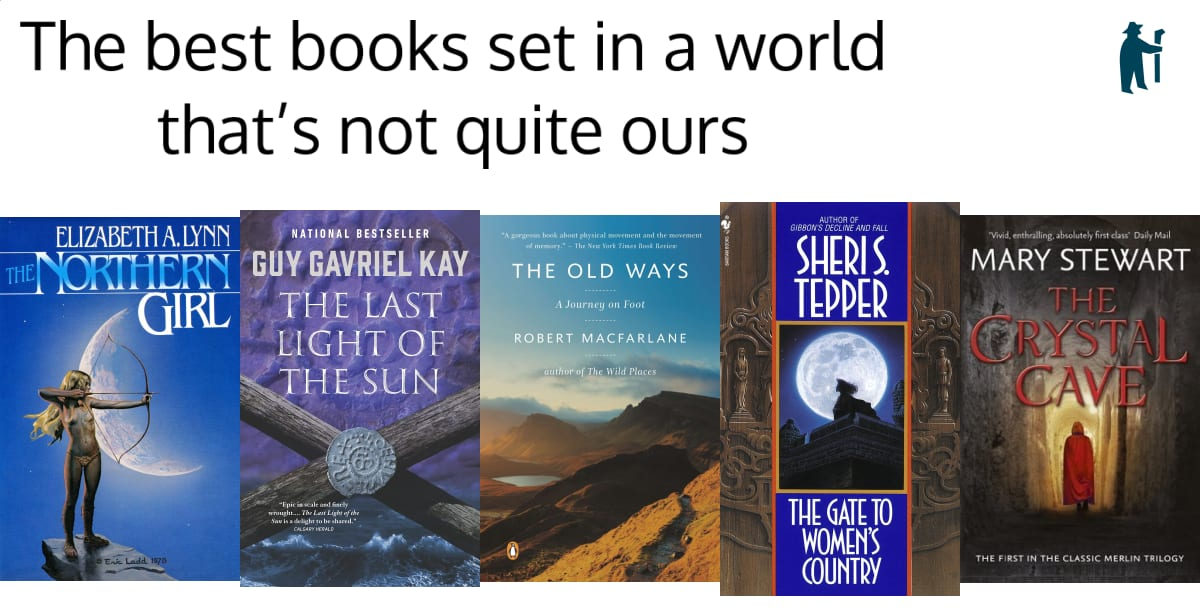
What are all these blue books?
This is my Shepherd.com list (find it at https://shepherd.com/best-books/set-in-a-world-thats-not-quite-ours)
(Hold on, you might be saying. What’s’ not our world’ about the non-fiction The Old Ways, by Robert Macfarlane? Well, it’s a way of seeing the world that isn’t, in my opinion, mainstream, although I wish it were, so I slipped it in. )
And if you’re a reader of my books, you probably think worldbuilding is important, so check out these other recommended books with outstanding worldbuilding.
How Has Writing Changed Me?
A guest post by Kathleen Marple Kalb (Nikki Knight)
Saved by the Work
When my husband and I walked our son into his first day of kindergarten, I knew our lives were changing. But not quite the way I thought they would.
I came home that morning and started writing fiction for the first time in more than twenty years. As a teenager, I’d written for fun, and even tried, unsuccessfully, to sell an historical novel. Now, with several free hours a day, I wanted to try again with everything I’d learned as a journalist and a person.
I didn’t know then how much I still had to learn.
That first book, a mystery set at a Vermont radio station, featuring a young, single woman – think Stephanie Plum with moose, only not as good – didn’t sell. Neither did the next book. The third one did, but that was only half of the story.
While I was querying that third book (you may know it as the Ella Shane mystery, A FATAL FINALE) my husband was diagnosed with cancer. He was in remission by the time my agent sold it, and there was a brief period where it looked like everything was coming together.
Then came Covid.
And suddenly, my fun little escape project became a lifeline.
During the run-up to publication, I had enough time to work on other things, including a new version of that Vermont mystery. This time, the main character was a grownup and a mother, but the place was the same. A warm, wonderful, safe little town with a diverse cast of people who borrowed from my colleagues.
The first Vermont book was done when the lockdown hit, but I was working on the sequel. And as that short lockdown wore into months and more than a year of virtual school, that little town became my happy place.
I’d sit on the couch in the basement office we’d fitted out as a schoolroom, keeping an eye on my son’s virtual fifth grade, first finishing the second book, and then writing short stories.
The work saved me.
Even as the real world fell apart around us, I was able to return to my happy place whenever I opened my laptop.
Not just that, I learned a new form, short stories. Initially, I wrote one for my Sisters in Crime chapter anthology. I wrote it only to be supportive and assumed it would be rejected. Turned out I loved writing it, and it was accepted.
Soon, I was writing short stories set in the world of the Vermont book and enjoying both the pleasure of hanging out in my happy place, and the satisfaction of producing a finished piece of work in a short time.
Relishing the challenge of creating a good story in a small space.
Exploring the world of my characters for story ideas.
Escape, sure.
But growth as a writer, too.
These days, as we settle back into whatever life looks like after the pandemic, we’re starting to forget how hard it was to stay focused and sane during the height of it. Writing, and particularly writing Vermont stories, pulled me out of the anxiety and kept me moving forward – even if I didn’t know what was out there.
The first Vermont book, and many of the stories are out in the world now. And so am I – a better writer, and a more focused professional. I hope, too, a much more aware and understanding person.
And grateful.


Kathleen Marple Kalb describes herself as an Author/Anchor/Mom…not in that order. An award-winning weekend anchor at 1010 WINS Radio in New York, she writes short stories and novels, including the Ella Shane Historical Mysteries for Kensington and, as Nikki Knight, LIVE, LOCAL, AND DEAD, a Vermont Radio Mystery from Crooked Lane. Her stories are in several anthologies, and she was a 2022 Derringer Award finalist. She, her husband, and son live in a Connecticut house owned by their cat.
Are you a writer who’d like to contribute to this series? Leave a comment below and I’ll get back to you!
Storytellers: New Cover!
Like interior decoration and wardrobes, book covers can need updating. Bjørn Larssen has a new cover for his haunting novel Storytellers, and I’m pleased to show it to you today.

If you don’t tell your story, they will.
Iceland, 1920. Gunnar, a hermit blacksmith, dwells with his animals, darkness, and moonshine. The last thing he wants is an injured lodger, but his money may change Gunnar’s life. So might the stranger’s story – by ending it. That is, unless an unwanted marriage, God’s messengers’ sudden interest, an obnoxious elf, or his doctor’s guilt derail the narrative. Or will the demons from Gunnar’s past cut all the stories short?
Side effects of too much truth include death, but one man’s true story is another’s game of lies. With so many eager to write his final chapter, can Gunnar find his own happy ending?
My 2019 Review:
Set against Iceland’s harsh but beautiful landscape in the late 19th and early 20th century, Bjørn Larssen’s debut novel Storytellers explores the multi-generational effect of the evasions, embellishments and outright lies told in a small village. The book begins slowly, almost lyrically, pulling the reader into what seems like situation borrowed from folktale: a reclusive blacksmith, Gunnar, rescues an injured stranger, Sigurd. In exchange for his care, Sigurd offers Gunnar a lot of money, and a story.
But as Sigurd’s story progresses, and the book moves between the past and the present, darker elements begin to appear. Gunnar’s reclusiveness hides his own secrets, and the unresolved stories of his past. As other characters are introduced and their lives interweave, it becomes clear that at the heart of this small village there are things untold, things left out of the stories, purposely re-imagined. Both individual and collective histories – and memories – cannot be trusted.
The book was reminiscent of Kazuo Ishiguro’s The Buried Giant, in both theme and mood. Both books deal with the unreliability of memory; both are largely melancholy books. And perhaps there is allegory in them both, too. Storytellers is a book to be read when there is time for contemplation, maybe of an evening with a glass of wine. It isn’t always the easiest read, but it’s not a book I’m going to forget easily, either.
Bjørn Larssen is an award-winning author of historical fiction and fantasy, dark and funny in varying proportions. His writing has been described as ‘dark,’ ‘literary,’ ‘cinematic,’ ‘hilarious,’ and ‘there were points where I was almost having to read through a small gap between my fingers.’
Bjørn has a Master of Science degree in mathematics, and has previously worked as a graphic designer, a model, a bartender, and a blacksmith (not all at the same time). He currently lives with his husband in Almere, which is unfortunately located in The Netherlands, rather than Iceland.
He has only met an elf once. So far.
Purchase links on Bjørn’s website.
How Has Writing Changed Me?
A guest post by J. Dalton

I’m pretty new to writing as I didn’t start until I turned 64. That was back in 2016 when I was diagnosed with CML Leukemia.
Getting Leukemia was a slap in the face that turned my life upside down. I lost a job I absolutely loved because of that, and thought I was going to die. Now that I am on the other side of it, I can honestly say that it turned out to be a good thing. It forced me to face my own mortality and look back on my life and the legacy I would leave. Now, I don’t fear death anymore, and I am no longer totally focused on work. I have found that family is the most important thing in my life.
With all of the high dose Chemo pills I was taking and the side effects they caused, (constant Pleural effusions where fluid would build up in the sack around my lungs making it difficult to breathe), there wasn’t much I could do physically any more, so I had this crazy idea that I would write a book for my grand-kids, after all, how hard could it be? (What the heck was I thinking?) That was the beginning of The Gates to the Galaxies Sci-Fi series.
Now, I’m seven books into the series and working on number eight, and I’m pretty sure not many people write the way I do.
I’m not the kind of author that can sit down at the computer and pound out a chapter or two. All of my Sci-Fi stories are based on my dreams. They come to me in full color like I’m watching a high def movie where each character speaks in their own unique voice. I dream a chapter or two each night when I’m “in the groove”, as I call it, and the next morning, I just write down what happened in the dream. I can go days without anything going on, then every day for weeks I dream about my story and sit down and write.
In my books, the villains, called the ‘Ones’ speak in musical notes and telepathic emotions that have different meanings when spoken in a different key.
I think this concept came from when I was a child. Music was a big part of my life back then from piano lessons, band, chorus and being exposed to a wide variety of musical styles at home like country, big band and of course, the classical music in the cartoons of my childhood. I would often just close my eyes and hear the music speaking to me as I made up words in my head to go along with the tune, so that became an integral part of my stories.
I don’t think of myself as an author or writer, but rather a story teller. Money, (or sales) never was a driving factor in doing this. All I ever wanted originally was to have my grand-kids and then eventually, other people read my stories and react to them.
There are a lot of different concepts in my books that most Sci-Fi stories don’t use and I think, based on the reviews I’ve gotten so far, that once people read my books, they enjoy them. That’s the most rewarding feeling to me.
As I said, for me the writing part is the easiest as I simply tell the stories of my dreams. Marketing, on the other hand, is something I struggle with but I keep working at it.
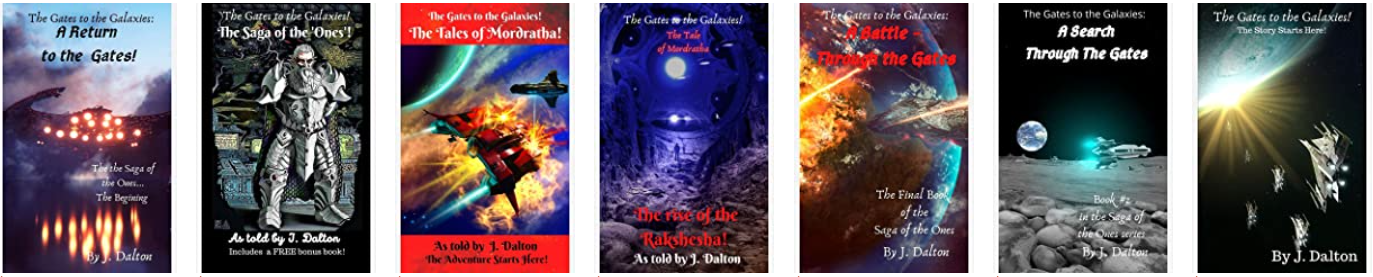
J.Dalton’s books can be found on Amazon.
Connect with him on Twitter using @JDaltonAuthor
Are you a writer who’d like to contribute to this series? Leave a comment below and I’ll get back to you!
 marianlthorpe.com
You must be logged in to post a comment.