Many thanks to Al at TheIndieView.com for interviewing me as to why and how I review books. Read the interview here.
Category: writing
Reverse Migration: A Discourse into the Spirit of Place: Excerpt 3
Edge
The cuckoos have gone. Two weeks ago, out at the Wash, they were calling from the shrubs surrounding the RSPB reserve, and further inland from the woodlands. Now, silence. Reed warblers and other small birds are busy raising huge cuckoo chicks, though.
There are two edges here. The first are the mudflats, those transient lands ‘between the salt water and the sea strand’, filled with birds; the second is the shingle beach, also but less obviously filled with life. The mudflats, actually silt-covered sand, are both mutable and immutable. Immutable, in that they have kept their basic shapes and properties for untold years, long enough to be both named and mapped; mutable, in that each tide reveals more or less of them, and each storm changes them slightly. Today at high tide the edges of Peter Black Sand are half a kilometer or more offshore, but with the right conditions of moonphase and water, high tide can lap the edges of the shingle. When this happens, the birds are pushed to the very edge in huge numbers, wheeling in huge clouds above the encroaching tide. But today they move slowly at the edge of the incoming water, only occasionally taking to the air.
The shingle beach here is where my great-grandfather’s beach bungalow stood. Sunny Ridge, it was called, and was a modest single-story construction of wood, with no plumbing of any kind. It was probably not much more than a camp kitchen with (perhaps) room for a table and chairs, and I believe not meant for anything more than day use. All the photos show groups of adults and children outside the bungalow, the women often with handwork – knitting, needlework; the men in jacket and tie, even here, and the children sitting on the shingle.
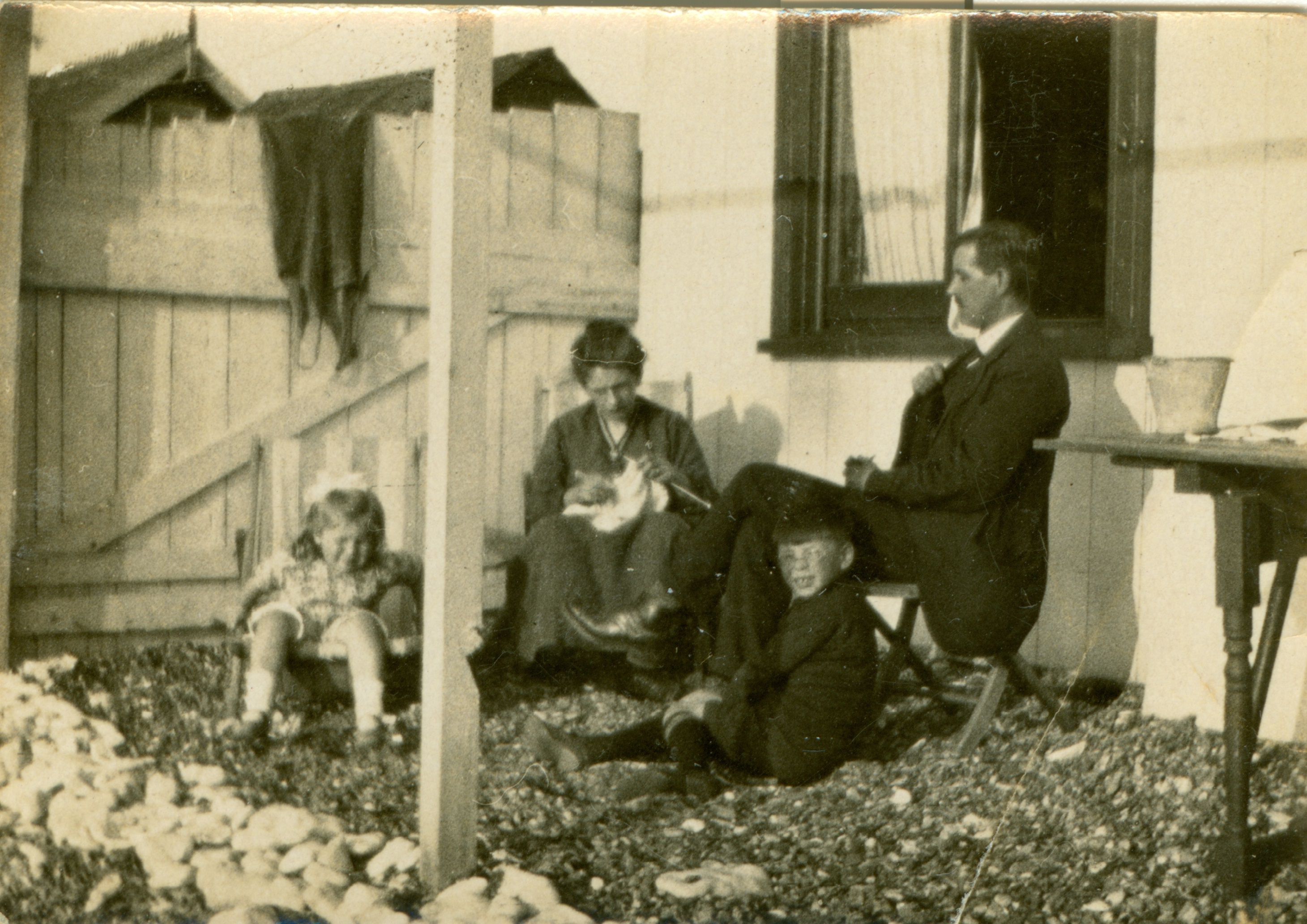
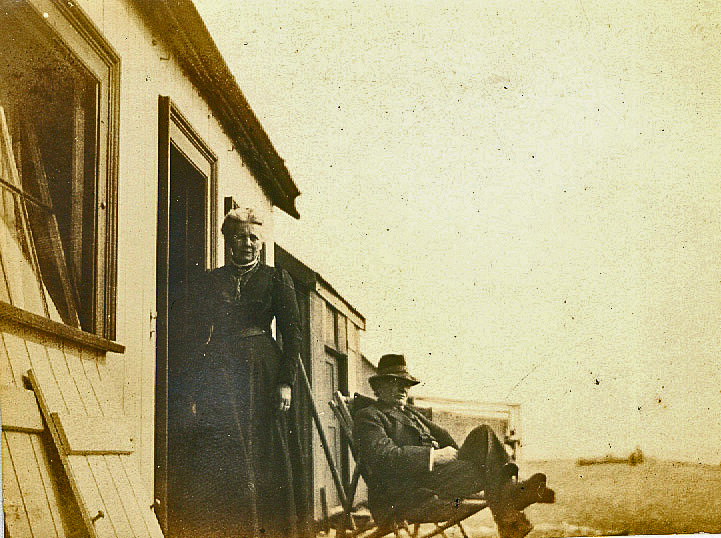
My belief that the bungalows were meant for day use is furthered by my father’s recollections of a man, possibly called Bob, who did live in a shack on the shingle, making a living somehow from the sea and odd jobs.
Queen Alexandra had a bungalow here too, closer to where Beach Road meets the Wash, from 1908 to 1925 (although it was, of course, rather posher). Built of the local red carrstone, a form of sandstone, she would frequently come out in the summer, sometimes with guests. On occasion she would be driven down the beach in her pony trap. One warm spring day she stopped to greet my great-grandfather and several of his sons & sons-in-law (most known to her as Sandrigham servants) who were busy creosoting Sunny Ridge, in shirt-sleeves and with filthy hands. The rest of this story is lost, all but the embarrassment (or amusement) that resulted.
During the second world war all the shingle huts were requisitioned by the military as housing, to support the RAF gunnery training camp situated there. At the same time, the shingle was mined to support the building of roads and runways, creating the pits that are now the ponds of the RSPB reserve. A jetty was built to load the shingle onto barges, which could access the outflow of the River Ingol at high tide. Seventy years and two massive floods later, the remains of the jetty still stand, providing nesting posts for black-headed gulls. What was left of Sunny Ridge, if anything, would have been washed away in the flood of 1953.

Now the shingle is quiet except for the screaming of gulls, the calls of waders, and the songs of small birds in the gorse. Oystercatchers and ringed plover nest on the beach, and the plant life is specialized and to some extent uncommon. While classified as shingle grassland, there are, apparently, twelve distinct plant communities, reflecting the height above high water mark and the composition of the shingle.
A sea-bank, or dyke, holds the Wash back from the arable fields to the east of it. Most of these embankments are on Faden’s 1797 map, and there are mentions in much older documents of sea-banks failing on the Dersingham marshes in medieval times. The shingle ecosystem exists between the Wash and the embankments, and to some extent on the side of the embankments facing the sea. In the flood of 2013, this whole area was under water. The rising sea destroyed one of the hides, moved another, and introduced salt water into the freshwater ponds. We walked the reserve only a few weeks after the flood: silt and debris covered the site and in some places was nearly to the top of the seawall. Less than two years later, there is almost no visible damage. The vegetation looks as it always has, in my memory.
There are no government plans to protect this coast any further, south of the village of Heacham. No higher sea-walls will be built: if it floods, it floods. (Landowners – mostly Sandringham and Ken Hill Estates – can choose to build privately funded embankments.) Saltmarshes are natural coastal protection, creating a buffer and a transition zone between the sea and the land. I may, one day, see the land between the village and the Wash return to saltmarsh, the haunt of waterfowl and curlew, the curls of the roddons below the soil echoed in the channels and ponds of a living marsh.
Did you miss the first two excerpts? Read them here.
A Sincere Thank You
Do what you love, and the work will come your way.
In the months that have passed since I officially retired from my salaried job (as opposed to the previous eight months, when I was off on medical leave), I’ve gone from a part-time writer, struggling to find the time to work with my editor and get Empire’s Daughter published, to a full-time writer, or, at least, someone involved in the indie writing world full-time.
I soon learned after retirement that I wasn’t cut out to do nothing but work on my own book. Perhaps because of years of having to juggle different projects, my ability to concentrate on one thing is limited to a couple of hours. After that, whatever I do probably isn’t worth the time it takes. So I gave it some thought: what aspects of my previous job(s) had I really enjoyed? What could I transfer to my new life?
The common themes going back through two different careers were these: writing, editing and reviewing. Over those careers, I’d written, reviewed, and critiqued everything from applications for hundreds of thousands of dollars worth of grants for scientific research, various master’s and doctoral theses (my husband’s M.Sc. thesis was classic, with the opening sentence going on for a page and half; luckily for our marriage, he’s a quick learner), and papers for submission to scientific journals. When I switched careers into education, I did the same for curriculum, writing prompts, policy and procedure documents, more grant applications, major reports to the government….But all this was non-fiction. Could it be transferred to fiction?
I’ve been reading since I was three, and have read (and continue to read) everything from classics to cyberpunk, from literary fiction to Lovecraft, and everything in-between. There is no better way to learn to write well – or recognize good writing – than to read and read and read. So, yes, I thought I could recognize good writing (and good storytelling, not always the same thing), and offer both fair and useful critiques.
So, as regular readers of this blog know, I started to write reviews. I offered editorial services, either beta-reads or full edits. Six weeks later, and my days (and both my review and editorial lists) are full. I spend my working hours in chunks of reading, reviewing, editing, and my own writing (plus a university course in a completely different area, to keep my scientific mind alive).
My own writing benefits greatly from this. Both in the reviewing and editing I am constantly reminded of what is good writing, what moves stories along, gives insight into characters, describes a situation or a location effectively. In looking at other writer’s work with a critical eye, I’ve become a better critic of my own work. In reading sentences or paragraphs or whole books that delight me, I learn more about what makes good writing – in my mind, that’s an apprenticeship without an end date.
So, to all of you who have offered me books to review, or trusted me with editorial services, thank you. I hope what I’m giving back is of value, but please know: you’re giving me work I love, and work I learn from. It’s very much appreciated.
Open Mike Night: Thoughts from the Morning After
As promised, here’s my report on Open Mike night for my writer’s group. Now, I should explain that my writer’s group isn’t, I don’t believe, typical. We don’t read to each other, or critique each others’ work. What we have is a space to write, coffee, tea, water and wi-fi provided, and a ‘den mother’ who strictly maintains the ‘no conversation, no phones’ rules.
So while we (mostly) recognize each other, we have no idea what anyone else is working on. So this yearly open-mike night is a chance to get to know each other a bit, as well as read our work. We started with drinks and munchies and conversation, and after half an hour or so of that, our ‘den mother’ got us started. I volunteered to read first, since that meant, firstly, I got it over with, and secondly, that I could then really listen to other work, instead of being nervous about my own reading.
Lights in the face, can’t see the room (this is good); my voice wavering a little at first but then steadying. I read my piece – an excerpt from Reverse Migration, chosen by all of you who voted here or on Twitter or privately e-mailed me. It sounds good, the words strong and flowing. The applause is hearty, more than polite, I think. And I don’t fall down (or up) the stairs.
About ten or twelve people read: award winning authors who make a living at this, and aspiring authors, some of whom read their rejection letters. Poems, short stories, self-help, memoir. A room full of talent, from twenty-something to seventy-something. Supportive, encouraging, genuinely interested in what each other is writing. Nice people. And now we know each other all a bit better.
Thanks to everyone who voted, and to those of you who asked for a report. The world is a better place when we listen to each others’ voices.
Open Mike Night: Help Me Decide What to Read
The Open Mike night for my writer’s group was postponed until this coming Tuesday. So I’ve had two extra weeks to decide what to read, and I’m still waffling. I have five minutes in which to read one piece. I can read an excerpt from my novel, Empire’s Daughter, or, an excerpt from my non-fiction book-in-progress, Reverse Migration: A Discourse on the Spirit of Place. The two excerpts are below. Please let me know what you think by using the comment section!
Excerpt from Empire’s Daughter:
At our mid-day break, Turlo offered to teach Garth to use the hunting bow. The day had turned glorious, the sky a clear blue with a light breeze. Garth accepted with alacrity.
“I’ll come to watch,” Bren said, standing. Garth nodded a welcome. He clearly liked Bren. After my talk with Casyn, I could see Bren’s distant manner in a new light. I no longer felt rejected by him, but I remained ambivalent.
“And you, Lena?” Turlo offered. I shook my head. My monthly bleeding had begun, and a general lassitude had settled over me. I stretched out in the warmth and drowsed as the hunters went off over a ridge. After a while, I stirred to see Casyn sitting on a nearby rock, a mug of tea in his hands. I rolled over and sat up.
“I thought you had gone hunting,” I said.
“Four is too many.”
“May I ask something? About Turlo?”
“Bren this morning, Turlo now?” he teased.
“It seems to me that Turlo is much like Garth. He is happier hunting, or wandering the wilds, than anything else, yet he holds a commission and serves the Empire.” I stopped, not sure how to continue.
“You are wondering why Turlo became an officer while Garth chose to desert,” he said gently. “There is no easy answer to that. Turlo, for all his love of the wild, came willingly. His father was on Wall duty, a scout, and his tales of that life probably had the boy enthralled. Also, the Wall is a place where Turlo’s skills and interests are needed and encouraged. By the time he came to the cadet camps, he was already a talented borders scout. But Turlo is also a born leader. He understands men much as he understands animals, instinctively, and we fostered that in him. Garth is a different man, and his opportunities were different. If (his father) had been in a borders regiment, then, yes, perhaps he would have reconciled to the army, but perhaps not. I doubt that Garth will ever be truly happy leading men, but I think he will teach boys with care and discipline and with a greater sensitivity than he received.” He sighed. “I am not sure I have answered your question, Lena, but it is difficult to talk about what might have been when we are speaking of men. I prefer analyzing strategy.”
“I’ve noticed,” I said dryly. “Although you’re not quite as bad as Bren.” He laughed. “I still wish things had been different for Garth.”
“And for yourself, and for Maya,” he said gently. “As I do. But we cannot shape the circumstances to fit our lives, only our lives to fit the circumstances. What defines us, as men and women, is how we respond to those circumstances. Courage comes in many forms, Lena, and I think perhaps Garth, in trying to reconcile his nature to the expectations of the Empire—and ultimately his own expectations of himself—is more courageous than Turlo.”
A gentle breeze rattled the dry leaves, and I could hear the horses cropping grass. Casyn sipped his tea. I lay back again in the sun. “When do our roads part?” I asked.
“Two days from now. About mid-morning on the second day, we’ll come to a track that runs south-easterly, while this road swings to the west. We’ll say our farewells there. The easterly track will bring us to the winter camp more quickly than the southern. Your errand takes you south, and neither should be delayed.”xxx
I nodded. I would miss him, but part of me wanted to be alone with Garth again, to talk to him of Maya and the future, and to camp under the trees and moon. I heard voices and looked up to see the men climbing over the ridge, rabbits swinging from their hands. Garth was grinning. A light breeze blew, his hair back across his forehead as he held up his brace. “Dinner tonight,” he said. He looked relaxed, his eyes lit up with pride in this new skill.
“If we can buy some root vegetables, pot herbs, and perhaps a loaf of bread at the next inn,” I said, “I’ll stew those rabbits tonight, as a change from roasting them.” This brought appreciative noises from Turlo, but then, anything to do with food usually did. We doused and scattered the fire, re-bridled the horses and tightened the girths, and mounted, turning south again into the red-gold afternoon.
Excerpt from Reverse Migration
Beyond the village, west towards the Wash, flat fields of barley and wheat, latticed with ditches, lie on either side of the paved right-of-way out to the water. Once this was marsh, and from the satellite images on Google Earth, the patterns of waterflow can still be seen, like a ghost, or a memory, held in the soil.
Around the village, around its bungalows and houses, shops and pubs, church and hall, people going about their lives shopping, walking dogs, gardening, working, I see other ghosts, memories not my own underlying the quotidian. My father’s memories, and his parents, and beyond that for unknown years. Memories now at their newest eighty-seven years past, and going back for generations.
I would like to know this place intimately, to understand its ecology and geology, its weather, its landscape, its history. I want to watch the seasons here, the ebb and flow of waders on the Wash, feel the wind off the North Sea in the winter, bringing hard frost and snow; hear the nightjars churring on the Fen at a summer’s dusk; see the hordes of geese returning, and leaving, autumn and spring. I would like, as much as can be in a changed world, to know this place as my forebearers did, the knowledge of foot and sight and smell and feel. I have been making small beginnings, over the last thirty years, coming closer together over these last ten. What can I learn, this time, in a month in spring?
A century ago my great-grandfather built a tiny wooden bungalow, a beach cottage, on the shingle beyond the marshes. I do not know exactly where. Between Dersingham and the Wash were the marshes, and, the first part of the lane which is now the bridleway from Station Road, which is recorded on Faden’s 1797 map of Norfolk. There was (and is) also the Drift, a droveway to move sheep on and off the marshes.
What lay between the edge of the village and the Wash I imagine to have been a mix of rush and sedge and ling, cut with hundreds of channels and small ponds, rich with wildfowl, water vole and waders. Perhaps not, though; perhaps it was grazing marsh, diked and drained, wet meadow. And perhaps it was a mix of the two; I suspect this is the most likely. At some point in the 1920’s, my grandfather, Percy, and one of his brothers-in-law, Sid or Eph, walked out from the Drift to the bungalow, across the wet land and the unbridged waterways. Because this story was still being told eighty years later, I think they arrived very wet, very muddy, and to a good telling off from the women.
The land now is arable, planted to cereals for the most part, but also managed for wildlife, or at least for shooting. Weedy headlands, broad buffer strips on either side of the waterways and around each field, some fields left to grass fallow, strips and clumps of trees: all give shelter not only to the pheasant and red-legged grouse, but to other wildlife. The first morning we walked out there were hares everywhere. Marsh harriers hunted over the fields and the marshes; whitethroat, dunnock, robins, blackcaps, and reed and sedge warblers sang, along with finches, green and gold, and linnets. Songs I do not know, songs to learn, to become part of the tapestry.
A few greylag geese are raising goslings in the fields near the Wash, along with several Egyptian geese. Oystercatchers and ringed plover nest on the beach. Goldfinches twitter from the tops of the blackthorn. Cuckoos call from the woodlands. A whitethroat sings from every bush or tall reed along the ditches, it seems; some will be raising cuckoo chicks, unwittingly.
The land has changed since my father’s childhood, but two things have not: the sky and the sea. The vast Norfolk skies, the ebb and flow of the tide over Ferrier and Peter Black Sands, and the birds that belong to both: in May, oystercatchers, dunlin, knot and grey plover, feeding at the edge of the sands, moving with the tide, or taking to the skies in huge wheeling flocks, sometimes put up by a peregrine, sometimes by seemingly nothing.
So, which one? Let me know what you think!
Name a Character Contest
I need a name for a fairly major character in my in-progress young adult adventure novel, Empire’s Hostage, the second in the Empire’s Legacy series. Empire’s Legacy is set in a world not quite our own, but that is based on Britain/Northern Europe in the years after the fall of Rome. The character I need to name is the “Viking” heir-apparent to the king of the islands of the north coast, more or less equivalent to the Hebrides.
He’s not a terribly nice character, so might not want to suggest your best friend’s name! The name also needs to sound vaguely Scandanavian/Icelandic/Gaelic to fit in with the rest of the names in the story.
What do you win? A mention in the acknowledgments in the book, when it sees the light of electronic day sometime next year; a free copy of it and its predecessor, Empire’s Daughter, and, if you wish, either a review of a book of your own on this website, or a beta-read of work-in-progress.
The contest remains open until I have twenty names to choose from, or to December 31. Respond in the comments section or to marianlthorpe at gmail.com
Feel free to send this out to others!
thanks,
Marian
How Stories Come to Be
If you’ve read my profile on this or other sites, (or if you read the post called Landscape and Story I posted a few days ago) you will know that I describe myself as (among other things) a part-time student of archaeology. Currently I’m in the middle of an on-line course from the University of Exeter called “Landscape Archeology I”. This week’s assignment was to look at what types of environmental archaeological evidence – things like animal bones, soil and water micro-organisms, wood – can be used to interpret either a castle or monastery site.
My response to the assignment was to write a brief story about a fictional monastery and point out all the things we knew about this monastery because of the archaeological evidence, which was fun and more interesting for me than just making a chart or list. However…now this fictional monastery has a life of its own in my writer’s brain, and doesn’t want to go away. It wants to tell its story more fully.
It doesn’t fit into the series I’m writing right now, but it may just fit into another planned novel/novel series. Or maybe it will be something completely new. I don’t know yet. I’m hoping I can use it for further assignments for the course, but regardless, it is now a real, dynamic place inside my mind, and another dimension of my created landscape(s) has made itself evident. Now I have to see where it takes me.
Empire’s Hostage: Chapters 1 – 5
Click here to read all the first five chapters. If you’d like to read Empire’s Daughter first, (or after), it’s available for free on Wattpad.
Seralized Fiction Bloggers – A Question for us All
If you’re publishing your book in installments on WordPress, like I do at empireshostage.com, here’s a question – or rather a two part question – for you:
- Is there a blog where such serializations can be listed, so they can be fairly easily found?
- If there isn’t, is it something that would be useful?
This question comes out of a on-line discussion I was having with a couple of other bloggers. I was thinking of something that was limited to blogs, rather than work on Wattpad or Inkitt or other sites…they have their own ways of promoting and advertising.
Anyhow…this is a serious question, and I’d appreciate serious answers, and re-blogs if possible. My goals, as many of you know, are to assist in the promotion and dissemination of indie writing, and I’d be willing to get something started if there is a need or an interest. I’m not looking to make money; thankfully, I don’t need to.
thanks
Marian
Join me on Twitter!
Find me on Twitter @marianlthorpe
Come and say hello!
 marianlthorpe.com
You must be logged in to post a comment.